Silane Siloxane Water Repellent vs Acrylic for Masonry
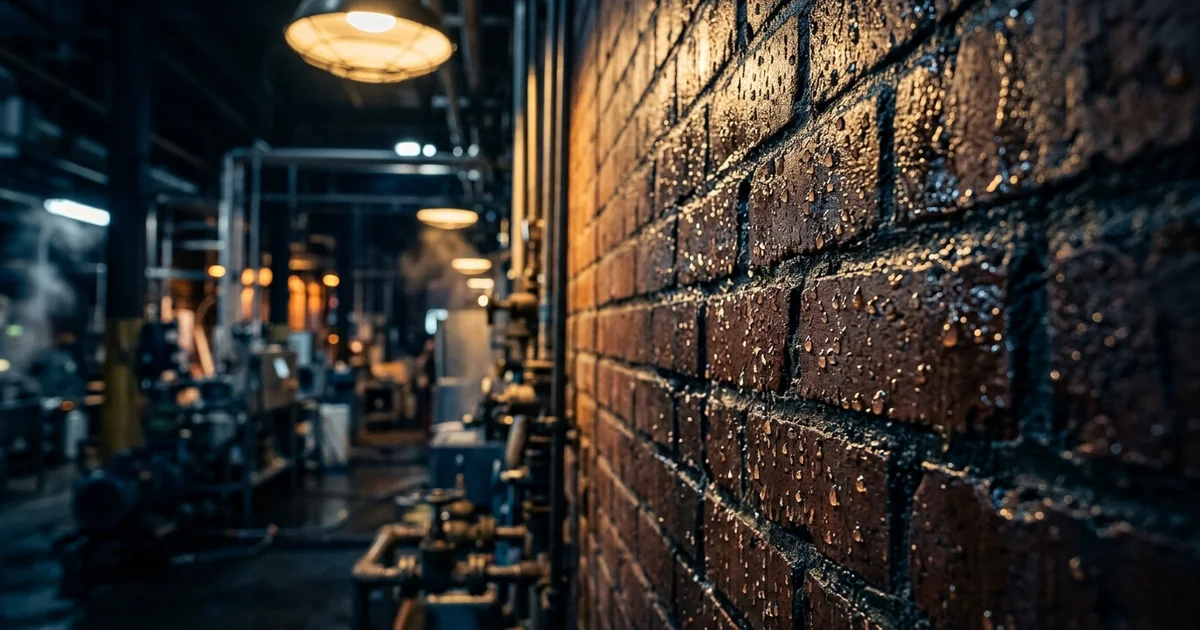
A facade that looks sound from the sidewalk can already be failing from the inside, one freeze-thaw cycle at a time. Water absorbed into brick, block, or precast concrete expands when it freezes, and that repeated cycling spalls the surface, corrodes embedded reinforcement, and eventually forces expensive restoration work that a properly specified coating could have prevented. Choosing between a silane siloxane water repellent and a film-forming acrylic coating is one of the first decisions that determines whether a facade protection system actually stops that damage or just delays it. This guide compares the chemistry, penetration behavior, breathability, and substrate suitability of both approaches so engineers and architects can specify with confidence. Global Formulation supports construction chemical manufacturers developing and refining water repellent product lines, and the comparisons below reflect how that specification decision actually gets made on real projects.
Why Unprotected Masonry Fails
Masonry is inherently porous, and that porosity is exactly what lets water intrusion become a structural problem rather than a cosmetic one. Brick, concrete block, and natural stone all absorb liquid water through capillary action, pulling moisture deep into the wall assembly well beyond what a casual glance at a damp surface would suggest. Once inside, that water drives several independent deterioration mechanisms simultaneously, each of which accelerates the others over time. Recognizing which failure mode a given facade is most exposed to is the first step toward specifying the right protective chemistry.
- Freeze-thaw spalling — absorbed water expands roughly 9% in volume when it freezes, generating internal pressure that fractures the masonry surface from within
- Reinforcement corrosion — chloride-laden water reaching embedded steel initiates corrosion that expands the rebar and cracks surrounding concrete cover
- Efflorescence — dissolved salts migrate to the surface as water evaporates, leaving visible white staining and, over repeated cycles, surface degradation
- Biological growth — persistently damp masonry supports algae, moss, and mold colonization that further degrades surface chemistry and appearance
None of these mechanisms require standing water to take hold — ordinary wind-driven rain against an exposed facade is enough. That's precisely the exposure condition water repellent chemistry is engineered to interrupt before it starts.
Silane Siloxane Water Repellent Chemistry vs Acrylic Coatings
Masonry protection chemistries fall into two fundamentally different categories, and understanding which category a product belongs to explains almost everything about how it performs. Penetrating repellents, built on silane and siloxane chemistry, soak into the substrate and react chemically to line pore walls with a hydrophobic layer while leaving the pore structure itself open. Film-forming systems, typically acrylic-based, instead build a continuous membrane on the surface that physically blocks water from reaching the substrate at all. That structural difference is the reason the two approaches suit different projects and, in many specifications, get used together rather than as competing alternatives.
| Chemistry | Mechanism | Breathability | Typical Penetration | Substrate Suitability |
|---|---|---|---|---|
| Silane | Small monomer penetrates deep, then reacts with substrate moisture/alkalinity to form a hydrophobic silicone resin in place | High — pore structure remains open | Deepest of the three, especially in dense substrates | Dense, low-porosity concrete and precast |
| Siloxane | Pre-polymerized oligomer reacts similarly but at larger molecular size | High — pore structure remains open | Moderate — shallower than silane alone | Porous brick, lightweight block, render |
| Silane-siloxane blend | Combines both molecule sizes to balance depth and surface-zone treatment | High — pore structure remains open | Graded depth across the treated zone | Mixed-porosity facades, most general specifications |
| Acrylic (film-forming) | Polymer film cures on the surface, physically blocking liquid water at the substrate face | Reduced — continuous film restricts vapor transmission | Surface only, no meaningful penetration | Sound, uncracked substrates where a visible finish is acceptable |
Acrylic coatings share underlying film-forming polymer chemistry with the broader family of decorative and protective concrete sealers, covered in more depth in our guide to acrylic, polyurethane, and epoxy decorative concrete sealers. Reactive silicone chemistry, by contrast, behaves closer to the crystalline and hydrophobic waterproofing admixtures used inside a concrete matrix rather than on top of it, a comparison explored in our crystalline versus hydrophobic waterproofing admixture guide.
Which chemistry wins on a given project depends less on which one is "better" in the abstract and more on how deep the treatment actually needs to reach — a question penetration depth and breathability answer directly.
Penetration Depth and Breathability
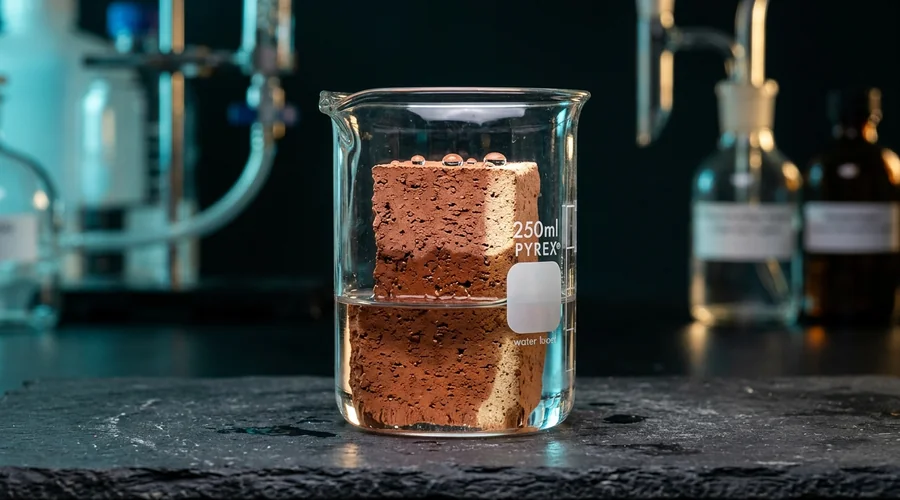
Penetration depth and breathability are the two properties that most directly separate penetrating repellents from film-forming coatings, and both matter more than surface appearance when a specification is being written. Penetration determines how much of the treatment survives surface abrasion, UV degradation, or minor mechanical damage before protection is lost. Breathability determines whether the wall assembly can still release the water vapor it constantly generates from interior humidity, residual construction moisture, or groundwater wicking through a foundation. A treatment that scores well on one property but poorly on the other creates a different failure mode than having no treatment at all.
- Penetration reserve — a deeper treated zone means minor surface wear or light sandblasting from wind-driven debris doesn't immediately expose untreated substrate
- Vapor permeability — an open pore structure lets interior or substrate moisture continue diffusing outward rather than accumulating behind the treated layer
- Freeze-thaw resistance — reduced liquid water absorption directly lowers the volume of water available to expand during freezing, independent of vapor performance
- UV and weathering stability — because the active chemistry sits below the surface rather than as an exposed film, it isn't directly exposed to UV degradation the way a coating's outer surface is
Silane and siloxane treatments chemically bond within the pore structure rather than sealing it, which is the mechanism behind their combination of water repellency and continued vapor openness. That combination is precisely why penetrating repellents remain the default recommendation for facades where trapped moisture risk, not just liquid water intrusion, is a concern.
Matching Chemistry to Substrate
No single water repellent chemistry performs optimally across every masonry substrate, which is why substrate assessment has to precede product selection rather than follow it. Porosity, alkalinity, existing coatings, and moisture content at the time of application all influence how well a given silane-siloxane ratio or acrylic system will perform. A treatment specified correctly for dense precast concrete can underperform badly on porous brick, and the reverse holds just as true. Facade protection product development for a manufacturer means building a product range, not a single formula, precisely because substrate variability is this significant.
- Precast and cast-in-place concrete — low porosity favors silane-dominant blends for maximum penetration depth
- Clay brick and lightweight block — higher porosity favors siloxane-dominant blends that distribute protection through a more porous pore network
- Natural stone (limestone, sandstone, granite) — mineralogy and pore structure vary widely by quarry source, requiring substrate-specific testing before full-scale application
- Previously coated or painted surfaces — existing film-forming coatings block penetrating repellent uptake entirely and generally require removal or a compatible film-forming reapplication instead
Substrate assessment answers what chemistry to use. Application method and performance verification answer whether that chemistry actually got installed correctly.
Facade Application and Performance Testing
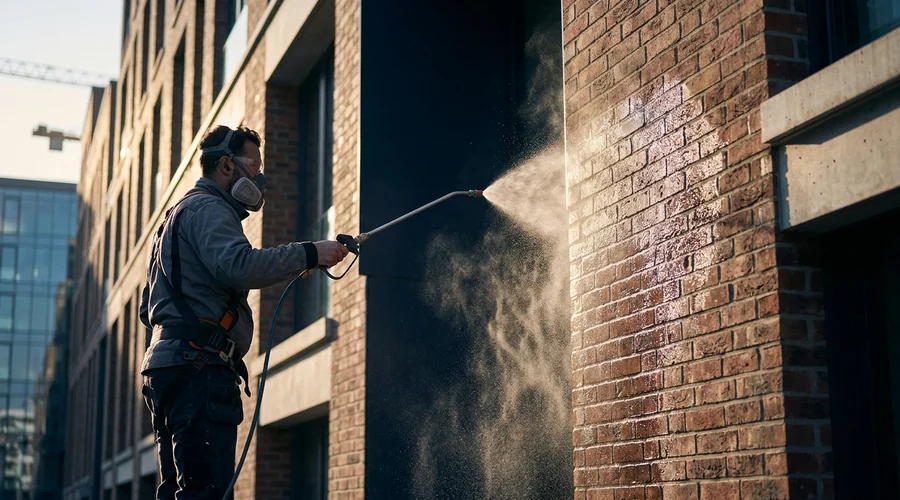
A correctly formulated repellent still fails in the field if it's applied incorrectly or never verified against a recognized performance standard. Spray application is the standard method for facade-scale projects because it delivers consistent, controllable coverage across large vertical surfaces faster than roller or brush application allows. Substrate moisture content, ambient temperature, and wind conditions during application all affect how well the treatment penetrates and cures, which is why experienced applicators check weather windows before mobilizing equipment. Performance verification after application, not just proper technique during it, is what turns a specification into a documented result.
- Low-pressure airless or conventional spray — standard method for facade-scale application, applied to the point of visible saturation on porous substrates
- Flood coating — used on horizontal or near-horizontal surfaces like copings and sills where runoff control is less of a concern
- Field water-absorption testing — a simple post-application check confirming the treated surface repels water as specified before scaffolding comes down
- Core sampling per ASTM E514 — used on larger or higher-value projects to physically verify penetration depth against the specified target
ASTM E514 remains the primary reference standard for evaluating water penetration through masonry wall assemblies under simulated wind-driven rain, and its full test method defines both the apparatus and the pass criteria specifiers reference. International projects frequently cross-reference ISO 15148, which covers water absorption coefficients for building materials under partial immersion. Confirming performance against the applicable standard, rather than trusting a manufacturer's marketing claim alone, is what separates a documented specification from an assumed one.
Service Life and Durability Factors
Service life expectations differ meaningfully between penetrating and film-forming systems, and that difference should shape both product selection and long-term maintenance planning. Because penetrating repellents don't rely on a surface film, they aren't subject to the cracking, chalking, or delamination that eventually ends a film-forming coating's service life. That doesn't mean penetrating treatments last indefinitely — the reactive silicone chemistry does gradually deplete under continuous UV and weathering exposure, just far more slowly than a surface film degrades. Realistic maintenance planning has to account for both chemistries' actual failure modes rather than treating either as permanent.
- UV exposure severity — south- and west-facing elevations in high-UV climates generally see faster degradation than shaded or northern elevations
- Wind-driven rain exposure — coastal and high-rise facades exposed to sustained wind-driven rain experience more repellent depletion than sheltered lower-rise walls
- Substrate alkalinity — highly alkaline fresh concrete can affect cure chemistry differently than aged, carbonated substrates
- Periodic verification — a simple field water-absorption check on a representative area is the most reliable way to determine when reapplication is actually needed
Reinforcement protection is often the underlying driver for specifying a water repellent in the first place, particularly on parking structures and bridges where chloride exposure accelerates corrosion. That connection between surface water repellency and embedded steel protection is covered directly in our concrete corrosion inhibitors and reinforcement protection guide. Manufacturers developing or refining a water repellent line benefit from formulation support that spans this full picture — chemistry selection, substrate compatibility, and documented test performance — which is the core of Global Formulation's construction chemicals formulation practice.
Getting service life right on paper only matters if the underlying chemistry, substrate match, and application were correct from the start — which is exactly why each of the decisions covered above has to work together rather than in isolation.
Frequently Asked Questions
What is the difference between a silane and a siloxane water repellent?
Silanes are small monomeric molecules with a correspondingly small molecular size, which lets them penetrate deep into dense, low-porosity substrates like precast concrete or natural stone before reacting with substrate moisture and alkalinity to form a hydrophobic silicone resin in place. Siloxanes are pre-polymerized oligomers, larger in molecular size, that penetrate less deeply but perform reliably in more porous substrates such as brick and lightweight block where a silane's fast reaction can leave it concentrated too near the surface.
Because the two molecules complement each other's weaknesses, manufacturers frequently blend them into a single silane-siloxane product rather than forcing a single-chemistry choice across every substrate on a project.
Why is breathability important in a masonry water repellent?
Masonry walls constantly exchange water vapor with the surrounding air, and a repellent that blocks that vapor movement traps moisture inside the wall rather than keeping it out. Silane-siloxane treatments react to line the internal pore walls with a hydrophobic layer while leaving the pore structure itself open, so liquid water is repelled at the surface while water vapor still diffuses through. Acrylic and other film-forming coatings instead form a continuous surface membrane that can significantly reduce vapor transmission.
On a wall assembly with any trapped moisture source, restricting that outward vapor path can accelerate freeze-thaw spalling, efflorescence, and coating disbondment rather than preventing it.
How deep does a penetrating water repellent actually go into masonry?
Penetration depth for silane and siloxane treatments depends heavily on substrate porosity, moisture content at application, and the specific molecule's size, and it is normally verified by breaking a treated core sample and observing the water-repellent zone under controlled conditions per ASTM E514 or similar substrate-specific test methods. Dense, low-porosity substrates such as precast concrete typically show shallower penetration than porous brick or block, which is one reason substrate assessment has to happen before a product is specified.
Surface application rates and reapplication intervals are project- and substrate-specific decisions that a qualified applicator or formulation consultant should verify against the actual masonry, not a generic published figure.
Can acrylic and silane-siloxane repellents be used on the same building?
Yes, and doing so deliberately is common on buildings with mixed substrates or mixed performance requirements — for example, an acrylic elastomeric coating on a cracked stucco field paired with a penetrating silane-siloxane treatment on an adjacent exposed masonry band. The two chemistries are not compatible when layered directly on top of each other in the same location, since a film-forming acrylic applied over a penetrating repellent will not bond properly to the now-hydrophobic surface, and the reverse combination defeats the acrylic's film integrity.
Substrate-by-substrate specification, not blanket application of one product across an entire facade, is the standard professional approach on buildings with varied cladding materials.
What test standards govern water repellent performance for masonry?
ASTM E514 evaluates water penetration and leakage through masonry wall assemblies under controlled wind-driven rain conditions, and it is the standard most commonly referenced for field and laboratory repellent performance. ASTM C67 covers sampling and testing brick units, including absorption behavior relevant to repellent uptake, while ISO 15148 and EN 1062-3 address water absorption coefficients for coatings and render systems in international specifications.
NCHRP and state DOT specifications also reference water absorption reduction and chloride-ion penetration resistance, particularly for bridge and parking structure applications where reinforcement corrosion protection is the primary driver. A formulation or specification consultant matches the applicable standard set to the project's jurisdiction and structure type rather than defaulting to one test method universally.
How long does a silane-siloxane water repellent treatment last?
Service life varies substantially by substrate, UV exposure, wind-driven rain severity, and the specific silane-to-siloxane ratio in the formulation, which is why manufacturers publish ranges rather than a single fixed figure and independent verification through field performance data remains the most reliable approach. Penetrating treatments generally outlast film-forming acrylic coatings because they don't rely on a surface film that can crack, chalk, or delaminate under UV and thermal cycling.
Reapplication timing should be determined by periodic water-repellency testing on the actual structure, such as a simple field water-absorption check, rather than by calendar assumption alone.
Why would a manufacturer need a formulation consultant for a water repellent product line?
Formulating a stable, effective silane-siloxane or acrylic water repellent involves balancing reactive silicone chemistry, solvent or water-carrier selection, catalyst systems, and shelf-stability constraints that differ meaningfully from general coatings formulation experience. A consultant experienced in penetrating sealer chemistry can help a manufacturer select the right silane-to-siloxane blend ratio for a target substrate category, troubleshoot premature hydrolysis or emulsion instability in water-based systems, and align product claims with the test standards specifiers actually require.
That guidance matters most when a manufacturer is entering the facade protection category for the first time or expanding an existing sealer line into new substrate applications, since mistakes in reactive silicone formulation are expensive to correct after a product has shipped.
Developing a Water Repellent Product Line?
Silane-siloxane blend chemistry, substrate compatibility strategy, application performance validation, and standards-aligned product development. Global Formulation supports construction chemical manufacturers building masonry and facade protection lines from formula selection through documented field performance.
Talk to Our Formulation Team