From Lab to Market: R&D to Commercial Manufacturing
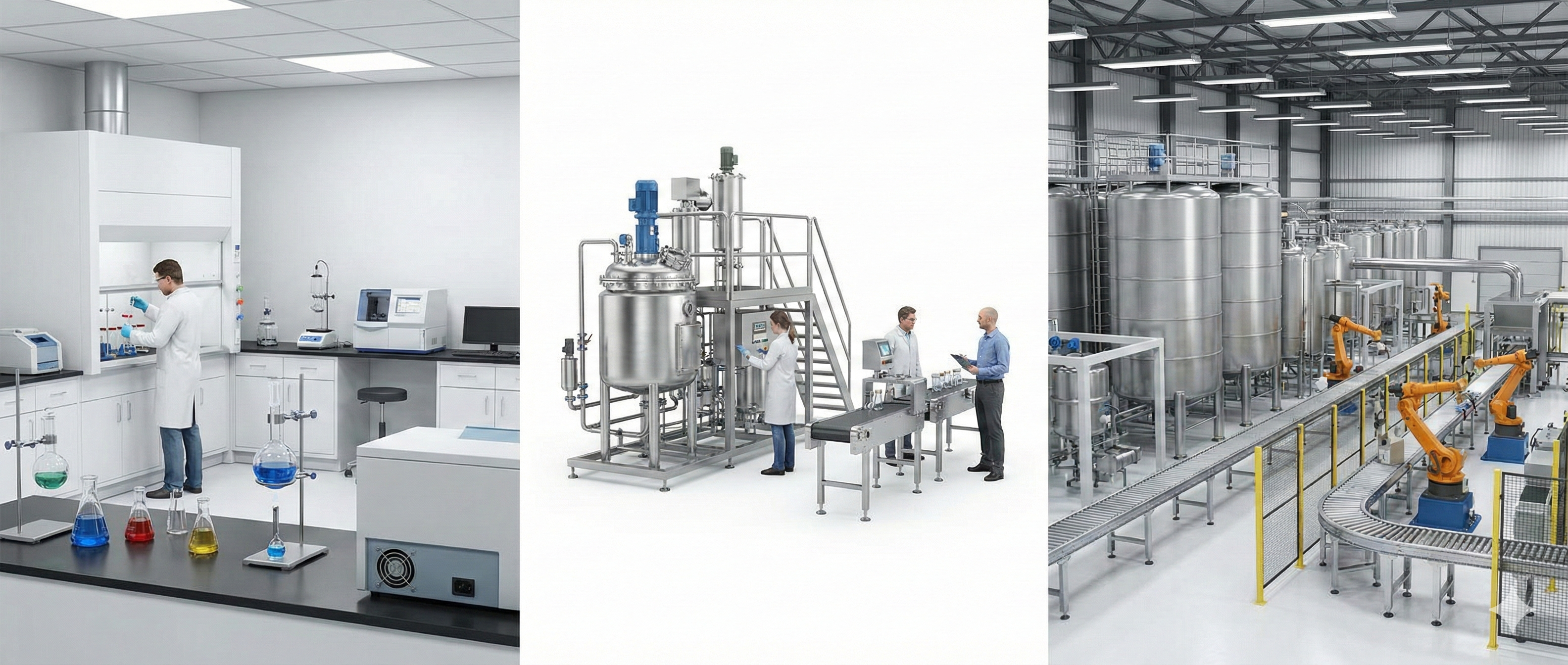
Bringing a chemical formulation or specialty product from the laboratory bench to global market commercialization is not a simple linear scale-up of vessel sizes. It requires a disciplined, multi-phase engineering progression across distinct development stages, each governed by completely different physical principles, operational limits, and economic success criteria. Startups, chemical engineers, and entrepreneurs must understand the transition from R&D proof-of-concept testing to intermediate pilot scale validation, and finally to full-scale commercial manufacturing.
Why Understanding Manufacturing Stages Matters
Formulations that work flawlessly in small laboratory glassware frequently fail when introduced to commercial factories. The physical reality of scaling up means that as fluid volumes expand, mixing efficiencies drop, heat dissipation slows down, and mass-transfer rates change dramatically. This is the same underlying physics that drives many of the defects covered in our guide to dangerous formulation mistakes, where a formula that never showed a problem in R&D fails only once it reaches a production vessel.
Ignoring these scaling realities and attempting to bypass critical developmental steps almost always leads to catastrophic yield failures, ruined batches, and wasted capital. A structured scale-up strategy, consistent with the three-stage process validation framework used by regulated manufacturers, ensures that technical variables are verified at each stage:
- Avoiding Late-Stage Scale-Up Failures: Finding physical and chemical incompatibilities early when process modifications are inexpensive.
- Optimizing Production Yields: Determining exact raw material characteristics and impurities that affect larger batches.
- Minimizing Financial Risk: Postponing major capital expenditures on factory machinery until pilot batches have been fully validated.
These same risks explain why the category of chemical and specialty products a company works in, whether paints and coatings, lubricants, or cosmetics, changes which physical variable dominates scale-up risk, even though the underlying engineering principles are the same across industries.
R&D Stage – Where Innovation Begins
The primary objective of the Research and Development (R&D) phase is to validate functional feasibility under highly controlled laboratory conditions. R&D scientists focus on understanding fundamental chemical kinetics, active ingredient synergies, and molecular stability, rather than industrial throughput efficiency.
In a standard laboratory setting, physical limitations such as thermal build-up, pumping friction, and mixing dead zones are virtually non-existent due to small container geometries. R&D results must therefore be treated as conceptual blueprints rather than factory-ready formulas:
- Micro-Batch Processing: Operating with batches ranging from a few grams to under five kilograms.
- High-Purity Reagents: Using analytical or pharmaceutical grade raw materials that are too expensive for commercial products.
- Manual Quality Control: Adjusting mixing rates, temperature profiles, and addition times manually in glassware.

Pilot Scale – The Most Critical and Misunderstood Stage
The pilot scale represents the most technical stage of product scale-up, serving as the bridge between laboratory formulations and full-scale industrial engineering. During pilot trials, engineers evaluate how the formulation behaves under real-world physical forces.
As the vessel volume scales up geometrically, heat dissipation is limited by the **Thermal Area-to-Volume Ratio (A/V) Scaling Relation**:
Pilot scale trials are designed to accomplish several key engineering goals:
- Equipment Adaptability: Verifying that standard industrial pumps, mixers, and filters can process the formulation.
- Operating Windows: Setting precise temperature, pH, and addition speed ranges that operators can maintain in a factory.
- Alternate Supplier Audit: Testing commercial grade raw materials from bulk suppliers to ensure they perform as well as laboratory reagents.
Commercial Manufacturing – Engineering, Not Chemistry
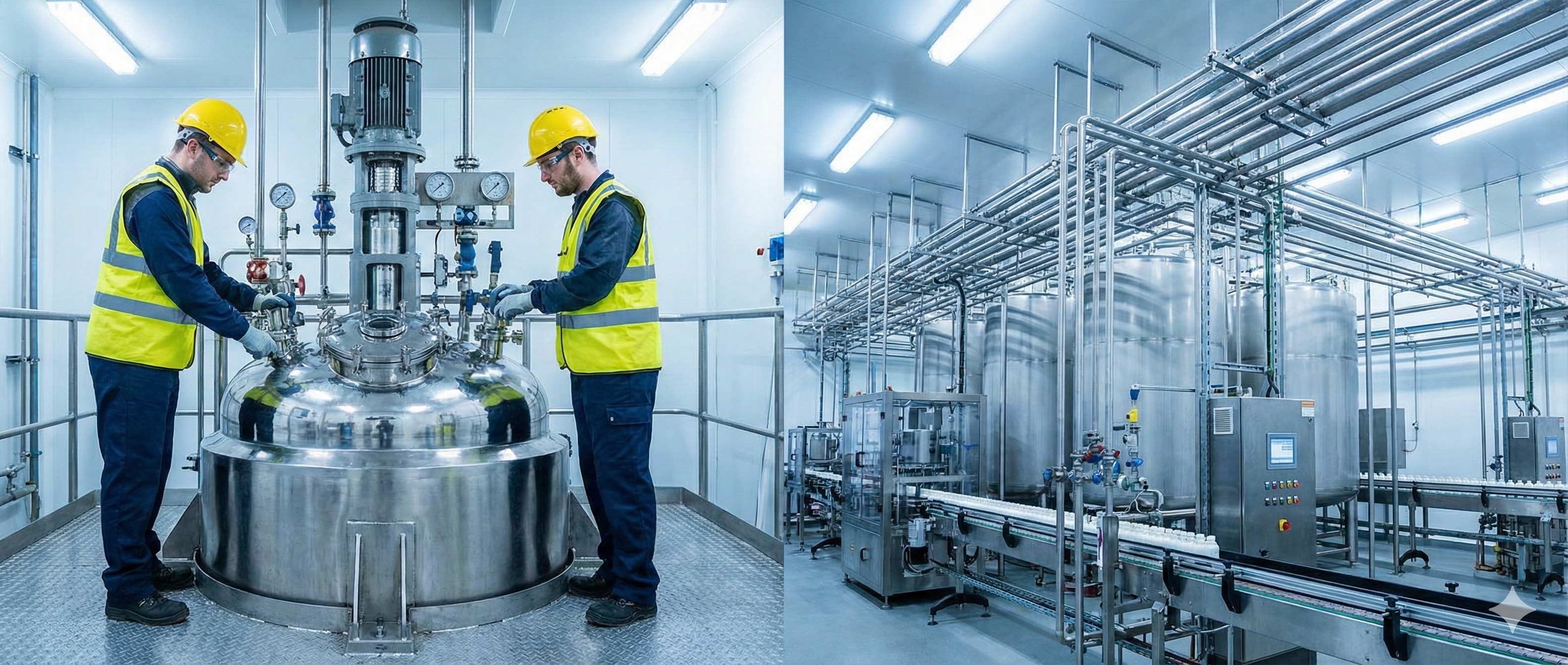
At the commercial manufacturing level, the chemical formulation is fully locked, and the focus shifts entirely to mechanical process control, consistency, safety, and unit economics. Full-scale factories must produce consistent batches across thousands of kilograms under rigid quality control limits, typically operating under the same Good Manufacturing Practice (GMP) framework that governs regulated sectors such as pharmaceuticals and food-contact products.
To prevent mixing failures and maintain product consistency, engineers must optimize the **Impeller Power Consumption (P) Equation**:
A commercial manufacturing line is characterized by highly structured operational systems:
- Automated Process Systems: Minimizing manual operation errors through PLC-controlled ingredient dosing.
- Validated Quality Control: Standardizing batch testing using defined specifications and official test methods.
- Strict Compliance & Traceability: Maintaining batch numbers and production logs for regular safety and regulatory audits.
This is also the stage at which formal documentation becomes non-negotiable — see our guide to MSDS, TDS, and COA requirements for how safety, performance, and batch-quality paperwork ties directly into commercial-scale compliance.
Why Products That Work in the Lab Often Fail at Scale
Scale-up failures are rarely caused by incorrect chemistry; they are almost always the result of physical scale changes that alter fluid dynamics. This behavior is governed by the **Fluid Dynamics Reynolds Number (Re) Impeller Scaling Equation**:
To avoid these common scale-up bottlenecks, process engineers must look for several key technical indicators:
- Poor Heat Removal: Thermal build-up in large vessels leading to degradation of heat-sensitive active ingredients.
- Mixing Dead Zones: Poor circulation in large tanks causing phase separation or uneven ingredient distribution.
- Raw Material Impurities: Uncontrolled trace minerals in bulk water or commercial-grade raw materials destabilizing the formula.
How Startups Should Approach Scale‑Up Strategically
Successful product scale-up begins in early R&D by designing formulations that are robust and tolerant to minor process variations, rather than overly sensitive. Startups should utilize intermediate pilot trials to identify scale-dependent issues before investing heavily in commercial-grade equipment.
A systematic, lower-risk strategy for taking a new chemical product from lab to market involves:
- Formulating for Tolerance: Designing bases that remain stable even with minor temperature or mixing variations.
- Leveraging Toll Manufacturers: Outsourcing early commercial production batches to certified contract manufacturing plants, an approach covered in depth in our manufacturing-without-a-factory guide.
- Involving Process Engineers Early: Consulting scale-up experts during the transition from laboratory glassware to pilot reactors.
Getting this sequencing wrong is costly regardless of end-market — the same tolerance-first thinking applies whether the product is an industrial lubricant or a formulated cleaning product, and our cleaning products manufacturing business guide walks through the equivalent sequencing for that sector.
Lab to Market: India vs Global Context
While the physical principles of chemical engineering are universal, executing a scale-up strategy varies by region. In India, chemical manufacturing is highly cost-competitive, often relying on semi-automated local plants or contract manufacturing.
In contrast, exporting to international markets like the European Union or the United States requires compliance with strict regulatory frameworks such as REACH. Startups must prepare detailed safety documentation, process validation records, and raw material audits to clear customs and regulatory checks — the same document set discussed in our MSDS, TDS & COA guide.
For more details on sustainable manufacturing models, refer to:
👉 Manufacturing Without a Factory and Contract Blending Guides
👉 Green Chemistry and REACH Compliance Frameworks
Frequently Asked Questions (FAQ)
1. Is pilot scale always required before commercial manufacturing?
In most process-based industries, pilot scale is strongly recommended because it reveals scale-dependent issues related to mixing, heat transfer, material handling, and process control. Skipping pilot scale significantly increases technical and financial risk during commercialization.
2. Can a formulation that works in the lab be directly manufactured at commercial scale?
Direct transfer from laboratory scale to commercial manufacturing is rarely successful. Laboratory conditions mask many physical and operational constraints that only appear at larger volumes, making intermediate pilot validation essential.
3. What is the biggest technical challenge during scale-up?
The most common challenges arise from non-linear scaling of physical phenomena such as heat removal, mass transfer, and mixing efficiency. These factors often dominate scale-up behavior rather than the underlying chemistry itself.
4. Why can't the Reynolds number and shear rate both stay constant during scale-up?
Reynolds number depends on the square of impeller diameter (Re = ρND2/η), while tip shear rate scales linearly with diameter and speed. Holding one constant as the vessel grows forces the other to change, which is why a mixing regime that is laminar at lab scale can become turbulent at commercial scale, or vice versa. Process engineers must choose which parameter to hold constant based on which one governs the formulation's critical quality attributes.
5. What is a toll manufacturer and how does it fit into the scale-up pathway?
A toll manufacturer is a contract production facility that processes a formulation using its own plant and equipment on behalf of the brand owner, who supplies the formula and specifications. Toll manufacturing lets startups access validated commercial-scale equipment without capital investment in their own factory, which is why it is a common bridge between pilot trials and full in-house commercial production.
6. How does batch size affect heat transfer during scale-up?
Heat-transfer surface area increases with the square of a vessel's characteristic dimension, while batch volume increases with the cube, so the ratio of available cooling or heating surface to volume (A/V) falls as batch size grows. Exothermic or temperature-sensitive reactions that self-regulate in small lab vessels can therefore experience temperature spikes or slower heat removal at pilot and commercial scale unless jacket area, coil design, or cooling capacity is engineered to compensate.
Need Scale-Up Consultancy & Process Engineering Support?
Discuss your mixing fluid dynamics, heat transfer surface optimization, and pilot-scale trials with Global Formulation. Bridge the gap between laboratory bench trials and commercial manufacturing success.
Email: consulting@globalformulation.com
Phone: +91 9819548320 +91 8169102990
About the Specialist
Absar Khan is the principal consultant and chemical formulation architect at Global Formulation. He possesses cross-disciplinary engineering expertise spanning agrochemical milling lines, aerosol packaging systems, pharmaceutical cleanroom layouts, cosmetics, and green chemical plant setups. Absar leads scientific and engineering advisory teams supporting manufacturers globally in technology selection, GMP layouts, validation frameworks, and regulatory strategies.
LinkedIn Portfolio: Connect with Absar Khan on LinkedIn