Adhesive Bond Durability Testing: Accelerated Weathering & Aging Protocols
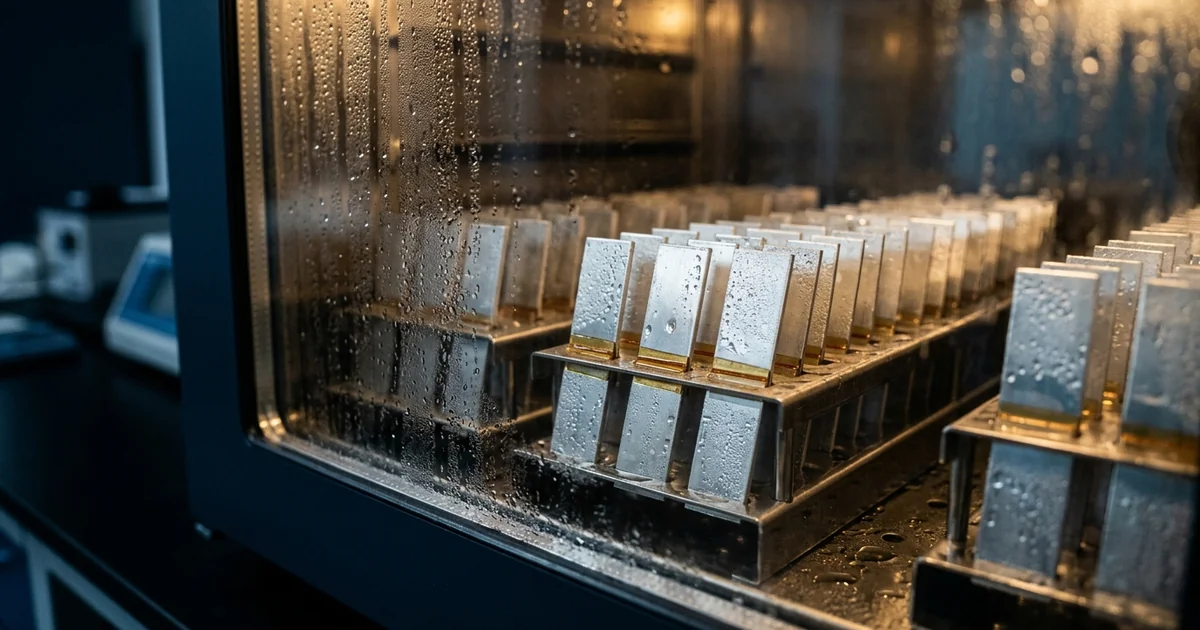
A structural adhesive passes every qualification test on the bench, goes into production, and eighteen months later parts start coming back from the field with the bond peeling cleanly off one surface. Nothing changed in the process. The adhesive was never the problem — the test was. A single-lap shear pull on a fresh joint measures how strong the bond is on the day it is made, and tells you almost nothing about how that strength holds up once water, heat and sunlight get to work on it. Adhesive bond durability testing exists to answer the question the strength test cannot: will this joint still be strong in five years? This guide walks through the degradation mechanisms that actually kill bonds in service, the accelerated weathering and hydrothermal aging protocols used to reproduce them, the stressed-joint tests such as the wedge test that discriminate a good surface preparation from a bad one, and why every relevant standard warns against turning an accelerated result into a guaranteed service life. It reflects the failure-first approach we bring to adhesives and sealants consulting, where a field failure is traced back to the test that should have caught it.
Why a Strong Adhesive Joint Is Not Automatically a Durable One
The strength of a fresh adhesive joint and the durability of that joint are two different properties, controlled by two different things. Fresh strength is dominated by the cohesive strength of the cured adhesive and the mechanical fit of the joint. Durability is dominated by what happens at the adhesive-substrate interface once the environment reaches it — and that is almost entirely a surface-preparation property. A joint can be strong and fragile at the same time: high load capacity when dry, rapid collapse when wet. Durability testing is the only way to separate the two, because the difference is invisible in a dry pull test.
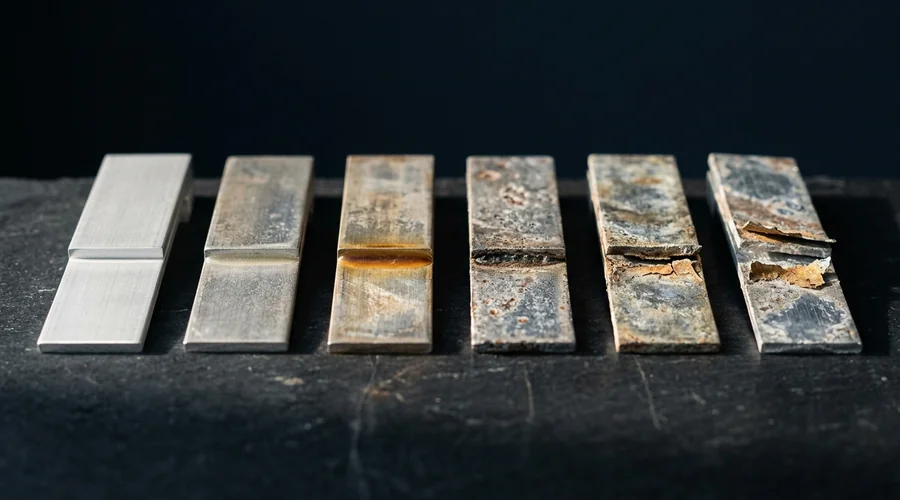
The distinction shows up as a shift in failure mode over time. A well-prepared joint fails cohesively — the break runs through the body of the adhesive, leaving residue on both surfaces. As the interface degrades, the same joint starts to fail adhesively, at the boundary, leaving one surface clean. Reading that shift is central to durability work, and it is covered in depth in our guide to adhesive failure modes. A durability programme tracks three things together:
- Retained strength — the fraction of the original lap-shear or peel strength that survives the exposure, plotted against exposure time
- Failure mode — whether the break stays cohesive or shifts toward the interface as aging progresses
- Rate of change — how fast strength is still dropping at the end of the test, which signals whether the joint has stabilised or is still degrading
A joint that loses 15 percent of its strength and then holds steady is behaving very differently from one that is still losing strength linearly when the test stops, even if both read the same number at the final pull. The trend matters more than any single data point, and that is the mindset the rest of this guide is built on.
Water Is the Main Degradation Path for Structural Bonds
For adhesive bonds on metals, glass and most mineral surfaces, water is the dominant durability threat, and it does not need liquid immersion to do damage. Humidity is enough. Water vapour diffuses through the cured adhesive film, concentrates at the adhesive-substrate interface, and attacks the bonds that hold the adhesive to the surface. On oxidised metal and glass, those anchoring interactions are hydrogen bonds and, where a silane primer is used, hydrolysable siloxane links. Water displaces the adhesive from the surface faster than it weakens the adhesive itself, which is why the failure mode shifts toward the interface.
This mechanism, sometimes called interfacial hydration-driven displacement, is the reason a hydrothermal aging block appears in almost every structural durability programme. The adhesive bonding literature treats moisture resistance of the interphase as the defining durability question for load-bearing joints. Several factors set how fast the attack proceeds:
- Surface preparation — the single biggest lever; a chemically stable oxide or a hydrolytically stable silane layer resists displacement, a physisorbed contact does not
- Adhesive water uptake and permeability — a film that absorbs less water and lets it diffuse more slowly delays the arrival of moisture at the interface
- Bond line geometry — moisture enters from the exposed edges, so a wide overlap protects its centre longer than a narrow one
- Temperature — heat speeds diffusion and the interfacial reactions together, which is exactly why aging tests run hot
- Applied stress — a joint under load while wet degrades faster than an unloaded one, because stress helps open the crack that moisture then follows
Because water is the primary agent, the two workhorse exposure categories — accelerated weathering and hydrothermal aging — are both, at their core, ways of getting water to the interface faster than nature would. They differ in whether sunlight is part of the picture.
Accelerated Weathering Adhesive Test Protocols: Xenon Arc and QUV
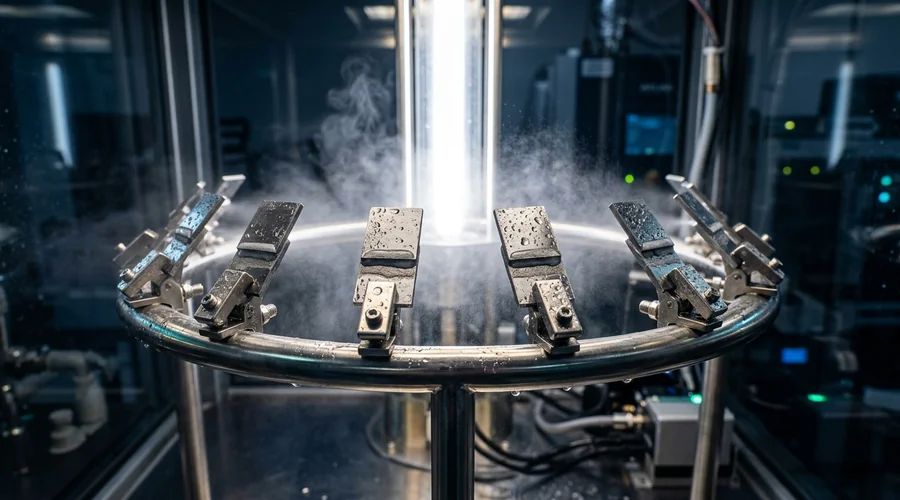
Accelerated weathering is the right test when the bond line, or an exposed sealant bead, actually sees sunlight — glazing seals, exterior panel bonds, signage adhesives, solar module laminates. It combines the three outdoor stressors that matter, ultraviolet radiation, heat and water, in a controlled chamber and cycles them to compress years of exposure into weeks. Two apparatus families dominate, and the choice between them affects how well the result maps to real outdoor performance.
The QUV xenon arc adhesive testing decision comes down to the light source:
- Xenon-arc chambers (ASTM G155, ISO 4892-2) — a filtered xenon lamp produces a spectrum close to full-spectrum natural sunlight, including the visible and near-infrared, making it the better choice for colour, gloss and sealant surface degradation
- Fluorescent-UV chambers (ASTM G154, ISO 4892-3) — QUV-type units use fluorescent lamps; a UVA-340 lamp reproduces the short-wave UV edge of sunlight for realistic screening, while a UVB-313 lamp gives a harsher, faster, less realistic spectrum
- Condensation and spray — both apparatus alternate a light-and-heat phase with a dark condensation or water-spray phase, driving the wet-dry cycling that a static soak misses
The controlled parameters are irradiance, black-panel temperature, chamber air temperature, relative humidity and the timing of the water cycle. A representative xenon setting for outdoor simulation holds irradiance near 0.70 W/m² at 340 nm with a black-panel temperature around 80 °C, alternated with a condensation step. These conditions are borrowed directly from coatings weathering practice, and the parallels are covered in our guide to exterior paint weathering and chalking.
Weathering answers the sunlight question. For the large population of bonds that live hidden inside a structure and never see light, the relevant exposure is heat and moisture alone.
Hydrothermal Aging Bond Test Methods and Cyclic Conditioning
Hydrothermal aging exposes bonded specimens to elevated temperature and high humidity, with or without immersion, and then measures the strength that remains. It is the core durability test for concealed structural bonds — automotive body joints, appliance assemblies, laminated panels — where the enemy is condensation and trapped moisture rather than rain and sun. The exposure can be a steady-state hold or a cycle, and cyclic conditioning is generally more severe because the repeated expansion and contraction adds fatigue stress at the interface on top of the chemical attack.
The standards define the menu of conditions rather than a single test:
- ASTM D1183 — standard practices for the resistance of adhesives to cyclic laboratory aging, cycling bonded specimens through high and low temperature and high and low humidity, with degradation read as the change in strength
- ISO 9142 — a guide to selecting standard laboratory ageing conditions for bonded joints, offering a structured set of climatic and chemical exposures to assemble into a programme
- Steady-state humid heat — a fixed temperature and relative humidity hold, common at conditions such as 40–70 °C and 80–95 percent relative humidity, used where a simple, repeatable benchmark is needed
- Water immersion — full immersion, sometimes in warm or boiling water, as an aggressive short-cut that saturates the joint quickly
- Salt fog and cyclic corrosion — ASTM B117 or ISO 9227 salt spray, and automotive cyclic tests such as SAE J2334, where the substrate can corrode under the bond
| Exposure type | Representative standard | Primary stressor | Best suited to |
|---|---|---|---|
| Xenon-arc weathering | ASTM G155 / ISO 4892-2 | Full-spectrum UV + heat + water | Exposed sealants, glazing, exterior bonds |
| Fluorescent-UV weathering | ASTM G154 / ISO 4892-3 | UV edge of sunlight + condensation | Screening, UV-sensitive polymer bonds |
| Cyclic temperature / humidity | ASTM D1183 | Hygrothermal cycling + fatigue | Concealed structural and assembly bonds |
| Standard ageing condition set | ISO 9142 | Selectable climatic / chemical | Building a full adhesive evaluation |
| Wedge crack durability | ASTM D3762 | Sustained cleavage stress + humidity | Ranking metal surface preparations |
| Sustained-load strength retention | ASTM D2919 | Static creep load + environment | Long-term load-bearing joints |
| Salt fog / cyclic corrosion | ISO 9227 / SAE J2334 | Chloride + wet-dry corrosion | Bonds over corrodible metal |
Whichever conditions are chosen, the specimen count has to allow several pull-out points, because a durability curve with two points is a straight line by assumption, not by evidence. The next question is whether the joint should carry stress while it ages.
Stressed Durability Testing: The Wedge Test and Sustained Load
An unstressed humidity soak is a weak discriminator. Many surface preparations that will fail in service still look acceptable after an unloaded soak, because without stress there is no crack for moisture to follow. Stressed durability tests fix this by holding the joint under load during the environmental exposure, and they separate good and bad surface preparations far more sharply. The wedge test is the best-known example and the one with the strongest service track record.
In the wedge test, standardised as ASTM D3762 and widely called the Boeing wedge test, a metal wedge is forced into the bond line between two bonded metal adherends, opening a crack under sustained cleavage stress. The specimen is then aged hot and humid, and the crack length is tracked over time:
- Bond two metal strips using the production adhesive and the exact surface preparation under evaluation
- Drive a wedge of specified thickness into one end, opening an initial crack, and mark its tip
- Place the stressed specimen in a hot, humid environment, commonly around 50 °C and high relative humidity
- Measure crack growth at intervals; a durable preparation shows minimal growth, a poor one shows the crack running rapidly toward the interface
- Break the specimen open at the end and inspect the fracture path — interfacial fracture in the aged region confirms a weak, hydrolytically unstable interface
The wedge test earned its place because it correlated with real aircraft bond service far better than lap shear or peel soaks, and it delivers a visual answer in days rather than weeks. Its close relative is the sustained-load test, in which lap-shear specimens carry a static fraction of their strength under a controlled environment and the time to failure, or the strength retained after a fixed period, is recorded — the approach behind ASTM D2919 and the reason a genuine load-bearing joint should never be qualified on short-term strength alone. These stressed methods sit alongside the toughness and impact tests discussed in our complete guide to structural adhesives.
Stressed or not, every one of these tests produces a strength-versus-time curve that someone will want to convert into a service-life figure. That conversion is where the most expensive mistakes happen.
Adhesive Service Life Prediction and Where It Breaks Down
The instinct after a durability test is to divide the exposure by an acceleration factor and quote a lifetime. Every standard that governs these tests warns against exactly that. ISO 9142 states plainly that there is no direct relation between its ageing results and the behaviour of a bonded assembly over time in service. ASTM D1183 states that no accelerated procedure correlates perfectly with actual service conditions. These are not disclaimers to skip past — they describe a real limitation in the physics.
The core problem is that acceleration is not a fixed multiplier. Raising temperature to speed a test can activate degradation reactions — hydrolysis of a particular linkage, a phase change, an additive migration — that simply do not run at service temperature. When that happens, the accelerated specimen fails by a mechanism the field joint will never experience, and the extrapolation is meaningless. A defensible service-life estimate is built carefully:
- Test at several stress levels — three or more temperatures or humidities, not one, so the rate-versus-stress relationship can actually be seen rather than assumed
- Confirm the failure mechanism is constant — the fracture surface and mode at every accelerated condition must match what the field joint shows; if the mechanism changes, the model is invalid
- Fit a rate model — an Arrhenius relationship for thermally driven degradation, extended with a humidity term where moisture drives the reaction
- Anchor to real-time data — real-world outdoor or in-service exposures, however slow, are the only true calibration for an accelerated model
- Report a margin, not a date — the useful output is "this preparation is twice as durable as that one" or "the joint retains adequate strength with margin to spare," not a guaranteed number of years
Used this way, accelerated durability testing is powerful: it ranks candidates reliably, exposes weak surface preparations quickly, and quantifies design margin. Used as a lifetime calculator fed by a single condition, it produces confident numbers that the field then contradicts.
Building an Adhesive Bond Durability Testing Programme
An adhesive bond durability testing programme is designed backwards from the service environment, not forwards from a catalogue of standards. The first job is to describe, in numbers, what the joint will actually endure: the temperature range, the humidity and wet time, the ultraviolet load if any, the chemicals and salt it might contact, and the mechanical load it carries. Everything else follows from that description. A programme built without it will either over-test — wasting months on exposures the joint never meets — or under-test, and miss the one condition that matters.
A workable programme comes together in a fixed order:
- Define the service envelope — real minimum and maximum temperature, humidity and condensation exposure, UV load, chemical and salt contact, and the sustained and cyclic mechanical loads
- Fix the substrate and surface preparation — use production's exact material, cleaning, abrasion, etch and primer; durability is a surface-preparation property, so a substituted preparation invalidates the result
- Choose the exposures — a weathering block only if the joint sees light; a hydrothermal or cyclic aging block for moisture; a salt or chemical block only if relevant; select conditions from ISO 9142 or the governing industry spec
- Decide on applied stress — add a wedge test or a sustained-load test for any load-bearing joint, because unstressed soaks under-discriminate
- Size the specimen matrix — a dry baseline set plus enough replicates for at least four or five pull-out points through each exposure, so the curve is measured rather than assumed
- Read strength and mode together — record retained strength and failure mode at every point, and judge the adhesive on the trend and the mode shift, never on a single final value
The output of a good programme is not a single lifetime figure. It is a ranked comparison of candidate adhesives and surface preparations, a strength-retention curve with a known slope, and a clear statement of design margin against the worst service condition. That is what lets a manufacturer commit an adhesive to production and defend the decision when a joint is questioned three years later. The bench strength test tells you what you have today; the durability programme tells you whether you will still have it.
Frequently Asked Questions
What is adhesive bond durability testing?
Adhesive bond durability testing measures how well a bonded joint keeps its strength after prolonged exposure to the conditions it will meet in service — usually water or humidity, heat, temperature cycling, ultraviolet light and sometimes chemicals or salt. A short-term strength test tells you how strong a fresh joint is. A durability test tells you whether that strength survives.
Most structural bonds do not fail on day one. They fail slowly, as water diffuses to the adhesive-substrate interface and displaces the adhesive. The test exposes replicate specimens to an accelerated version of the service environment, then pulls them at intervals and tracks the loss of strength and the shift in failure mode.
Why does an adhesive joint that passes a strength test still fail in service?
A single-lap shear or peel test on a fresh joint measures the strength of the bond as built, in a dry laboratory. It says nothing about what water does to that bond over months. Water is the main enemy of structural adhesion on metals and glass — it diffuses through the adhesive, reaches the interface, and breaks the hydrogen bonds and hydrolysable silane links that anchor the adhesive to the surface.
A joint that failed cohesively — through the adhesive — when fresh will often shift to adhesive failure at the interface after humid aging, at a fraction of the original load. Surface preparation that looks adequate in a dry test can be exposed as inadequate only by a durability test.
What is the wedge test and why is it used for bond durability?
The wedge test, standardised as ASTM D3762 and often called the Boeing wedge test, drives a metal wedge into the bond line between two bonded metal adherends to open a crack. The stressed specimen is then placed in a hot, humid environment and the crack is measured over time. A durable surface preparation holds the crack nearly stationary; a poor one lets the crack run rapidly, often with the fracture jumping to the interface.
It is valued because it applies a constant opening stress, concentrates moisture at the crack tip, and has correlated with real aircraft service far better than an unstressed lap shear soak. It gives a fast, visual read on whether a surface treatment will last.
How is accelerated weathering different from accelerated aging for adhesives?
Accelerated weathering focuses on the outdoor exposure factors — ultraviolet light, heat and water — and is run in a xenon-arc or fluorescent-UV chamber under standards such as ASTM G155, ASTM G154 and ISO 4892. It is the right test when the bond line or an exposed sealant sees sunlight.
Accelerated aging is broader: it covers heat, humidity, thermal cycling and immersion, whether or not light is involved, under practices such as ASTM D1183 and the condition menu in ISO 9142. A hidden structural bond inside a car body does not need UV, so it is aged, not weathered. Many test programmes combine a weathering block and a hygrothermal aging block because the two attack the joint differently.
Can accelerated testing predict the real service life of an adhesive bond?
Not with a single number, and the standards say so plainly. ISO 9142 states there is no direct relation between its ageing results and how a bonded assembly behaves over time in service. ASTM D1183 says no accelerated procedure correlates perfectly with actual service. The reason is that raising temperature to speed a test can switch on degradation reactions that never occur at service temperature, so the acceleration factor is not constant.
Useful lifetime estimates come from testing several elevated conditions, checking that the failure mechanism is the same as in the field, fitting a rate model such as an Arrhenius relationship, and treating the output as a ranking and a design margin rather than a guaranteed date.
Which ASTM and ISO standards cover adhesive bond durability?
The core set includes ASTM D3762 for the wedge crack durability test on aluminium, ASTM D1183 for cyclic temperature and humidity aging of bonded specimens, ASTM D2919 for strength retention of lap joints under sustained load, and ISO 9142 as the guide to selecting standard laboratory ageing conditions. For weathering, ASTM G154 covers fluorescent-UV apparatus, ASTM G155 covers xenon-arc apparatus, and ISO 4892 parts 2 and 3 are the international equivalents.
Salt-fog exposure runs under ASTM B117 or ISO 9227, and cyclic corrosion tests such as SAE J2334 are common in automotive. The strength test used to read the aged specimens is usually ISO 4587 or ASTM D1002 for lap shear and ISO 11339 or ASTM D1876 for peel.
How do you set up a bond durability test for a new adhesive?
Start from the service environment: list the real temperature range, humidity, wet time, UV load, chemicals and mechanical load the joint will see. Choose the substrate and the exact surface preparation that production will use, because durability is mostly a surface-preparation property. Bond enough replicate specimens for several pull-out points across the exposure — a baseline set pulled dry, then sets pulled at intervals through the aging.
Pick the aging conditions from ISO 9142 or the relevant industry spec, and decide whether stress is applied during aging, as in the wedge or sustained-load tests, because unstressed soaks are far less discriminating. Pull the specimens, record both the retained strength and the failure mode, and judge the adhesive on the trend and the mode shift, not on any single value.
Designing a Bond Durability Programme?
Global Formulation provides adhesives consultancy — service-environment analysis, surface-preparation strategy, weathering and hydrothermal aging protocol design, wedge and sustained-load test setup, and defensible service-life interpretation.
Talk to Our Formulation Team