Adhesive Tape Backing Materials: Film, Foam & Fabric
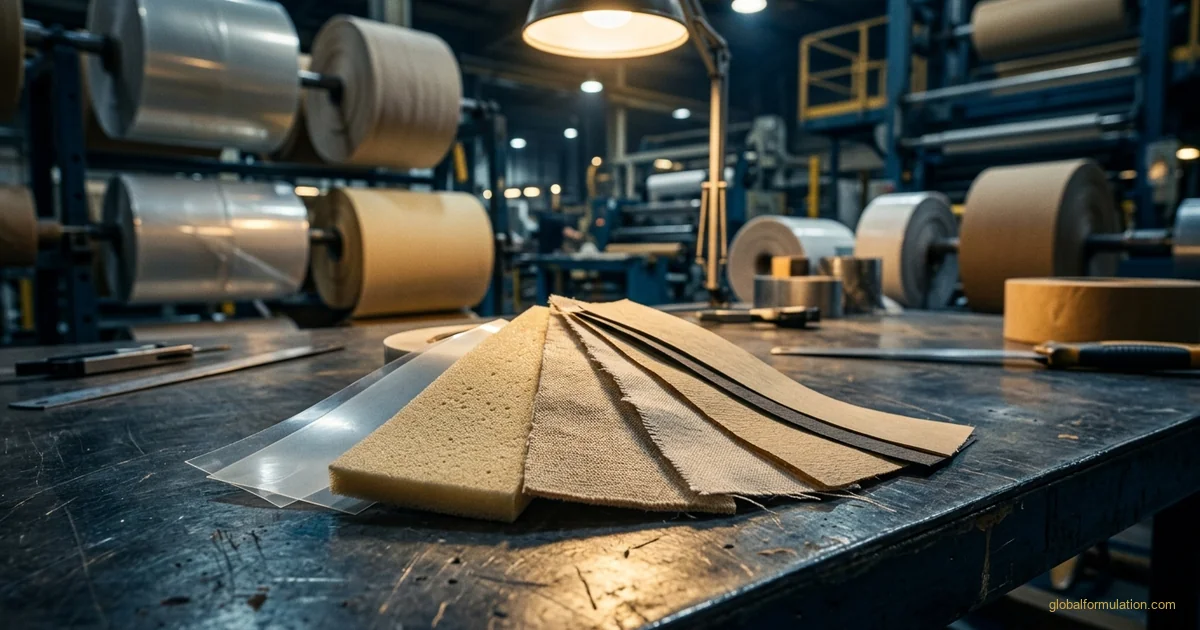
A packaging engineer swaps to a cheaper carton-sealing tape to trim cost, and within a week returned pallets start showing split seams under routine forklift handling. Both tapes use nearly identical acrylic adhesive — the difference lives entirely in what's underneath it. Adhesive tape backing materials are the substrate layer that carries the adhesive, and it's the backing, not the adhesive chemistry, that decides how much load a tape resists, how it conforms to a curved surface, whether it tears cleanly by hand, and how it holds up to heat, moisture, or years of outdoor exposure. This guide walks through the chemistry and mechanical behavior of the four backing families that dominate commercial tape — film, foam, fabric, and paper — plus how release liners and coating lines turn raw backing stock into a finished roll. It reflects the same backing-first evaluation process we apply across adhesives and sealants consulting work, where a failed bond gets traced back to substrate choice as often as it does to the adhesive itself.
Why Adhesive Tape Backing Materials Decide What a Tape Can Do
Every pressure-sensitive tape is built from three layers stacked together: the backing, the adhesive, and a release liner that protects the adhesive until the tape is used. The adhesive layer has one narrow job — wet out the surface it touches and generate tack, peel strength, and shear resistance at the bond line. Almost everything else a finished tape needs to do is a property of the backing instead: resisting tension without stretching apart, conforming around a curved pipe or fender edge, blocking moisture, or coming apart cleanly by hand instead of needing a blade. That division of labor explains why two tapes coated with the identical acrylic adhesive can perform completely differently once they're built on different backing stock.
- Tensile strength and elongation — how much pulling force the tape resists before it stretches permanently or breaks
- Conformability — how closely the backing follows a curved or irregular surface without wrinkling or lifting at the edge
- Tear resistance and hand-tearability — whether the tape parts cleanly across its width by hand or needs scissors or a blade
- Environmental resistance — how the backing holds up to UV exposure, moisture, temperature swings, and chemical contact
- Dimensional stability — resistance to shrinking or expanding during adhesive coating, storage, or temperature change
Specify the backing correctly for the job first, and the adhesive choice becomes a secondary decision instead of the whole specification.
Film Backings: PET, BOPP and PVC Chemistry
Plastic film backings dominate commercial tape because a single polymer can be engineered across an unusually wide property range just by changing how it's processed. Biaxial orientation — stretching the film in both the machine and cross directions during manufacturing — aligns the polymer chains and produces the high tensile strength and dimensional stability that unoriented film can't match. Three films account for most of what's on the market: polyester (PET), biaxially oriented polypropylene (BOPP), and polyvinyl chloride (PVC), and each earns its place through a different balance of strength, cost, and flexibility. Choosing among them is almost entirely a backing decision, not an adhesive one.
| Film Backing | Orientation | Distinguishing Property | Common Application |
|---|---|---|---|
| PET (polyester) | Biaxially oriented | Highest tensile strength and dimensional stability of the three; tolerates high heat | Splicing tape, electrical/electronic tape, high-speed packaging lines |
| BOPP (polypropylene) | Biaxially oriented | Lower cost than PET; good optical clarity; moderate tensile strength | Carton sealing tape, general-purpose packaging |
| PVC | Calendered, unoriented | Highly stretchable and conformable; accepts flame-retardant additive packages | Electrical insulation tape, wire harness wrapping, color-coding tape |
Polyester's combination of strength and heat resistance is why it shows up where failure isn't an option — splicing tape used mid-run on a converting line, or electronic assembly tape that has to survive a reflow oven. BOPP trades some of that strength for cost, which is exactly the trade-off a corrugated-carton line wants when it's sealing thousands of boxes a day. PVC film takes a different route entirely: calendered rather than oriented, it's built for stretch instead of raw strength, giving it the flexibility to wrap tightly around irregular wire bundles and connectors. That conformability, combined with a flame-retardant additive package, is what lets PVC electrical tape earn a listing under UL 510, the North American standard covering dielectric strength, flame resistance, and adhesion for insulating tape rated up to 600 V.
Film backings solve the strength-and-precision end of the market. The next backing family solves a completely different problem: absorbing stress instead of resisting it.
Foam Backings: Cushioning, Gap-Filling and Stress Distribution
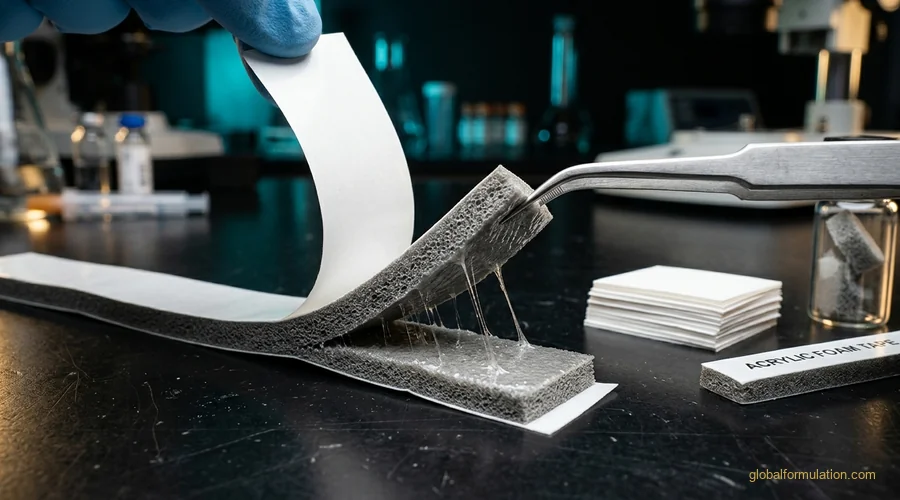
Foam-backed tapes exist to do a job film can't: fill a gap, absorb vibration, and spread a mechanical load across an entire bonded area instead of concentrating it at a few fastener points. Where a rivet or screw creates a stress riser at one small contact point, a pressure-sensitive foam tape backing distributes load continuously along the whole bond line, which is exactly why foam tape has replaced mechanical fasteners in mounting applications from trim panels to signage. Polyethylene foam is the economical option — closed-cell and reasonably compressible for general cushioning and gasketing. Acrylic foam, marketed widely under names like VHB-style tape, is the high-performance end of the category, engineered as a viscoelastic material rather than a simple compressible cushion.
- Polyethylene foam — closed-cell, low-cost, general-purpose cushioning and light gasketing
- Polyurethane foam — open- or closed-cell, higher compressibility, common in sealing and sound-dampening tape
- Acrylic foam — dense, viscoelastic, engineered for structural mounting and permanent bonding of dissimilar substrates
That trade-off between dynamic strength and long-term creep is a foam property, not an adhesive one — a distinction the next backing family makes even more obvious.
Fabric and Cloth Backings: Tear Resistance and Hand-Tearability
Cloth-backed tape solves a problem film and foam both handle poorly: tearing cleanly by hand, in a straight line, without a blade or scissors. A woven fabric backing achieves that because its thread structure gives the tape high strength along the length of the roll while remaining easy to separate across its width — pull perpendicular to the weave and the individual threads part in sequence rather than all at once. Duct tape is the clearest commercial example: a woven cotton, polyester, or fiberglass scrim laminated to a low-density polyethylene film and coated with a rubber-based adhesive, as documented in technical references on duct tape construction. The polyethylene layer supplies the moisture barrier the scrim alone can't provide, while the scrim supplies the tensile strength and hand-tearability the polyethylene alone can't provide.
- Cotton cloth — the traditional gaffer- and duct-tape backing, valued for a matte, non-reflective finish and clean removal in premium gaffer-grade tape
- Polyester or fiberglass scrim — higher tensile strength and better dimensional stability than cotton, used where the tape needs to survive heavier loads
- Weave density and pattern — the variable manufacturers tune directly to control how easily a given tape tears by hand
The thread count that makes a tape tear cleanly by hand is a deliberate manufacturing choice, not an incidental side effect — and paper backings push that same design philosophy even further.
Paper Backings: Creping, Saturation and Conformability
Paper is the oldest tape backing material, and it still wins jobs film and cloth can't: masking tape that removes cleanly after paint cures, and low-cost carton and label stock that doesn't need to survive rough handling. Raw kraft paper is too weak and too easily torn on its own, so manufacturers saturate it with a latex binder to control tear propagation before it's coated with adhesive. From there, paper tape backing splits into two distinct products depending on whether the job needs stretch.
- Creped paper — mechanically compressed into fine ridges, commonly on the order of 15 to 30 crepe lines per lineal inch for standard masking tape, giving the backing a built-in stretch that lets it hug curved trim and irregular surfaces without wrinkling
- Flatback paper — uncreped and dimensionally stable, used for splicing tape, carton sealing, and printable label stock where stretch isn't wanted
Getting the backing right solves the in-use performance problem. Getting it onto the tape in the first place is a manufacturing problem, and that's where release liners and coating lines take over.
Manufacturing and Testing: Coating Lines, Release Liners and Tensile Standards
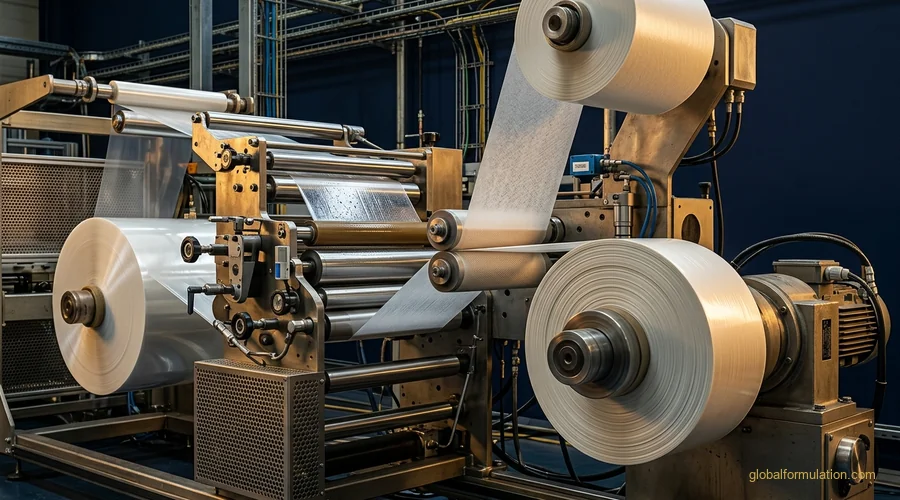
Turning a roll of raw backing into finished pressure-sensitive tape happens on a coating line, and the sequence is largely the same regardless of which backing family is running through it. Film backings usually get a corona surface treatment first, which raises surface energy so the adhesive actually wets and anchors to the substrate instead of beading up. The adhesive itself is applied through one of three main methods, and the coating method is chosen to match the backing and the adhesive chemistry, not picked independently of either one.
| Coating Method | Adhesive Type | Best-Suited Backing |
|---|---|---|
| Knife-over-roll | High-viscosity solvent-based | Film, cloth |
| Slot die | Water-based emulsion, precise thickness control | Film, paper |
| Hot melt | 100%-solids hot melt adhesive | Foam, high-speed film lines |
After coating, the adhesive layer is dried or cooled and immediately laminated with a release liner — typically a siliconized paper or film — so the tape can be wound into a roll without the adhesive sticking to the backing's opposite face. The silicone coating on that liner is engineered to a specific release force: too aggressive and the liner won't peel away cleanly before use, too light and it falls off in shipping. Once laminated, the finished web is slit to width and wound into large logs before being converted into the individual rolls sold to end users, a scale-up path that follows the same lab-to-plant progression covered in our guide to commercial manufacturing scale-up. Backing performance is verified the same way industry-wide: tensile strength and elongation at break are measured on a constant-rate-of-extension tester under ASTM D3759, the standard method referenced across pressure-sensitive tape specifications for both machine- and cross-direction testing.
None of these backing families is inherently "better" — a PET splicing tape and a crepe paper masking tape are both correctly engineered for their job and would both fail immediately in the other's application. The decision that matters is matching tensile strength, conformability, and tear behavior to the actual load and surface the tape will see in service, then treating adhesive selection as the second question rather than the first.
Frequently Asked Questions
What is the difference between tape backing and tape adhesive?
The backing is the structural substrate — film, foam, fabric, or paper — that carries the adhesive layer and gives the tape its mechanical properties: tensile strength, conformability, tear resistance, and how it responds to heat or moisture. The adhesive is a separate, thin coated layer whose only job is generating tack, peel strength, and shear resistance at the bond line.
A tape's overall performance is the product of both layers working together, but properties like hand-tearability, stretch, and load capacity come almost entirely from the backing, not the adhesive chemistry.
Why does PET film backing cost more than BOPP?
PET (polyester) film generally costs more to produce than BOPP (polypropylene), and that added cost buys measurably higher tensile strength, better dimensional stability, and greater heat resistance. For applications like splicing tape on a converting line or electronic assembly tape that has to survive a reflow oven, that performance margin is worth the premium.
For carton sealing, where the tape just needs to hold a box shut through a supply chain, BOPP's lower cost and adequate strength make it the standard choice instead.
Can foam tape backing really replace mechanical fasteners like screws or rivets?
In many mounting applications, yes — acrylic foam tape is widely used in place of rivets and screws for exterior trim, signage, and panel bonding because it distributes load continuously across the entire bonded area instead of concentrating stress at a few fastener points. That said, foam tape is viscoelastic, so a bond that performs well under fast, dynamic loading can still creep slowly under a constant static load over months.
Engineers who substitute foam tape for fasteners in structural or safety-critical applications need to account for that long-term creep behavior, not just the initial peel strength.
Why do some tapes tear by hand while others need scissors or a blade?
Hand-tearability comes from the backing's fiber structure, not the adhesive. Woven cloth and creped paper backings are built so their fibers separate in sequence across the width of the tape when pulled perpendicular to the weave or grain, letting the tape part cleanly by hand.
Oriented film backings like PET and BOPP don't have that fiber structure — their polymer chains are aligned for strength in both directions, which is exactly what makes them resist tearing well enough that they need a blade or built-in dispenser to cut cleanly.
What does crepe paper backing actually do for masking tape?
Creping mechanically compresses raw paper into fine ridges — typically in the range of 15 to 30 crepe lines per lineal inch for standard masking tape — which gives the paper backing a built-in stretch it wouldn't otherwise have. That stretch lets the tape hug curved trim, window frames, and irregular surfaces without wrinkling or lifting at the edge, which is exactly where paint would otherwise bleed underneath.
Flatback, uncreped paper skips that step entirely because splicing tape and carton-sealing applications need dimensional stability instead of stretch.
What is a release liner and why is it siliconized?
A release liner is the paper or film layer laminated over the adhesive side of a tape before it's wound into a roll, protecting the adhesive and keeping it from sticking to the backing's opposite face. It's coated with a thin silicone layer engineered to a specific release force — light enough that the liner peels away cleanly by hand right before the tape is applied, but strong enough that it doesn't fall off or shift during shipping and storage.
Get that release-force balance wrong in either direction and the tape becomes difficult to use even if the adhesive and backing are performing exactly as specified.
How is tape backing tensile strength actually tested?
Tape tensile strength and elongation at break are measured on a constant-rate-of-extension testing machine under ASTM D3759, the standard method used across the pressure-sensitive tape industry. A sample of specified width is clamped and pulled at a controlled rate in both the machine and cross directions until it breaks, recording the peak force and the percentage of stretch reached at that break point.
The Pressure Sensitive Tape Council's parallel PSTC-131 method covers the same measurement and is the version most commonly cited in tape manufacturers' technical data sheets.
Developing a Tape or Laminated Adhesive Product?
Global Formulation provides adhesive and sealant consultancy — backing material selection, adhesive chemistry matching, coating-line process design, and scale-up from lab to production.
Talk to Our Formulation Team