Agrochemical Manufacturing 101: Formulation & Safety Guide

Agrochemicals and fertilizers together form the absolute chemical infrastructure of modern global food production. Every ton of commercial grain, fruit, or vegetable harvested today is directly reliant on the optimized utilization of crop protection inputs and balanced soil nutrition. To build a successful agrochemical manufacturing business, entrepreneurs must balance multi-phase physical chemistry, process engineering safety standards, environmental effluent controls, and stringent global toxicological registrations.
Guide Contents
- 1. Agrochemicals in Modern Agriculture
- 2. Comprehensive Classifications
- 3. Fertilizer Chemistry & Forms
- 4. Actives vs. Formulated Products
- 5. Physical Formulation Chemistry
- 6. Step-by-Step Production Process
- 7. Colloid Stability & Sedimentation Physics
- 8. Plant Engineering & ATEX Zoning
- 9. Regulatory Frameworks (CIBRC, FCO & REACH)
- 10. Cost Structures & Scale-up Risks
- 11. Frequently Asked Questions (FAQ)
1. Agrochemicals and Fertilizers in Modern Agriculture
The commercial scale of modern agricultural systems demands continuous, predictable control over plant biological environments. Traditional soil management alone cannot replenish macronutrients at the pace required by multi-cropping cycles, nor can biological pest controls isolate intensive monocultures from devastating insect infestations. Agrochemicals act as chemical crop protection walls, while fertilizers provide highly concentrated, bioavailable metabolic substrates.
For chemical manufacturers, entering the agrochemical space is a complex, capital-intensive venture characterized by high toxicological accountability and rigorous plant engineering standards. However, the recurring demand cycle and stable market volumes across global agrarian networks provide long-term profitability. Aligning product designs with modern environmental mandates is the primary differentiator for emerging manufacturing brands.
India has positioned itself as a global leader in generic agrochemical formulation, leveraging abundant organic synthesis raw materials and cost-efficient chemical process engineering. To access premium export segments in Latin America, Europe, and Africa, manufacturers must design formulations with exceptional chemical stability, rainfastness, low environmental persistence, and compliant pesticide residue parameters. A broader look at how these formulation principles apply across agro chemical products and technology provides useful context before drilling into individual formulation types.
2. Comprehensive Classification of Agrochemicals
Crop protection inputs are classified according to their target biological pests and chemical active modes of action. Each category demands unique chemical processing, blending safety rules, and packaging barriers. For example, highly volatile organic herbicides must be processed in isolated rooms away from broad-spectrum insecticides to prevent trace cross-contamination that could destroy crops during field sprayings.
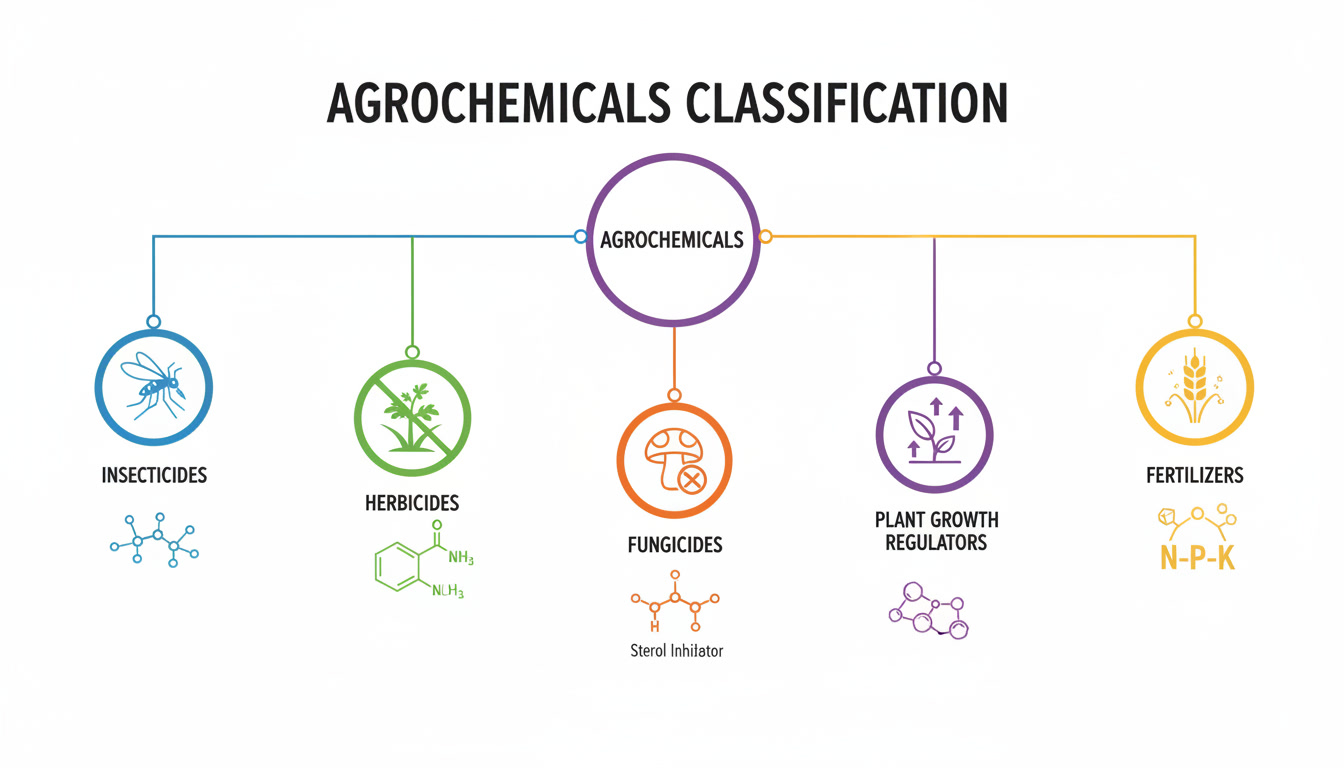
The primary divisions of commercial crop inputs include:
- Insecticides: Chemicals targeting insect pests (e.g., organophosphates, pyrethroids, neonicotinoids) acting on nerve transmission systems or metabolic pathways.
- Herbicides: Compounds designed to isolate and eliminate competing weed species (e.g., glyphosate, triazines, phenoxy carboxylic acids) by disrupting photosynthesis or cellular division.
- Fungicides: Target fungal pathogens (e.g., triazoles, strobilurins, dithiocarbamates) preventing spore germination or mycelial growth.
- Plant Growth Regulators (PGRs): Hormonal modulators (e.g., gibberellic acid, auxins, ethephon) regulating cell elongation, fruit ripening, and root initiation.
3. Types of Fertilizers Based on Chemical Composition
Fertilizer technology revolves around the industrial synthesis of stable chemical salts containing highly bioavailable nitrogen, phosphorus, and potassium (NPK) matrices. Because plants absorb nutrients exclusively through ionic soil solutions, the chemical solubility, pH reaction, and moisture absorption profile of these fertilizers govern their agronomic efficiency and shelf stability in warehouse settings.
Modern soil replenishment strategies utilize:
- Nitrogenous Fertilizers: Formulations supplying amide or ammonium nitrogen (e.g., Urea, Ammonium Nitrate). Urea chemistry is highly soluble and prone to atmospheric volatilization, requiring urease inhibitors or polymer coatings to control nutrient release.
- Phosphatic Fertilizers: Products delivering phosphate ions (e.g., DAP, MAP, SSP). Their manufacturing involves acid-rock digestions, followed by controlled crystallization to maintain high water-soluble phosphorus fractions.
- Potassic Fertilizers: Supplying potassium ions (e.g., Muriate of Potash - MOP, Sulfate of Potash - SOP). Potassium salts are highly crystalline and hygroscopic, demanding rigorous anti-caking coatings during high-pressure granulation.
- Micronutrient Chelates: Delivering essential metallic elements (e.g., Zinc, Iron, Manganese) protected inside organic rings (such as EDTA or DTPA) to prevent oxidation, precipitation, and soil locking.
Liquid fertilizer blends follow a related but distinct formulation logic to the solid salts above, since nutrient ions must stay fully dissolved without crystallizing out during storage or cold transport. Founders evaluating this segment separately can review our dedicated liquid fertilizer manufacturing unit guide for equipment and NPK blending process detail.
4. Active Ingredients vs. Formulated Agrochemical Products
Pesticide technical active ingredients (AIs) are high-purity crystalline solids or viscous organic liquids synthesized in chemical reactors. In their raw technical forms, they exhibit poor water dispersibility, rapid degradation under ambient UV radiation, weak cuticular leaf penetration, and extreme toxicity to biological handlers, making them completely unsuitable for direct agricultural field applications.
Formulation chemistry solves these mechanical challenges by combining raw active molecules with targeted organic solvents, non-ionic and anionic surfactants, dispersants, wetting agents, viscosity modifiers, and UV stabilizers. This chemical engineering sequence yields a stable commercial input that can be diluted in field spray tanks to form a uniform, biological-penetrating, leaf-wetting crop protection film.
5. Major Agrochemical Formulation Types and Their Chemical Behavior
Agrochemical formulations are complex physical-chemical mixtures designed to deliver hydrophobic active ingredients uniformly through water-based spray systems. Choosing the correct formulation format—such as an Emulsifiable Concentrate (EC), Suspension Concentrate (SC), or Water Dispersible Granule (WG)—depends on the active ingredient's solubility, melting point, chemical stability in water, and safety parameters.
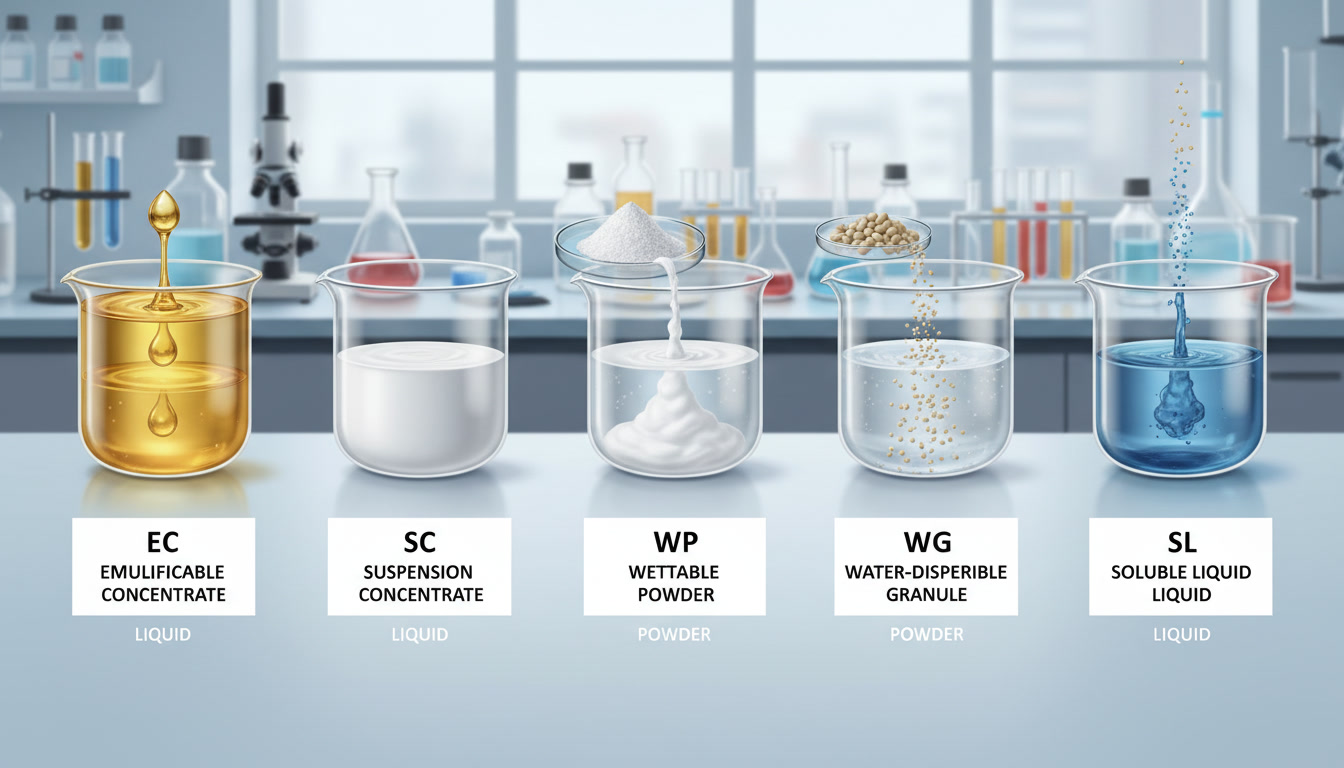
The most widely manufactured formulation types in global pesticide markets are:
- Emulsifiable Concentrates (EC): Liquid oil-in-water precursor systems where the hydrophobic active ingredient is dissolved in aromatic hydrocarbon or polar ester solvents along with a balanced surfactant system. Upon diluting in spray tanks, it forms a spontaneous emulsion.
- Suspension Concentrates (SC): Aqueous dispersions of finely milled crystalline active ingredients. Solid particles are suspended in water using wetting agents, polymeric dispersants, and rheology control agents to prevent settling and hard packing.
- Water Dispersible Granules (WG / WDG): Solid dry granular systems designed to disintegrate spontaneously in spray tanks to yield a fine suspension. They offer the safety of dust-free handling and are synthesized via fluid-bed spray granulation.
- Soluble Liquids (SL): Homogeneous molecular solutions where the active ingredient is fully water-soluble. They represent the simplest liquid systems, governed primarily by salt-buffer chemistry and hydrolytic prevention systems.
Because Emulsifiable Concentrates rely on aromatic hydrocarbon or polar ester solvents, formulators must also track the volatile organic compound (VOC) content of the finished product, since solvent choice directly affects worker exposure limits, flash point classification, and regional emissions compliance.
| Formulation Type | Active Ingredient State | Key Stabilizers | Typical Handling Risk |
|---|---|---|---|
| EC | Dissolved in organic solvent | Non-ionic/anionic surfactant blend | Solvent flammability, VOC emissions |
| SC | Milled solid, suspended in water | Polymeric dispersants, xanthan gum | Sedimentation and hard-caking on aging |
| WG / WDG | Dry granule, disintegrates in tank | Binders, disintegrants | Dust exposure during granulation |
| SL | Fully water-soluble molecule | Buffer salts, hydrolysis inhibitors | pH drift and hydrolytic degradation |
6. Step-by-Step Manufacturing Process of Agrochemicals
Manufacturing pesticide formulations involves precise, high-shear mechanical milling, dry powder blending, and liquid-phase dissolution. Because solid active ingredients often exhibit crystalline structures, mechanical particle reduction is required to ensure that diluted field sprays do not clog tractor nozzles and that active particles are small enough to penetrate plant cell membranes.

The industrial manufacturing sequence for a modern Suspension Concentrate (SC) formulation comprises:
- High-Shear Pre-Mixing: Crystalline active ingredients are blended into water along with wetting agents, defoamers, and polymeric dispersants inside a high-speed cowles-blade disperser to form a coarse slurry.
- Horizontal Wet Bead Milling: The coarse slurry is pumped into high-energy horizontal bead mills containing zirconia silicate media. Continuous high-shear impact reduces particle size down to 1 to 3 microns.
- Viscosity Modification & Standardization: Polysaccharide structuring thickeners (like xanthan gum) and organic biocide preservatives are added to balance the rheological yield point of the suspension, preventing sediment caking.
- Automated Packing and Sealing: The finished SC is filtered, checked for chemical assay compliance, and discharged into high-density polyethylene (HDPE) containers utilizing nitrogen-flushed automated filling lines.
7. Colloid Stability and Sedimentation Physics in Formulations
Pesticide Suspension Concentrates (SC) are thermodynamically unstable colloidal dispersions that rely on kinetic barrier systems to prevent phase separation. Because solid active ingredients have a higher density than the aqueous continuous phase, continuous gravitational force acts on the particles, driving them to aggregate, sediment, and solidify into a hard, non-redispersible clay mass at the bottom of containers.
7.1 DLVO Colloid Theory & Dispersant Repulsive Mechanics
The physical stability of a pesticide suspension concentrate is mathematically modeled by the DLVO (Derjaguin-Landau-Verwey-Overbeek) Theory. The total interaction potential energy (Vtotal) between two colliding active particles is the sum of attractive and repulsive molecular forces:
Where:
- Vtotal is the total potential energy governing colloid stability.
- VA is the attractive Van der Waals potential energy drawing particles together.
- VR is the electrostatic repulsive potential energy generated by ionic double-layers.
- VS is the steric repulsive potential energy created by adsorbing polymeric dispersants.
To maintain kinetic stability and prevent particle coagulation, formulation chemists must maximize the electrostatic repulsive potential (VR) by maintaining a high zeta potential (ζ ≥ |30| mV) on particle surfaces. Additionally, adsorption of non-ionic block copolymer dispersants creates a physical steric barrier (VS) that prevents attractive Van der Waals forces (VA) from dominating during particle collisions.
7.2 Stokes' Law & Gravitational Sedimentation Velocity
The rate at which suspended active pesticide particles settle under gravity over their shelf life is quantified by Stokes' Law of terminal sedimentation velocity ($v$):
Where:
- v is the terminal sedimentation settling velocity of the solid pesticide particle.
- g is the acceleration due to gravity (9.81 m/s2).
- r is the average radius of the suspended solid pesticide particle.
- ρp and ρf are the densities of the solid particle and continuous fluid phase, respectively.
- η is the dynamic shear viscosity of the continuous aqueous phase.
Stokes' Law clearly demonstrates that particle radius (r) is the most critical parameter governing suspension stability, as settling velocity scales quadratically (r2). Therefore, reducing particle size below 3 microns via wet bead milling is a physical requirement. Simultaneously, increasing continuous phase dynamic viscosity (η) utilizing shear-thinning polysaccharide hydrocolloids (like xanthan gum) reduces settling velocity to near-zero under static warehouse storage conditions.
8. Plant Engineering and Safety Requirements
Agrochemical manufacturing facilities are high-risk industrial environments that handle toxic active dusts, flammable organic solvents, and concentrated reactive acids. The plant design must physically isolate dry powder handling zones from liquid solvent filling areas to eliminate cross-contamination and dust explosion hazards. Comprehensive engineering controls are mandatory to protect operators and satisfy environmental licenses.
Core engineering safety requirements inside modern agrochemical plants include:
- Flameproof Electricals & ATEX Zoning: Classifying liquid solvent storage and EC formulation blending zones as ATEX Zone 1 or Zone 2 areas. All motors, switches, and agitators must utilize spark-proof, EEx-d explosive ratings.
- Negative-Pressure Dust Extraction: Dry powder formulation areas (like WP/WG processing) must operate under continuous negative pressure, venting through reverse-pulse bag filters to protect operators from toxic inhalation.
- Dedicated Zero-Liquid-Discharge (ZLD) ETP: Agrochemical effluents contain highly toxic, non-biodegradable pesticide molecules. The facility must run an isolated effluent treatment plant combining advanced chemical oxidation (Fenton's reactions) and multi-effect evaporators.
9. Regulatory Framework for Agrochemicals and Fertilizers
Pesticide and fertilizer manufacturing operations are subject to intense legal regulation in India and globally to prevent ecological poisoning and verify product nutrient quality. Startups must navigate multiple independent regulatory registration pathways before they can legally construct a plant, manufacture active molecules, or execute commercial domestic or export shipments.
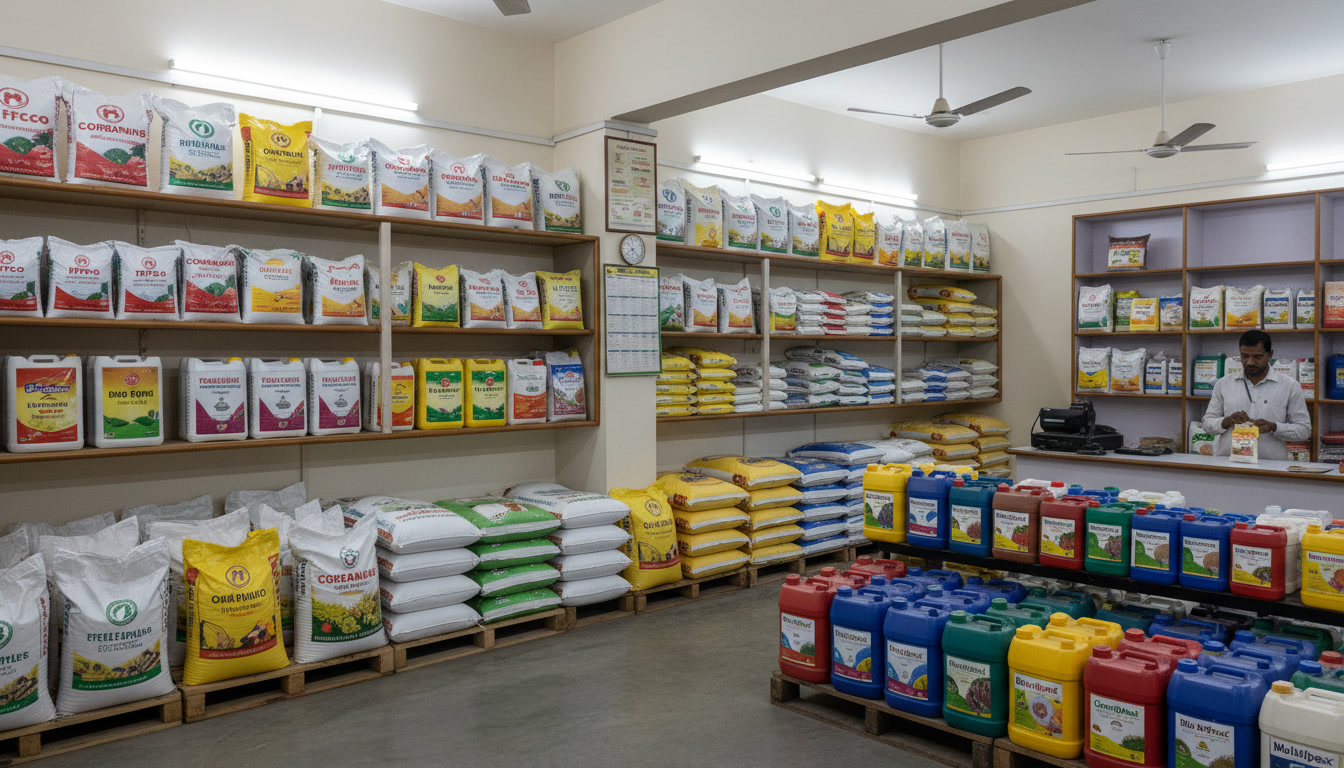
The primary regulatory compliance pathways are:
- CIBRC Pesticide Approval (India): Governing all crop protection inputs under the Insecticides Act, 1968. Manufacturers must obtain registration from the Central Insecticides Board & Registration Committee (CIBRC) for every technical and formulated molecule.
- Fertilizer Control Order (FCO): Fertilizers sold domestically in India must strictly comply with the Fertilizer Control Order, 1985. This governs mandatory macro and micronutrient limits, moisture limits, and labeling requirements.
- Global Registration (REACH & EPA): Exporting pesticides to Europe requires chemical compliance under REACH regulations, while shipping to the United States requires EPA registration. All export shipments must also comply with target country Maximum Residue Limits (MRLs).
Every registration dossier submitted to CIBRC, REACH, or the EPA must be backed by accurate MSDS, TDS, and COA documentation for each batch, since regulators and importing customs authorities cross-check these certificates against the declared active content and hazard classification before clearing shipments.
10. Cost Structures and Scale-Up Risks in Manufacturing
The financial success of an agrochemical manufacturing business depends on supply-chain stability and process optimization. Because raw active ingredients are typically expensive and often imported, manufacturing yield losses during milling or filtration directly degrade commercial margins. Startups must balance raw material procurement, plant utility costs, and safety compliance charges to protect profitability. Entrepreneurs weighing entry into this sector should also review our step-by-step agrochemical formulation business startup guide for capital and licensing specifics.
Common process risks during commercial scale-up trials include:
- High Milling Shear Heat: Bead milling solid actives under high-shear generates intense thermal energy. If cooling jackets fail, active ingredients with low melting points can melt and recrystallize, causing complete mill blockages.
- Viscosity Inversion during Granulation: Spray drying fluid-bed granules requires precise control of binder spraying rates. Incorrect moisture or air-flow parameters can cause granules to cake inside drying towers.
- Suboptimal Effluent Management: Underestimating chemical oxidation costs in the effluent treatment plant is a common cause of regulatory plant shutdowns and operational cash drains.
Frequently Asked Questions (FAQ)
1. What is the minimum investment to start agrochemical manufacturing in India?
Setting up a small-scale pesticide liquid formulation plant (EC/SL systems) typically starts at INR 2 to 5 crore. Integrated formulation plants combining Suspension Concentrates (SC) with dry granular systems (WG) and Zero-Liquid-Discharge effluent treatment require capital upwards of INR 10 to 15 crore to comply with local safety and environmental laws.
2. Is CIBRC registration mandatory for export‑only manufacturing?
Yes. In India, even if a pesticide formulation is manufactured exclusively for export markets, CIBRC export registration and approval under the Insecticides Act, 1968 remain legally mandatory before commercial production or shipping can occur.
3. Can startups export agrochemicals through contract manufacturing?
Yes. Startups can utilize third-party contract manufacturing plants that possess active CIBRC formulation licenses. The brand owner must hold valid export registrations and ensure that all batches comply with target country Maximum Residue Limits (MRLs).
4. What is the regulatory difference between fertilizers and pesticides?
Fertilizers are governed by the Fertilizer Control Order (FCO), focusing primarily on quality control, moisture limits, and minimum nutrient values. Pesticides fall under the Insecticides Act, demanding exhaustive toxicological, biological efficacy, and environmental impact data before registration approval.
5. Why do many agrochemical formulations fail shelf‑life testing?
Most stability failures stem from molecular hydrolysis of water-sensitive actives, active recrystallization due to low storage temperatures, particle sedimentation due to weak dispersant electrostatic double-layers, or container chemical degradation.
6. How is agrochemical shelf-life predicted without waiting years for real-time data?
Manufacturers rely on accelerated storage stability testing, most commonly the CIPAC MT 46 protocol of storing samples at 54°C for 14 days to approximate roughly two years of ambient shelf life. Low-temperature stability tests, typically 0°C storage, run in parallel to confirm the suspension or emulsion does not crystallize, freeze-separate, or thicken irreversibly in cold climates. Both tests are standard requirements in CIBRC and FAO/WHO specification dossiers before a formulation is approved for commercial sale.
Conclusion
Agrochemical and fertilizer manufacturing represents a technically complex but highly rewarding sector within industrial agriculture. Long-term commercial success depends on the precise integration of physical colloid science, process engineering safety standards, environmental effluent controls, and global regulatory registration compliance.
For entrepreneurs, technical managers, and investors, partnering with specialized chemical formulation consultants from day one is the most reliable way to select correct milling machinery, design compliant ATEX layouts, and scale-up robust, high-yielding product lines. This same shift toward lower-solvent, lower-residue formulation strategy is part of the broader green chemistry movement reshaping industrial chemical manufacturing more widely.
Need Technical Formulation or Plant Design Services?
Discuss your agrochemical formulation, suspension milling, or fertilizer plant design project with Global Formulation. Obtain professional CIBRC-compliant layouts, ATEX electrical engineering audits, and robust product formulations.
Email: consulting@globalformulation.com
Phone: +91 9819548320 +91 8169102990
About the Specialist
Absar Khan is the principal consultant and chemical formulation architect at Global Formulation. He possesses cross-disciplinary engineering expertise spanning agrochemical milling lines, aerosol packaging systems, pharmaceutical cleanroom layouts, cosmetics, and green chemical plant setups. Absar leads scientific and engineering advisory teams supporting manufacturers globally in technology selection, GMP layouts, validation frameworks, and regulatory strategies.
LinkedIn Portfolio: Connect with Absar Khan on LinkedIn