Air Entraining Admixtures: Freeze-Thaw Durability in Concrete
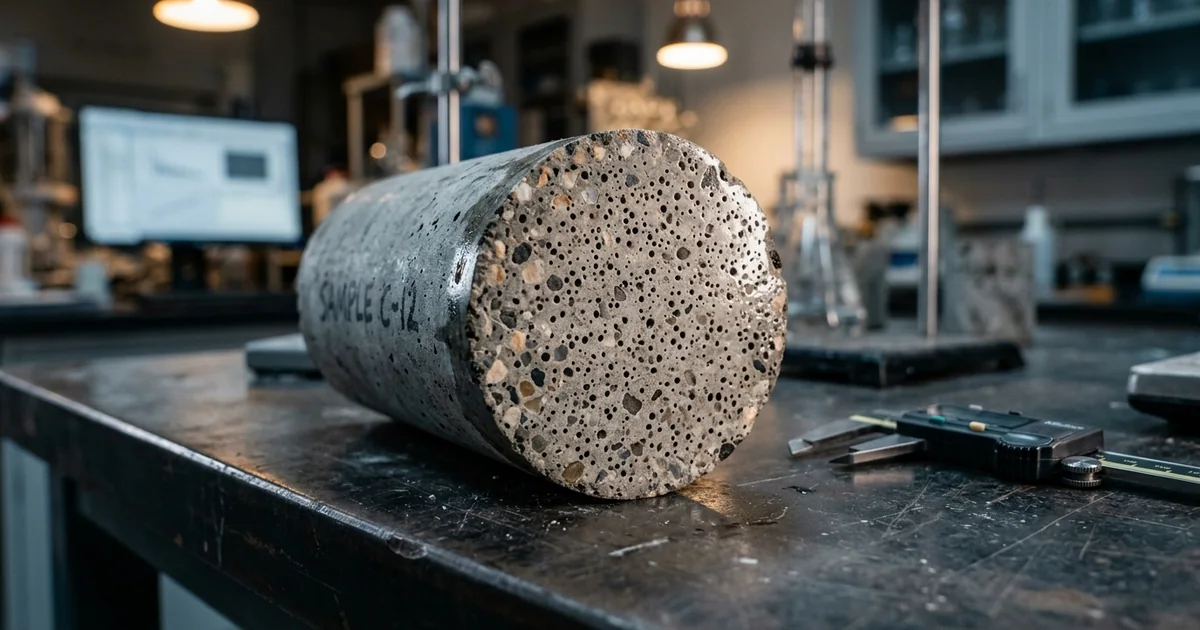
A parking structure in a cold climate looks fine its first winter, shows a few flaking patches by year three, and by year eight the surface is scaling away in sheets wherever deicing salt collects. The concrete mix passed every strength test at 28 days, so the failure gets blamed on the salt, the contractor, or the weather — when the real cause was decided at the batch plant, in a decision about entrained air that nobody flagged as critical at the time. An air entraining admixture concrete mix design is the difference between a structure that shrugs off forty freeze-thaw cycles a year and one that scales apart within a decade, and the mechanism is more specific than "more air is better." This article explains how entrained air actually protects concrete, why the spacing between bubbles matters more than the total air percentage, which surfactant chemistries are used to build that bubble system, and where dosing goes wrong in real production. It draws on the same admixture chemistry and mix-design discipline that underpins plasticizers and superplasticizers in modern concrete.
Why Air Entraining Admixture Concrete Survives Winters Better
Concrete is never fully dry once it is in service — capillary pores in the hardened cement paste hold water drawn in from rain, snowmelt, groundwater, or condensation. In a climate with freeze-thaw cycling, that trapped water is a structural liability, because water expands by roughly nine percent when it freezes and has nowhere to go inside a dense, saturated paste. An air entraining admixture concrete mix solves this before the concrete ever sees its first winter, by deliberately building a network of microscopic air bubbles into the paste during mixing that gives freezing water somewhere to expand into.
- Deicing salt exposure — sodium and calcium chloride salts increase the frequency and severity of surface freeze-thaw cycling and are strongly associated with scaling in non-air-entrained concrete.
- Repeated cycling — bridge decks, pavements, and parking structures can see dozens of freeze-thaw cycles per winter, so even small pressure damage compounds quickly.
- Invisible until failure — freeze-thaw damage accumulates as internal microcracking long before it becomes visible scaling or spalling on the surface.
- Code-mandated, not optional — most cold-climate building codes and transportation agency specifications require a minimum entrained air content for exterior exposure classes.
That protection depends entirely on how the air is introduced and stabilized, which is a very different problem from simply whipping bubbles into a fluid. The next section covers exactly what happens inside the paste as ice forms, and why that determines what the bubble system has to accomplish.
The Freeze-Thaw Damage Mechanism
Freeze-thaw damage in concrete follows a specific, well-documented physical sequence rather than being generic cold-weather wear. Water in the larger capillary pores of the cement paste freezes first because it is less strongly bound than water in the finer gel pores, and as it turns to ice it expands by about nine percent in volume. That expansion forces the remaining unfrozen water in the surrounding paste to migrate away from the growing ice front, and if that water cannot escape fast enough, hydraulic pressure builds inside the pore structure.
Once that hydraulic pressure exceeds the tensile strength of the surrounding cement paste, it produces microcracks. A single freeze-thaw cycle rarely does visible damage, but the process repeats every cycle throughout the concrete's service life, and the microcracks accumulate, connect, and eventually surface as scaling, spalling, or a general loss of surface integrity. Deicing salts make this worse through additional mechanisms, including localized osmotic pressure and increased degree of saturation near the salted surface, which is why salt-exposed pavements and decks are held to stricter air-content requirements than interior structural elements.
Entrained air interrupts this sequence by giving the migrating water a nearby escape route: an empty, discrete air void that the water can be pushed into instead of building pressure against the paste. Whether that escape route is close enough to matter is a question of geometry, not just quantity — which is exactly what the next section addresses.
Air Content vs. the Spacing Factor
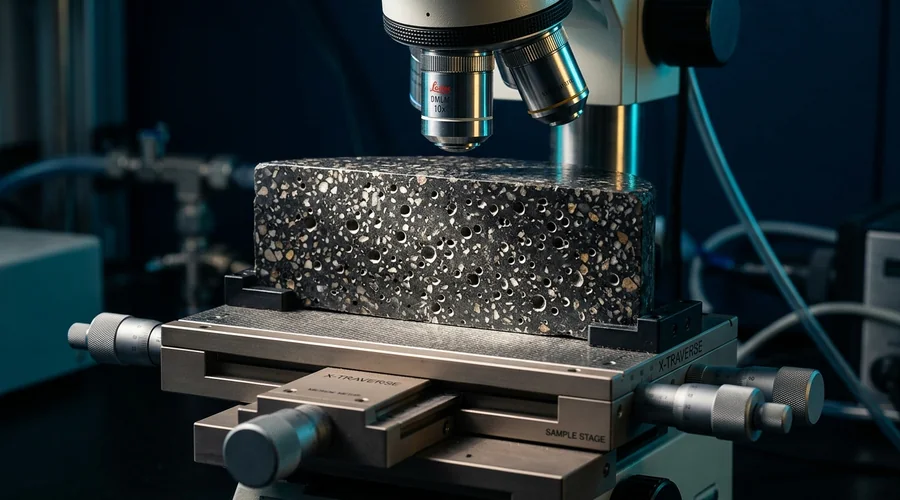
It is tempting to treat entrained air as a single number — hit 6% air content and the concrete is protected — but that number alone does not guarantee durability. Two mixes can report identical total air content on a pressure meter and behave completely differently in freeze-thaw testing, because what actually matters is how close together the individual air voids are, not how much air is present in total. This is measured as the spacing factor, defined under ASTM C457 as an estimate of the maximum distance any point in the paste has to travel to reach the nearest air void.
| Parameter | What it measures | Typical target for good durability |
|---|---|---|
| Total air content | Volume of entrained + entrapped air as a % of concrete volume | Commonly 4–8%, depending on exposure class and aggregate size |
| Spacing factor (ASTM C457) | Estimated maximum travel distance from paste to nearest void | Widely cited threshold near 0.20 mm (200 microns) or lower |
| Specific surface | Surface area of voids per unit volume of air — a fineness indicator | Higher values generally indicate a finer, more effective void system |
| Void size distribution | Proportion of voids in the effective size range vs. large entrapped voids | Predominance of fine, discrete voids in the 10–500 micron range |
A coarse, unevenly distributed void system can hit a target air percentage while still leaving wide gaps in the paste where water has too far to travel before it finds relief, which is precisely the failure mode a spacing-factor check is designed to catch. That means the choice of admixture chemistry and how it is mixed into the batch has a direct bearing on durability, not just on the number that appears on a field air meter.
Surfactant Chemistry Behind Air Entrainment
Air entraining admixtures work because they are surface-active agents — surfactants — that lower the surface tension of the mix water and stabilize air bubbles at the water-air interface long enough for the cement paste to set around them. Without a stabilizing surfactant, the mechanical action of mixing does introduce some air, but those bubbles coalesce and escape almost as fast as they form, leaving only the coarse, irregular entrapped air that offers little freeze-thaw protection. The commercial chemistry used to solve this has settled into a handful of established classes, each with a characteristic bubble size, stability profile, and sensitivity to the rest of the mix.
- Vinsol resin salts — wood-derived, saponified rosin acid salts; the classical air-entraining chemistry, known for a robust, relatively coarse but stable void system with good tolerance to batch-to-batch variability.
- Alkyl sulfates and alkyl ether sulfates — synthetic anionic surfactants that tend to generate a finer, more uniform bubble size distribution than resin-based systems.
- Sulfonated hydrocarbons — another synthetic anionic class, often blended with other surfactants to balance bubble fineness against stability during transport and pumping.
- Fatty acid and fatty acid salts — used both as standalone air-entraining agents and as co-surfactants that fine-tune foam stability.
- Proteinaceous and other natural-derivative surfactants — used in specific regional or legacy formulations, generally offering a different balance of stability and dosage sensitivity.
Choosing the right surfactant chemistry is only half the formulation problem, because an air-entraining agent almost never operates alone in a modern concrete mix. The other admixtures and supplementary materials present in the batch can dramatically change how much air that same dose actually produces.
Compatibility With Other Admixtures and SCMs
Because air entrainment is an interfacial phenomenon governed by surface chemistry, anything else in the mix that is also surface-active or that adsorbs onto cement and aggregate particles can shift the dose-response curve for a given air-entraining admixture. This is one of the most common sources of field variability in air content, and it is why air-entraining dosage cannot be fixed once and assumed to hold across every project and every batch of raw material.
- Polycarboxylate ether (PCE) superplasticizers — some PCE side-chain architectures are mildly air-entraining or, less commonly, mildly defoaming, so switching superplasticizer chemistry can change air content even at a constant air-entrainer dose.
- High-carbon fly ash — residual unburned carbon in fly ash adsorbs surfactant molecules and removes them from solution, a well-documented and often unpredictable cause of air loss in fly-ash concretes.
- Silica fume and slag — high surface area supplementary cementitious materials can increase water demand for a given dose and shift the amount of admixture needed to achieve target air.
- Cement alkali and fineness — finer or higher-alkali cements generally require more air-entraining agent to reach the same air content as a coarser, lower-alkali cement.
- Mixing time, temperature, and transport — extended mixing, retempering, pumping, and hot weather can all reduce entrained air after the initial batch reading.
These interactions are exactly why every combination of cement, supplementary cementitious material, aggregate, and admixture package is trial-batched before it goes into production concrete, and why the air-entraining dosage is treated as a variable to revisit whenever any other ingredient in the mix changes. The interactions with superplasticizer chemistry in particular mirror the compatibility work already required across the broader construction chemicals field, including plasticizers and superplasticizers, since both admixture families compete for the same cement particle surfaces.
Dosing, Mixing, and Field Control
Getting the chemistry right in the lab is only useful if the batch plant can reproduce it, batch after batch, in conditions the lab never sees. Air content is unusually sensitive among concrete properties to how and when the admixture is added, how long the concrete is mixed, and what happens to it between the plant and the point of placement, which makes field control as much a part of the durability outcome as the formulation itself.
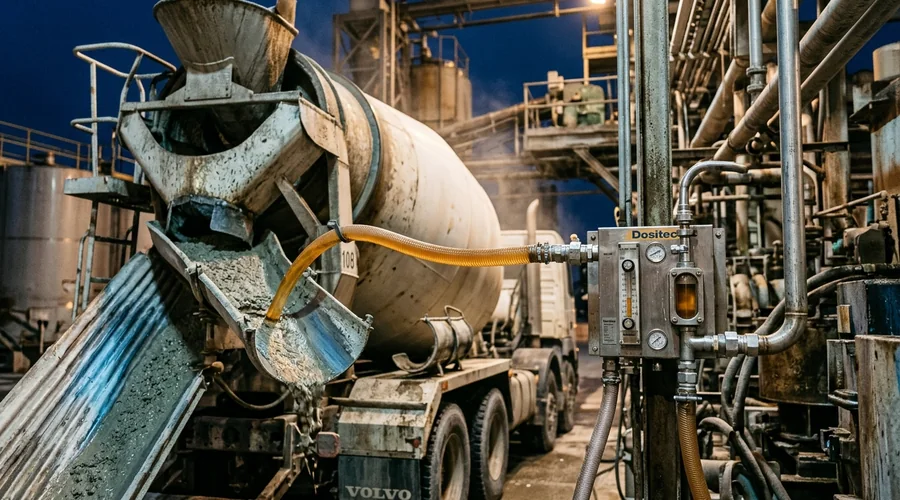
- Calibrated dosing — the admixture is metered by a calibrated pump into the batch water or directly into the mixer, with dosage set from qualification trials using the actual production materials.
- Adequate mixing energy — sufficient mixing time and speed are needed to distribute and stabilize the bubble system uniformly; undermixing leaves air unevenly distributed and often lower than target.
- Transport and retempering control — extended haul times, drum rotation during transit, and any retempering with added water can raise or lower air content before placement.
- Pumping losses — pumping concrete through a line can reduce entrained air, so mixes intended for pumped placement are often qualified with the pump line in the test loop.
- Ambient temperature sensitivity — hot weather generally reduces air content for a fixed dose while cold weather can increase it, so seasonal dosage adjustment is common practice.
None of this field discipline matters, however, unless the plant is actually verifying that the target air-void system is present rather than assuming a good dosage recipe will always deliver it — which is where testing and standards take over.
Testing and Standards
Because entrained air is both critical to durability and sensitive to so many variables, its presence is verified with a defined hierarchy of tests rather than a single measurement, moving from fast field checks to detailed laboratory analysis. Understanding which test answers which question keeps a quality program from mistaking a passing field reading for proof that the freeze-thaw protection is actually in place. This is the same standards-driven discipline that governs admixture qualification generally, and it connects directly to how corrosion inhibitors and other durability admixtures are validated for reinforced concrete exposed to the same freeze-thaw and deicing-salt environments.
| Test | Standard | What it confirms |
|---|---|---|
| Pressure method | ASTM C231 / EN 12350-7 | Fast field total air content on fresh concrete with normal-weight aggregate |
| Volumetric method | ASTM C173 | Total air content where lightweight or porous aggregate would distort a pressure reading |
| Linear-traverse / point-count analysis | ASTM C457 | Void size distribution and spacing factor on a polished hardened section |
| Rapid freeze-thaw testing | ASTM C666 | Relative dynamic modulus of concrete prisms after repeated cycling, as a durability proxy |
| Scaling resistance | ASTM C672 | Visual surface scaling resistance under deicing salt exposure |
A field air-content reading within specification is a necessary but not sufficient signal — it confirms the total volume of air but not its distribution, which is why mix-design qualification for genuinely cold-climate or salt-exposed work should include an ASTM C457 spacing-factor check, and ideally freeze-thaw durability testing under C666 or scaling testing under C672, rather than relying on the pressure meter alone.
Frequently Asked Questions
What does an air entraining admixture actually do in concrete?
An air entraining admixture is a surfactant that stabilizes a system of microscopic, discrete, spherical air bubbles throughout the concrete during mixing, typically 10 to 500 microns in diameter. These bubbles are not the larger, irregular voids that arise from poor consolidation or trapped air, which weaken concrete.
Instead, a well-formed air-void system gives freezing water inside the concrete somewhere to expand into. As pore water freezes and increases roughly 9% in volume, the nearby air voids relieve the hydraulic pressure that would otherwise crack the cement paste from the inside. Air entrainment is the single most effective and most widely specified method for protecting concrete exposed to cyclic freezing and thawing, particularly in the presence of deicing salts.
How does air entrainment protect concrete from freeze-thaw damage?
Concrete is a porous material saturated to varying degrees with water. When ambient temperature drops below freezing, water in the larger capillary pores freezes first and expands, forcing the remaining unfrozen water to migrate through the paste under hydraulic pressure. If that water has nowhere to go, the pressure builds until it exceeds the tensile strength of the paste, producing microcracks that accumulate cycle after cycle as scaling, spalling, and internal deterioration.
A closely spaced network of entrained air voids acts as pressure-relief chambers: unfrozen water is squeezed into the nearest air void rather than having to travel far through the paste, which keeps the hydraulic pressure below the cracking threshold. The critical design parameter is not just how much air is present but how close together the voids are, expressed as the spacing factor.
What is the spacing factor and why does it matter more than total air content?
The spacing factor, defined in ASTM C457, is an estimate of the maximum distance any point in the cement paste must travel to reach the nearest air void, and it is calculated from measurements of void size distribution on a polished concrete section. A spacing factor at or below approximately 0.20 mm (200 microns) is the widely cited threshold for good freeze-thaw durability, though the exact critical value depends on the paste's degree of saturation and the specific aggregate and mix design.
Two mixes with identical total air content can have very different spacing factors if one has many small, closely spaced bubbles and the other has fewer, larger, more widely spaced ones. This is why simply hitting a target air content percentage on a pressure meter does not guarantee durability — the void system has to be fine and well distributed, which depends on the admixture chemistry, the mixing energy, and the aggregate gradation.
What are the main chemical classes used in air entraining admixtures?
Commercial air entraining admixtures are almost always anionic or, less commonly, nonionic surfactants that lower the surface tension of the mix water and stabilize bubbles at the air-water interface during mixing. The classical and still widely used class is based on wood-derived materials, primarily vinsol resin salts, which produce a robust, relatively coarse but stable void system with good tolerance to mix variability.
Synthetic surfactant classes include alkyl sulfates, alkyl ether sulfates, and sulfonated hydrocarbons, which tend to generate a finer, more uniform bubble size distribution and can be more sensitive to cement fineness, alkali content, and other admixtures in the mix. Fatty acid and fatty acid salt-based systems and proteinaceous materials are also used, each with a different balance of bubble stability, sensitivity to mixing time, and compatibility with other admixtures such as water reducers and superplasticizers.
Why do air-entraining agents sometimes lose effectiveness when combined with other admixtures?
Air entrainment is a surface-active, interfacial phenomenon, so anything that changes the surface chemistry of the mix water or competes for adsorption sites on cement particles can shift the amount of air generated for a given dose. High-range water reducers and polycarboxylate ether superplasticizers are the most common source of interaction: some PCE structures are themselves mildly air-entraining or defoaming depending on their side-chain architecture, which means a formulation validated with one superplasticizer chemistry can behave quite differently with another.
Fly ash, particularly high-carbon fly ash, is a well-documented cause of air loss because residual carbon adsorbs the surfactant and removes it from solution before it can stabilize bubbles. Because of these interactions, every combination of cementitious materials, admixtures, and aggregate is trial-batched before it is used in production, and the air-entraining dosage is treated as a variable to be re-optimized whenever any other component of the mix changes.
How is entrained air measured and controlled in production concrete?
Total air content is measured on fresh concrete using the pressure method (ASTM C231 / EN 12350-7), which works well for most concretes, or the volumetric method (ASTM C173) for mixes containing lightweight or highly porous aggregate that would distort a pressure reading. These field tests give a fast total air percentage but say nothing about bubble size or spacing, which is why the more detailed linear-traverse or point-count analysis on a hardened, polished section under ASTM C457 is used to verify the spacing factor during mix design qualification and periodically thereafter.
In production, batch plants control air by fixing the admixture dosage, monitoring mixing time and temperature, and running routine pressure-meter checks on delivered loads, since air content is sensitive to overmixing, retempering, pumping, and ambient temperature. A formulation and QC program that only checks total air percentage without periodically verifying the void system under ASTM C457 is not confirming that the freeze-thaw protection is actually present.
Where should a manufacturer get help developing or troubleshooting an air-entraining admixture?
Air-entraining admixture development sits at the intersection of surfactant chemistry, cement hydration, and field performance testing, and small formulation changes can produce large, hard-to-diagnose shifts in dosage response once a product reaches the ready-mix plant. A construction chemicals formulation consultant can help select the surfactant class and co-formulants appropriate to the target market, design compatibility trials against common superplasticizers and supplementary cementitious materials, and build the mix-design validation program around ASTM C231, C173, and C457 rather than total air content alone.
This kind of contract formulation support is especially valuable for admixture manufacturers entering cold-climate markets, entrepreneurs building a new admixture line, or producers troubleshooting air-content variability that is already causing rejected loads or premature scaling complaints in the field.
Developing an Air-Entraining or Cold-Climate Admixture Line?
Global Formulation provides air entraining agent formulation consulting, cold climate concrete product development, admixture manufacturer technical support, and surfactant-based air entraining agent development for producers and entrepreneurs.
Talk to Our Formulation Team