Alkyd Resin Manufacture: Oil Length and Process Route Selection
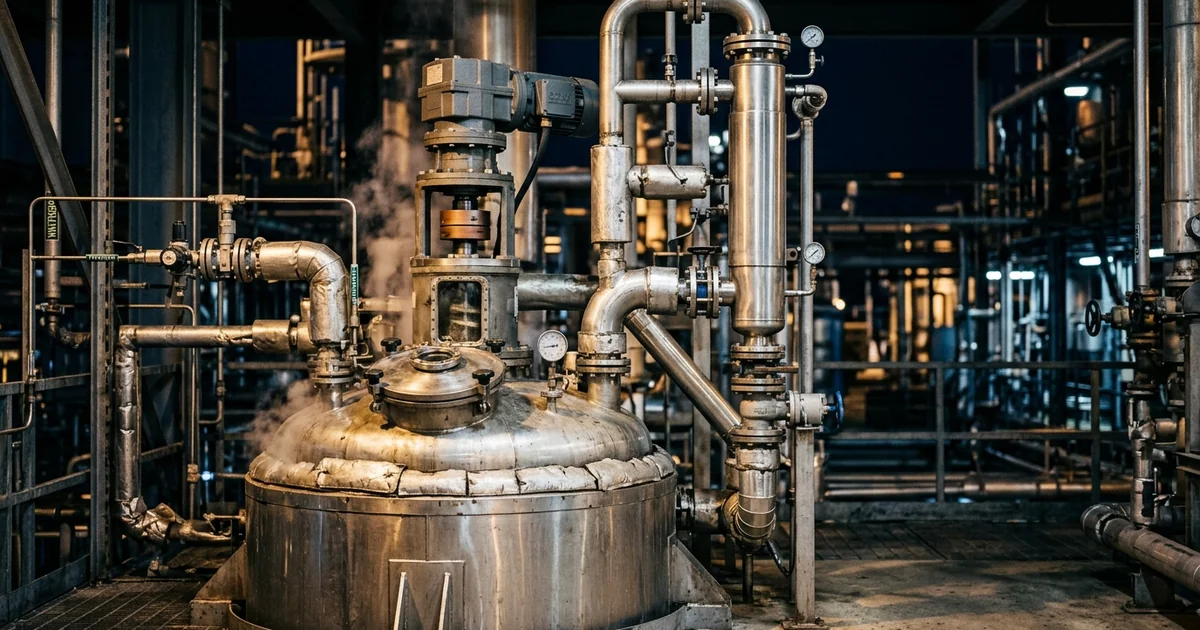
A plant takes on an alkyd resin that ran cleanly at 5 L in the lab, scales it to a 10 m³ reactor, and the third batch gels solid in the vessel overnight. The formulation was never the problem — the process route was. Alkyd resin manufacture is one of the oldest polyester processes in the coatings industry, and it is also one of the least forgiving to scale, because the same chemistry that builds molecular weight can build it past the gel point in the space of one late viscosity sample. Getting the route right matters in hard commercial terms: a gelled batch is a full raw material loss plus days of reactor downtime for mechanical cleaning, and a resin cooked too dark is downgraded to primer at a fraction of its intended value. This guide covers how oil length sets the character of the resin, how the monoglyceride and fatty acid routes differ, when to choose the solvent process over the fusion process, and how the cook is actually controlled at the reactor. It reflects the approach we take in our chemical reaction engineering practice when a resin process moves from bench to plant.
What an Alkyd Resin Actually Is
An alkyd is a branched polyester built from three kinds of building block, and understanding which reactive groups each one brings is what makes the rest of the process logical. The polyol supplies hydroxyl groups, the polybasic acid supplies carboxyl groups, and the fatty component supplies a long hydrophobic chain that stays pendant on the polyester backbone. The polyester forms by esterification, releasing one molecule of water for every ester bond made, and that water has to leave the reactor continuously or the reaction simply stalls at equilibrium.
The three components in a typical alkyd are:
- Polyol — glycerol (trifunctional) or pentaerythritol (tetrafunctional) are standard. Functionality above two is what makes the polyester branch rather than stay linear.
- Polybasic acid — phthalic anhydride is the workhorse; isophthalic acid gives harder, more durable resins but reacts more slowly and needs higher temperature.
- Fatty component — a drying or semi-drying oil (linseed, soya, sunflower) supplied either as the whole triglyceride or as pre-distilled fatty acid.
The fatty chains do not take part in building the polyester. They stay attached to the backbone and later crosslink by air oxidation once the resin is in a coating film, which is why a drying oil is used rather than a saturated one. The film cures because the pendant unsaturation reacts with atmospheric oxygen through a driers-catalysed mechanism — the same oxidative crosslinking chemistry set out in our guide to the difference between acrylic, alkyd, epoxy and polyurethane resins.
The single most important number to fix before any of this reaches a reactor is oil length, and that is where route selection starts.
Oil Length: The Decision That Sets Everything Downstream
Oil length is the mass of oil (or fatty acid expressed as its oil equivalent) in the resin as a percentage of total non-volatile solids, and it is the closest thing an alkyd has to a master variable. Change it and you change solubility, drying speed, film hardness, flexibility, gloss and — critically for the plant — how close the batch runs to the gel point at the intended endpoint. Choosing oil length is not a formulation refinement done late; it is the first decision, because it constrains which solvent the resin will dissolve in, which market it serves, and how tightly the cook has to be controlled.
The three conventional bands behave as follows:
| Property | Short oil (< 45%) | Medium oil (45–55%) | Long oil (> 60%) |
|---|---|---|---|
| Solvent solubility | Aromatic only (xylene, naphtha) | Aromatic / aromatic-aliphatic blend | Aliphatic (white spirit, mineral spirits) |
| Drying / cure | Needs force-dry or stoving | Air-dry, moderate speed | Air-dry, slower, longer tack |
| Film hardness | Highest | Moderate | Softest, most flexible |
| Typical use | Industrial stoving enamels, coil primers | General-purpose gloss enamels | Decorative trim paints, exterior wood |
| Proximity to gel point at endpoint | Moderate | Higher | Highest — tightest control needed |
| Cook viscosity | Higher, harder to stir | Moderate | Lower, easier to handle |
The plant consequence sits in the last two rows. A long oil alkyd has fewer branch points per unit mass, so it can be pushed to high conversion for molecular weight — which means it approaches the gel point asymptotically and a small overshoot in cook time translates into a large viscosity jump. A short oil alkyd is more heavily branched but is usually stopped at lower conversion, so it has more margin on time but is harder to agitate because the melt is more viscous. The underlying alkyd chemistry is the same in both cases; only the balance of components and how far the cook is driven changes. Neither is easier overall; they fail in different ways.
Monoglyceride Route vs Fatty Acid Route
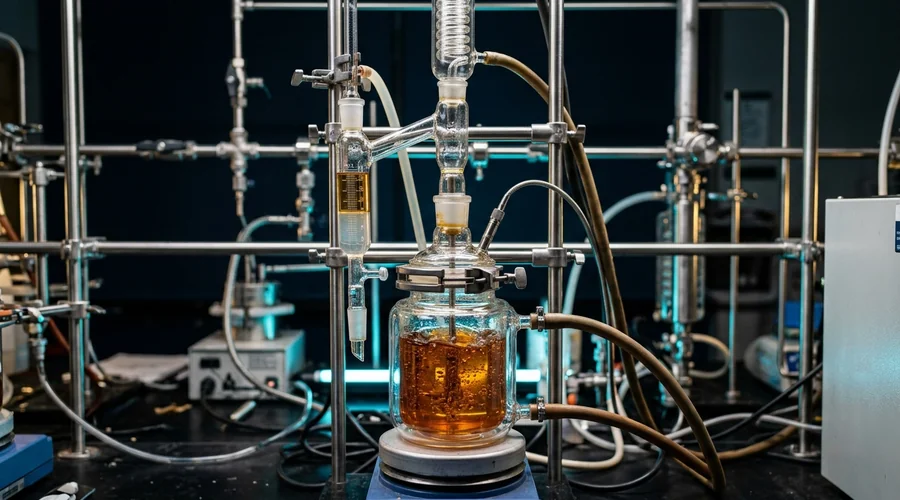
The choice between the monoglyceride and fatty acid routes is fundamentally a choice about where the fatty component enters the process, and it drives raw material cost, cycle time and colour in opposite directions. The monoglyceride route brings the fat in as a whole triglyceride oil, which is cheaper, but that oil cannot polyesterify directly because its hydroxyl groups are already tied up as ester bonds to the glycerol. It has to be broken apart first.
That first step is alcoholysis — heating the oil with extra polyol and a trans-esterification catalyst so ester bonds redistribute and free hydroxyl groups appear on the resulting mono- and di-glycerides. The endpoint is judged by a solubility test: a sample that becomes clear when diluted in a set volume of methanol indicates enough conversion to proceed. Only then is the phthalic anhydride charged and polyesterification run. The fatty acid route skips all of this by starting from pre-distilled fatty acid, which already carries free carboxyl groups, so polyol, acid and fatty acid are charged together and cooked in a single esterification stage.
| Factor | Monoglyceride route | Fatty acid route |
|---|---|---|
| Fatty raw material | Whole triglyceride oil — lower cost | Distilled fatty acid — higher cost |
| Process stages | Alcoholysis, then polyesterification | Single-stage esterification |
| Cycle time | Longer — extra alcoholysis hold | Shorter |
| Endpoint of first stage | Operator-dependent solubility test | Not applicable |
| Hydroxyl balance precision | Lower — depends on alcoholysis completeness | Higher — all monomers metered directly |
| Resin colour | Darker | Paler — better for decorative grades |
| Batch reproducibility | Moderate | High |
| Best suited to | Bulk industrial alkyds, primers | Pale, high-value decorative and industrial alkyds |
In practice the split is commercial. A plant supplying bulk industrial alkyd for machinery enamels runs the monoglyceride route because oil is the cheaper feedstock and colour tolerance is wide. A plant supplying pale, water-white decorative resin runs the fatty acid route because the colour penalty of the monoglyceride step would push the resin out of specification. Many plants run both, choosing per product, and the transferable skill is knowing which one a given specification actually needs — a judgement our scale-up support team makes routinely when a resin line is being commissioned or debottlenecked.
Solvent Process vs Fusion Process
Independent of which route feeds it, the polyesterification itself is run in one of two ways, and the difference is simply how the water of reaction is removed. The fusion process — also called the bulk or oil process — uses only a sub-surface inert gas sparge, usually nitrogen or carbon dioxide, to strip water vapour out of the melt and carry it overhead. The solvent process adds a few percent of xylene or light aromatic naphtha that refluxes, forms an azeotrope with the water, and carries it to a decanter where the phases separate and the dry solvent returns.
The trade-offs are consistent across resin plants. The solvent process runs the batch 10 to 20 °C cooler for the same rate of water removal, because the azeotrope volatilises water below its normal boiling point. That lower peak temperature is why solvent-process resins are paler — colour bodies form fastest at the top of the temperature range. The refluxing solvent also blankets the vapour space, so less phthalic anhydride sublimes and condenses in the offgas line as a waxy solid that eventually blocks it, and less fatty acid is lost overhead. Against that, the solvent process needs a condenser, a decanter, solvent inventory and the associated fire-area classification.
- Choose the fusion process when colour is not critical (dark primers, bituminous-modified alkyds), capital is tight, and the plant wants the simplest possible vapour system.
- Choose the solvent process for pale decorative and general-industrial alkyds, when raw material yield matters, and when tight temperature control is needed to hit a colour specification on the Gardner scale.
The fusion route's higher operating temperature is also its main hazard characteristic: running a highly unsaturated oil near 260 °C narrows the margin to thermal degradation and darkening, which is one reason the solvent process has become the default for most modern lines. The next section covers how that temperature is managed at the reactor and how the batch is stopped at the right point.
Reactor Design and Endpoint Control
The alkyd reactor is a jacketed, agitated stirred tank reactor, and almost every design choice on it exists to serve two competing needs: getting enough heat in and out across a wide viscosity range, and stopping the reaction cleanly before it gels. The batch starts as a mobile liquid and finishes as a viscous resin, so the agitator has to move both — typically an anchor or a large-diameter low-speed impeller rather than a turbine. Heating is by thermal fluid or high-pressure steam in the jacket, and the same jacket must switch to cooling water fast at the end of the cook.
Endpoint control rests on two measurements run in parallel on reactor samples:
- Acid value — milligrams of potassium hydroxide to neutralise the free acid in one gram of resin, measured by titration to the method in ISO 2114. It falls steadily as esterification proceeds and gives a linear, well-behaved measure of conversion.
- Cut viscosity — the resin diluted to a fixed solids content in a standard solvent and measured on a bubble tube (Gardner–Holdt) or cone-and-plate. It tracks molecular weight and rises slowly, then sharply as the gel point nears. Colour is read against the same reference system, the Gardner colour scale (ASTM D1544).
The reason both are needed is that acid value alone does not warn you about gelation. Two batches can reach the same acid value with very different molecular weights if the branching or the hydroxyl balance differs. Viscosity is the direct read on how close the network is to becoming infinite, but on its own it is noisy near the end. Read together, acid value confirms the chemistry is where it should be and viscosity tells you when to stop.
Stopping means dropping the temperature and adding cold thinning solvent, and the timing is unforgiving because viscosity accelerates in the last stage. Good practice is to shorten the sampling interval to 15 or 20 minutes in the final hour, hold a chilled solvent charge ready to quench on a moment's notice, and never leave a batch at temperature waiting for a lab result. This corpus does not publish exact temperature–time profiles or charge ratios, because those constitute a runnable plant recipe; the public methods and standard ranges are what belong in an article, and the site-specific window belongs in a validated batch record.
Where an Alkyd Cook Goes Wrong
Alkyd process problems cluster into a short list of failure modes, and almost all of them trace back to either a formulation that was never checked against the gel-point calculations or a charging and control discipline that slipped. Recognising the signature of each one quickly is what limits the damage, because several of these are recoverable if caught early and total losses if not.
- Reactor gelation — the batch turns to rubber or solid in the vessel. Cause: average functionality too high (excess pentaerythritol relative to phthalic anhydride), a weighing error shifting the acid-to-hydroxyl ratio, lost solvent reflux causing overheating, or overcooking past the viscosity target. A gelled batch is normally a write-off and the reactor needs mechanical cleaning.
- High acid value at endpoint — esterification has stalled short of target. Cause: inadequate water removal (weak inert gas sparge, flooded condenser, wet return solvent), temperature too low, or loss of a volatile glycol overhead shifting the stoichiometry. Often correctable by restoring water removal and continuing the cook.
- Dark colour — resin exceeds its Gardner target. Cause: peak temperature too high, excessive time at temperature, air ingress oxidising the melt, iron contamination from corroded equipment, or an overcooked alcoholysis step in the monoglyceride route.
- Haze or incompatibility — the thinned resin is cloudy or separates. Cause: oil length mismatched to the solvent, incomplete alcoholysis leaving unreacted triglyceride, or a fatty acid blend with too much saturated content for the chosen oil length.
- Slow esterification — the cook takes far longer than the standard cycle. Cause: catalyst omitted or deactivated, water removal too slow so equilibrium is limiting, or a reactor running below its intended temperature because the thermal fluid system is underperforming.
The pattern is that gelation and dark colour are usually formulation or temperature failures, while high acid value and slow cooks are usually water-removal failures. Diagnosing which family a problem belongs to points straight at the fix, and a resin plant that logs acid value and viscosity against time for every batch builds the dataset that makes that diagnosis fast.
A Route-Selection Framework for Alkyd Manufacture
Choosing how to make a given alkyd is a sequence, not a preference, and working it in order means the constraints that eliminate options are settled before the ones that only rank them. The output of this sequence is also most of the content a technology transfer package needs, so the analysis is not wasted effort.
- Fix the oil length from the end use. Solvent type, drying mechanism and market segment follow from it. This decides nothing else can be decided without.
- Calculate the gel-point margin. Use the Carothers equation and the Patton alkyd constant to check the formulation reaches its target viscosity comfortably below the gel point. If the margin is thin, either reformulate or commit to a chilled-solvent quench system.
- Choose the fatty component form. Distilled fatty acid for pale, reproducible, high-value resins; whole oil via the monoglyceride route for bulk industrial grades where cost leads and colour tolerance is wide.
- Choose solvent or fusion process. Solvent process for colour-critical grades and better yield; fusion process only where colour does not matter and capital simplicity is the priority.
- Size the reactor and agitator for the peak melt. The agitator has to move the resin at its most viscous, and the jacket has to switch from heating to cooling fast enough to arrest the cook.
- Define the endpoint control regime. Acid value and cut viscosity targets, sampling interval schedule, and the written quench rule for late results.
Most decorative and general-industrial alkyds land on the fatty acid route run as a solvent process, and most bulk industrial alkyds land on the monoglyceride route — but the value is in knowing why a given specification points one way or the other, because that is what makes the process defensible when it is transferred to a new site or a toll manufacturer. Alkyd manufacturing capacity in India, the Gulf and Southeast Asia has grown alongside regional coatings demand, and much of that new capacity is being built or debottlenecked on exactly these route decisions. If you are taking an alkyd from development toward production, our scale-up and process development service covers this route selection and the reactor design behind it, and the broader path from bench to commercial supply is set out in our guide to going from lab to market. The downstream side — how these resins are turned into finished coatings — is covered across our paints and coatings resources, and the resin-synthesis picture more broadly in our resins hub.
Frequently Asked Questions
What is oil length in an alkyd resin?
Oil length is the mass of triglyceride oil (or its equivalent as fatty acid) in the finished resin, expressed as a percentage of the total non-volatile solids. A long oil alkyd carries roughly 60 percent oil or more, a medium oil alkyd sits near 45 to 55 percent, and a short oil alkyd is below about 45 percent.
The number is not a formulation detail — it fixes the whole character of the resin. Higher oil length gives better solubility in aliphatic hydrocarbons, slower air drying, softer films and more flexibility, while lower oil length gives faster hardness development, better gloss and a resin that needs stronger aromatic solvent to stay in solution. It also drives the process: high oil length resins are close to the gel point at high conversion and demand tighter endpoint control.
How are alkyd resins manufactured?
An alkyd is a polyester made by reacting a polyol such as glycerol or pentaerythritol, a polybasic acid such as phthalic anhydride, and a fatty acid or drying oil. If a triglyceride oil is the starting material it must first be broken down by alcoholysis — reacting it with extra polyol so that free hydroxyl groups become available for polyesterification.
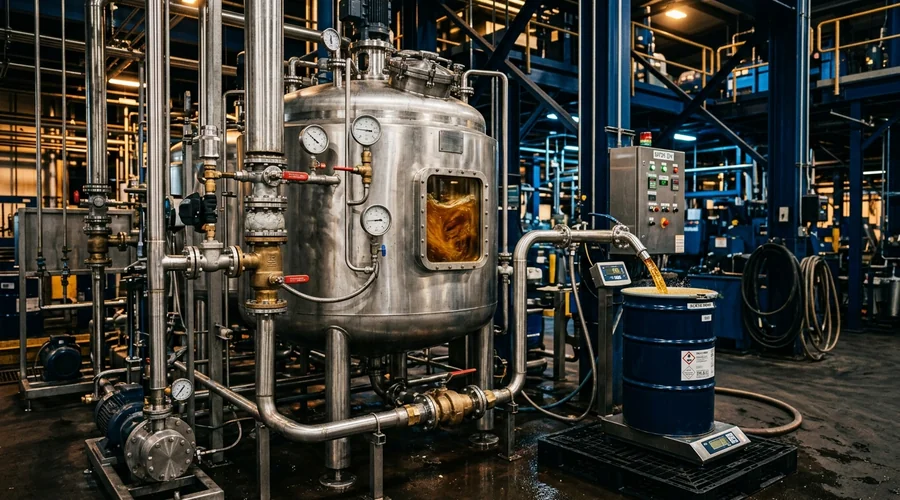
The charge is then heated in a stirred, jacketed reactor under an inert gas blanket to between about 220 and 260 °C, and water of esterification is removed continuously. The cook is tracked by acid value and by viscosity of a solvent cut, and it is stopped short of the gel point by cooling and thinning into solvent. The finished resin solution is filtered and drummed or piped to storage.
What is the difference between the monoglyceride route and the fatty acid route?
The monoglyceride route starts from a whole triglyceride oil and converts it in situ. The oil is heated with the polyol and a trans-esterification catalyst until a clear alcoholysis product is reached, then the phthalic anhydride is added and polyesterification proceeds. It is cheaper because oil costs less than distilled fatty acid, but the alcoholysis step is an extra hour or two of cycle time, its endpoint is judged by a solubility test that can be operator-dependent, and the hydroxyl balance is less precise.
The fatty acid route starts from pre-distilled fatty acid, so all three monomers are charged together and esterified in one stage. It gives better colour, tighter reproducibility and shorter cycle time, at a higher raw material cost. Plants making pale, high-value resins usually run the fatty acid route; plants making bulk industrial alkyds usually run the monoglyceride route.
Why is xylene used in alkyd resin production?
Xylene, or sometimes a light aromatic naphtha, is added at a few percent of the charge as an azeotroping solvent in the solvent process. It refluxes with the water of esterification, carries that water overhead to a separator where the two phases split, and returns dry to the reactor while the water is drawn off.
This does three useful things: it removes water efficiently at a lower bulk temperature than the fusion process needs, it sweeps the vapour space so less fatty acid and anhydride are lost by sublimation, and it improves colour because the batch spends less time at peak temperature. The alternative fusion process uses only an inert gas sparge to strip water and runs hotter, which is simpler but gives darker resin and higher raw material loss.
How is the endpoint of an alkyd cook controlled?
Two measurements are taken in parallel on samples pulled from the reactor. Acid value, measured by titration against the method in ISO 2114, tracks how far the esterification has progressed and falls steadily through the cook. Viscosity of a standard solvent cut — the resin diluted to a fixed solids content and measured on a bubble tube or cone-and-plate — tracks molecular weight build and rises, slowly at first and then sharply as the batch approaches the gel point.
The operator stops the reaction when both hit their target window, usually by dropping the batch temperature and pumping in cold thinning solvent. Because viscosity accelerates near the end, the sampling interval is shortened in the final stage and a plant will often hold a chilled solvent charge ready to quench the batch on short notice.
What causes gelation in an alkyd reactor?
Gelation is runaway crosslinking to an infinite network, and it happens when the average functionality of the charge is high enough that the gel point is reached before the intended endpoint. The usual triggers are a formulation with too much of a trifunctional or tetrafunctional polyol such as pentaerythritol relative to the phthalic anhydride, a charging error that shifts the acid-to-hydroxyl ratio, loss of solvent reflux so the batch overheats, or simply overcooking past the viscosity target because a sample result came back late.
Once a batch gels in the vessel it is usually a total loss and the reactor needs mechanical cleaning. Prevention is a combination of a formulation checked against the Carothers and Patton calculations, accurate weighing, a reliable reflux system, and tight sampling discipline in the last hour.
Is the solvent process or the fusion process better for alkyd manufacture?
Neither is universally better; they trade capital and simplicity against product quality and yield. The fusion process needs only a reactor, an inert gas system and a condenser, so it is cheaper to build and easier to run, but it operates 10 to 20 °C hotter, gives a darker resin and loses more phthalic anhydride and fatty acid overhead.
The solvent process adds a reflux condenser, a decanter and solvent handling, and in return gives paler colour, lower raw material loss, better temperature control and a cleaner vapour system. For pale decorative and industrial alkyds the solvent process is standard. For dark primers, bituminous-modified grades and some bulk industrial resins where colour does not matter, the fusion process is still economic.
Developing or Transferring an Alkyd Resin Process?
Global Formulation provides route selection, reactor design and scale-up support for alkyd and polyester resin manufacture — from oil-length strategy and gel-point analysis to a defensible endpoint control regime and technology transfer package.
Talk to Our Process Team