Anti-Carbonation Coating for Concrete: CO2 Protection Guide
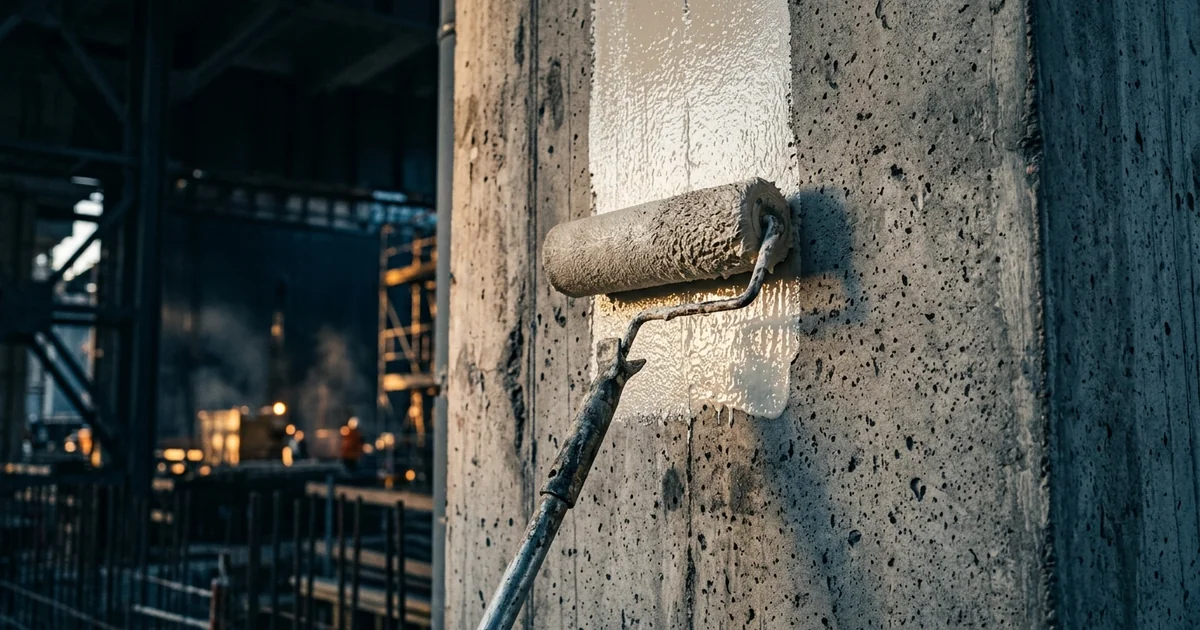
A concrete facade can look flawless for a decade while carbon dioxide is already dismantling its most important defense: the alkaline chemistry that keeps embedded steel reinforcement from rusting. By the time hairline cracks, rust staining, or spalling appear at the surface, the anti-carbonation coating concrete needed years earlier is no longer a preventive option — it is a far more expensive repair problem. Structures in urban and industrial environments with elevated ambient CO2, and any building with thin or under-specified concrete cover, are especially exposed, and the cost of ignoring it compounds quickly: a single reinforcement repair zone can run into tens of thousands of dollars once corrosion has actually started. This guide explains how carbonation attacks reinforced concrete, what an anti-carbonation coating has to achieve chemically and physically to stop it, and how coating chemistry, crack-bridging performance, and verification testing fit together into a system that actually protects a structure for decades. It draws on the same building-envelope and construction chemicals formulation expertise we apply across our construction chemicals consulting work.
Why Carbonation Threatens Reinforced Concrete
Reinforced concrete owes its long service life to a genuinely elegant piece of chemistry: the highly alkaline pore solution inside hardened cement paste, typically above pH 12.5, spontaneously forms a thin, stable passive oxide film on embedded steel that blocks corrosion almost completely. Carbonation dismantles that protection from the outside in. Atmospheric carbon dioxide diffuses through the concrete's connected pore network and reacts with calcium hydroxide (portlandite) in the cement paste to form calcium carbonate, a reaction that consumes the alkalinity reserve and drops pore solution pH below the roughly 9-to-10 threshold at which the passive film is no longer thermodynamically stable. Once carbonation reaches rebar depth and oxygen and moisture are both present, corrosion can begin — and because carbonation-induced depassivation happens across a broad front rather than at isolated points, as detailed in our guide to concrete corrosion inhibitors, the resulting damage tends to be widespread rather than localized.
- Water-to-cement ratio — a higher w/c ratio increases capillary porosity, giving CO2 a faster diffusion path through the cement paste, the same porosity mechanism discussed in our guide to concrete admixtures and superplasticizers
- Concrete cover depth — thinner cover over reinforcement means carbonation reaches the steel sooner for a given diffusion rate
- Relative humidity — carbonation proceeds fastest in a mid-range humidity band; the reaction needs dissolved CO2 and calcium hydroxide in pore water, but it slows sharply in fully saturated concrete because CO2 diffuses far more slowly through water-filled pores than air-filled ones
- Ambient CO2 concentration — urban, industrial, and enclosed or underground environments carbonate faster than rural exposure due to elevated ambient CO2
- Curing quality — inadequately cured concrete has a coarser, more permeable surface pore structure, accelerating early carbonation ingress
| Pore Solution Condition | Approx. pH | Steel Passivation State |
|---|---|---|
| Sound, uncarbonated concrete | > 12.5 | Passive film stable — corrosion effectively arrested |
| Partially carbonated zone | ~9 – 11 | Passive film degrading |
| Fully carbonated at rebar depth | < 9 | Passive film unstable — corrosion can initiate with O2 and moisture |
Carbonation is invisible to the eye until it has already reached the reinforcement, which is exactly why protection has to be designed in before the depth becomes critical rather than diagnosed after rust stains appear — and that protection strategy starts with understanding what an anti-carbonation coating actually has to block.
How Anti-Carbonation Coatings Work: The Diffusion Barrier Concept
An anti-carbonation coating's entire job is to slow CO2 diffusion into the concrete substrate enough that the carbonation front never reaches the reinforcement within the structure's service life, and European testing standards quantify that performance in a specific, comparable way. EN 1504-2, the European standard covering surface protection systems for concrete, expresses a coating's CO2 resistance as an equivalent air layer thickness, denoted Sd — the thickness of a hypothetical layer of still air that would offer the same diffusion resistance as the actual coating film. A coating recognized as an effective carbonation barrier under EN 1504-2 needs an Sd(CO2) value of at least 50 metres, meaning its resistance to CO2 diffusion equals that of fifty metres of stagnant air, despite the coating film itself typically measuring only a fraction of a millimetre thick.
This dual requirement — dense enough to block gas-phase CO2, open enough to pass water vapour — is what separates a genuine anti-carbonation system from a standard decorative or light-duty sealer; our guide to decorative concrete sealers covers the acrylic, polyurethane, and epoxy chemistries used where appearance and light traffic resistance are the priority rather than gas-diffusion control. Meeting both diffusion targets simultaneously is a polymer film-design problem, not just a thickness problem, which is why the resin chemistry a coating is built on matters as much as how many coats go on.
Coating Chemistry Classes: Acrylic, Polyurethane, and Elastomeric Systems
Three broad polymer chemistry families dominate the anti-carbonation coating market, and each reaches its CO2 diffusion resistance through a different balance of film continuity, crosslink density, and elasticity. Choosing between them is rarely about which chemistry is "best" in the abstract — it is about which balance of UV stability, crack-bridging capability, and substrate compatibility a given facade actually needs.
- Acrylic and styrene-acrylic elastomeric coatings — water-based, cost-effective, with good inherent UV stability and moderate-to-good crack-bridging when formulated with elastomeric copolymer resins; the workhorse chemistry for most facade anti-carbonation systems
- Polyurethane coatings — form denser, tougher films that provide strong CO2 diffusion resistance along with good abrasion and chemical resistance; aliphatic PU grades are used for UV-exposed topcoats since aromatic PU chalks and yellows under sustained sunlight
- Silicate-based (mineral) coatings — react chemically with calcium compounds in the substrate to form an integrated mineral barrier, valued for high vapour permeability and compatibility with historic or mineral substrates, though generally offering lower crack-bridging capability than elastomeric organic systems
| Chemistry Class | UV Stability | Crack-Bridging | Vapour Permeability |
|---|---|---|---|
| Acrylic / styrene-acrylic elastomeric | Good | Good to excellent | Good |
| Aliphatic polyurethane | Excellent | Moderate to good | Moderate |
| Silicate / mineral | Excellent (inorganic) | Low | Excellent |
Resin family sets the ceiling on what a coating can achieve, but where a formulation sits relative to its own critical PVC decides whether it actually reaches that ceiling in the field — which is exactly why crack-bridging and weathering performance are tested as their own separate requirements rather than assumed from resin chemistry alone.
Crack-Bridging and Weathering Performance Requirements
Concrete facades move — thermal cycling, drying shrinkage, and structural loading all open hairline cracks over time, and a coating that cannot stretch across those cracks simply reopens a direct CO2 pathway exactly where cover is often already thinnest. EN 1062-7 is the European standard used to classify a coating's crack-bridging ability, testing how far a film can elongate across a crack under both static conditions and, for the more demanding classes, dynamic cyclic movement, including at temperatures as low as -20°C to confirm the film does not become brittle in cold weather. Coatings are grouped into static bridging classes (A1 through A5, in increasing crack-width capability) and dynamic classes (B1 through B4, for coatings that must accommodate a crack that keeps opening and closing after application) — and the right class for a given project depends on the substrate's existing crack width and how much further movement it is expected to see.
- UV and weathering resistance — aliphatic polyurethane and acrylic topcoats resist chalking and yellowing under sustained UV exposure; aromatic polyurethane systems, while cheaper, degrade visibly and lose film integrity faster outdoors
- Adhesion to substrate — pull-off adhesion, tested per ASTM D4541 or EN 1542, confirms the coating will not delaminate under its own crack-bridging strain or from vapour pressure building up behind the film
- Dirt pick-up and self-cleaning behavior — surface energy and hardness affect how quickly a facade re-soils, a durability factor independent of diffusion performance but relevant to long-term maintenance planning
A coating can pass every diffusion and adhesion test in a lab and still fail in the field if it cannot stretch across a moving crack in a cold snap — which is exactly the scenario accelerated testing protocols exist to catch before a product ever reaches a facade.
Testing and Verifying Carbonation Resistance
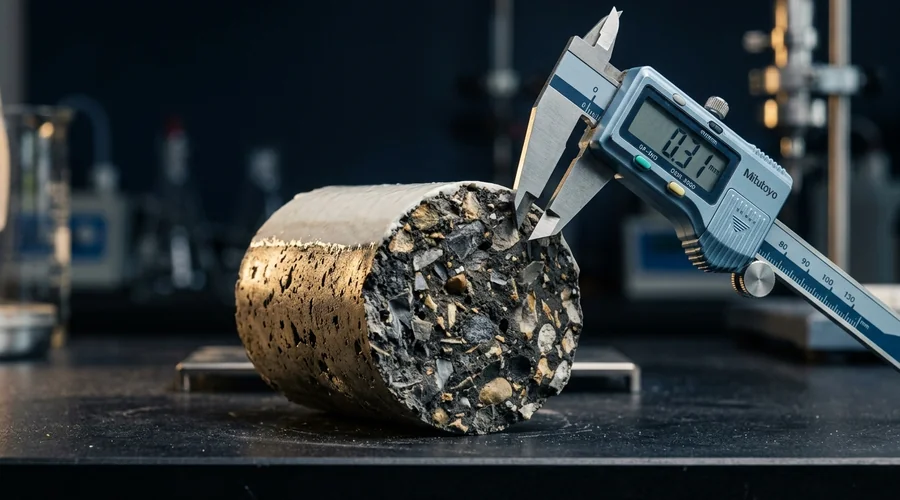
None of a coating's diffusion resistance or crack-bridging claims mean anything without standardized testing behind them, and the industry relies on a specific set of accelerated methods rather than waiting years to observe real-world carbonation. EN 13295 and the widely referenced RILEM CPC-18 method both describe how to measure carbonation depth directly: a concrete core or broken section is sprayed with a phenolphthalein indicator solution, which turns magenta-pink in alkaline, uncarbonated concrete and stays colorless in carbonated zones where the alkalinity has already been consumed.
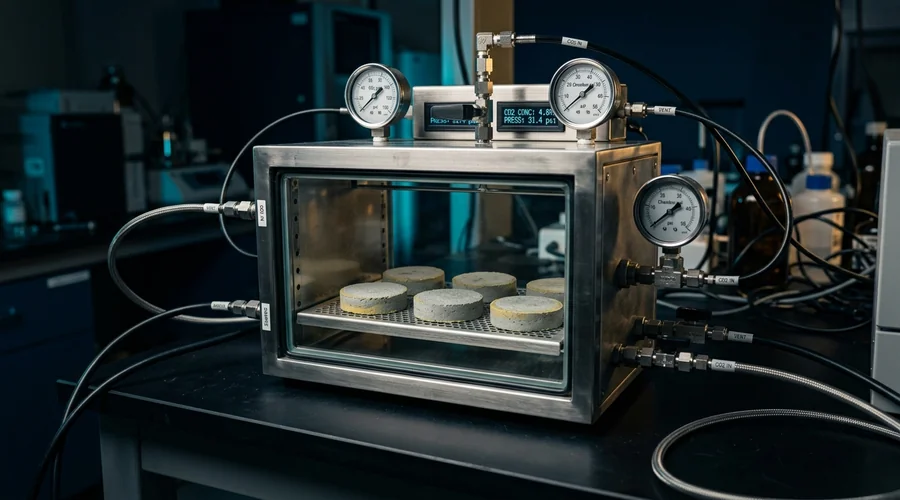
- Accelerated carbonation exposure — coated and uncoated reference specimens are exposed to an elevated CO2 concentration and controlled humidity for a defined period, then split and sprayed with phenolphthalein to compare carbonation depth against the uncoated control
- Sd(CO2) diffusion measurement — direct laboratory measurement of the coating film's carbon dioxide diffusion resistance, expressed as equivalent air layer thickness
- Water vapour transmission testing (EN ISO 7783) — confirms the coating stays within the vapour-permeability limit so trapped moisture can still escape
- Artificial weathering — accelerated UV and condensation cycling verifies the topcoat resists chalking, cracking, and adhesion loss over a simulated multi-year exposure
| Test Method | What It Verifies | Standard |
|---|---|---|
| Phenolphthalein spray test | Actual carbonation depth reached in exposed concrete | RILEM CPC-18 / EN 13295 |
| Sd(CO2) diffusion resistance | Coating's CO2 barrier performance | EN 1504-2 |
| Water vapour transmission | Coating's breathability / moisture-escape capacity | EN ISO 7783 |
| Pull-off adhesion | Bond strength to substrate | ASTM D4541 / EN 1542 |
| Crack-bridging | Film elongation across a moving crack | EN 1062-7 |
A coating that clears every one of these tests on a datasheet is a genuinely different product from one marketed on chemistry claims alone — which is exactly the distinction a facility owner or product developer needs to verify before specifying or manufacturing an anti-carbonation system at scale.
Selecting and Developing an Anti-Carbonation Coating for Concrete
Choosing or developing an anti-carbonation coating starts before any product selection happens, with an honest assessment of how far carbonation has already progressed into the existing structure — a coating applied over concrete where the carbonation front has already reached the rebar only slows further ingress, it does not reverse damage already done. That assessment, combined with the structure's exposure environment, expected service life, and existing crack pattern, determines which resin chemistry, crack-bridging class, and film-thickness specification actually make sense, rather than defaulting to a single "carbonation coating" product across every project.
- Substrate carbonation survey — phenolphthalein testing across representative cores establishes current carbonation depth and remaining cover before any coating decision is made
- Exposure and service-life targeting — coastal, industrial, and high-CO2 urban environments justify a higher-performance, and typically costlier, coating system than a low-exposure interior structure
- Crack survey and movement-class matching — existing and anticipated crack widths determine the EN 1062-7 class the coating needs to meet
- Substrate preparation and compatibility — surface profile, moisture content, and existing coating removal all affect adhesion and are frequently the actual cause of field failures attributed to the coating itself
For a manufacturer or entrepreneur developing a new anti-carbonation coating rather than specifying an existing one, the formulation work sits at the intersection of polymer chemistry, standards compliance, and independent test verification — exactly the combination a dedicated construction chemicals formulation partner is built around, from resin selection and PVC optimization through EN 1504-2 and EN 1062-7 test coordination ahead of a commercial launch. Get the underlying carbonation assessment and standards testing right, and an anti-carbonation coating becomes a genuinely durable, decades-long line of defense for reinforced concrete — get it wrong, and even a well-marketed coating just delays a corrosion problem it was never actually built to stop.
Frequently Asked Questions
What exactly does carbonation do to reinforced concrete, and why is it dangerous?
Carbonation is the reaction between atmospheric carbon dioxide and calcium hydroxide inside the cement paste, which gradually converts the concrete's normally highly alkaline pore solution (above pH 12.5) into a much less alkaline one as calcium carbonate forms in its place. That alkalinity is what keeps a thin, stable passive oxide film intact on the surface of embedded steel reinforcement, so once carbonation reaches rebar depth and the pore solution pH drops below roughly 9 to 10, that passive film is no longer stable and the steel becomes vulnerable to corrosion whenever oxygen and moisture are both present.
The danger is that carbonation itself produces no visible surface symptoms — cracking, rust staining, and spalling only appear once corrosion is already underway, by which point repair is far more invasive and expensive than prevention would have been.
How is an anti-carbonation coating different from a regular concrete sealer or paint?
A decorative sealer or standard paint is typically formulated for appearance, light abrasion resistance, and basic water repellency, without any specific requirement around gas-phase CO2 diffusion resistance. An anti-carbonation coating has to meet a defined, testable barrier performance target — under EN 1504-2, an equivalent air layer thickness (Sd) for CO2 of at least 50 metres — while simultaneously staying permeable enough to water vapour that moisture inside the concrete can still escape.
That dual, quantified performance requirement is what makes anti-carbonation coating formulation a distinct engineering discipline rather than a marketing label added to an existing decorative product.
What is the Sd value, and why does it matter for choosing a coating?
Sd, or equivalent air layer thickness, expresses how much a material resists gas diffusion by comparing it to an equivalent thickness of still air offering the same resistance — a coating with an Sd(CO2) of 50 metres resists CO2 diffusion as much as a 50-metre-thick layer of stagnant air would, despite the actual coating film being a fraction of a millimetre thick.
It matters because it is the measurable, standardized criterion under EN 1504-2 that separates a genuine carbonation barrier from a coating that merely claims protective performance without test data behind it. Any coating being specified or purchased specifically for carbonation protection should have a documented Sd(CO2) test result, not just a general durability claim.
Why does an anti-carbonation coating also need to let water vapor escape?
Concrete is a naturally moist, porous material, and moisture inside it needs a way to migrate outward and evaporate; a coating dense enough to block CO2 but also dense enough to block water vapour traps that moisture behind the film instead. Trapped moisture under pressure, especially through freeze-thaw cycling or solar-driven vapour-pressure buildup, causes blistering, delamination, and coating failure, often faster than the carbonation the coating was meant to prevent.
EN 1504-2 addresses this directly by capping acceptable water vapour diffusion resistance (Sd(H2O), tested per EN ISO 7783) at roughly 4 metres or less, so an effective anti-carbonation coating is deliberately engineered to be selectively permeable rather than simply dense.
How is carbonation resistance actually tested and verified before a product ships?
Manufacturers run accelerated carbonation exposure tests, placing coated and uncoated reference concrete specimens in a chamber with elevated CO2 concentration and controlled humidity for a defined exposure period that simulates years of real-world exposure in a much shorter timeframe. After exposure, the specimens are split and sprayed with a phenolphthalein indicator solution, which turns magenta-pink where the concrete is still alkaline and stays colorless where carbonation has already consumed that alkalinity, letting testers directly measure and compare carbonation depth against the uncoated control.
This method, standardized under EN 13295 and RILEM CPC-18, is combined with direct Sd(CO2) diffusion measurement, water vapour transmission testing, pull-off adhesion testing, and crack-bridging testing under EN 1062-7 to build a complete performance profile before a coating is marketed for carbonation protection.
Do anti-carbonation coatings need to bridge cracks in the concrete surface?
In most real applications, yes — concrete facades develop hairline cracks from thermal cycling, drying shrinkage, and structural movement over time, and a coating that cannot stretch across those cracks simply reopens a direct, unprotected CO2 pathway exactly where the concrete cover may already be thinnest. EN 1062-7 classifies coatings by their crack-bridging capability under both static conditions and, for higher classes, ongoing dynamic movement, including testing at low temperatures where films are more prone to becoming brittle.
The right crack-bridging class depends on the specific structure's existing and anticipated crack widths, which is why a proper substrate crack survey should happen before a coating class is chosen, not after installation reveals it was inadequate.
Should carbonation depth be assessed before choosing a coating system?
Yes, and skipping this step is one of the most common reasons anti-carbonation coating projects underperform. A phenolphthalein test on representative concrete cores establishes how far carbonation has already progressed relative to the actual concrete cover over the reinforcement — if the carbonation front has already reached the rebar, a surface coating can only slow further ingress and won't reverse corrosion that has already initiated, meaning the project may also need repair mortar or corrosion-inhibitor measures alongside the coating.
Skipping this assessment risks either under-specifying a coating for a structure that's already at high risk, or over-specifying, and overpaying for, a high-performance system on a structure that didn't need it.
Why would a coatings manufacturer bring in an outside formulation consultant instead of developing an anti-carbonation coating in-house?
Developing a genuinely compliant anti-carbonation coating requires polymer chemistry expertise across resin selection, critical pigment volume concentration optimization, and crack-bridging additive systems, plus coordinated access to EN 1504-2, EN 1062-7, and accelerated weathering test facilities that many coatings manufacturers don't operate in-house. A formulation consultant who has already run that testing pathway can shortcut months of trial-and-error reformulation by starting from resin and PVC combinations already known to hit the required Sd and crack-bridging targets.
That said, the manufacturer still owns the finished product's regulatory and performance claims, so vetting a consultant's actual track record against EN 1504-2 test data, not just general coatings experience, is what actually reduces launch risk.
Developing an Anti-Carbonation Coating?
Global Formulation provides construction chemicals consultancy — anti-carbonation coating formulation, EN 1504-2 test coordination, and product development support for coatings manufacturers.
Talk to Our Formulation Team