Antimicrobial Preservative Selection for Multi-Dose Pharmaceutical Products
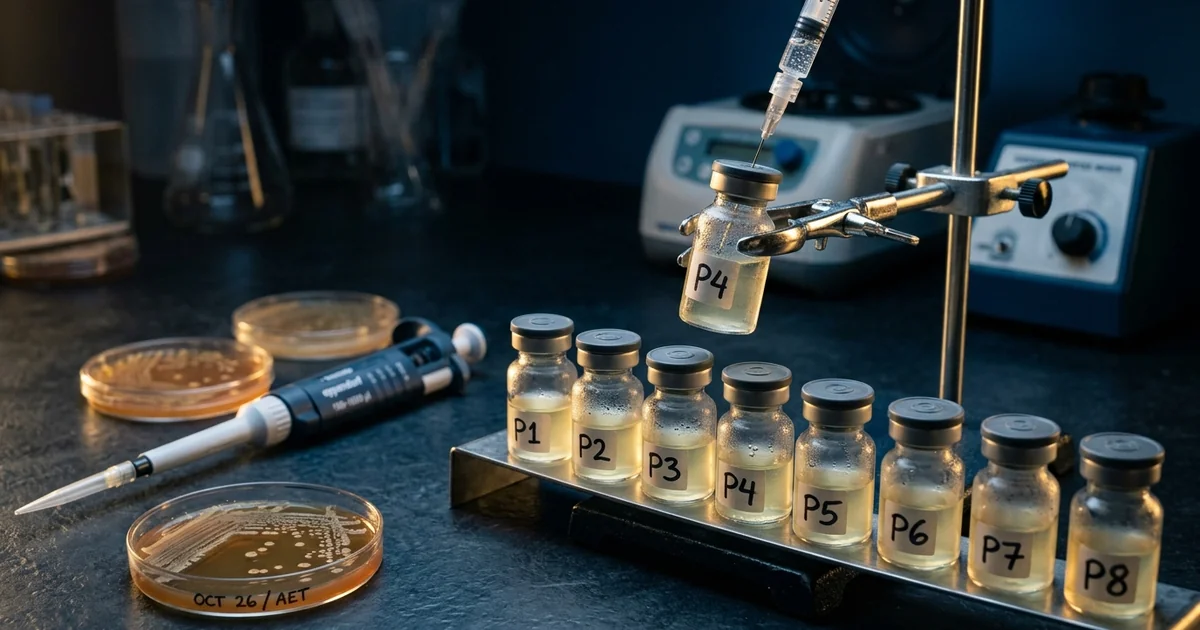
A multi-dose vial, an eye-drop bottle, or an oral suspension is opened, used, and resealed dozens of times across a course of therapy. Every use draws in room air, touches a dropper to the eye or a needle through a septum, and offers environmental microorganisms a route into a product that left the factory sterile or with tightly controlled bioburden. Selecting a pharmaceutical preservative for a multi-dose product is the safety decision that keeps those entry points from turning into an infection: the preservative is the only barrier between the first dose and the last. Contaminated multi-dose sterile products have caused documented outbreaks of endophthalmitis and bloodstream infection, and when they do, the preservative system is usually absent, under-strength, or inactivated by the formulation around it. This guide walks through the main preservative classes, the route-specific limits that rule several of them out, how antimicrobial effectiveness testing under USP <51> and the European Pharmacopoeia works, and the formulation and packaging factors that quietly strip a preservative of its activity. It draws on the formulation and validation experience behind our pharmaceuticals and healthcare consulting practice.
Why Multi-Dose Products Carry a Preservative and Single-Dose Units Do Not
The choice between a preserved multi-dose presentation and a single-dose unit is an economic and clinical trade-off before it is a chemistry problem. Single-dose containers such as blow-fill-seal ampoules and unit-dose vials eliminate in-use contamination entirely, because the container is used once and discarded. They also cost more per dose, generate more packaging waste, and are impractical for self-administered chronic therapies like glaucoma drops or insulin. Multi-dose presentations are cheaper and more convenient, yet they must survive repeated breaches of container integrity, so a pharmacopoeia- and regulator-mandated antimicrobial preservative is required unless the sponsor can justify its omission. The preservative does not sterilise the product; it holds any introduced organisms in check long enough that a normal dosing regimen never lets contamination reach an infective level.
- In-use contamination — organisms introduced by the patient or caregiver during withdrawal, instillation, or actuation
- Container breach — air ingress and dropper-tip or needle contact on every single use
- Manufacturing bioburden — low-level survivors in non-sterile multi-dose oral liquids that are not terminally sterilised
- Extended in-use shelf life — the weeks-to-months window between first use and discard, frequently at uncontrolled room temperature
Regulatory expectations reflect this directly. Compendial guidance on injections requires multi-dose containers to contain an antimicrobial preservative or to be demonstrated to prevent growth, and the ophthalmic regulations in the United States require multi-dose eye products to be both sterile and adequately preserved. Regulators also expect the lowest preservative concentration that reliably passes the challenge test, because every preservative carries some tissue toxicity, a principle that matters most for multi-dose parenteral formulations where the agent is injected directly. The practical takeaway is that the preservative is not an optional robustness feature — for a multi-dose sterile product it is a registration requirement, and the rest of this article is about choosing one that actually works.
How Antimicrobial Preservatives Control Microbial Growth
Preservatives are low-level biocides, and almost all of them act on structures common to microbial cells: the cytoplasmic membrane, the cell wall, or key proteins and enzymes. Their job is to be static-to-cidal at low concentration against a broad range of bacteria, yeasts, and moulds without harming the patient's tissue at the exposure delivered per dose. Because the usable concentration is capped by toxicity, a preservative rarely has a comfortable safety margin, so anything in the formulation that lowers the free active concentration can tip it below effectiveness. Understanding the mechanism is what explains why some combinations are synergistic and others are antagonistic.
- Membrane disruption — quaternary ammonium compounds such as benzalkonium chloride, and biguanides such as chlorhexidine, adsorb to the anionic cell surface and disorganise the lipid bilayer, causing leakage of cytoplasmic contents
- Protein and enzyme denaturation — alcohols and phenolics including benzyl alcohol, phenol, the cresols, and chlorocresol penetrate the cell and coagulate proteins
- Proton-motive-force collapse — weak-acid preservatives such as benzoic and sorbic acid enter as the un-ionised acid and acidify the cytoplasm
- Outer-membrane permeabilisation — EDTA is not a preservative itself but chelates the divalent cations that stabilise the Gram-negative outer membrane, opening the cell to other preservatives
Two practical points follow from the mechanism. First, a preservative is not a sterilant: it slows or stops growth and kills slowly, so the challenge test measures kill kinetics over days, not instant sterility. Second, Pseudomonas aeruginosa and moulds are the hard targets — many otherwise-useful preservatives are weak against one or both, which is why potentiators and preservative pairs are common. The next question is which chemical class to start from, and that is set as much by the route of administration as by the microbiology.
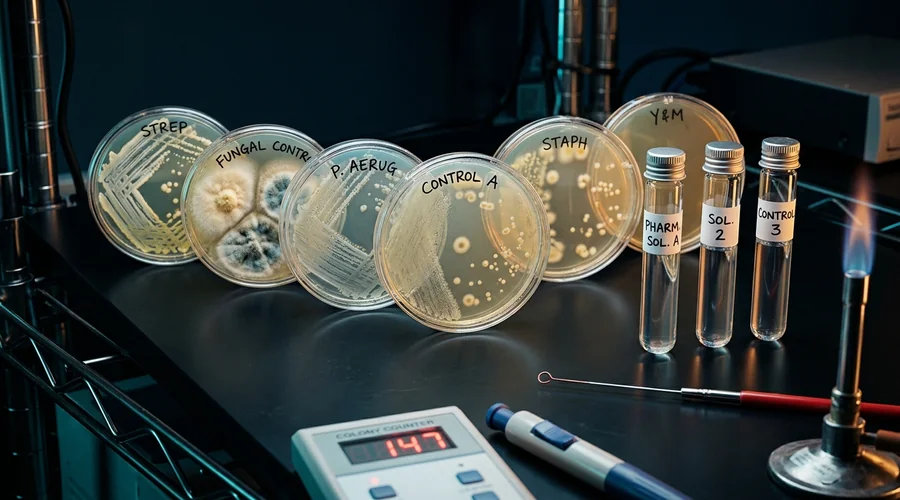
Pharmaceutical Preservative Classes for Multi-Dose Formulations
The workable shortlist of pharmaceutical preservatives is small, and each class carries a characteristic spectrum, a pH window, and a set of incompatibilities. Quaternary ammonium compounds and chlorhexidine are potent but cationic, so they clash with anionic excipients and are limited by tissue toxicity. Alcohols and phenolics are reliable in injectables and are the standard choice for multi-dose biologics, but they interact with proteins and rubber closures. Parabens, benzoic acid, and sorbic acid dominate oral liquids, where the binding constraint is pH and partitioning rather than acute toxicity.
| Preservative class | Typical spectrum | pH window | Main limitation |
|---|---|---|---|
| Quaternary ammonium (benzalkonium chloride) | Strong vs bacteria, moderate vs fungi | Wide | Ocular-surface toxicity; incompatible with anionic and some nonionic species |
| Chlorhexidine salts | Strong vs bacteria, weak vs Pseudomonas and moulds | Near-neutral | Precipitates with anions; limited antifungal cover |
| Benzyl alcohol | Broad, moderate | Acidic preferred | Neonatal toxicity; protein binding; sorption into rubber |
| Phenol / m-cresol / chlorocresol | Broad | Acidic to neutral | Injection-site irritation; protein interaction; odour |
| Chlorbutanol | Moderate, slow-acting | Acidic only | Volatile loss; hydrolysis; permeation through containers |
| Phenylethyl alcohol | Weak alone (mainly Gram-negative) | Wide | Used only as a secondary preservative |
| Parabens (methyl + propyl) | Broad, weak vs Pseudomonas | Below ~8 (un-ionised) | Oil and micelle partitioning; nonionic-surfactant and plastic sorption; endocrine scrutiny |
| Benzoic / sorbic acid | Moderate; sorbic weak vs bacteria | Acidic (below ~5) | Active only as the un-ionised acid; sorbic acid oxidises and discolours |
| Thimerosal (organomercurial) | Broad | Wide | Mercury content; largely phased out; hypersensitivity |
It is worth looking at benzalkonium chloride preservative chemistry in a little more detail, because it is the most common ophthalmic and nasal preservative and its behaviour is representative of the cationic class. It is not a single compound but a mixture of alkylbenzyldimethylammonium homologues of different chain lengths, it is strongly surface-active, and it adsorbs onto glass, many plastics, and filter membranes. That sorption means the free concentration in a filled container can drift downward over time, so container conditioning and a justified manufacturing overage are part of using it well. With the classes mapped, the next filter is the one that eliminates the most options at once: the route of administration.
Matching the Preservative to Route and Dosage Form
The route of administration disqualifies more preservative options than the microbiology does. The eye, the subarachnoid space, the lung, and the neonatal circulation each have specific vulnerabilities that make otherwise-standard preservatives unacceptable. A preservative that is routine in a multi-dose intramuscular vial can be contraindicated in the same molecule delivered intrathecally or to a premature infant. Getting this wrong is a clinical-safety failure rather than a stability problem, so route constraints are screened first, before any efficacy work begins.
| Route / dosage form | Common preservatives | Key constraint |
|---|---|---|
| Multi-dose ophthalmic | Benzalkonium chloride, polyquaternium-1, oxidative systems | Corneal epithelial toxicity and tear-film disruption with chronic use |
| Multi-dose injectable (IM / SC / IV) | Benzyl alcohol, phenol, m-cresol, parabens | Not for neonates or intrathecal / epidural use; elastomer and protein compatibility |
| Multi-dose biologic, insulin, vaccine | m-cresol, phenol, phenoxyethanol, thimerosal (legacy) | Preservative can alter protein conformation and aggregation; some also stabilise the insulin hexamer |
| Nasal / otic | Benzalkonium chloride, phenylethyl alcohol, parabens | Ciliotoxicity in the nose; ototoxicity risk if the tympanic membrane is perforated |
| Oral liquids and suspensions | Parabens, benzoic acid, sodium benzoate, potassium sorbate | pH control; sweeteners and sorbitol act as a mould substrate; taste |
| Topical semisolids | Parabens, phenoxyethanol, formaldehyde-donor systems | Partitioning into the oil phase; packaging sorption; skin sensitisation |
Two route-specific cases are worth spelling out. In the eye, benzalkonium chloride is effective and inexpensive, but its detergent action strips the corneal epithelium and destabilises the tear film, and the damage is cumulative. That is why chronic-use glaucoma products have moved toward gentler preservatives such as polyquaternium-1, toward oxidative systems that revert to water and oxygen on contact with the eye, or toward preservative-free multi-dose delivery. In injectables, benzyl alcohol's association with a fatal toxic syndrome in premature neonates, often called gasping syndrome, means benzyl-alcohol-preserved products carry a neonatal warning and preservative-free single-dose presentations are used in neonatology. Once the route has narrowed the field, the surviving candidates still have to be proven — and the proof is the antimicrobial effectiveness test.
Antimicrobial Effectiveness Testing and Regulatory Criteria
Preservative efficacy is never assumed from the concentration used; it is demonstrated by challenge testing the finished product in its final container. The compendial methods — USP <51>, European Pharmacopoeia 5.1.3, and the Japanese Pharmacopoeia equivalent — have harmonised their organism panels and broadly aligned their acceptance criteria, though the European criteria are stricter for parenteral and ophthalmic products. The test inoculates the product with defined bacteria and fungi, incubates it, and counts survivors at fixed intervals to confirm a specified log reduction. A pharmaceutical preservative system passes only if it meets every log-reduction and no-increase requirement for its product category.
- Challenge organisms — Staphylococcus aureus, Pseudomonas aeruginosa, Escherichia coli, Candida albicans, and Aspergillus brasiliensis, plus any relevant in-house environmental isolate
- Product categories — USP groups products by route; Category 1 (injections, ophthalmics, sterile nasal) faces the tightest bacterial log-reduction targets, while oral liquids sit in a more lenient category
- Sampling points — counts at day 7, 14, and 28 for USP; the European Pharmacopoeia adds 6-hour and 24-hour points for its recommended "A" criteria on parenterals
- Acceptance logic — a defined bacterial log reduction by set days, and no increase in yeast and mould counts through day 28
| Time point | Bacteria (USP <51> Category 1) | Yeasts and moulds |
|---|---|---|
| Day 7 | Not less than 1.0 log reduction from initial | No increase from initial |
| Day 14 | Not less than 3.0 log reduction from initial | No increase from initial |
| Day 28 | No increase from the day-14 count | No increase from initial |
The European "A" criteria demand a faster initial kill, and the less stringent "B" criteria are allowed only when the "A" target cannot be met for a justified formulation reason. Two design consequences matter. The test must be run on the worst case — the lowest preservative content in the specification, at the end of the claimed shelf life. It is also the challenge-test result that sets the lower release limit for preservative content, while toxicology sets the upper limit. Because the regulatory route hinges on getting this evidence package right, sponsors often bring in an FDA, ICH, and USP regulatory perspective early, and an antimicrobial effectiveness testing pharmaceutical consultant can design the study so the worst-case sample is actually the one on test. A product can still pass the USP antimicrobial efficacy test at release and fail in the clinic, though, because the number that matters is the free preservative concentration, not the amount added.
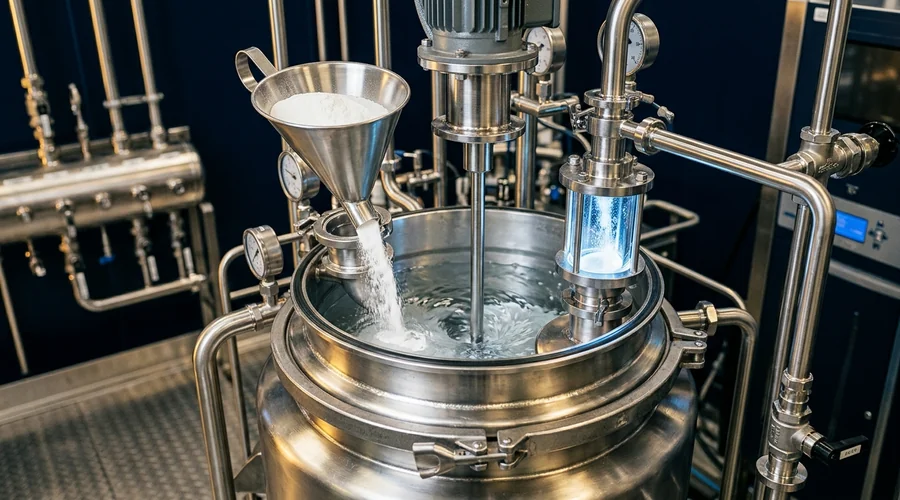
Formulation and Packaging Factors That Undermine Preservation
The single most common reason a preservative fails is that only a fraction of what was added is chemically available to attack microorganisms. Preservatives partition into oil phases, bind inside surfactant micelles, adsorb onto container surfaces, complex with macromolecular excipients, and degrade or evaporate over shelf life. Each of these lowers the aqueous free concentration — the only fraction that does the preserving — while an assay of total content can still look on target. A preservative selection that ignores these losses will pass early and fail late.
- pH and ionisation — weak-acid preservatives and parabens work only in the un-ionised form, so a formulation above the pKa loses most of the active species
- Oil–water partitioning — in emulsions and solubilised systems, preservative dissolved in the oil phase is unavailable; the free aqueous concentration, not the nominal amount, must clear the challenge test
- Micellar binding — nonionic surfactants such as the polysorbates sequester parabens and phenolics inside micelles, a well-documented antagonism
- Container sorption — rubber closures, polyethylene, and nylon adsorb benzalkonium chloride, parabens, and chlorbutanol; multi-dose vials with a large closure surface area are especially affected
- Macromolecule interaction — polyethylene glycols, cellulose derivatives, povidone, and proteins bind or inactivate several preservatives
- Volatile and hydrolytic loss — chlorbutanol hydrolyses and evaporates; phenol and benzyl alcohol are lost slowly through some closure systems
The shelf-life dimension deserves its own emphasis. Preservative content usually declines during storage, so the challenge test should be performed on aged samples at the low end of the specification, and the routine ICH stability programme should trend the preservative assay alongside the active. When these losses cannot be engineered out, or when the route rules out every adequate preservative, the answer is to remove the preservative and redesign the delivery instead.
Preservative-Free and Reduced-Exposure Strategies
For chronically dosed and vulnerable-population products, the industry has moved steadily toward removing the preservative rather than optimising it. The driver is cumulative tissue toxicity, most visibly the ocular-surface disease associated with long-term benzalkonium chloride exposure in glaucoma patients. Preservative-free formulation alternative technology now spans both packaging engineering and formulation chemistry, and the right choice depends on dosing frequency, container economics, and how sensitive the active is. These systems move cost and complexity from the formulation into the container.
- Unit-dose presentations — single-use vials, blow-fill-seal ampoules, and sachets; no preservative needed, but the highest packaging cost and waste
- Preservative-free multi-dose eye droppers — one-way valves, sterilising filter membranes at the tip, or spring-loaded mechanisms that keep the residual contents sterile without a chemical agent
- Airless and unidirectional pump packaging — for topicals and some nasal products, preventing suck-back of contaminated air into the reservoir
- Self-dissipating preservatives — oxidative systems that revert to water, oxygen, and chloride on contact with tissue, and ionic-buffered systems whose activity collapses when diluted by tears
- Gentler molecules — polyquaternium-1, a polymeric quaternary too large to penetrate the corneal epithelium readily, used as a lower-toxicity benzalkonium chloride replacement
Preservative-free is not automatically the better answer. Unit-dose raises cost and carbon footprint, valve-and-filter bottles add device qualification and can restrict formulation viscosity, and "vanishing" preservatives still have to pass the same challenge test. Because the decision dictates the container, the fill process, and the stability programme, it belongs in early development, not at the end. A defensible selection sequence runs in this order: screen out preservatives the route contraindicates; reconcile the target pH and dosage form with the surviving classes; shortlist a primary agent plus a potentiator or secondary preservative; challenge-test the final formula at the worst case; confirm efficacy on end-of-shelf-life samples; and if nothing clears both the safety and the efficacy bar, move to a preservative-free presentation. Sponsors without in-house depth here often run this with multi-dose vial preservative product development services or a preservative-system contract formulation partner, precisely because the late failures are the expensive ones.
Frequently Asked Questions
Why do multi-dose pharmaceutical products need an antimicrobial preservative when single-dose units do not?
A single-dose container is opened once and discarded, so there is no opportunity for a patient or caregiver to introduce organisms and then store the product for later use. A multi-dose presentation is breached repeatedly over days or weeks, and each actuation draws in air and brings a dropper tip or needle into contact with non-sterile surfaces.
The antimicrobial preservative holds any organisms that get in below an infective level for the whole in-use period, so a normal dosing schedule never lets contamination proliferate. Pharmacopoeial and regulatory frameworks therefore require multi-dose sterile products to contain an effective preservative or to justify its omission, while single-dose products are usually preservative-free because the container design already removes the risk and several preservatives carry route-specific toxicity.
What is the difference between USP <51> and European Pharmacopoeia 5.1.3 antimicrobial effectiveness criteria?
Both methods challenge the finished product with the same core panel of bacteria and fungi and then count survivors over 28 days, and the organism lists are harmonised. The key difference is speed of kill for parenteral and ophthalmic products.
USP <51> Category 1 asks for a 1-log bacterial reduction by day 7 and a 3-log reduction by day 14, with no increase thereafter. The European Pharmacopoeia adds 6-hour and 24-hour sampling points and its recommended "A" criteria require a faster initial kill; its less stringent "B" criteria are permitted only when the "A" target cannot be met for a justified formulation reason. In practice a product intended for both markets is developed against the European "A" criteria because they are the harder test to pass.
Why is benzalkonium chloride still used in eye drops if it damages the ocular surface?
Benzalkonium chloride is a potent, broad-spectrum, inexpensive preservative that is stable over a wide pH range and compatible with most ophthalmic actives, so for an occasional-use or short-course product it remains a sensible default. Its detergent action on the corneal epithelium and tear film is dose- and duration-dependent, so the harm becomes clinically important mainly with chronic daily use, most notably in glaucoma patients who may instil preserved drops for years.
For those long-term products the industry has moved toward gentler preservatives such as polyquaternium-1, toward oxidative systems that revert to water and oxygen on contact with the eye, or toward preservative-free multi-dose bottles. The decision is a risk balance between the well-characterised antimicrobial performance of benzalkonium chloride and the cumulative surface toxicity for a given dosing pattern.
Which preservatives are unsafe for neonates or for intrathecal use?
Benzyl alcohol is the clearest example. It has been linked to a fatal toxic syndrome in premature and low-birth-weight infants, characterised by metabolic acidosis and gasping respirations, which is why benzyl-alcohol-preserved products carry a neonatal warning and preservative-free single-dose presentations are standard in neonatology.
Benzyl alcohol and most other common preservatives are also unsuitable for intrathecal, epidural, or intraocular injection because of neurotoxicity, so products for those routes are formulated preservative-free in single-dose containers. As a general rule, any route that bypasses the normal dilution and clearance the body provides, or any vulnerable-population product, should be screened for preservative contraindications before the antimicrobial system is chosen.
How does formulation pH affect preservative efficacy?
Several important preservatives are weak acids or weakly ionisable, and only the un-ionised molecule crosses the microbial cell membrane and acts. Benzoic acid and sorbic acid are effective only in acidic formulations, typically below pH 5, and lose most of their activity above their pKa.
Parabens are active in their un-ionised form and start to lose potency as the formulation rises toward and past pH 8, and phenolic preservatives also perform best below neutral pH. This means the target pH of the product, which is usually set by active stability and physiological tolerance, can quietly disqualify a preservative class before any challenge testing is done, so pH and preservative choice have to be reconciled together early in development.
Why can a preservative pass the challenge test at release but fail later in shelf life?
The challenge test measures what the free, aqueous preservative concentration can do, and that free fraction is almost always lower than the amount added and tends to fall during storage. Preservative can partition into an oil phase or into surfactant micelles, adsorb onto rubber closures and plastic components, complex with polymeric excipients or proteins, and in some cases hydrolyse or evaporate through the closure.
A batch can assay near 100 percent of the labelled preservative content and still have too little free preservative to control organisms after months on the shelf. This is why antimicrobial effectiveness testing should be run on aged samples held at the low end of the preservative specification, not only on fresh product.
What are the realistic options for a preservative-free multi-dose product?
There are three broad routes. The first is to abandon the multi-dose format and use single-use vials, blow-fill-seal ampoules, or sachets, which removes the need for a preservative entirely but raises packaging cost and waste. The second is engineered multi-dose packaging: eye-drop bottles with one-way valves, sterilising filter membranes at the tip, or spring-loaded mechanisms that keep the residual contents sterile without a chemical agent, plus airless or unidirectional pumps for topical and nasal products.
The third is a self-dissipating preservative, such as an oxidative system that reverts to water and oxygen on contact with tissue, or an ionic-buffered system whose activity collapses when diluted by tears. All of these still have to pass the same antimicrobial effectiveness test, and the packaging routes add device qualification work.
When should a formulator bring in a preservative-system consultant?
The most useful point is during pre-formulation, before the pH, the surfactant system, the container-closure, and the route-specific presentation are locked, because those choices determine which preservatives can work at all. A consultant who has taken multi-dose products through antimicrobial effectiveness testing brings a shortlist of viable preservative and potentiator combinations for the dosage form, knowledge of the container-sorption and micellar-antagonism traps that cause late failures, and a test plan that challenges the worst-case formula at the end of shelf life rather than only at release.
Engaging that expertise after a formulation has failed challenge testing is possible but expensive, because a preservative change can reset stability and, for sterile products, container-closure and process work as well.
Selecting a Preservative for a Multi-Dose Product?
Global Formulation provides pharmaceutical and healthcare product development consultancy — preservative-system selection, antimicrobial effectiveness testing strategy, and preservative-free delivery design for multi-dose vials, drops, and oral liquids.
Talk to Our Formulation Team