Automotive E-Coat Primer Chemistry: The Cathodic Electrodeposition Process

A car body can spend less than three minutes fully submerged in a coating bath and come out with corrosion protection reaching into every box section, weld seam, and hidden cavity in the structure — a result no spray gun could ever achieve on its own. That capability is automotive e-coat primer chemistry: cathodic electrodeposition, the process responsible for the anti-corrosive primer layer on nearly every mass-produced vehicle body built today. Corrosion perforation warranties now commonly run ten years or longer, and the rocker panels, door bottoms, and box sections where warranty claims actually originate are precisely the areas a line-of-sight spray gun cannot fully reach. This guide explains how the cathodic electrodeposition process works at the chemistry level, what the epoxy-amine resin and blocked isocyanate crosslinker system contributes to film performance, why pretreatment quality decides whether e-coat succeeds or fails, and how manufacturers verify corrosion performance before a body shell ever reaches the paint booth. It's written for engineers and entrepreneurs evaluating coating lines within paints and coatings manufacturing.
Why Automotive Bodies Need Cathodic E-Coat
Every welded automotive body-in-white is riddled with enclosed box sections, overlapping flanges, and narrow gaps between panels that a spray gun physically cannot reach in a direct line of sight, no matter how the gun angle or booth layout is optimized. These hidden cavities aren't a minor design inconvenience — they're precisely where moisture, road salt, and condensation collect and linger longest, which makes them the most corrosion-prone locations on the entire vehicle rather than the least.
Spray-only priming leaves these recesses either completely bare or coated with an unpredictably thin, uneven film, which is functionally the same as no corrosion protection at all in the areas that matter most. Cathodic electrodeposition solves this by using an electric field rather than mechanical spray trajectory to drive the coating onto the metal, reaching anywhere the conductive bath fluid itself can physically penetrate — including deep inside hollow structural rails and door boxes.
Because the driving force behind e-coat is electrical rather than mechanical, understanding how that electrochemistry actually deposits a uniform film is the key to understanding why the process works as well as it does.
The Cathodic Electrodeposition Process
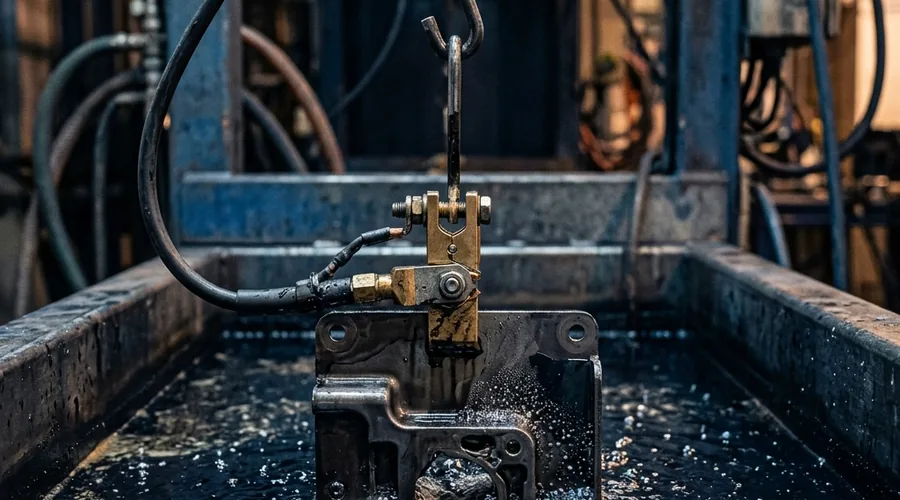
Cathodic electrodeposition, universally shortened to CED or e-coat in the industry, immerses the fully pretreated body-in-white in a large, stirred, temperature-controlled tank containing a water-based emulsion of cationic resin and pigment. The body is wired as the cathode, with anode electrodes positioned around the tank walls, and applying DC voltage across this arrangement is what actually deposits the coating — not the immersion itself.
At the cathode surface, a reduction reaction consumes hydrogen ions and generates hydroxide ions, locally raising the pH right at the metal interface. The resin in the bath is only water-soluble because its amine groups have been protonated with an organic acid; that local pH rise neutralizes the protonation, and the resin abruptly loses solubility and coagulates directly onto the steel as a continuous, adherent film.
- Immersion and voltage ramp — The pretreated body enters the bath and DC voltage is applied in a controlled ramp to avoid excessive gassing at the metal surface
- Film deposition — Resin coagulates onto every conductive surface the bath fluid reaches, with deposition current dropping locally as film thickness builds
- Post-rinse — The body is rinsed with ultrafiltrate recovered from the bath itself, removing loosely adhered, non-deposited resin without washing away the deposited film
- Bake and cure — The rinsed body passes through an oven, typically around 170–180°C, where the crosslinking reaction that finishes the film actually occurs
That deposition mechanism only works because of specific resin chemistry engineered to be cationic, water-dispersible, and capable of crosslinking into a dense film once the bake oven takes over — which is exactly where the chemistry gets interesting.
E-Coat Resin Chemistry
Cathodic e-coat resins are built around a bisphenol A epoxy backbone chemically modified with amine functionality, a combination chosen because the epoxy structure delivers excellent corrosion resistance and adhesion while the amine groups provide the site for water-dispersibility. Protonating those amine groups with an organic acid such as acetic or lactic acid converts the resin into a stable cationic emulsion that can be diluted into the aqueous e-coat bath in the first place.
Deposition alone doesn't finish the film — the resin still needs to crosslink into a dense, chemically resistant network, and that job belongs to a blocked polyisocyanate crosslinker dispersed alongside the resin. At bath temperature the isocyanate groups stay chemically inert, "blocked" by a protecting group that prevents premature reaction, which is essential since the bath must remain stable in storage and in the tank for extended periods.
Only in the bake oven does the blocking agent release, freeing the isocyanate to react with hydroxyl groups on the resin backbone and form urethane crosslinks throughout the film. This delayed-reaction design is deliberate: it separates the electrodeposition step, which must happen at room temperature in a stable aqueous bath, from the curing step, which requires heat and forms the crosslinked network responsible for the film's solvent resistance, hardness, and long-term corrosion performance.
Resin and crosslinker chemistry alone can't guarantee good film performance, though — none of it matters if the underlying steel surface wasn't properly prepared before the body ever entered the e-coat tank.
Pretreatment: Why Surface Prep Decides Performance
E-coat does not work in isolation — it depends entirely on a properly prepared steel surface, and the quality of the metal pretreatment stage upstream of the e-coat tank has a direct, measurable effect on both adhesion and final corrosion resistance. Skipping or under-performing pretreatment doesn't just weaken the coating slightly; it can undermine the entire corrosion-protection system regardless of how well the electrodeposition chemistry itself is controlled.
A conversion coating — historically zinc phosphate, and increasingly a thin-film zirconium-oxide alternative in modern lines seeking lower sludge generation and reduced heavy-metal content — chemically bonds to bare steel and creates a microscopically roughened, reactive surface. This treated surface gives the e-coat resin dramatically better anchorage than it would ever achieve on untreated metal, and it contributes its own independent layer of corrosion resistance beneath the e-coat film itself.
- Alkaline cleaning — Removes drawing lubricants, weld scale, and shop oils that would otherwise block conversion coating formation and e-coat adhesion
- Rinse stages — Prevent cleaning chemistry from contaminating the conversion coating bath downstream
- Conversion coating — Forms the phosphate or zirconium-oxide layer that bonds to bare steel and anchors the e-coat film
- Final deionized rinse — Removes residual conversion coating chemistry before the body enters the e-coat tank itself
Once the surface is properly converted and rinsed, the coating system is ready to be evaluated for how well it actually holds up in service — which is a question of testing and quality control, not just process design.
Film Defects and Quality Control
Even a well-designed e-coat line can produce visible film defects, and recognizing what causes each one is essential for diagnosing a production problem quickly rather than treating every defect as a mystery. Most e-coat defects trace back to either bath contamination, voltage control, or the inherent geometric limits of electrodeposition itself.
- Craters — Small circular voids caused by surface-tension-disrupting contamination such as silicone or oil droplets in the bath or on the substrate
- Pinholing — Trapped gas bubbles from excessive hydrogen evolution at the cathode, typically caused by too rapid a voltage ramp before the film has built enough insulating resistance
- Faraday cage thinning — Reduced film build in the deepest, most shielded box sections, where field lines are weakest even though overall throwing power is good on more open surfaces
Verifying that a production line is avoiding these defects and meeting corrosion targets relies on a defined set of quality checks: dry film thickness gauges confirm coating build at multiple body locations, cross-hatch adhesion testing per ASTM D3359 confirms the film is properly bonded, and solvent-rub testing confirms the bake cure actually crosslinked the film rather than leaving it under-cured.
These test protocols exist because e-coat's real job is protecting metal for a decade or more in the field, not just looking flawless the day the vehicle leaves the plant — which is also exactly why e-coat is only the first of several coating layers a body receives, not the last.
E-Coat vs Spray Primer in the Paint Stack
E-coat and conventional spray-applied primer aren't competing technologies so much as complementary layers with entirely different jobs, and virtually every modern automotive body receives both in sequence rather than one instead of the other. E-coat is engineered purely for corrosion protection and adhesion — it typically ships in a flat gray or black color with no gloss or UV-durability requirement, since none of it remains exposed once the rest of the paint stack is applied.
| Characteristic | Cathodic E-Coat | Spray-Applied Primer-Surfacer |
|---|---|---|
| Application method | Full immersion, electrically driven deposition | Spray gun, line-of-sight only |
| Coverage in box sections and seams | Excellent — reaches recesses via electric field | Poor to none — mechanically blocked |
| Primary role | Corrosion protection and substrate adhesion | Surface smoothness and chip resistance |
| Typical film thickness | ~18–25 microns | Varies by product, applied over e-coat |
| Position in paint stack | First layer, directly over pretreated steel | Second layer, applied over cured e-coat |
After e-coat cures, the body typically receives a spray-applied primer-surfacer for smoothness and stone-chip resistance, then a basecoat for color, and finally a clearcoat for gloss and UV protection — each layer, discussed in more depth in our broader guide to anti-corrosion coatings, doing a job that e-coat's electrodeposition chemistry was never designed to handle.
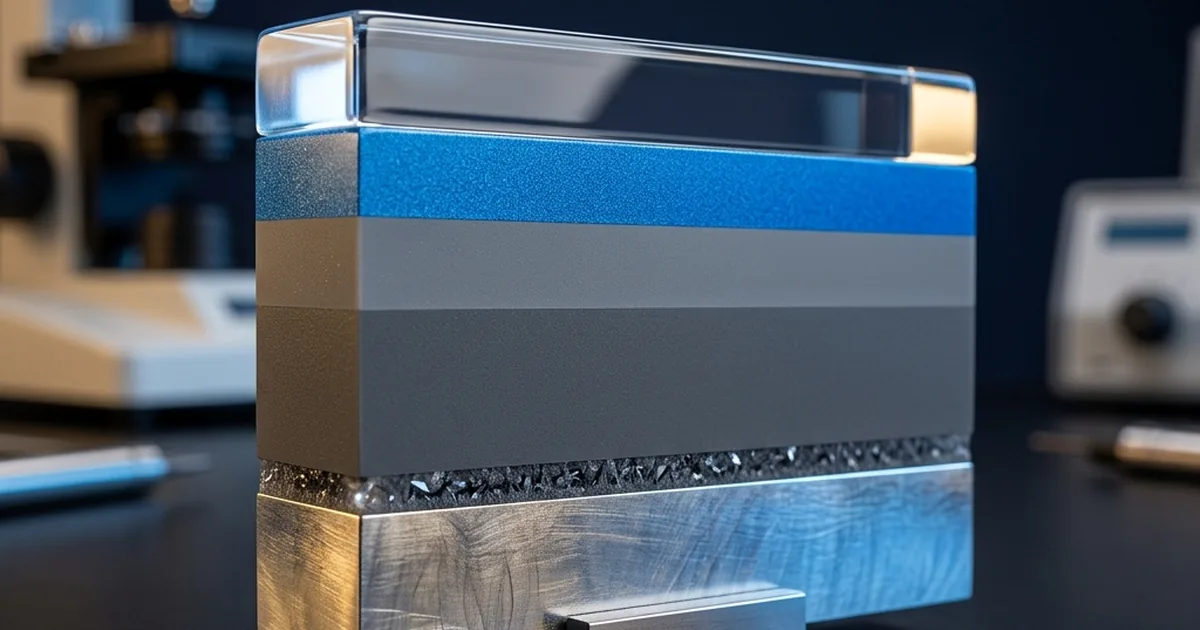
Understanding where e-coat's job ends and the rest of the paint stack begins is what lets a manufacturer specify the right process for corrosion protection without over-engineering the layers that only need to look good.
Frequently Asked Questions
Why can't automakers just spray-coat car bodies instead of using e-coat?
Spray application relies on a direct line of sight between the spray gun and the surface being coated, and a welded automotive body-in-white is full of enclosed box sections, overlapping flanges, and narrow gaps between panels that no gun angle can reach. Cathodic electrodeposition works differently — it uses an electric field to drive charged resin particles onto every conductive surface the coating bath can penetrate, including the inside of hollow structural members, because the driving force is electrical rather than mechanical spray trajectory.
This is precisely why e-coat, not spray primer, is responsible for protecting the hidden cavities where the vast majority of automotive corrosion perforation actually originates.
What is "throwing power" in electrodeposition, and why does it matter so much for car bodies?
Throwing power describes an electrodeposition system's ability to build a reasonably uniform film thickness even in recessed, low-current-density areas far from the tank's counter-electrodes, and it matters because a car body's most corrosion-prone areas are exactly those hard-to-reach recesses. Cathodic e-coat achieves good throwing power because the deposited film itself is electrically insulating, so as film thickness builds on any given spot, the local deposition rate there slows down while thinner, less-coated areas continue receiving current — a self-limiting, self-leveling mechanism no spray process can replicate.
Throwing power isn't unlimited, though, and very deep or narrow box sections still experience some reduction in film build compared to open panel surfaces, which is why pretreatment and drainage design in body engineering remain important alongside e-coat chemistry itself.
What actually happens chemically when the resin deposits onto the car body in the e-coat tank?
The car body is wired as the cathode and immersed in a water-based bath containing a cationic epoxy-amine resin emulsion, and when DC voltage is applied, a reduction reaction at the body's metal surface generates hydroxide ions and consumes hydrogen ions from the surrounding bath. This local rise in pH at the metal surface neutralizes the resin's protonated amine groups, which were only water-soluble because they were acid-protonated to begin with, causing the resin to lose its water solubility and coagulate directly onto the steel as a continuous, adherent film.
The reaction is entirely interfacial and self-terminating: once a spot is coated, the insulating film blocks further current flow at that exact location, which is the same mechanism responsible for the process's excellent throwing power.
Why did the industry move from anodic to cathodic e-coat?
Anodic electrodeposition, the earlier version of the technology, wired the car body as the anode, which meant the deposition reaction actually oxidized iron at the steel surface, releasing iron ions that migrated into the depositing film and measurably degraded its corrosion resistance and adhesion over time. Cathodic e-coat reverses the polarity so the body is the cathode undergoing a reduction reaction instead, which avoids dissolving the substrate metal into the coating and was the key chemistry change that let cathodic systems deliver substantially better long-term corrosion performance.
By the 1980s, cathodic e-coat had become the dominant automotive primer technology worldwide specifically because of this corrosion-performance advantage, and it remains the standard today.
Does e-coat replace pretreatment, or do car bodies still need phosphating first?
E-coat does not replace pretreatment — the two work together, and skipping or under-performing pretreatment will compromise e-coat's adhesion and corrosion performance regardless of how well the electrodeposition chemistry itself is controlled. A conversion coating, historically zinc phosphate and increasingly a thin-film zirconium-oxide alternative in modern lines, chemically bonds to bare steel and creates a microscopically roughened, reactive surface that the e-coat resin adheres to far more strongly than it would to untreated metal.
Pretreatment also contributes its own layer of corrosion resistance beneath the e-coat film, so the two processes are genuinely complementary rather than one substituting for the other.
How thick is a typical automotive e-coat film, and how is that controlled?
Automotive e-coat films typically build to roughly 18 to 25 microns dry film thickness, a range chosen to balance corrosion protection, chip resistance, and the coating's own self-limiting deposition behavior. Film thickness is controlled primarily through bath voltage, immersion time, bath solids concentration, and conductivity, since the deposition process is inherently self-regulating — once the growing film's electrical resistance reaches a threshold at a given voltage, further deposition at that spot effectively stops.
Manufacturers verify actual film build with dry film thickness gauges at multiple body locations, since Faraday cage effects in the deepest recesses can still produce measurably thinner film there than on open, more exposed panel surfaces.
Is e-coat the final coating layer on a car body, or does more paint go on top?
E-coat is never the final visible finish — it is strictly a corrosion-protection and adhesion-promoting primer layer, applied in a gray or black color with no gloss or UV-durability requirement, since none of it will remain exposed once the rest of the paint stack goes on. After the e-coat film is baked and cured, the body typically receives a spray-applied primer-surfacer for smoothness and chip resistance, followed by a basecoat for color and finally a clearcoat for gloss and UV protection, with each layer serving a role that e-coat's electrodeposition chemistry simply isn't designed to provide.
Developing an Automotive Coating Line?
Global Formulation provides coatings consultancy — e-coat and pretreatment process selection, resin chemistry evaluation, and corrosion-testing programme design.
Talk to Our Formulation Team