Reactor Selection for Specialty Chemicals: Batch vs Semi-Batch vs Continuous
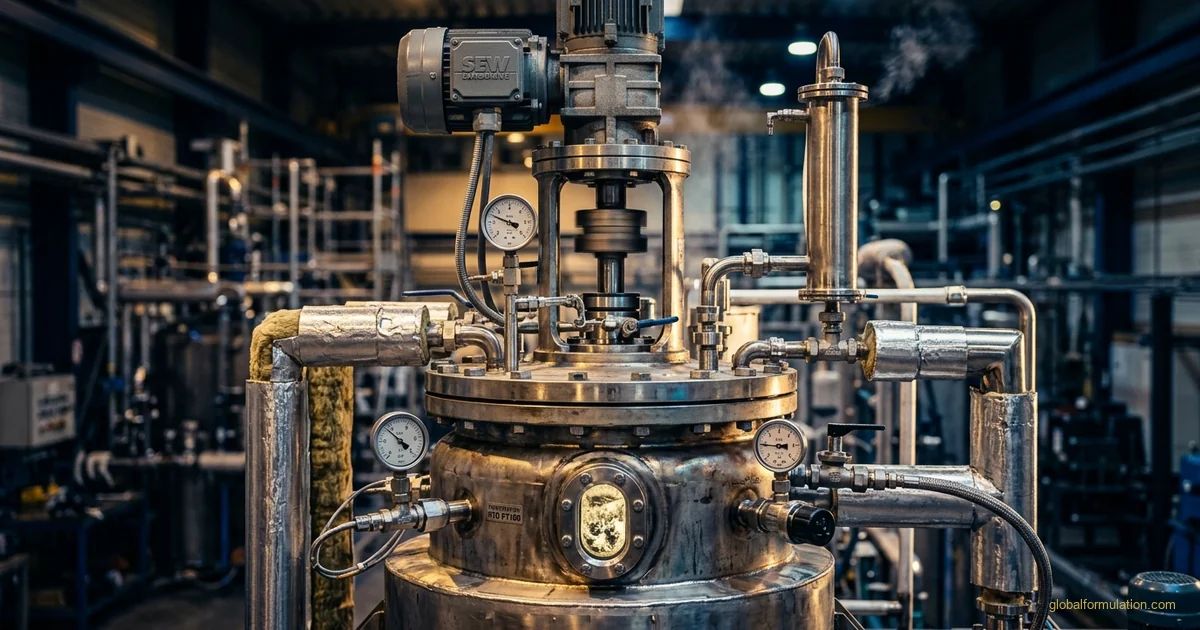
A plant buys a 6 m³ jacketed vessel because that is what the last product needed, then discovers the new chemistry releases heat four times faster than the jacket can remove it. The batch has to be run at half charge, the cycle time doubles, and a process that looked profitable on paper stops being so. Reactor selection for specialty chemicals is the decision that quietly sets the ceiling on everything downstream — throughput, product quality, safety margin, and cost per kilogram — and it is routinely made on the basis of what equipment already exists rather than what the reaction actually requires. The cost of getting it wrong is not a design error you can patch later; it is a vessel you own and cannot use properly. This guide sets out what genuinely drives the choice between batch, semi-batch and continuous operation, how each configuration behaves, where selection most often goes wrong, and a decision sequence that puts the binding constraints first. It reflects the approach we take in our chemical reaction engineering practice.
What Actually Drives Reactor Selection
Most reactor selection arguments start in the wrong place — with capital cost, or with a general preference for continuous processing borrowed from bulk chemicals. Neither is where the decision is genuinely made. A reactor configuration is chosen or ruled out by a small number of physical constraints, and once those are established the commercial comparison usually has only one or two viable candidates left in it. Working in that order saves a great deal of wasted engineering.
Four constraints do most of the work:
- Heat release rate — how fast the reaction produces energy compared with how fast the vessel can remove it. This is the constraint that most often eliminates an option outright.
- Reaction rate — how long the chemistry needs to reach acceptable conversion, which sets whether a practical residence time exists at all.
- Selectivity behaviour — whether a high local concentration of one reagent drives an unwanted side reaction, which determines whether reagents can be present together from the start.
- Annual volume and product mix — how many tonnes, of how many different products, through the same asset.
Heat deserves particular attention because it is the constraint that changes most dramatically with scale. Heat generation scales with volume, while heat removal through a jacket scales with surface area, so the surface-area-to-volume ratio (A/V) falls as a vessel gets larger. A reaction that a chemist controls comfortably in a 2 L flask can be genuinely difficult to control in a 6 m³ vessel using the same recipe, not because the chemistry changed but because the geometry did. Any configuration decision made without a measured heat of reaction (ΔHr) is a guess dressed as engineering.
The Batch Reactor: Where It Still Wins
In a batch reactor every reagent is charged before the reaction starts, conditions are brought to setpoint, and the vessel is emptied when the endpoint is reached. It remains the default across specialty chemical manufacturing for a reason that has little to do with the chemistry and everything to do with the business: one vessel can make many different products. That flexibility is worth a great deal when a plant runs a portfolio rather than a single high-volume line.
The stirred tank reactor is also the best-understood piece of equipment in the industry. Scale-up correlations, agitator selection, and jacket design are all supported by decades of published practice, and vessels built to the ASME Boiler and Pressure Vessel Code are readily available in stainless, glass-lined and exotic alloys. When a process has to be transferred to a toll manufacturer, batch equipment is what most sites actually have.
The limitations are equally well known. Cycle time includes charging, heating, reaction, cooling, discharge and cleaning, and reaction is often not the longest of those. Batch-to-batch variability is inherent, since each batch is a separate experiment with its own charging accuracy and thermal history. And because the entire reagent inventory is present from the start, the full adiabatic temperature rise (ΔTad) is available from the moment conditions are reached — which is why batch operation is the least forgiving configuration for strongly exothermic chemistry.
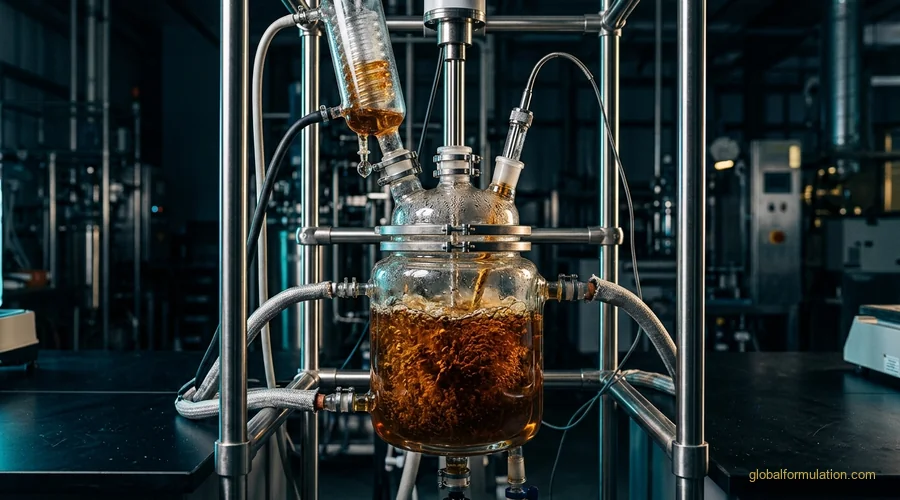
The Semi-Batch Reactor: Dosing as a Design Variable
Semi-batch operation charges part of the reaction mass up front and feeds the remainder progressively while the reaction proceeds. It is the most common configuration for exothermic specialty chemistry, and the reason is control: the feed rate becomes a throttle on heat release. Instead of the vessel having to absorb whatever the full charge produces, the operator sets how fast energy enters the system.
That control extends to selectivity. Where an unwanted side reaction is driven by high local concentration of one reagent — a second addition to an already-substituted product, for instance, or oligomerisation competing with the desired step — keeping that reagent at low instantaneous concentration suppresses the side path. This is why so many resin and intermediate processes feed one component slowly rather than charging everything at once, and it is a recurring theme in resin manufacturing where viscosity and molecular weight also evolve through the batch.
The critical caveat is accumulation. The safety benefit of dosing holds only while the reaction genuinely consumes feed as fast as it arrives. If the reaction stalls — catalyst poisoned, temperature below initiation, agitator tripped — feed keeps accumulating and the unreacted inventory grows silently. A stalled semi-batch reaction with a large accumulated charge is a worse position than a batch charge, precisely because nobody expects it. Dosing strategy therefore has to be paired with a means of confirming the reaction is actually running, whether that is a temperature response to feed, an in-line measurement, or an interlock that stops the feed on loss of agitation.
Continuous Reactors: CSTR and Plug Flow
Continuous operation feeds reagents and withdraws product simultaneously at steady state, so the reactor holds only a small quantity of reacting material at any instant. That single characteristic drives most of its advantages. Heat removal per unit volume is far better because the geometry can be chosen for heat transfer rather than for holding capacity, and the consequence of a control failure is bounded by a small inventory instead of a full batch.
Two idealisations bracket real continuous equipment. The continuous stirred tank reactor (CSTR) is well mixed, so its contents sit at the outlet composition throughout — good for reactions needing a constant, low reagent concentration, less efficient where high conversion is needed. The plug flow reactor (PFR) moves material through without back-mixing, so composition varies along its length and it reaches a given conversion in less volume than a single CSTR. In practice a cascade of CSTRs in series approaches plug flow behaviour as the number of stages rises.
Real continuous equipment sits between those ideals, and how far it deviates is measured by its residence time distribution. Tracer studies reveal the bypassing, channelling and dead zones that separate a real vessel from its model, and that gap is where unexplained conversion and selectivity losses usually hide. Modern continuous processing also extends well beyond tubes and tanks — loop reactors, static mixer reactors, and microreactors all intensify heat and mass transfer enough to run chemistry that would be unmanageable in a stirred tank.
Continuous operation is genuinely well suited to a narrower set of cases than its reputation suggests. It rewards high volume of a single product, fast kinetics, and hazardous or strongly exothermic chemistry where small inventory is worth paying for. Falling-film sulfonation in surfactant manufacturing is a good example: the reaction is fast, extremely exothermic, and made at scale, so a continuous reactor with a thin reacting film and large heat transfer area is the only sensible answer. It is poorly suited to frequent changeovers, solids that foul narrow channels, and slow reactions that would demand impractical reactor volume.
Batch vs Semi-Batch vs Continuous: Direct Comparison
Setting the three configurations side by side clarifies that they are not competing options along a single axis of sophistication. Each is the correct answer to a different combination of constraints, and the comparison below is best read as a set of gates rather than a scorecard. A configuration that fails on heat removal or on product mix cannot be rescued by scoring well elsewhere.
| Criterion | Batch | Semi-Batch | Continuous |
|---|---|---|---|
| Reagent inventory at risk | Full charge | Charge plus accumulated feed | Small, bounded by holdup |
| Heat release control | Governed by cooling capacity only | Governed by feed rate | Governed by feed rate and high A/V |
| Selectivity in concentration-sensitive chemistry | Poorest | Good — low instantaneous concentration | Good in CSTR, varies along a PFR |
| Product flexibility | Highest — many products, one vessel | High | Lowest — usually optimised for one chemistry |
| Suitability for slow reactions | Good | Good | Poor — demands large reactor volume |
| Solids handling | Straightforward | Straightforward | Difficult — fouling and blockage risk |
| Batch-to-batch consistency | Variable by nature | Variable by nature | Most consistent once at steady state |
| Capital per tonne at high volume | Highest | High | Lowest |
| Capital viability at low volume | Good | Good | Poor — utilisation too low |
| Startup and shutdown losses | None beyond changeover | None beyond changeover | Significant — off-spec during transitions |
The pattern that emerges is consistent: batch buys flexibility, semi-batch buys thermal and selectivity control, and continuous buys consistency and inventory reduction at the price of dedication to one product. A plant making twenty products a year and a plant making one are not making the same decision.
Where Reactor Selection Goes Wrong
Selection errors rarely announce themselves at commissioning. They surface months later as a capacity shortfall, a quality complaint, or a near miss, and by then the vessel is installed and the options are expensive. The failure modes below account for most of what we see when a client asks why a process that worked in development is underperforming in production.
- Choosing by available asset — fitting the chemistry to the vessel already on site. This is defensible only after the thermal and kinetic checks confirm the vessel can actually do the duty; done before those checks, it produces plants that run permanently at reduced charge.
- Scaling the recipe instead of the process — multiplying every quantity by the scale factor and assuming behaviour follows. Heat transfer, mixing time and mass transfer all change with scale, so the recipe that worked in a flask is a starting point, not a design.
- Ignoring cycle time outside the reaction — sizing on reaction time alone, then discovering that charging, heating, cooling, discharge and cleaning together dominate the cycle. Capacity calculations built on reaction time consistently overpromise.
- Treating dosing as inherently safe — assuming semi-batch removes the thermal hazard without assessing accumulation if the reaction stalls.
- Converting to continuous without redeveloping — porting a batch recipe into a flow reactor unchanged. Residence times of hours rarely translate, and forcing them shorter changes temperature, concentration or catalyst loading, which changes the impurity profile the downstream purification was designed for.
- Overlooking product mix — specifying a dedicated continuous line for a product that will only run two short campaigns a year, where utilisation never justifies the capital.
The common thread is a decision made before the data existed to make it. Each of these is cheap to avoid with a calorimetric study and an honest cycle-time model, and expensive to correct once steel is in the ground.
A Practical Decision Framework
A defensible reactor selection follows a sequence rather than a weighted comparison, because the early questions eliminate options entirely and the later ones only rank what survives. Working the sequence in order also produces the evidence a tech transfer package needs, so the effort is not spent twice.
- Measure the thermal data. Establish ΔHr and the resulting ΔTad by calorimetry. Without this, every subsequent step is speculation.
- Compare heat release with removal capacity. Check the required duty against what the candidate vessel can achieve at its actual A/V ratio and coolant temperature. If batch fails here, move to semi-batch and reassess.
- Check the kinetics against a practical residence time. If the reaction needs hours, continuous operation demands reactor volume that rarely makes sense.
- Test selectivity sensitivity. Determine experimentally whether instantaneous concentration affects the impurity profile. If it does, dosing is a process requirement, not a preference.
- Model the full cycle. Build capacity from charging, heating, reaction, cooling, discharge and cleaning — then compare against annual demand.
- Apply the commercial filter last. Capital, utilisation and product mix decide between the configurations that survived steps one to five.
Most specialty processes land on semi-batch, and that is not a compromise — it is usually the configuration that genuinely fits chemistry that is exothermic, concentration-sensitive and made in campaigns. The value of the sequence is that it tells you why, which is what makes the decision defensible to a regulator, an insurer, or the engineer who inherits the plant. If you are working through this for a process heading toward production, our scale-up support service covers exactly this assessment, and the broader route from bench to plant is set out in our guide to taking a product from lab to market.
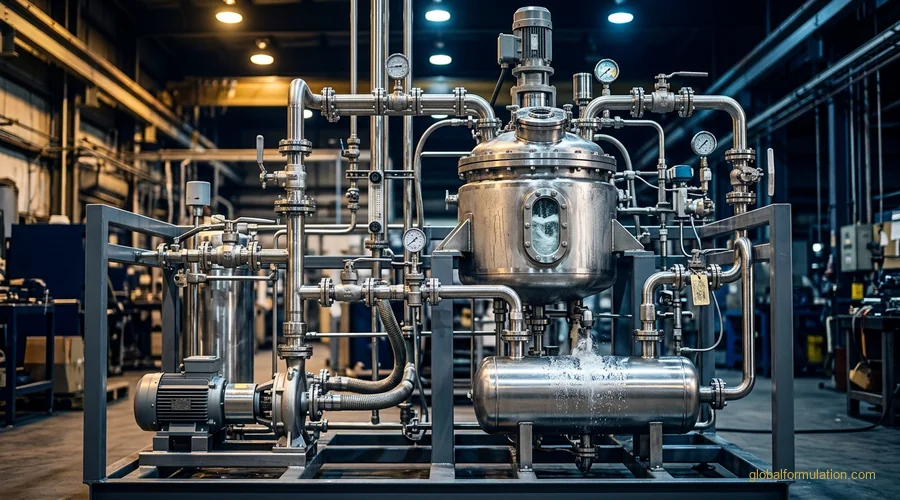
Whichever configuration is selected, the thermal assessment behind it is site- and recipe-specific. It requires measured calorimetric data for the actual system and should be carried out by qualified process safety engineers against the regulatory regime that applies to the site — the process safety management framework published by CCPS at AIChE sets out what a competent assessment covers.
Frequently Asked Questions
What is the difference between a batch and a semi-batch reactor?
In a batch reactor every reagent is charged before the reaction begins, so the full heat of reaction is available to release from the moment conditions are reached. In a semi-batch reactor one or more reagents are fed in progressively while the reaction runs, which means the operator controls how much unreacted material is present at any moment.
That single difference changes the safety profile completely: the feed rate becomes the throttle on heat release, and the maximum credible exotherm is governed by how much reagent has accumulated rather than by the whole charge. Semi-batch operation also tends to improve selectivity in reactions where a high local concentration of one reagent drives an unwanted side reaction.
When should you use a continuous reactor instead of batch?
Continuous operation earns its place when the same product is made at high volume for long periods, when the reaction is fast enough to complete within a practical residence time, and when the chemistry is either too exothermic or too hazardous to hold in a large inventory. A continuous reactor holds only a small quantity of reacting material at any instant, so the consequence of a loss of control is bounded by that inventory rather than by a full batch charge.
The economics turn on utilisation: a dedicated continuous line that runs for months justifies its capital, whereas one that runs a few short campaigns per year rarely does. Frequent product changeovers, solids handling, and very slow reactions all push the decision back toward batch.
Why are most specialty chemicals still made in batch reactors?
Specialty chemical plants typically make many different products in modest volumes, and a batch reactor is the only configuration that handles that flexibility economically. The same jacketed vessel can run a resin one week and an intermediate the next, with cleaning and a recipe change in between, whereas a continuous train is usually optimised around one chemistry.
Batch equipment is also well understood, widely available second-hand, and straightforward to scale using established correlations. The trade-off is that batch operation carries changeover time, batch-to-batch variability, and a heat-removal problem that grows worse as vessel size increases.
How do you choose between batch and continuous processing?
Start with the constraint that will actually bite rather than with a preference for one configuration. Establish the heat of reaction and the adiabatic temperature rise first, because if the vessel cannot remove the heat at the rate the reaction produces it, batch operation is ruled out regardless of any other advantage.
Then check the reaction half-life against a realistic residence time, the annual volume against plausible campaign lengths, and whether solids are present at any stage. Only after those four answers are in should capital cost enter the discussion, because a configuration that cannot meet the thermal or kinetic constraint is not cheaper — it simply does not work.
Is a semi-batch reactor safer than a batch reactor?
For exothermic chemistry it usually is, because the feed rate limits how much unreacted reagent can accumulate and therefore caps the energy available for release. That advantage is real but conditional: it only holds while the reaction is genuinely consuming the feed as fast as it arrives.
If the reaction stalls — because the catalyst failed, the temperature dropped below the initiation point, or the agitator stopped — feed continues to accumulate and the situation becomes more dangerous than a batch charge, because the operator may not realise the accumulation is happening. This is why dosing strategy has to be paired with a means of confirming the reaction is actually proceeding, and why the thermal assessment must consider the stalled-reaction case explicitly.
What reactor volume do I need for my process?
Working volume follows from the annual tonnage, the achievable number of batches per year, and the fill fraction the chemistry allows, and the third of those is the one most often underestimated. A vessel is rarely charged above roughly 70 to 80 percent of geometric volume because headspace is needed for agitation, foaming, reflux and thermal expansion, and reactions that foam or gas off need considerably more.
Batches per year then depends on the full cycle — charging, heating, reaction, cooling, discharge and cleaning — not on reaction time alone, and cleaning is routinely the step people forget to count. Working the calculation backwards from annual demand through realistic cycle time is the only way to avoid buying a vessel that turns out to be a bottleneck.
Can you convert an existing batch process to continuous operation?
Sometimes, but a direct translation almost never works because the two configurations impose different constraints on the same chemistry. A batch recipe developed over several hours may need to complete within minutes to give a practical residence time, which usually means running hotter, more concentrated, or with a different catalyst loading — and each of those changes the impurity profile that the downstream purification was designed around.
Reactions that produce or handle solids are the hardest to convert, since fouling and blockage risk rises sharply in narrow continuous channels. The realistic path is to treat it as a process redevelopment with its own kinetic study and pilot campaign rather than as an equipment swap.
Selecting a Reactor for a New Process?
Global Formulation provides reaction engineering and process development support — thermal assessment, reactor selection, and scale-up from bench data to a defensible plant design. For a worked example on a real product, the Acid Slurry (LABSA) Manufacturing Standard Project Report is a costed India-basis feasibility study of a sulfonation plant — a single recommended configuration (CPCB Red, mandatory Environmental Clearance), with a five-year financial model and a conservatively priced spent-acid byproduct credit.
Talk to Our Process Team