Biosurfactants Cleaning Formulation: The Sustainable Shift
A cleaning-brand founder wants a genuine sustainability story, reads that biosurfactants are the answer, and asks a formulator to swap them in. The formulator knows the harder truth: biosurfactants in a cleaning formulation are a real advance, but a straight one-for-one replacement of the petrochemical surfactant almost never works first time. Foam changes, viscosity drifts, the cost per wash jumps, and the supplier can only ship so many tonnes. That gap between the promise and the practicalities is where products stall, and it costs a launch its timeline. This guide explains why formulators are moving toward biosurfactants, what sophorolipids and rhamnolipids actually are and how they behave, where the cost and supply limits really sit, and how to bring them into a formulation without redesigning the whole product blind. It reflects the questions we field from founders building household and industrial cleaning ranges around a credible green claim.
Why Biosurfactants Are Entering Cleaning Formulation
The pressure on conventional surfactants is coming from several directions at once, and it is not going away. Petrochemical surfactants such as linear alkylbenzene sulfonate carry a fossil-carbon footprint, while the oleochemical alternatives from palm and coconut oil bring land-use and deforestation scrutiny of their own. Regulators, retailers and consumers are all asking cleaning brands to show a better ingredient story, and biosurfactants answer several of those asks together.
- Renewable feedstock — they are fermented from sugars and renewable or waste oils rather than crude oil or newly planted tropical oil crops
- Low-energy production — fermentation runs at ambient temperature and pressure, unlike the high-temperature sulfonation and ethoxylation steps behind commodity surfactants
- Readily biodegradable — the commercial glycolipids typically pass ready-biodegradability testing and show low aquatic toxicity, which supports ecolabels and safer-ingredient programmes
- Skin mildness — sophorolipids and mannosylerythritol lipids are gentle enough for personal care, which carries over into hand dishwash and other skin-contact cleaners
None of this is theoretical any more. Fermentation rhamnolipids and sophorolipids are in retail all-purpose cleaners, dish liquids and laundry products from mainstream brands, and dedicated production plants have been built to supply them. The shift is underway; the useful question is no longer whether to consider biosurfactants but how to use them well, which starts with understanding what they are.
What Biosurfactants Are: Glycolipids from Fermentation
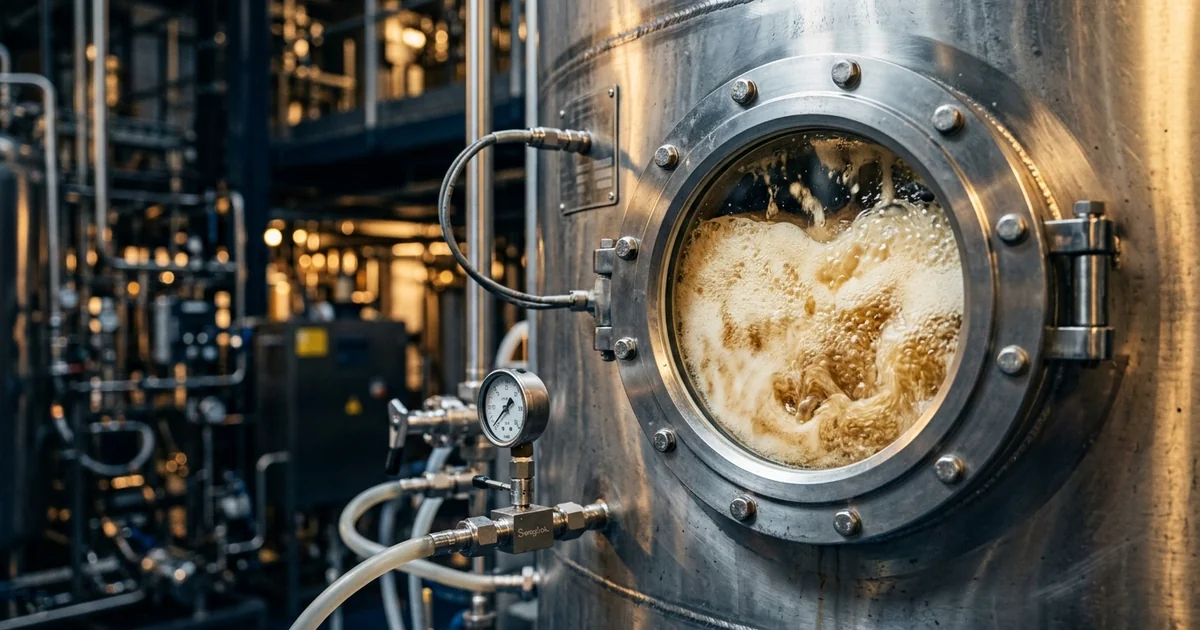
A biosurfactant is a surface-active molecule built by a living microorganism rather than assembled in a reactor. It still has the classic surfactant architecture of a water-loving head and an oil-loving tail, so it lowers surface tension, wets soils and lifts grease like any surfactant. What differs is the origin and the structure: the producing organism stitches a sugar head group onto a fatty acid tail during microbial fermentation, and the output is a family of closely related molecules rather than one defined compound. For cleaning, two glycolipid families matter most.
- Sophorolipids — produced by non-pathogenic yeast such as Starmerella bombicola from glucose plus a vegetable oil or fatty acid; they come in an acidic form that foams well and a lactonic form that is a stronger antimicrobial and better at cutting surface tension
- Rhamnolipids — one or two rhamnose sugar units on a fatty acid dimer, produced by bacteria; modern commercial routes use engineered non-pathogenic hosts fed on sugar rather than the original Pseudomonas aeruginosa
- Mannosylerythritol lipids and others — MEL from yeasts is prized for mildness in personal care; lipopeptides such as surfactin cut surface tension dramatically but are still too costly for volume cleaning
The single most important structural fact for a formulator is that a sophorolipid or rhamnolipid grade is a mixture. The proportions of acidic to lactonic, the fatty acid chain lengths and the degree of acetylation all vary with strain and process, and they set the foam, viscosity and effective HLB you will work with. That mixture nature is both the source of some useful robustness and the reason batch consistency needs attention, a theme the limits section returns to.
How Sophorolipids and Rhamnolipids Perform in Cleaners
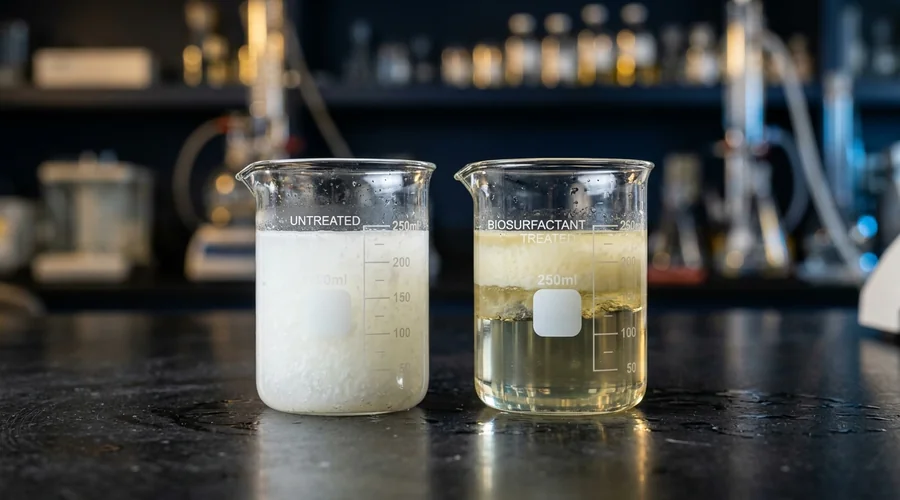
Biosurfactants are not a single performance package; the two main families play to different strengths, and knowing which does what saves a lot of trial formulation. Sophorolipids lead on availability, wetting and mildness. Rhamnolipids lead on emulsification, grease removal and efficiency at low dose. Both hold up better than soap and better than many petrochemical anionics in hard water, and both can lower the total surfactant needed when blended with a conventional partner.
| Property | Sophorolipids | Rhamnolipids |
|---|---|---|
| Production yield / availability | Higher fermentation yields; the more available and lower-cost option | Historically lower yields and higher cost; improving with engineered strains |
| Foam | Good, especially the acidic form; suits hand dishwash and sprays | Moderate, stable; strong emulsification rather than high foam |
| Grease and oil removal | Good general wetting and soil release | Excellent emulsifier; strong on oily and greasy soils and biofilm |
| Efficiency (use level) | Moderate; often used at co-surfactant levels | Low critical micelle concentration; effective at low addition |
| Robustness | Tolerates wide ionic strength; lactonic form sensitive to strong acid | Stable across a wide pH band and in hard water |
| Mildness | Mild to skin and eyes; used in personal care | Milder than harsh anionics; assess per grade |
The practical read is that these materials complement conventional surfactants rather than simply substituting for them. A rhamnolipid can carry the degreasing load in an all-purpose cleaner at a low addition level, letting you cut the primary anionic. A sophorolipid can replace part of the nonionic in a hand dishwash while adding mildness. The gains are largest when the biosurfactant is paired to exploit surfactant synergy rather than dropped in alone. Choosing the right family for the soil and the format is the first design decision, and it feeds directly into how much conventional surfactant you can remove.
Cost, Batch Variability and the Real Limits
Every honest biosurfactant project runs into the same three constraints, and it is better to plan around them than to discover them at scale-up. The cost per kilogram is still above commodity surfactants, the supplied material varies more than a synthetic feedstock, and global production volume is a fraction of the surfactant market. None of these is a reason to avoid biosurfactants, but each shapes what a realistic formulation looks like.
- Cost — commodity surfactants are made in huge optimised plants at a low price per kilogram, while fermentation ties up a tank for days and then needs a separation and purification train that is often the largest single cost element; the gap has narrowed sharply but has not closed
- Batch-to-batch variability — because the product is a congener mixture set by strain, feedstock and fermentation conditions, foam, viscosity, colour and cloud point can shift between lots, so incoming specifications and formulation robustness both need to be tighter
- Colour and odour — crude biosurfactant broth carries a brown tint and a fermentation smell that must be reduced for a consumer product, which adds a processing step and cost
- Supply volume — dedicated plants exist and are expanding, but total capacity is small next to the millions of tonnes of surfactant used each year, so a fast-growing brand needs a supply agreement, not a spot purchase
The cost picture improves when it is measured correctly. Because rhamnolipids work at a low addition level and biosurfactants let you trim the rest of the surfactant system, the right comparison is cost per cleaning performance in the finished product, not price per kilogram of raw material. Even so, a formulator should size the biosurfactant contribution to what the target retail price can carry, and a consultant can model that trade-off early rather than after the formula is locked.
Formulating With Biosurfactants: Co-Surfactant First
The most reliable way to bring a biosurfactant into a cleaning formulation is as a co-surfactant that upgrades an existing system, not as a wholesale replacement done in one step. Used that way, the biosurfactant boosts wetting or emulsification enough to let you cut the primary surfactant, delivers the renewable-content and biodegradability story, and keeps the reformulation contained. A full switch to a biosurfactant-dominant system is possible but means redesigning foam, rheology and preservation together.
- Start from the soil and format — pick sophorolipid for wetting, foam and mildness in dishwash and sprays; pick rhamnolipid for degreasing and biofilm in heavy-duty and industrial cleaners
- Blend for synergy — biosurfactants often lower the critical micelle concentration of a nonionic or anionic partner, so the pair cleans better than either alone and the total active drops
- Re-check thickening — glycolipids do not respond to salt thickening the way sulfates do, so plan on a different rheology modifier or an associative thickener
- Preserve properly — a biosurfactant is a carbon source for microbes, so the finished product needs a robust, compliant preservative system and sound hygiene in manufacture
- Watch strong acid and cationics — lactonic sophorolipid can hydrolyse at very low pH, and biosurfactant charge interactions with cationic actives need checking case by case
This is the same disciplined approach that underpins any surfactant selection exercise: match the surfactant to the soil, exploit synergy to cut total active, and confirm the supporting system still works. Fold the biosurfactant into that framework and it becomes one more tool, integrated the same way you would integrate any new surfactant into a household cleaner formulation. The final piece is making sure the regulatory and claims side keeps pace.
Regulatory Pull and the Realistic Outlook
Regulation is pulling in the same direction as the biosurfactant trend, which is unusual and worth using. Surfactant biodegradability is already mandatory under the EU Detergents Regulation, ecolabels reward readily biodegradable and low-toxicity ingredients, and voluntary schemes give biosurfactants a clear runway. At the same time, natural origin does not exempt any material from proper safety assessment, and green claims on the finished product carry their own legal risk if the wording outruns the evidence.
- Biodegradability and ecolabels — the commercial glycolipids generally pass ready-biodegradability testing and fit the surfactant requirements of the EU Detergents Regulation and major ecolabels
- Safer-ingredient programmes — biosurfactants can qualify for the US EPA Safer Choice programme and its Safer Chemical Ingredients List, which retailers increasingly ask for
- Inventory listing and safety — confirm the specific grade is registered on the chemical inventories of every market you sell into, and review the supplier's toxicological dossier including any endotoxin control for bacterial biosurfactants
- Claims discipline — terms such as plant-based, biodegradable and readily biodegradable have defined meanings and test methods, and the claim must match the whole formulation, not just one ingredient
The realistic outlook is incremental, not a clean break. Over the next few years biosurfactants will keep taking share as co-surfactants and as the hero ingredient in premium green ranges, while commodity surfactants still carry the bulk of global volume on price. For a brand, the winning move is to decide now where a biosurfactant genuinely strengthens the product and the claim, size it to the retail price, lock a supply agreement, and formulate against real batch variation. Do that and the sustainability story is defensible; skip it and the reformulation stalls between the marketing brief and the plant.
Frequently Asked Questions
What are biosurfactants and how are they different from ordinary surfactants?
Biosurfactants are surface-active molecules made by living microorganisms, usually yeasts or bacteria, in a fermentation tank rather than by chemical synthesis from petroleum or palm and coconut oil. The commercially important ones for cleaning are glycolipids: sophorolipids from non-pathogenic yeast such as Starmerella bombicola, and rhamnolipids from bacteria.
Chemically they still have a water-loving head and an oil-loving tail and behave as surfactants, lowering surface tension, wetting soils and lifting grease. The practical differences are that they are produced from sugars and renewable oils at ambient temperature and pressure, they are readily biodegradable and low in aquatic toxicity, and they come as a mixture of closely related molecules rather than a single defined structure.
Can biosurfactants replace all the surfactant in a cleaning product?
In most consumer and industrial products today they do not replace the whole surfactant system; they replace part of it. The usual approach is to use a biosurfactant as a co-surfactant alongside a conventional anionic or nonionic base, where it boosts performance enough to cut the total surfactant load or to swap out a portion of the petrochemical content.
A few niche products are built almost entirely on biosurfactants, but cost and supply volume make that hard at scale. Sophorolipids and rhamnolipids also foam and thicken differently from the surfactants formulators are used to, so a full replacement usually means redesigning the product rather than a drop-in substitution.
Are sophorolipids or rhamnolipids better for cleaning formulations?
They suit different jobs. Sophorolipids are produced at higher fermentation yields, which makes them the more affordable and available option, and they give good wetting, reasonable foam and mildness to skin, so they fit hand dishwash, all-purpose sprays and personal care. The acidic form foams better while the lactonic form is a stronger antimicrobial.
Rhamnolipids are harder and more expensive to produce, but they are very effective emulsifiers and grease removers, work efficiently at low use levels, and tolerate a wide pH and hard water well, so they earn their place in degreasers and heavy-duty cleaners. Many formulators end up using both, or a biosurfactant blended with a conventional surfactant, rather than choosing one.
Why are biosurfactants still more expensive than petrochemical surfactants?
Commodity surfactants such as linear alkylbenzene sulfonate are made in enormous, highly optimised plants and sell for a low price per kilogram. Biosurfactants are made by fermentation, which ties up a tank for days, needs sterile operation and a controlled feed, and then requires a separation and purification train to recover the product from a complex broth. That downstream recovery is often the largest single cost.
Fermentation yields, especially for rhamnolipids, are still lower than mature fermentation products, and the plants are far smaller. The gap has narrowed a lot as strains, feedstocks and processes have improved, and sophorolipids in particular are now close enough that performance-per-dose can offset the premium, but they are not yet at commodity price.
What does batch-to-batch variability mean for a biosurfactant formulation?
A biosurfactant is not a single molecule; it is a family of related structures that differ in fatty acid chain length, in how many sugar units are attached, and in acetylation or the ratio of acidic to lactonic forms. That mixture shifts with the microbial strain, the feedstock and the fermentation conditions, so two batches can differ in foam height, viscosity, cloud point and effective HLB.
For a formulator this means tighter incoming specifications, more robust formulations that tolerate some drift, and early conversations with the supplier about which parameters they can hold constant. It is a real constraint, but it is improving as producers standardise strains and processes, and it is manageable with normal quality-control discipline.
Are biosurfactants automatically safe and non-toxic?
They generally have a favourable profile: readily biodegradable, low aquatic toxicity and often mild to skin, which is why they appear on programmes that reward safer ingredients. But natural origin is not the same as automatic safety, and each material still has to be assessed on its own data.
Rhamnolipids from the opportunistic pathogen Pseudomonas aeruginosa raised questions that the industry answered by moving production to non-pathogenic host organisms and controlling residual endotoxin. Crude biosurfactants also carry colour, odour and fermentation residues that have to be removed for a consumer product. Treat a biosurfactant like any other raw material: check the supplier's toxicological and regulatory dossier, confirm it is listed on the inventories you sell into, and preserve the finished product properly because biosurfactants can feed microbial growth.
Do biosurfactants meet regulatory expectations for green cleaning claims?
Biosurfactants line up well with the direction of regulation and voluntary standards. They typically pass ready-biodegradability testing, meet the surfactant biodegradability requirements of the EU Detergents Regulation, and can qualify for ecolabels and for the US EPA Safer Choice programme and its Safer Chemical Ingredients List.
That said, a green claim on the finished product depends on the whole formulation and on the specific evidence behind the wording, not on the presence of a biosurfactant alone. Claims such as biodegradable, plant-based or readily biodegradable each have defined meanings and test methods, and marketing needs to match what the data supports to avoid greenwashing exposure.
Building a Cleaning Range Around a Green Claim?
Global Formulation provides cleaning-product consultancy — biosurfactant selection, co-surfactant formulation, cost-per-performance modelling and claims and regulatory strategy from brief to production.
Talk to Our Cleaning Team