Concrete Bonding Agent Selection: Old-to-New Chemistry and Application
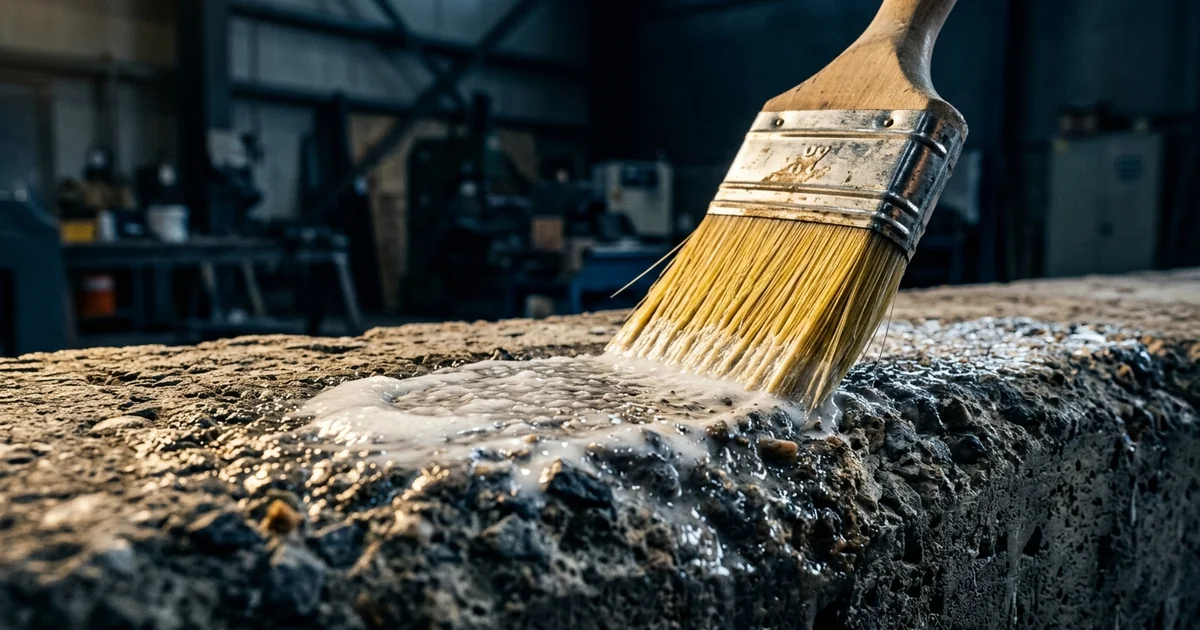
A concrete overlay that debonds from its substrate two winters after it was placed is a failure that rarely announces itself early — it starts as a hollow sound under a hammer and ends as a lifted, cracked patch that has to be broken out and redone. The old-to-new concrete interface is the weakest part of almost every repair, topping, or bonded screed, because fresh cementitious material has no natural chemical affinity for dense, cured, often contaminated concrete. A concrete bonding agent is the material engineered to bridge that gap, and choosing the wrong type — or applying the right type at the wrong moment — is behind a large share of repair callbacks across the construction chemicals industry. This guide explains what actually happens at the interface, how epoxy, SBR latex, and cement-slurry bonding agents differ in chemistry and behaviour, why open time and surface preparation decide the outcome more than the product label does, and how bond strength is verified. Read it and you will be able to specify or formulate a bonding system on the mechanism, not on marketing.
Why the Old-to-New Concrete Interface Fails
Understanding a bonding agent starts with understanding why a bare interface is weak in the first place, because the failure mechanisms are what each product class is designed to counter. Hardened concrete is a low-porosity, largely unreactive surface, and its outer skin is frequently the worst part of it: a laitance layer of weak cement fines, plus dust, curing-compound residue, oil, or carbonated material. When fresh mortar or concrete is placed against that skin, the bond it forms is thin, uneven, and mechanical rather than chemical.
Three loads then attack that fragile bond line over the service life of the repair:
- Differential shrinkage — the new layer shrinks as it cures while the old substrate, which finished shrinking years ago, does not, putting the bond line in sustained tension and shear
- Thermal cycling — a thin overlay heats and cools faster and further than the thermal mass behind it, so the interface is worked back and forth with every day-night and seasonal cycle
- Moisture transfer — a dry substrate wicks mixing water out of the fresh layer at the interface, starving the bond zone of the water it needs to hydrate and leaving a porous, weak boundary
A bonding agent addresses these by wetting the substrate better than cement paste, sealing or filling the surface pores, and providing a tough, sometimes flexible adhesive layer that co-cures with or keys into the new material. The mechanism it uses to do that is what separates one product class from another, which is where selection begins. For the wider context of how repair systems are built around this interface, our guide to polymer-modified repair mortars covers the mortar side of the same problem.
Concrete Bonding Agent Types Compared
Bonding agents fall into three broad chemistry families, and each trades bond strength against tolerance of real site conditions in a different way. The families are not interchangeable: an epoxy bonding agent and an SBR film coat solve the same problem with opposite constraints on open time, substrate moisture, and vapour permeability. Getting the family right for the job is a bigger decision than choosing a brand within a family, and it is central to practical construction chemicals specification.
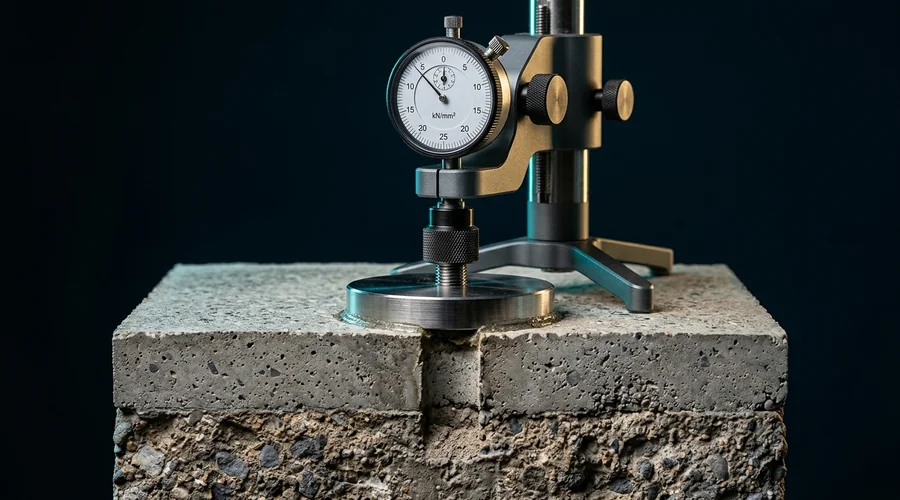
| Type | Chemistry | Bond Strength | Best Suited For |
|---|---|---|---|
| Epoxy bonding agent | Two-part reactive epoxy resin + hardener | Highest; structural connection possible | Structural repairs, smooth or low-porosity substrates, dry conditions |
| SBR latex bonding agent | Styrene-butadiene rubber polymer dispersion | Moderate to good | General repair, render and screed bonding, damp-tolerant work |
| Acrylic / PVA dispersion | Acrylic or polyvinyl acetate emulsion film | Low to moderate; PVA re-emulsifies if wetted | Internal, dry, non-structural bonding only (PVA unsuitable for external/wet use) |
| Cement-latex slurry bond coat | Cement + sand + SBR/acrylic, gauged on site | Good; forgiving wet-on-wet | Most repair mortar and overlay bonding when preparation is sound |
One distinction on that table matters more than any other for external or wet-exposed work: polyvinyl acetate (PVA) bonding agents re-emulsify when they get wet again, so a PVA bond line can fail simply from moisture reaching it, which is why PVA is confined to internal, permanently dry applications. The reactive epoxy and SBR families are where serious repair and overlay bonding is done, so each deserves a closer look at how its chemistry drives its behaviour on site.
Epoxy Bonding Agent Chemistry
An epoxy bonding agent is a two-component system in which a liquid epoxy resin, usually based on bisphenol-A diglycidyl ether, reacts with an amine or polyamide hardener to crosslink into a rigid, dense, chemically resistant polymer film. That reaction is irreversible and produces the strongest bond of any agent class, strong enough that the interface can be treated as a structural connection between old and new concrete. The film is also effectively impermeable to water, which is both its strength and its main constraint.
The chemistry imposes a specific way of working:
- Mix within the stated ratio — epoxy cure depends on stoichiometry; a mis-proportioned mix cures soft, tacky, or not at all, and the bond is lost
- Respect the pot life — once mixed, the resin begins to react and its viscosity climbs; beyond pot life it can no longer wet the substrate properly
- Place new concrete within the open time — the fresh layer must go down while the epoxy film is still wet and tacky so the two co-cure into one continuous bond
- Apply to a dry substrate — standard grades will not develop full adhesion on damp concrete, though moisture-tolerant epoxy grades exist for that situation
Because the impermeable film blocks vapour movement, an epoxy bonding agent is the wrong choice over a substrate that is damp underneath and needs to dry through the repair — the trapped moisture creates its own failure plane. That limitation is exactly where the breathable latex systems earn their place. For the closely related use of epoxy as a structural adhesive in its own right, see our guide to grouting technology for precast concrete connections.
Latex and Slurry Bond Coats
SBR latex bonding agents work on a completely different principle from epoxy: instead of a reactive cure, they rely on a styrene-butadiene rubber polymer that coalesces into a continuous, flexible, tacky film as its water carrier evaporates or is absorbed. That film improves adhesion, adds flexibility across the bond line, and — unlike epoxy — remains breathable, letting water vapour pass through the interface. SBR systems are also far more tolerant of the damp substrates and imperfect site conditions that repair crews actually encounter.
There are two ways to use an SBR bonding agent, and they behave very differently:
- Brushed film coat — the neat or diluted latex is brushed onto the substrate and the new material is placed while the film is still tacky; simple, but unforgiving if the film is left to dry to a non-porous skin before overlay
- Cement-latex slurry bond coat — the latex is gauged into a slurry of cement and fine sand, then scrubbed hard into the substrate; the new layer goes on wet-on-wet into the wet slurry, which is the most robust and forgiving method available
Acrylic dispersion bonding agents sit alongside SBR with broadly similar behaviour and generally better UV and ageing resistance, making them preferable where the bond coat might see light before overlay. Whichever latex system is chosen, its performance collapses if the substrate underneath it is not sound and correctly conditioned — which brings the discussion to the two variables that decide almost every bonding job.
Surface Preparation and Open Time
More bonded repairs fail from poor surface preparation and mistimed placement than from any deficiency in the bonding agent itself. A bonding agent is an aid to bond, not a substitute for a sound, clean, roughened, correctly conditioned substrate — and current repair-industry guidance increasingly treats mechanical preparation as the primary bond mechanism, with the agent as support. The two site variables that decide the outcome are the state of the surface and the timing of the overlay.
Substrate preparation
Preparation has to remove everything weak and expose sound, textured concrete for the bond to grip:
- Remove unsound material — all delaminated, cracked, spalled, or carbonated concrete is taken back to solid substrate
- Strip the weak skin — laitance, curing-compound residue, dust, oil, and paint are removed by scarifying, grit blasting, or high-pressure water jetting
- Open the texture — the target is an exposed-aggregate profile (commonly specified against the ICRI concrete surface profile chips) that gives real mechanical keying
- Condition the moisture — for cement and latex systems, pre-wet to a saturated-surface-dry state; for standard epoxy, ensure the surface is dry
Open time
Open time is the window between applying the agent and placing the concrete, and each chemistry has its own trap. Reactive epoxy must be overlaid while still wet and tacky, before it gels. Brushed SBR film coats must also still be tacky, not dried to a sealed skin. Cement-latex slurry coats are the most forgiving because they go on wet-on-wet, but even they must not dry out. Published open times assume moderate temperatures and shorten sharply in heat, wind, and low humidity — the International Concrete Repair Institute and manufacturer data sheets give the reference figures, but site judgement adjusts them.
Get preparation and timing right and a modest bonding agent will outperform a premium one applied carelessly — which is why product selection, covered next, is the last decision rather than the first.
Product Selection and Bond Testing
By the time a bonding agent is chosen, the substrate condition, the repair's structural role, the moisture state, and the required cure speed have already narrowed the field. Selection is a matter of matching those known constraints to a chemistry family, then verifying the result with a recognised bond test rather than trusting the data sheet alone. The decision logic is straightforward once the constraints are written down.
- Structural connection needed? — use a reactive epoxy bonding agent on a dry, sound substrate
- Substrate damp or needs to breathe? — use an SBR or acrylic latex system, ideally a scrubbed-in cement-latex slurry
- Preparation excellent and overlay cementitious? — a same-material slurry bond coat may be all that is required
- Internal, dry, non-structural only? — an acrylic dispersion is adequate; avoid PVA for anything that could get wet
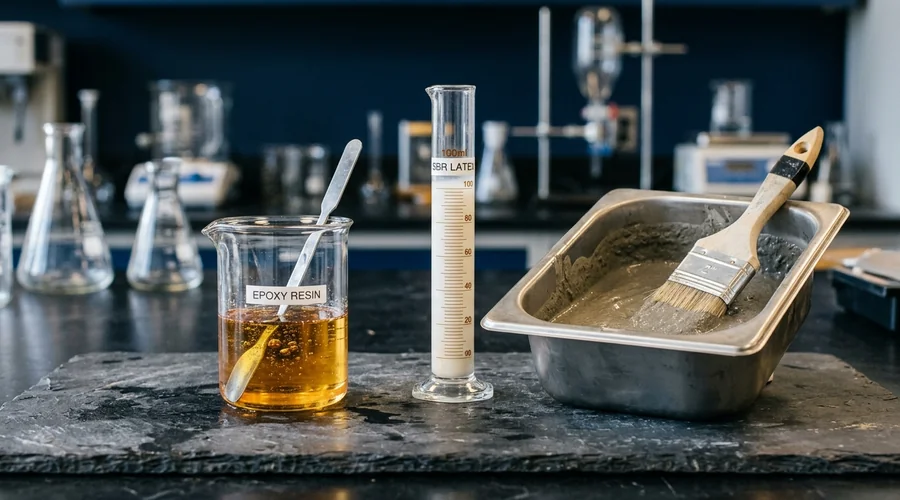
Whichever route is chosen, the bond should be proven with a pull-off (direct tension) test to ASTM C1583: a steel disc is bonded to the overlay, a partial core is cut into the substrate, and the disc is pulled to failure. A cohesive failure within the old concrete means the interface is stronger than the parent material — the target result. A clean adhesive failure at the bond line is a deficiency no matter how high the number. Slant shear testing to standards such as ASTM C882 is the common laboratory complement for comparing systems under combined compression and shear.
Manufacturing a Bonding Agent Product
For a manufacturer bringing a bonding agent to market, the formulation challenge is not raw adhesion — it is building a product that still works when a site crew uses it in conditions the lab never saw. A latex bonding agent that demands a 15-minute open time, or an epoxy that fails on the damp substrates its users will inevitably meet, produces field complaints that are slow and expensive to trace back to their cause. The product has to be engineered around real use, not ideal use.
The variables that decide whether a bonding agent product succeeds commercially include:
- Polymer selection and solids content — sets film continuity, flexibility, water resistance, and the realistic open time the product can offer
- Substrate-moisture tolerance — deciding early whether the product is positioned for SSD damp substrates or dry-only, and formulating and labelling accordingly
- Dispersion stability — the packaged latex must survive storage, transport, and freeze-thaw without irreversibly coagulating
- Batch consistency — solids, viscosity, and pH held within tight limits so every drum behaves like the one that passed qualification testing
Scaling a bonding agent from a lab formulation to drummed production brings the same nonlinear surprises common across construction chemicals, where mixing shear, addition order, and temperature control at plant scale rarely transfer directly from bench trials. Establishing that scale-up path and the quality-control regime around it early is what keeps a promising formulation from turning into a warranty problem after launch — and it is the point where formulation consultancy earns its keep.
Frequently Asked Questions
What does a concrete bonding agent actually do?
A concrete bonding agent is a liquid or slurry applied to an existing hardened concrete surface immediately before placing fresh concrete, mortar, or render, and its job is to create a durable adhesive bridge across the old-to-new interface that would otherwise be a plane of weakness. Old concrete is dense, largely non-reactive, and often contaminated with laitance or dust, so fresh cementitious material placed directly against it tends to bond only mechanically and unevenly.
The bonding agent wets the substrate more effectively than cement paste, penetrates surface pores, and either co-cures with the new layer (reactive epoxy and cement-latex slurries) or forms a tacky film that the new layer keys into (polymer dispersion types). The practical result is a bond line that transfers shear and tensile stress rather than delaminating under load, thermal cycling, or shrinkage.
What is the difference between an epoxy bonding agent and an SBR latex bonding agent?
An epoxy bonding agent is a two-component reactive system that cures chemically into a rigid, high-strength, moisture-impermeable film, producing the strongest possible bond and the option of a structural connection between old and new concrete. Its main constraints are a defined pot life, a limited open time within which the new material must be placed, and full incompatibility with damp or green substrates for many grades.
An SBR latex bonding agent is a styrene-butadiene rubber polymer dispersion that is either brushed on as a film coat or, more robustly, gauged into a cement slurry that is scrubbed into the substrate wet-on-wet. SBR systems are more forgiving of site conditions, breathable, and well matched to general repair and screed bonding, but they deliver lower ultimate bond strength than epoxy and the film-coat method is sensitive to being left too long before overlay.
Why is open time so important when using a concrete bonding agent?
Open time is the window between applying the bonding agent and placing the fresh concrete or mortar over it, and getting it wrong is one of the most common causes of bond failure on site. With reactive epoxy bonding agents, the new material must be placed while the epoxy is still wet and tacky so that it can co-cure and form a continuous chemical bond; if the epoxy has already gelled or cured, the overlay simply sits on a hard film and the bond is drastically weaker.
With brushed SBR film coats the opposite risk applies in a different form: the film must still be tacky, not fully dried to a non-porous skin, or the new layer cannot key into it. Cement-latex slurry bond coats are the most forgiving because they are placed wet-on-wet, but even those must not be allowed to dry out before the overlay goes down. Manufacturer data sheets give open times for stated temperatures, and those figures shorten sharply in hot, dry, or windy conditions.
Do you always need a bonding agent for a concrete repair or overlay?
Not always. Modern practice, reflected in guidance from bodies such as the International Concrete Repair Institute, increasingly favours achieving bond through aggressive mechanical surface preparation and correct saturated-surface-dry substrate conditioning rather than relying on a bonding agent as the primary bond mechanism.
A properly roughened, sound, clean, pre-wetted substrate can develop an excellent bond with a well-designed repair mortar or overlay using only a scrubbed-in bond coat of the same cementitious material. Bonding agents earn their place where preparation is limited, where the substrate is smooth or low-porosity, where a structural connection is required (epoxy), or where the overlay is thin and vulnerable to rapid moisture loss into the substrate. Using a bonding agent as a substitute for proper preparation is a frequent and costly mistake.
How is bond strength across the old-to-new concrete interface measured?
The most widely used method is the pull-off (direct tension) test, standardised under ASTM C1583, in which a steel disc is bonded to the surface of the new layer, a partial core is cut down through the overlay and slightly into the substrate, and a calibrated device pulls the disc until failure. Both the stress at failure and the failure location matter.
If the failure occurs cohesively within the old substrate concrete, the interface bond is stronger than the parent material, which is the target outcome. If it fails cleanly at the bond line, that is an adhesive failure and signals a genuine bonding deficiency, regardless of the numeric value. Slant shear tests are also used, particularly for comparing bonding agents and repair materials in the laboratory under combined compression and shear.
Can a bonding agent be used on a damp or freshly cast concrete substrate?
It depends entirely on the chemistry. Cement-based and cement-latex slurry bond coats, and many SBR dispersion products, are designed to be applied to a saturated-surface-dry substrate, meaning the concrete has been pre-wetted so its pores are full but no free water stands on the surface. Applying them to a bone-dry substrate lets the old concrete pull mixing water out of the bond coat and the fresh layer, weakening both.
Conventional epoxy bonding agents are the opposite: most standard grades require a dry substrate and will not cure properly, or will lose adhesion, if applied to damp concrete, though moisture-tolerant epoxy grades exist specifically for this situation. Always match the product's stated substrate moisture requirement to the real site condition rather than assuming.
When should a manufacturer bring in a formulation consultant for a concrete bonding agent product?
The most valuable point of engagement is at the system-design stage, when the polymer type, solids content, film-forming behaviour, open time, and substrate-moisture tolerance all have to be balanced against the target application and the realities of site use. A bonding agent that tests well in a controlled lab but has an unrealistically short open time, or that fails on damp substrates its users will inevitably encounter, generates field complaints that are expensive to trace and fix after distribution.
A consultant also adds value in scale-up, where polymer dispersion stability, freeze-thaw robustness of the packaged product, and batch-to-batch consistency of solids and viscosity need to be locked down before commercial launch. Engaging early is particularly important for manufacturers entering the construction chemicals repair segment for the first time.
Developing a Concrete Bonding Agent Product?
Global Formulation provides construction chemicals formulation consultancy, epoxy and latex bonding agent system design, dispersion scale-up guidance, and contract development support for repair product manufacturers worldwide.
Talk to Our Formulation Team