Bookbinding Adhesive Chemistry: PUR, EVA & Dextrin
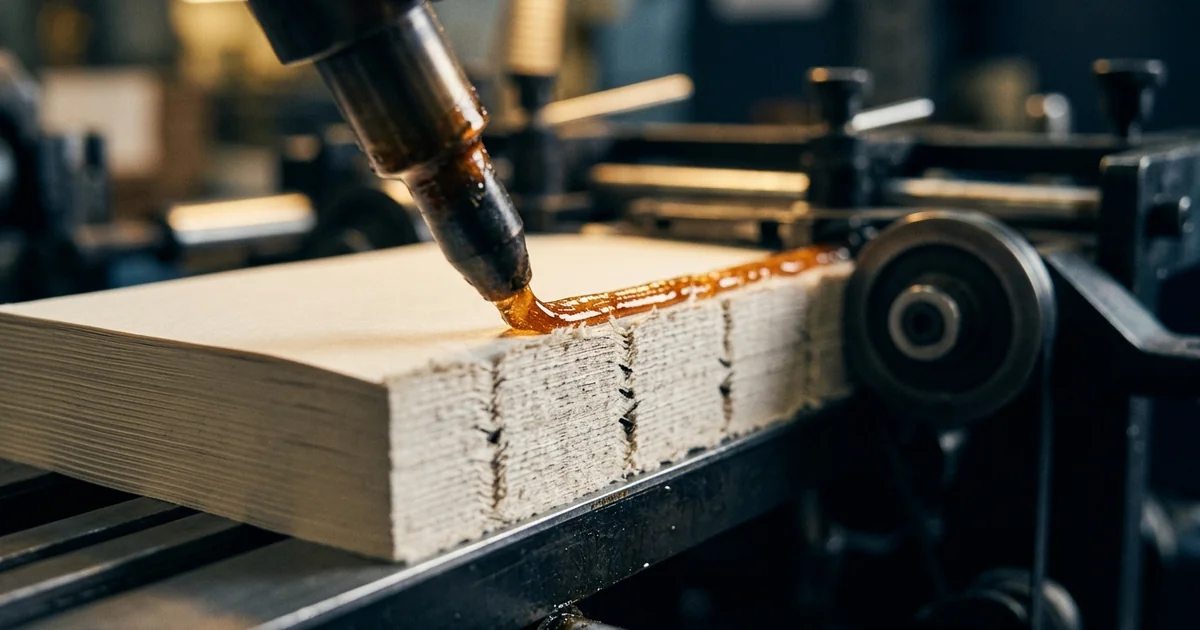
A publisher moves a 20,000-copy textbook run to a new printer to save a few cents a unit, and within a month the returns start: covers still attached, but loose pages sliding out of the spine after the books rode through an unheated winter warehouse. The reprint, the pulped stock and the bookseller's lost confidence cost far more than the binding line ever saved. Bookbinding adhesive chemistry is where that kind of failure is decided, because the glue on a book's spine or in its hinge has to survive years of flexing, temperature swings and handling that no other part of the product endures. This guide walks through the adhesive families that hold books and paper products together — EVA and PUR hot melts on the spine, dextrin and starch pastes in case-making and cartons, PVAc emulsions and protein glues in the book block, and water-based systems for paper lamination — and shows how each one matches a binding style, a substrate and a service condition. It reflects the substrate-and-service-first approach we bring to adhesives and sealants consulting, where a failed bond is traced back to the job it was asked to do as often as to the chemistry itself.
Why Bookbinding Adhesive Chemistry Follows the Binding Style
The single most useful thing to understand before comparing adhesives is that a book is not one bond but several, and each one has a different mechanical job. The spine of an adhesive-bound paperback has to resist a page being pulled straight out while also flexing every time the cover opens. The hinge of a hardcover has to bend thousands of times without cracking or telegraphing through the endsheet. A laminated board-book page has to stay bonded edge to edge through a toddler chewing it. Matching an adhesive to a book therefore starts with the binding style, not the glue catalogue.
Two quantities dominate the specification for any spine adhesive, and both are measured routinely in bindery quality control:
- Page pull strength — the force needed to draw a single leaf out of the bound spine, measured with a clamp and force gauge and reported per unit of bound length
- Flex endurance — how many open-and-close or page-turn cycles the spine survives under load before a page releases, measured on a flex tester with the book held open flat
Different binding styles load those two properties in different proportions, which is what steers the chemistry choice.
| Binding style | Dominant mechanical demand | Adhesive families used |
|---|---|---|
| Perfect binding (paperback, magazine) | Page pull plus moderate spine flex | EVA hot melt, or PUR reactive hot melt |
| Lay-flat / PUR binding (manuals, cookbooks, photo books) | High page pull with repeated full-open flex | PUR reactive hot melt |
| Case (hardcover) binding | Flexible hinge, block-to-case adhesion, no read-through | PVAc emulsion, PVAc/EVA blend, hot animal glue |
| Board and children's books | Sheet-to-sheet lamination, moisture and abuse resistance | PVAc and dextrin laminating adhesives |
| Cartons, slipcases, rigid boxes | Fibre-tearing bond on coated board | Water-based EVA/PVAc, dextrin |
Read that table as a decision order: fix the binding style and the service environment first, and the field of candidate chemistries narrows to two or three before cost even enters the conversation. The rest of this guide takes each family in turn, starting with the one that binds the most books.
EVA Hot Melts: The Perfect Binding Workhorse
Ethylene-vinyl acetate hot melt is the default spine adhesive for high-volume perfect binding, and it earns that position through speed and simplicity rather than ultimate performance. An EVA hot melt is a fully thermoplastic blend — an EVA base polymer for cohesive strength, a tackifying resin to wet the paper, and a wax to control melt viscosity and set speed — that carries no solvent and no water. It is applied molten from a roller or nozzle onto the milled spine at roughly 150 to 175 degrees Celsius, and it builds essentially its entire bond in the seconds it takes to cool and solidify. That means a book can be clamped, cased and trimmed almost immediately, which is exactly what a line running thousands of books an hour needs. The mechanism and compounding logic are the same across the category, and are covered in depth in our guide to hot melt adhesive chemistry.
The limits of EVA all trace back to the fact that it stays thermoplastic for the life of the book:
- Cold embrittlement — the film stiffens as temperature falls and typically loses useful flex near or just below freezing, the root cause of pages dropping out of books shipped in winter
- Heat softening — the same low softening point that makes EVA easy to apply lets the spine creep or re-soften in a hot truck or a sunlit shop window
- Difficult substrates — clay-coated covers and toner-fused digital text stock give the melt little raw fibre to grip, so page pull suffers without aggressive spine milling
- Higher add-on — because the bond is weaker per unit area than a cured reactive adhesive, EVA needs a thicker spine glue line to hit the same page-pull target
For a mass-market paperback that lives its life indoors, none of those limits matter and EVA is the correct, economical choice. When the book has to survive cold logistics, lie genuinely flat, or bond a coated stock, the specification moves to a reactive chemistry.
PUR Reactive Hot Melts: Moisture-Cure Chemistry and Why It Wins
Reactive polyurethane hot melt, universally shortened to PUR, is the premium spine adhesive, and it behaves in two stages. It is a polyurethane prepolymer whose chains are capped with reactive isocyanate groups, applied molten at a lower temperature than EVA — commonly 120 to 140 degrees Celsius. On contact with the cooler spine it sets physically like any hot melt, giving enough green strength to move the book down the line. Then the chemistry starts: the isocyanate end groups react with water vapour from the air and moisture already present in the paper, forming urea linkages that stitch the prepolymer chains into a cross-linked network. This is the same moisture-cure mechanism used in polyurethane sealants, applied to a thin adhesive film instead of a joint bead.
The cured network is a genuinely different material from a thermoplastic EVA bond, and the performance gap shows up on every axis that matters for a book that has to last:
| Property | EVA hot melt | PUR reactive hot melt |
|---|---|---|
| Bond development | Full strength on cooling, seconds | Green strength on cooling, full cure over 24–48 h |
| Application temperature | ~150–175 °C | ~120–140 °C |
| Page pull after cure | Baseline | Markedly higher for the same glue line |
| Adhesive add-on for equal strength | Higher film weight | Roughly half |
| Cold flex | Embrittles near 0 °C | Stays flexible below −40 °C |
| Heat resistance | Re-softens in hot transit | Cross-linked; resists re-melting |
| Coated & digital stock | Marginal without heavy spine prep | Tolerates low-energy surfaces better |
| Equipment | Open melt tank | Sealed, moisture-protected melter with purge routine |
PUR's costs are real and worth naming. The adhesive is more expensive per kilogram, the equipment must keep the melt sealed from air or it skins and cures inside the machine, and unused material in the hose has to be purged on shutdown. Binders accept that overhead because PUR is the only mainstream spine chemistry that delivers cold-crack resistance, heat stability and true lay-flat behaviour at once — which is why manuals, cookbooks, photo books and library-grade paperbacks are almost all PUR-bound today.
Dextrin and Starch Adhesives: Case-Making, Tube Winding and Cartons
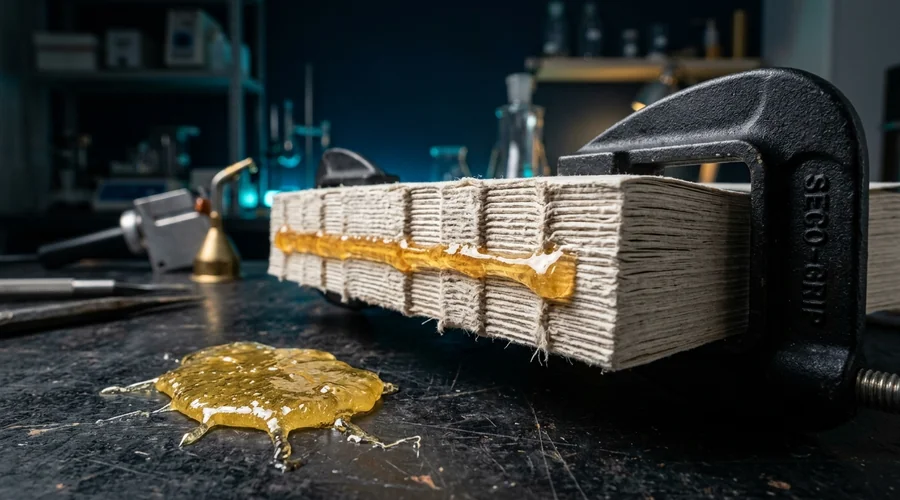
Away from the spine, most of the adhesive in a book and in paper packaging is still water-based and made from starch. Dextrins are starches that have been partially broken down — depolymerised — by heating them with a small amount of moisture and a catalyst, a process called dextrinisation. The result is a family of adhesives that dissolve or disperse in water, dry to a hard fibre-bonding film, cost very little, and release no solvent. They will not go on a modern perfect-bound spine because they lack the flex endurance, but they dominate dextrin paper adhesive applications like case-making, tube and core winding, bag and envelope seams, bottle labelling, and remoistenable gummed tape.
The trade splits dextrins into three classes by how they are converted, and the class determines the working properties:
| Type | Conversion conditions | Character | Typical use |
|---|---|---|---|
| White dextrin | Acid catalyst, lower roast temperature | Light colour, lower viscosity, faster tack, more water-sensitive film | Flat gumming, envelope seams, remoistenable labels |
| Yellow (canary) dextrin | Acid catalyst, higher roast temperature and longer time | Darker, high cold-water solubility, high solids, strong film | Case-making, tube winding, bottle labelling, laminating |
| British gum | Alkaline catalyst, prolonged high-temperature roast | Dark, high viscosity, long tack, cohesive | Gummed tape, heavy paper and board laminating |
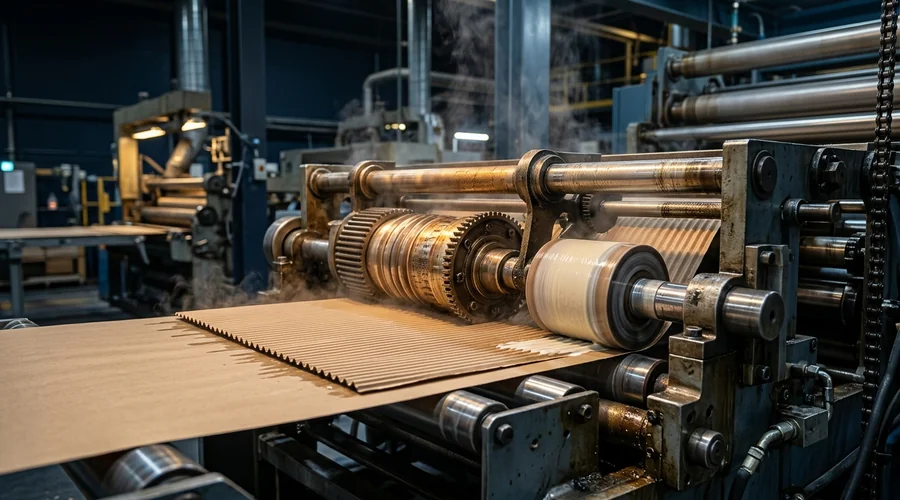
The largest single use of starch adhesive in the paper industry is corrugated board itself. The fluted medium is bonded to the flat linerboard with a starch-based adhesive at the single-facer, almost always a Stein-Hall formulation: a small fraction of the starch is fully cooked with caustic soda into a thin carrier, raw ungelatinised starch is suspended in that carrier with borax, and the mix stays fluid until it hits the hot corrugator rolls and gels sharply to grab the paper. Sealing the finished corrugated carton flaps is a separate downstream step that usually switches to a water-based EVA or PVAc emulsion for faster set on the packing line.
Starch chemistry, in other words, is the invisible backbone of paper converting — cheap, green, and strong enough for fibre-to-fibre bonds that never have to flex. Where the bond does have to flex, the industry reaches for a polymer emulsion instead.
PVAc and Protein Glues: Building and Casing-In the Book Block
The assembly of a hardcover book — turning folded sections into a text block and then joining that block to its rigid case — runs on two older water-based chemistries. Polyvinyl acetate emulsion, the same white glue family used in wood glue manufacturing, dries to a clear, permanently flexible film that makes an ideal book hinge: it bends through thousands of open-and-close cycles without cracking and without reading through the thin endpaper. Hot animal glue — a protein adhesive rendered from hide and bone collagen — sets by gelling as it cools, giving an almost instant grab that lets a casemaking machine or a hand binder position boards and turn edges without waiting.
Each chemistry owns a specific step in the sequence:
- Text block gluing — a flexible PVAc or PVAc/EVA blend applied to the gathered spine, sometimes over a sewn block, sometimes as the sole bond in adhesive binding
- Spine lining — animal glue or PVAc used to attach a mull (gauze) and paper lining that transfer stress from the block to the case
- Casemaking — animal glue or a fast-setting PVAc/dextrin blend bonding cloth or paper over the boards
- Casing-in — PVAc emulsion pasting the endpapers to the inside of the case, the bond a reader stresses every time the cover opens
Traditional and conservation binderies still favour animal glue for one practical reason beyond tack: it can be softened again with heat and moisture, so a damaged joint can be opened and repaired decades later without destroying the book. That reversibility is a feature in library binding and a liability nowhere else, which is why production lines have largely moved to PVAc.
Paper Lamination Adhesives: Bonding Sheets, Covers and Boards
Laminating one sheet of paper or board to another is its own adhesive problem, distinct from spine binding, and it turns on controlling water. A wet water-based adhesive swells the paper fibres on the side it touches; if the bonded sheets then dry at different rates, the laminate curls or warps, which is unacceptable for a book cover wrapped onto a board or a printed sheet mounted to backing. Paper lamination adhesive chemistry is largely about getting a strong fibre bond while putting down as little water as the process allows and letting both plies equilibrate.
- Dextrin and starch laminating pastes — lowest cost, used for paper-to-board mounting and rigid box wraps where some press time to flatten the laminate is available
- PVAc emulsion laminating adhesives — faster setting, more flexible dry film, used for book cover lamination and case wraps
- PVAc/EVA copolymer blends — tuned for machine lamination speed with reduced curl on lighter stocks
Bonding a printed film rather than paper — the glossy or matte plastic layer on a book jacket or carton — is a different chemistry again, using solventless polyurethane or acrylic systems covered in our guide to flexible packaging lamination adhesives. The dividing line is simple: porous substrate, water-based paper adhesive; non-porous film, reactive laminating adhesive that does not need a route for water to escape.
Get the water balance right and a paper laminate stays flat for the life of the product; get it wrong and no amount of bond strength saves a warped cover. That leaves one question — how to choose among all these families for a given job.
Matching Adhesive Chemistry to the Binding Job
Every adhesive covered here is the right answer for some book and the wrong answer for others. A dextrin case-making paste would fail instantly on a perfect-bound spine, and a PUR hot melt would be a wasteful, over-engineered choice for laminating a slipcase. Selection comes down to working through four questions in order, because each one eliminates whole families before the next is asked.
- What is the binding style? Spine binding points to hot melt; block assembly and casing-in point to PVAc and animal glue; sheet and board work points to starch and PVAc laminating adhesives.
- What service environment will the book see? Cold logistics, hot storage, or a demand to lie flat rules out plain EVA and points to PUR.
- What is the substrate? Coated cover stock and digital text stock need either aggressive spine prep with EVA or the surface tolerance of PUR; uncoated stock is forgiving of either.
- What do volume and cost allow? Very high volumes with indoor-only service justify EVA's lower cost; lower volumes or premium products absorb PUR's material and equipment overhead easily.
The mistake that drives most binding failures is skipping straight to question four. A printer who chooses the cheapest spine adhesive without first asking where the books will travel is the printer who takes the winter return. Specify the job — style, environment, substrate — and let those constraints choose the chemistry, then treat price as the tie-breaker among the survivors rather than the first filter.
Frequently Asked Questions
What is the difference between EVA and PUR binding glue?
EVA is a thermoplastic hot melt that builds its full bond as it cools and solidifies, which takes only seconds, so an EVA-bound book can be trimmed and packed almost immediately. PUR is a reactive hot melt built on an isocyanate-terminated polyurethane prepolymer that sets physically on cooling but then chemically cross-links with ambient and paper moisture over the following day or two, reaching a bond that is substantially stronger and stays flexible in cold weather.
The practical trade is speed and simplicity against performance: EVA runs on a basic melt tank, while PUR needs a sealed, moisture-protected melter and a purge routine, but it delivers higher page pull, a spine that lies flatter, and resistance to both cold cracking and hot-transit softening.
Why do perfect-bound book pages sometimes fall out in winter?
Standard EVA hot melt spine adhesive becomes progressively more brittle as temperature drops and typically loses useful flexibility near or just below freezing. A book that ships or is stored in an unheated warehouse or truck in winter can reach a temperature where the spine glue line cracks under the normal flex of opening the cover, and once the film fractures, pages release.
Reformulating with a lower-softening-point EVA helps only marginally. The durable fix for books that must survive cold logistics is PUR reactive hot melt, which remains flexible well below minus 40 degrees Celsius because it is cross-linked rather than simply frozen thermoplastic.
What is PUR adhesive and why does it need moisture to cure?
PUR reactive hot melt is a polyurethane prepolymer whose chains are capped with reactive isocyanate groups. When the applied adhesive is exposed to water molecules from the surrounding air and from the paper itself, those isocyanate groups react to form urea linkages and release carbon dioxide, joining the prepolymer chains into a cross-linked network that no longer melts on reheating.
Because the reaction consumes atmospheric moisture, full cure depends on ambient humidity and generally takes 24 to 48 hours. The same reactivity means unused adhesive must be kept sealed from air, or it will skin over and cure inside the equipment.
Are dextrin and starch adhesives still used in commercial bookbinding and paper converting?
Yes, extensively, though rarely on the spine of a modern adhesive-bound book. Dextrins are partially hydrolysed starches, classified as white dextrins, yellow or canary dextrins, and British gums depending on whether an acid or alkaline catalyst is used and how hot and long the starch is roasted.
They remain the standard chemistry for case-making, tube and core winding, bag and envelope seams, bottle labelling, remoistenable gummed tape, and paper-to-board laminating, because they are inexpensive, water-based, bond fibre to fibre strongly, and carry no solvent load.
What adhesive is used to bond corrugated cardboard boxes?
The corrugated board itself is made by bonding the fluted medium to the flat linerboard with a starch-based adhesive at the single-facer and double-backer sections of the corrugator. Most plants run a Stein-Hall type formulation: a small fraction of the starch is fully cooked with caustic soda and water into a thin carrier, and raw ungelatinised starch is suspended in that carrier along with borax, so the mix stays fluid until it hits the hot rolls and then gels sharply to grab the paper.
Sealing the finished box flaps is a separate step that usually uses a water-based EVA or PVAc emulsion adhesive for a fast set on the packing line.
Can you perfect-bind onto coated or digitally printed paper?
You can, but the spine preparation matters more than the adhesive choice. Clay-coated stock and toner-fused digital prints give a hot melt very little raw fibre to key into, so the binder must mill and notch the spine aggressively to expose fresh paper edges and create mechanical grip.
With proper spine prep, PUR reactive hot melt bonds coated and digital stock reliably because its cross-linked film tolerates the low-energy surface better than EVA. Without spine prep, even PUR will let pages pull cleanly out of a coated sheet.
What glue holds a hardcover book's cover to the pages?
A hardcover, or case-bound, book is assembled in stages with more than one adhesive. The folded sections are sewn or adhesive-bound into a text block, the spine is lined, and then the endpapers are pasted to the inside of the rigid case during the casing-in step, most often with a PVAc emulsion or a PVAc and EVA blend chosen for a flexible hinge that will not read through the endsheet.
Traditional and conservation binderies still use hot animal glue for casemaking and for rounding and backing the spine, valuing its fast initial tack and the fact that it can be reactivated with heat and moisture for later repair.
Developing a Binding or Paper Adhesive Product?
Global Formulation provides adhesive and sealant consultancy — hot melt and emulsion chemistry selection, substrate matching, application-line process design, and scale-up from lab to production. For the commercial planning side, the Water-Based Packaging & Paper Adhesives Standard Project Report is a costed India-basis feasibility study covering corrugation gum, dextrin, gummed-tape and lamination adhesive across three investment configurations.
Talk to Our Formulation Team