Carpet Cleaner Formulation: Foam vs Extraction Chemistry
A facilities manager signs off on a professional carpet clean, the building looks immaculate on Monday, and by the end of the month the main traffic lanes are visibly greyer than they were before the work started. That outcome is so common it produced a durable industry myth — that cleaning carpet makes it get dirty faster — and the myth is really a formulation failure with a specific chemical cause. Carpet cleaner formulation chemistry is unusual because the product's most important performance property is not how well it lifts soil on the day, but what it leaves behind in the pile afterwards. Every litre of solution sprayed into a carpet is applied to a substrate that cannot be rinsed the way a hard floor can, so residue behaviour governs whether a customer sees a clean that lasts three months or three weeks. This guide covers why residue defines the category, how high-foam shampoo and low-foam extraction products are built to opposite specifications, what encapsulation polymers actually do, how fibre type and pH constrain the whole formula, and what certification demands of a manufacturer entering the professional channel. It reflects the formulation discipline we apply across household and industrial cleaners consulting work.
Why Carpet Cleaner Formulation Chemistry Is a Residue Problem
Carpet is the only major cleaning substrate that traps the cleaning product inside itself. A worktop is wiped, a floor is mopped and rinsed, but carpet pile holds solution deep in the yarn bundles and at the base of the tufts where no realistic rinse fully reaches. Whatever surfactant stays there dries onto the fibre and becomes a permanent part of the surface until the next clean.
That matters because conventional detergent residue dries to a soft, faintly tacky film. Dry particulate soil — the overwhelming majority of what a shoe carries into a building — then adheres to that film instead of falling to the base of the pile where a vacuum can retrieve it. The carpet greys from the top down, and it does so fastest in exactly the traffic lanes the customer notices. The standard technical account of carpet cleaning methods records this plainly: shampoo residues can continue to collect dirt after cleaning, which is the origin of the belief that cleaning makes carpet dirtier faster.
For a formulator, that reframes the whole brief. Detergency is table stakes; residue behaviour is the differentiator. Four properties end up carrying most of the product's commercial value:
- Residue character on drying — whether the dried film is tacky and soil-attracting, or brittle and vacuum-removable
- Foam profile matched to the machine — high foam for rotary shampoo, deliberately suppressed foam for extraction equipment
- pH held inside the fibre's safe window — because the substrate can be permanently damaged in ways a hard surface cannot
- Drying time — governing whether a space can be returned to service in hours, and whether the backing stays wet long enough to cause secondary problems
Those four pull against each other, and the method the customer uses decides which compromise is acceptable. That starts with the oldest method still in commercial use.
Foam Shampoo Chemistry: Building Foam That Dries Brittle
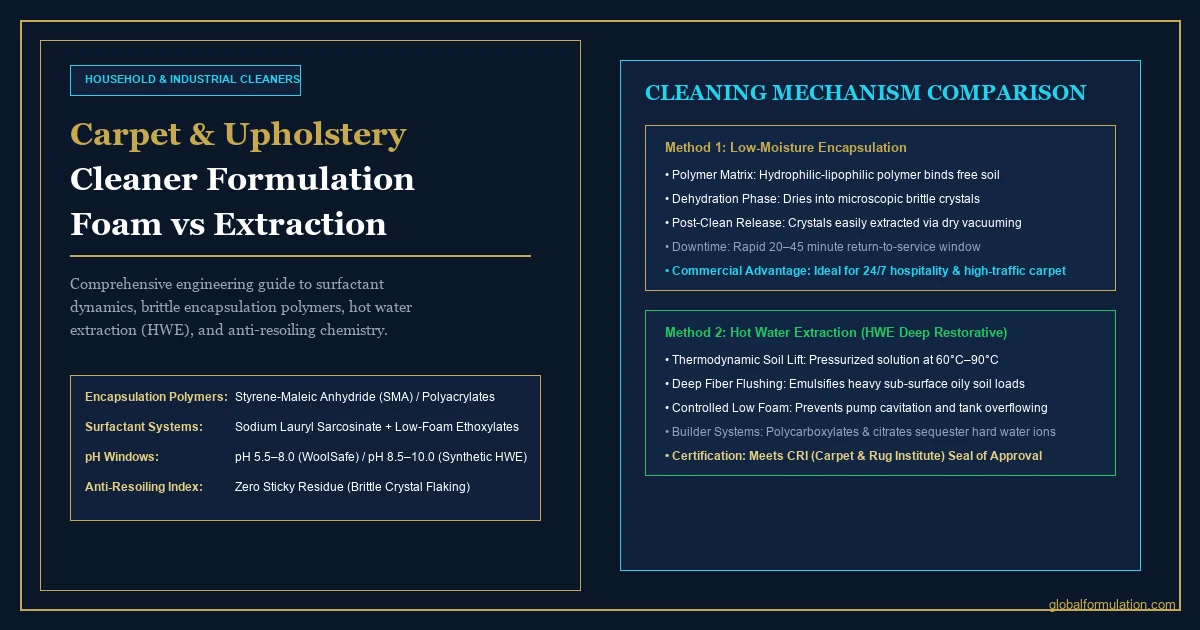
Rotary shampoo works by generating a dense foam and driving it into the pile with a brush, and the foam is not cosmetic — it is the delivery mechanism. Foam carries surfactant to the fibre surface while holding total water content low, which is precisely why the method survives in situations where a soaked carpet would be unacceptable. The formulation problem is that the properties which make foam stable enough to work are also the properties that historically made shampoo residue so troublesome.
Foam volume and wet stability come from the surfactant system and the boosters built around it. Amphoteric surfactants such as betaines, along with amine oxides, are widely used to stabilise the foam structure and slow drainage so the foam survives long enough to be worked through the pile. The wider mechanics of building and controlling foam are covered in our guide to foam control in cleaning products, and the same principles apply in reverse here — this is one of the few cleaning categories where foam is engineered up rather than suppressed.
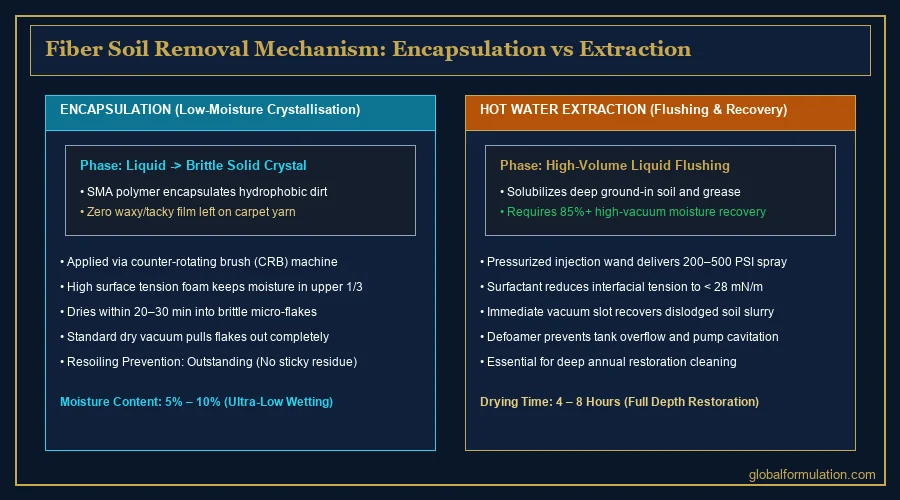
The modern fix for the residue problem is to change what the residue is rather than to try to eliminate it. Crystallising polymers are built into the shampoo so that as the foam dries, the film that remains sets hard and brittle instead of soft and tacky. Under foot traffic it fractures into fine particles, and routine vacuuming lifts those particles — and the soil bound up with them — out of the pile.
Shampoo's remaining limitation is that it removes soil to the surface and relies on vacuuming to take it away, with no flushing step at all. Where soil has been walked deep into the backing over years, the industry turns to a method that does flush.
Hot Water Extraction: Prespray Chemistry and the Acid Rinse
Hot water extraction is the method most carpet manufacturers point to for restorative cleaning, and it is widely — if inaccurately — called steam cleaning, since no steam is involved. Heated solution is injected into the pile under pressure and immediately drawn back out by vacuum, carrying suspended soil with it. Because the process actually flushes the carpet, it is the only common method that removes soil from the structure rather than bringing it to the surface for a vacuum to collect.
Effective extraction is a two-chemistry system, and treating it as one product is the most frequent formulation mistake in the category. An alkaline prespray is applied first and given dwell time with agitation: alkalinity saponifies fatty soils and swells the soil matrix so it releases its grip on the fibre, often supported by glycol ether solvents for oily soil and by enzymes where protein staining dominates. The extraction step then flushes with an acidic rinse, which neutralises the prespray so that no alkaline residue is left sitting in the pile.
The rinse is where several problems are solved at once. Neutralising alkalinity protects the fibre, removes the tacky alkaline salts that would otherwise drive resoiling, and helps control cellulosic browning — the discoloration that wicks up from a jute backing when a carpet has been over-wet. Extraction detergents are also deliberately low-foaming, since foam carried into the recovery tank reduces suction and can reach the vacuum motor.
| Method | Foam Requirement | Moisture Level | Soil Removal Route | Best-Fit Use |
|---|---|---|---|---|
| Rotary shampoo | High foam, engineered up | Low to moderate | Brought to surface; removed by later vacuuming | Water-sensitive installations, budget maintenance |
| Hot water extraction | Low foam, actively suppressed | High | Flushed out and captured in recovery tank | Restorative deep cleaning, heavy soil loads |
| Encapsulation | Low to moderate | Very low | Crystallised around soil; vacuumed over following days | Interim maintenance in occupied commercial space |
| Bonnet / absorbent pad | Low | Low | Transferred to an absorbent pad | Fast surface appearance work in high-traffic areas |
Matching the foam profile to the machine is not a refinement — a shampoo poured into an extractor will flood the recovery system, and an extraction detergent in a shampooer simply will not foam enough to function. Method and chemistry are a single decision, which is exactly what made the next development so commercially disruptive.
Encapsulation Chemistry and the Low-Moisture Shift
Encapsulation arrived in the 1990s and reshaped commercial carpet maintenance by attacking the residue problem at its root rather than working around it. The method uses specialty detergent polymers — generally acrylic or styrene-acrylic copolymers — that surround soil particles as the applied solution dries. Instead of a soft film, the polymer sets into a brittle crystalline structure that locks the detergent and the soil together inside it.
What follows is deliberately slow, and that is the part newcomers to the category misunderstand. Foot traffic fractures the crystals over the following hours and days, and routine vacuuming progressively lifts them out. The clean continues improving after the technician has left the building, which is a very different service proposition from extraction's immediate result. The trade-offs are worth stating directly:
- Very short dry times — moisture use is far lower than extraction, so occupied space returns to service quickly
- Resoiling resistance by design — the crystalline residue cannot behave as a tacky soil magnet
- Dependence on the vacuuming regime — the method only completes if the site actually vacuums, which makes it unsuitable for poorly maintained premises
- Limited on heavy embedded soil — with no flushing step, deeply loaded carpet still needs periodic restorative extraction
- Polymer build-up over repeated cycles — a real consideration in maintenance programmes, and a reason encapsulation is positioned as interim rather than exclusive
Encapsulation is therefore best sold as part of a maintenance cycle rather than as a replacement for extraction, and formulators serving this channel usually build a matched range rather than a single product. Whichever method a range targets, one constraint sits underneath all of them and cannot be formulated around: the fibre itself.
Fibre Type, pH and the Upholstery Constraint
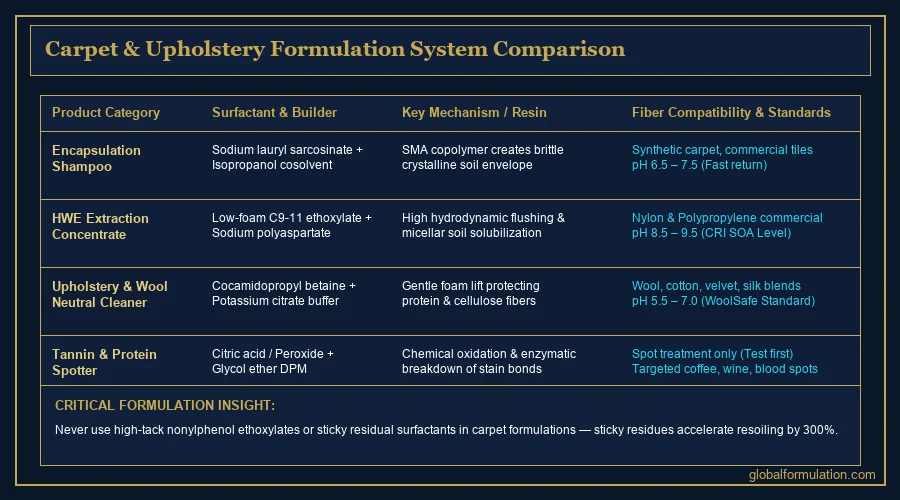
Carpet is not one substrate, and the differences between fibres are severe enough to make a single universal product commercially dishonest. Wool is a protein fibre and is attacked by alkalinity, so wool-safe chemistry sits near neutral or mildly acidic and high-pH products can cause damage that cannot be reversed. Nylon tolerates alkalinity far better as a fibre, but the acid-dye-blocker stain-resist treatment on most residential nylon can be stripped by aggressive high-pH cleaning — leaving a carpet that looks undamaged yet stains permanently more easily afterwards.
Synthetic olefin and polyester behave differently again. Both are oleophilic, holding oily soil tenaciously while shrugging off water-based staining, which shifts the formulation emphasis toward solvency rather than pH aggression. The interaction between pH and cleaning performance across product types is set out more fully in our guide to acid, neutral and alkaline cleaning products.
| Fibre | pH Tolerance | Primary Risk | Formulation Emphasis |
|---|---|---|---|
| Wool | Near-neutral to mildly acidic only | Alkaline attack on the protein structure; browning | Controlled pH, gentle surfactants, thorough neutralisation |
| Nylon | Tolerates moderate alkalinity | Stripping of acid-dye stain-resist treatment | Effective soil release without over-alkalinity |
| Polyester (PET) | Broad | Oily soil retention; permanent oil staining | Solvency and emulsification of oleophilic soil |
| Olefin / polypropylene | Broad | Oily soil retention; pile crush under heat | Solvent-assisted detergency, controlled temperature |
Upholstery narrows every one of these constraints further. Fabric sits over foam and a frame rather than on a floor, so deep wetting causes water rings, wicking as the piece dries, and possible shrinkage; fibre content is frequently unknown or mixed; and colourfastness is far less reliable than in carpet, which is why a hidden-area test is standard practice. Those constraints push upholstery products toward lower moisture, faster drying and gentler chemistry, and they explain why spot cleaners are built around specific soil types — solvent-based for oily marks, enzyme-containing for protein spots — rather than sold as universal spotters. Similar surfactant-synergy thinking applies across the wider range, as covered in our work on multi-surface cleaner surfactant synergies.
Certification, Testing and Entering the Professional Market
The professional carpet care channel is gated in a way the consumer cleaning aisle is not, and that gate is the single biggest surprise for manufacturers entering the category. Carpet mills reference approved cleaning chemistry in their warranty terms, which means a professional cleaner risks a customer's warranty by using an uncertified product. Certification is therefore a commercial requirement rather than a marketing enhancement.
The Carpet and Rug Institute's Seal of Approval programme subjects cleaning solutions to laboratory testing and certifies those that remove soil effectively without adversely affecting the appearance or the performance of the carpet — a two-part test that catches products which clean aggressively at the cost of the substrate. Soil-release treatments carry a separate and increasingly urgent question, since the fluorochemical protectors long used for stain resistance are PFAS-based, and PFAS chemistry is under sustained regulatory scrutiny worldwide. Any protector product developed today needs a credible non-fluorinated path.
A workable route to market in this category runs roughly as follows:
- Choose the method the range serves first — shampoo, extraction or encapsulation, because foam specification and polymer choice follow from that decision and cannot be retrofitted
- Fix the fibre scope — decide whether wool is in or out, since its pH window will otherwise constrain every product in the line
- Design the residue, not just the detergency — validate the dried film's physical state, since that determines the resoiling performance customers actually judge you on
- Test resoiling over time, not cleaning on the day — accelerated soiling on standard swatches after cleaning is what separates a durable product from a good first impression
- Budget for certification early — testing costs and lead times belong in the development plan, not discovered after the formula is locked
- Match the concentrate and dilution system to the channel — professional operators buy concentrates and dose them on site, which is a different packaging and stability problem from a retail ready-to-use bottle
The decision framework for this category is narrower than it looks from outside. Pick the method, fix the fibre scope, engineer the residue rather than fight it, and prove the result four weeks after cleaning rather than four minutes after. A carpet cleaner that looks brilliant on the day and greys out by the month is not a marketing problem to be solved later — it is a formulation that has not finished.
Frequently Asked Questions
Why does carpet get dirty faster after cleaning?
The usual cause is surfactant residue left in the pile after cleaning. Conventional detergents dry to a soft, slightly tacky film on the fibre, and that film behaves as a soil magnet — dry particulate soil tracked in on shoes sticks to it instead of falling to the base of the pile where a vacuum can lift it out.
The result is a carpet that looks visibly grey again within weeks, which is where the long-standing belief that cleaning makes carpet dirty faster comes from. Modern carpet cleaner formulation chemistry addresses this directly by using polymers that dry brittle and crystalline rather than tacky, so any residue fractures under foot traffic and is removed by routine vacuuming.
What is the difference between carpet shampoo and hot water extraction chemistry?
They are formulated to opposite foam specifications because the machines demand opposite things. A rotary shampoo is deliberately high-foaming: the foam is the working medium that carries surfactant into the pile under brush agitation while keeping total moisture low, so foam boosters and stabilisers are built into the formula.
A hot water extraction product must be low-foaming, because foam carried into the recovery tank and vacuum path reduces suction and can damage the vacuum motor. The active chemistry may overlap considerably, but a shampoo used in an extractor will flood the recovery system, and an extraction detergent used in a shampooer will not generate enough foam to work.
What is encapsulation carpet cleaning and how does the chemistry work?
Encapsulation is a low-moisture method built around specialty detergent polymers, typically acrylic or styrene-acrylic copolymers, that surround soil particles as the product dries. Rather than drying to a sticky film, the polymer sets into a brittle crystalline structure that traps the detergent and the soil together inside it.
Foot traffic then fractures those crystals and ordinary vacuuming lifts them out of the pile over the following days. Because it uses far less water than extraction, dry times are short and the method suits commercial spaces that cannot be taken out of service, though it is generally positioned as interim maintenance between deeper restorative cleans rather than a full replacement for extraction.
Why do carpet cleaning systems use an alkaline prespray and an acidic rinse?
The two steps do different jobs and are formulated to different pH targets on purpose. The prespray is alkaline because alkalinity saponifies fatty soils and swells the soil matrix so it releases from the fibre, and it is given dwell time and agitation to work before any water is introduced.
The rinse is acidic to neutralise that alkalinity, because alkaline residue left in the pile is both a resoiling risk and a genuine hazard to wool and to stain-resist treatments on nylon. An acid rinse also helps control the cellulosic browning that can wick up from a jute backing when a carpet has been over-wet.
Can the same carpet cleaner be used on wool and nylon?
Not safely, and fibre identification should precede product selection every time. Wool is a protein fibre and is attacked by alkalinity, so wool-safe products are formulated to a near-neutral to mildly acidic pH and high-pH cleaners can cause irreversible damage to the fibre.
Nylon tolerates far more alkalinity as a fibre, but most residential nylon carpet carries an acid-dye-blocker stain-resist treatment that aggressive high-pH chemistry can strip, leaving the carpet permanently more prone to staining even though the fibre itself looks undamaged. A formulator serving both markets generally builds separate products rather than one compromise, because the pH windows do not overlap usefully.
What does CRI Seal of Approval certification mean for a carpet cleaning product?
The Seal of Approval programme run by the Carpet and Rug Institute puts cleaning solutions through laboratory testing and certifies those that remove soil effectively without adversely affecting the appearance or performance of the carpet. For a manufacturer, the practical significance goes beyond the logo: carpet mills frequently reference approved chemistry in their warranty terms, so certification affects whether a professional cleaner can use a product without putting a customer's carpet warranty at risk.
That makes certification a commercial gate rather than a marketing extra for anyone selling into the professional channel, and the testing cost belongs in the development budget from the start.
How is an upholstery spot cleaner formulated differently from a carpet cleaner?
Upholstery formulation is constrained mainly by moisture and by substrate uncertainty. Fabric is mounted over foam and a frame rather than laid on a floor, so a product that wets deeply risks water rings, wicking as the piece dries, and shrinkage or distortion of the covering, which pushes upholstery products toward lower moisture and faster drying.
The fibre content is also frequently unknown or mixed, and many upholstery fabrics are far less colourfast than carpet, which is why a colourfastness check on a hidden area is standard practice before any product is applied. Spot cleaners are additionally built around specific soil chemistries — solvent-based for oily marks, enzyme-containing for protein spots, tannin-targeted for beverages — because a single universal spotter performs poorly across all of them.
Developing a Carpet or Upholstery Care Range?
Global Formulation provides cleaning product consultancy — surfactant and polymer selection, foam profile design for shampoo and extraction equipment, resoiling testing and certification strategy.
Talk to Our Formulation Team