Cascade Temperature Control of Jacketed Reactors
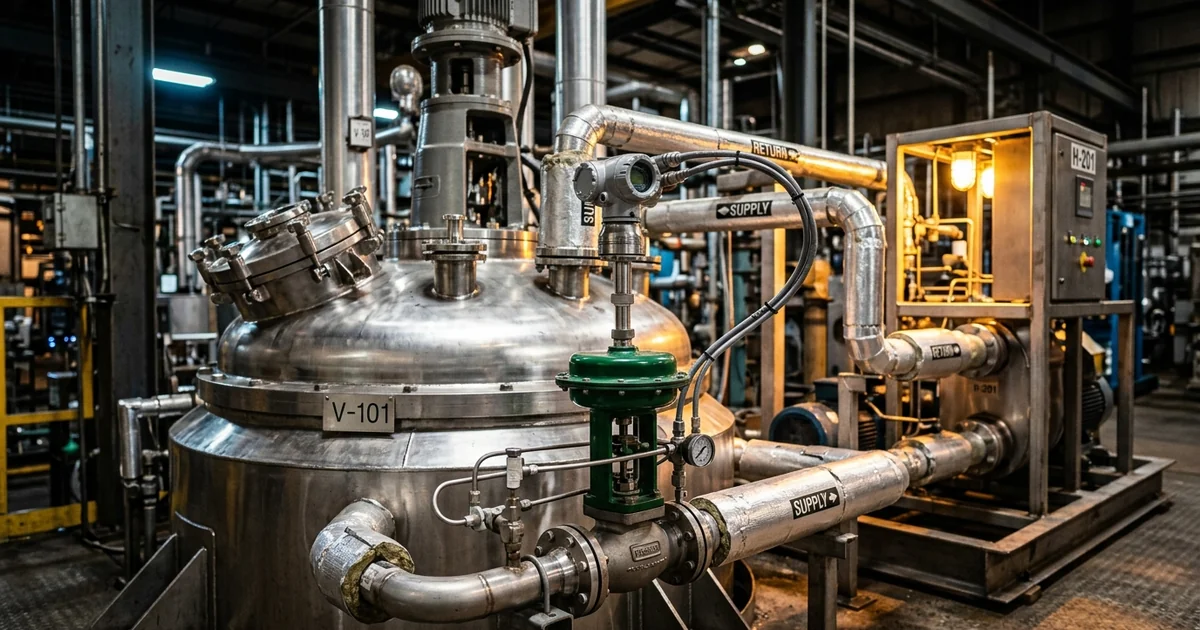
A transferred process holds reactor temperature to within a fraction of a degree in the pilot plant, then swings several degrees at production scale every time the boiler load changes on site. The chemistry did not move, the recipe did not move, but the temperature control did not survive the transfer. This is one of the most common and most avoidable problems in scaling a batch process, and the fix is usually a control-strategy change rather than a bigger jacket or a faster valve. Cascade temperature control of a jacketed reactor splits the job into two nested loops so that jacket-side disturbances are caught and corrected before they ever reach the batch. This article explains how the master and slave loops work, why the inner loop must be faster than the outer one, the order you tune them in, how cascade compares with single-loop and feedforward control, and the failure modes that show up on a real plant. It reflects the control philosophy work we do when a jacketed-reactor process moves from development into production, described in our chemical reaction engineering practice.
Why a Single Control Loop Struggles on a Jacketed Reactor
A single-loop controller measures the reactor contents temperature and drives the jacket control valve directly from the error. That sounds sufficient, but the reactor contents are separated from the valve by the entire thermal mass of the jacket and the vessel wall. Any disturbance that enters at the jacket — a change in thermal fluid supply temperature, a utility pressure swing, a pump trip on the heat-transfer skid — has to work its way through that mass and change the batch temperature before the controller even sees it. By then it is minutes late.
The practical consequences of that delay are familiar to anyone who has commissioned a reactor bay:
- Overshoot on heat-up — the controller keeps calling for full heating until the contents reach setpoint, but the jacket is already far hotter and keeps delivering heat after the valve closes.
- Poor utility-upset rejection — a drop in steam header pressure cools the jacket, and the batch drifts off setpoint for several minutes before the loop recovers.
- Valve nonlinearity passed straight through — an equal-percentage valve near its seat has very high gain, so a loop tuned for mid-travel hunts badly at low duty.
- Scale sensitivity — the same controller settings that were stable in a 50 L vessel become sluggish or unstable at 6300 L because the ratio of heat-transfer area to volume, and therefore the process gain, has changed.
The root issue is that a single loop has only one measurement and one correction point, with a long lag between them. Cascade control adds a second measurement where the disturbances actually enter, which is what lets the strategy survive a scale-up that a single loop does not.
How Cascade Control Works
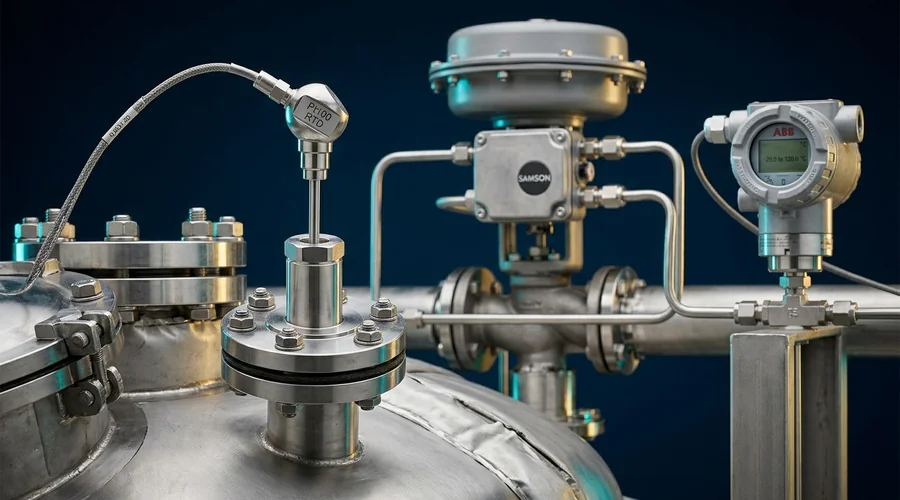
Cascade control nests one feedback loop inside another. The outer loop still controls the variable that matters — the reactor contents temperature — but its controller output is no longer a valve signal. Instead, it is a setpoint handed to the inner loop. The inner loop controls the jacket temperature and manipulates the physical control valve on the thermal fluid or utility supply. Two controllers, two measurements, one valve.
The reason this works is a separation of timescales. The inner loop is fast: the jacket has far less thermal mass than the batch, so its temperature responds to the valve in seconds to tens of seconds. When a utility disturbance hits the jacket, the inner loop corrects it almost immediately, long before the outer loop notices any change at the reactor contents. The outer loop then only has to deal with the slow, well-behaved dynamics of heat passing from a cleanly controlled jacket into the batch. It sees a much simpler process than a single loop does.
This is the same principle that makes reaction calorimetry data so useful before a transfer: once you know the heat the reaction actually releases, you can size the jacket duty and specify a cascade loop that will hold temperature through the exotherm rather than chasing it.
Master and Slave: Roles, Measurements and Speeds
The two controllers in a cascade have distinct jobs, and getting the roles clear is half the battle in commissioning one. The master owns the objective; the slave owns the actuator. Confusing the two — for example letting the master output move too quickly, or tuning the slave to be slow and gentle — is the usual reason a cascade performs no better than the single loop it replaced.
- Master (primary, outer) controller — measures reactor contents temperature via an RTD or thermocouple in a thermowell reaching into the batch. Its output is the jacket temperature setpoint. It is tuned to be slow and steady, because the contents temperature is a slow variable and does not need aggressive correction.
- Slave (secondary, inner) controller — measures jacket or thermal fluid temperature, usually at the jacket outlet or in the recirculation loop of the heat-transfer skid. It drives the control valve. It is tuned to be fast and firm, because its whole purpose is to kill jacket disturbances quickly.
- Speed separation — the inner loop should settle roughly three to five times faster than the outer loop. This margin keeps the loops from interacting. If they are tuned to similar speeds, the master and slave fight each other and the system can oscillate even though each loop is stable on its own.
One practical detail matters on batch plants: the jacket temperature setpoint from the master is normally clamped to a safe range so the master cannot demand a jacket temperature that would thermally shock the vessel or exceed the thermal fluid rating. That clamp is a limit, not a set point to publish — the actual values come from the vessel datasheet and the heat-transfer fluid specification for the specific installation.
Tuning Order: Inner Loop First, Always
Cascade loops are tuned from the inside out, and skipping that order is the single most common commissioning mistake. If you try to tune the master while the slave is loose, the master is reacting to a jacket that does not do what it is told, and no set of master gains will ever look right. Fix the jacket loop first, then the contents loop sees a predictable process.
The sequence on a real reactor bay looks like this:
- Put the master in manual. The operator sets a fixed jacket temperature setpoint directly into the slave.
- Tune the slave loop. Make step changes in jacket setpoint and adjust the slave until it responds quickly, reaches setpoint with minimal overshoot, and does not hunt. Proportional-plus-integral action is usually enough; derivative action on a noisy jacket measurement often does more harm than good.
- Close the master loop. Switch the master to automatic. A well-designed system uses bumpless transfer so the jacket setpoint does not jump at the moment of switching.
- Tune the master loop. Make step changes in contents setpoint and tune the master to be several times slower than the slave. Aim for a smooth approach with little or no overshoot rather than the fastest possible response.
- Check disturbance rejection. Force a jacket disturbance — a deliberate utility step, or a change in recirculation rate — and confirm the contents temperature barely moves. That test, not the setpoint response, is the real measure of whether the cascade is doing its job.
Established methods such as Ziegler–Nichols or lambda tuning give starting values for each loop, but they are starting points. Reactor loops almost always need a final adjustment against the actual batch, because process gain changes with fill volume, viscosity and the presence of solids.
Cascade vs Single-Loop vs Feedforward Control
Cascade is not the only way to improve reactor temperature control, and it is often combined with the alternatives rather than chosen instead of them. Understanding what each strategy does well makes it clear why most well-engineered jacketed reactors end up with a cascade core and feedforward trim. The comparison below is the one that usually settles a control-philosophy discussion.
| Strategy | What it does | Strength | Limitation |
|---|---|---|---|
| Single loop | Contents temperature drives the jacket valve directly | Simplest to commission and maintain; one measurement, one tuning set | Slow to reject jacket disturbances; sensitive to valve nonlinearity and scale |
| Cascade | Contents loop sets a jacket temperature target; jacket loop moves the valve | Rejects jacket and utility disturbances before they reach the batch; linearises the valve behaviour seen by the master | Needs a reliable jacket measurement and a fast inner loop; two loops to tune and maintain |
| Feedforward | Measured disturbance (e.g. feed rate, feed temperature) pre-emptively adjusts the jacket demand | Acts before the disturbance affects temperature at all; excellent for known, measurable upsets like a dosed addition | Only as good as the disturbance model; does nothing for unmeasured upsets; always paired with feedback |
| Cascade + feedforward | Cascade core with feedforward trim on the master output | Handles both measured disturbances (feedforward) and everything else (cascade feedback) | Most engineering to set up; feedforward model needs validation against the real process |
The pattern in practice is straightforward: use cascade as the default structure for any jacketed reactor with a real heat-transfer circuit, and add feedforward when there is a large, measurable, predictable disturbance such as a semi-batch reagent addition. A single loop is defensible only for small vessels with a stable utility and no significant jacket disturbances.
Split-Range Heating and Cooling on One Cascade
Most specialty reactors have to both heat and cool the same batch — heat-up to reaction temperature, then remove an exotherm, then cool for discharge. A jacket circuit that does both usually has more than one final control element: a heating valve, a cooling valve, and sometimes a bypass. Split-range control lets the single output of the slave controller operate all of them in sequence, so the cascade structure stays intact across the whole batch.
The slave output is mapped so that the lower part of its range opens the cooling path and the upper part opens the heating path, with a controlled overlap or deadband at the crossover. Done well, this gives a smooth transition from cooling to heating with no bump at the handover. Done poorly, the reactor sits in the deadband with neither valve doing anything useful, or both valves crack open and waste utility. The crossover behaviour is worth commissioning carefully because it is where split-range systems most often misbehave.
- Deadband too wide — sluggish response near the neutral point, the batch drifts before either valve responds.
- Deadband too narrow or negative — heating and cooling fight each other at the crossover, burning energy and cycling the valves.
- Mismatched valve gains — the loop is well tuned on the heating side and hunts on the cooling side, or vice versa, because the two valves have very different installed characteristics.
Split-range keeps one coherent cascade loop responsible for temperature through heat-up, reaction and cool-down, which is far easier to operate and troubleshoot than switching between separate heating and cooling controllers.
Troubleshooting a Cascade Temperature Control Loop
When a cascade loop misbehaves, the symptom shows up at the reactor contents but the cause is usually in the inner loop, the valve, or the interaction between the two. Working through the failure modes below in order — measurement, valve, inner loop, then outer loop — resolves most cases without a full retune.
- Contents temperature cycles steadily — most often the master gain is too high or its integral time too short for the process lag. On a cascade it can also mean the master and slave speeds are too close and the loops are interacting; slow the master down and confirm the cycle disappears.
- Jacket valve hunts continuously — usually valve stiction, which produces a square-wave limit cycle no retune will fix, or an oversized valve operating near its seat where the installed gain is very high. Check the valve travel and the flow characteristic before touching controller settings.
- Large overshoot every heat-up — the master is winding up its integral term while the batch is far from setpoint and the jacket is saturated at maximum. Anti-reset windup on the master, and a jacket setpoint clamp, both address this.
- Offset that never clears — a proportional-only inner loop leaves a steady-state error that the master has to absorb, which can look like a persistent contents offset. Add integral action to the slave.
- Poor control at low fill volume — a part-charged reactor has a higher process gain and a shorter time constant than a full one, so settings tuned at full charge are too aggressive. Either gain-schedule the master by batch size or accept looser tuning that is stable across the range.
- Sluggish recovery after a long addition — the master integral has saturated during the addition and takes time to unwind. Feedforward from the addition flow, trimming the master output, prevents the windup in the first place.
- Cascade performs no better than the old single loop — the inner loop is too slow, often because the jacket temperature is measured somewhere with a long transport lag, or the final control element cannot move fast enough. Move the jacket measurement closer to the vessel and check the valve stroke time.
A structured loop-performance review — measurement, valve, inner loop, outer loop — is exactly the kind of work an automation and control scoping engagement covers, and it usually pays for itself in recovered batch time and fewer off-spec lots.
Where Cascade Fits the Wider Control Philosophy
Cascade temperature control is rarely specified in isolation. It sits inside a control philosophy document that also covers addition-rate control, pressure and vacuum control, interlocks and the batch sequence. The temperature loop is usually the one that decides whether the whole process is reproducible, because reaction rate, selectivity and product form all track temperature. Getting the cascade right is what makes the rest of the automation worth building.
The strategy choice also connects directly upstream to the reactor itself. The heat-transfer area available, the jacket type — plain jacket, half-pipe coil or internal coil — and the thermal fluid system all set what the cascade can achieve. A reactor chosen without regard to its heat-removal duty cannot be rescued by clever control, which is why control philosophy and equipment selection belong in the same conversation. Our guide to batch, semi-batch and continuous reactor selection covers how the reactor configuration constrains the temperature control that follows, and the same thinking applies to isolating a temperature-sensitive product, as in controlled crystallisation where the cooling profile is itself a cascade setpoint trajectory.
For a new line or a transferred process, the practical sequence is: confirm the reaction heat load from calorimetry, confirm the jacket duty and heat-transfer skid can meet it, then specify a cascade loop with feedforward on any large measured disturbance, and commission it inner loop first with a disturbance-rejection acceptance test. That sequence is what turns a process that works in the pilot plant into one that holds temperature on a real site in India, the Gulf or Southeast Asia, where utility quality varies and the control strategy has to absorb it. It is the core of the scale-up support we provide when a jacketed-reactor process moves into production.
Frequently Asked Questions
What is cascade control on a reactor?
Cascade control uses two nested feedback loops instead of one. An outer master loop compares the reactor contents temperature to its setpoint and, rather than driving a valve directly, outputs a jacket temperature setpoint. An inner slave loop then drives the jacket control valve to hold that jacket temperature.
Because the inner loop measures and corrects jacket disturbances before they reach the reactor contents, the reactor temperature sees a much cleaner, more predictable heat-transfer surface than a single loop can provide.
Why use cascade control instead of a single loop?
A single loop only reacts once a disturbance has already changed the reactor contents temperature, which for a large batch can be many minutes later. Utility pressure swings, thermal fluid supply drift and valve nonlinearity all show up at the contents thermocouple far too late to correct cleanly.
Cascade control puts a fast inner loop directly on the jacket, so those disturbances are caught and corrected in seconds, before they disturb the batch. The result is tighter control, less overshoot on heat-up, and far better rejection of utility upsets.
What is the master loop and slave loop in cascade control?
The master loop, also called the primary or outer loop, controls the variable you actually care about: the reactor contents temperature. Its output is not a valve signal but a setpoint for the slave.
The slave loop, also called the secondary or inner loop, controls the jacket or thermal fluid temperature and manipulates the physical control valve. The master is slow and sets the target; the slave is fast and does the work of holding the jacket where the master asked.
How do you tune a cascade temperature control loop?
Tune the inner loop first, with the outer loop in manual. Get the jacket loop responding quickly and stably to setpoint changes, typically with proportional-plus-integral action and little or no derivative.
Once the slave tracks its setpoint cleanly, put the outer loop in automatic and tune it to be several times slower than the inner loop. The separation of timescales is what makes cascade stable: if the outer loop is tuned nearly as fast as the inner one, the two interact and the whole system can oscillate.
Should the inner loop be faster than the outer loop?
Yes, and by a clear margin. A common design guideline is that the inner loop should be roughly three to five times faster than the outer loop, measured by closed-loop response time.
The inner loop needs to settle a jacket disturbance well before the outer loop notices any change at the reactor contents. If the jacket loop is sluggish, cascade provides little benefit over a single loop, because the disturbance still propagates to the batch before it is corrected.
What causes reactor temperature to cycle?
Sustained cycling usually means the controller gain is too high or the integral time too short for the process dead time and lag. On a cascade system it can also mean the two loops are fighting because their speeds are too close, or that the jacket valve is oversized and operating near its seat where its gain is very high.
A changeover to a much smaller batch volume increases the process gain and can push a loop that was stable at full charge into oscillation. Valve stiction produces a distinctive square-wave cycle that no amount of retuning will fix.
When is cascade control not worth it?
Cascade earns its keep when there is a meaningful, measurable intermediate variable and real disturbances entering there. If the jacket has no significant disturbances — a small electrically heated vessel with a stable supply, for example — a well-tuned single loop may perform almost identically with less to maintain.
Cascade also adds little if you cannot measure the jacket temperature reliably, or if the inner loop cannot be made fast because of a slow final control element. In those cases the second loop is complexity without payback.
Reactor Temperature Not Surviving the Transfer?
Global Formulation develops control philosophies, scopes automation and commissions cascade and feedforward loops for jacketed-reactor processes — from heat-load confirmation through disturbance-rejection acceptance testing.
Talk to Our Process Control Team