Pigment Dispersion in Color Cosmetics: Wetting, Milling, and Stability Control
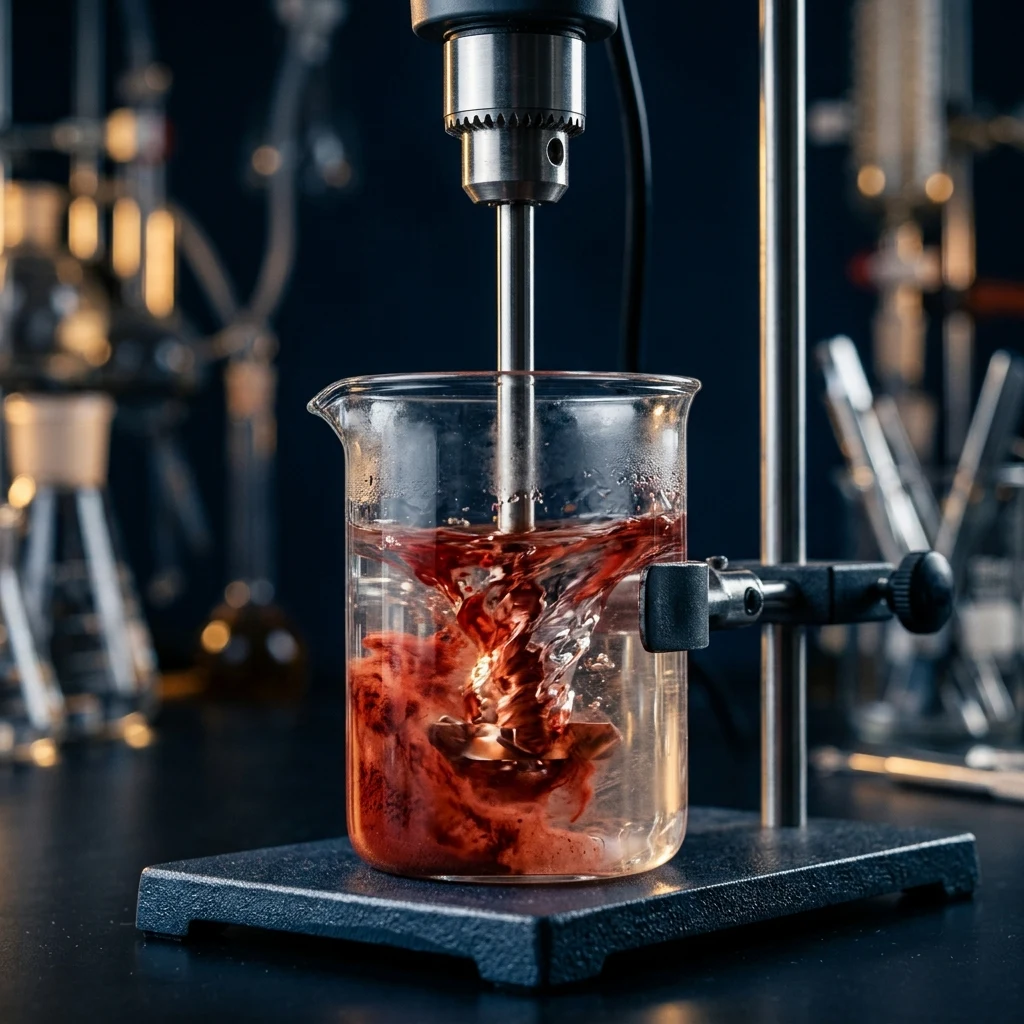
A foundation that swatches beautifully on the back of a hand but streaks unevenly once blended into skin is almost never a raw-material problem — it is a pigment dispersion problem. Pigment dispersion in color cosmetics determines whether iron oxides, titanium dioxide, and pearlescent mica particles are broken down and wetted finely enough to deliver even color, smooth application, and consistent tone from batch to batch, or whether they remain as gritty agglomerates that scatter light unpredictably and separate on the shelf. Getting dispersion wrong is expensive twice over: once in wasted pigment that never contributes its full color strength, and again in customer complaints about patchy coverage, muddy shade match, or a product that looks nothing like its swatch. This guide explains how wetting agents, milling equipment, and dispersion-quality testing work together to turn raw pigment powder into a stable, reproducible color base, and what a formulator or brand founder should verify before scaling a shade range into production. Understanding these mechanics gives founders and formulators the technical vocabulary to evaluate a contract manufacturer's dispersion process with real confidence.
The Three Stages of Pigment Dispersion
Pigment dispersion is not a single mixing step — it is a sequential process with three distinct physical stages, and skipping or under-processing any one of them leaves color strength and application texture compromised. Raw pigment powder as received from a supplier exists as tightly bound agglomerates and looser aggregates of primary particles, held together largely by van der Waals forces and, in the case of iron oxides, residual moisture from the manufacturing process. Getting from that raw powder to a smooth, uniformly colored base requires wetting the particle surfaces, mechanically breaking the agglomerates apart, and then stabilizing the resulting fine particles so they do not simply reflocculate before the batch is even finished. This staged view of dispersion is standard across pigment-vehicle systems generally, not unique to cosmetics, and it underpins dispersion work across all of cosmetics and personal care product development, from foundations to eyeshadow pans.
- Wetting — surfactant or dispersant molecules displace air and moisture trapped at the pigment particle surface, allowing the liquid vehicle to make intimate contact with each particle
- Deagglomeration — mechanical shear breaks the weakly bound agglomerates and aggregates apart into their smaller constituent particles, increasing the effective surface area exposed to the vehicle
- Stabilization — adsorbed dispersant molecules build an electrostatic or steric barrier around each particle that keeps the newly separated particles from clumping back together over time
A dispersion that looks smooth immediately after milling but reflocculates in the following days has typically failed at the stabilization stage, not the milling stage — a distinction that matters enormously when troubleshooting a failing batch. Selecting the specific pigments and wetting agents suited to a target formulation is the next design decision, and it depends heavily on which pigment class is involved.
Pigments and Wetting Agents Used in Color Cosmetics
Color cosmetics rely on a relatively small set of pigment classes, each with distinct surface chemistry that dictates which wetting agents and dispersion approach will work. Inorganic pigments such as iron oxides and titanium dioxide dominate foundation, concealer, and eyeshadow formulations because of their strong chemical stability and broad regulatory acceptance, while synthetic mica coated with metal oxide layers supplies the pearlescent and shimmer effects seen in highlighters and eyeshadow. Organic pigments, typically supplied as lakes precipitated onto an inert substrate, extend the achievable color gamut into brighter reds, oranges, and blues that inorganic pigments cannot match on their own. Because each pigment class presents a different particle surface — hydrophilic metal oxide, coated mica platelet, or organic lake substrate — the wetting agent chosen must be matched to that specific surface chemistry rather than treated as a universal ingredient.
| Pigment Class | Typical Use | Dispersion Consideration |
|---|---|---|
| Iron oxides (yellow CI 77492, red CI 77491, black CI 77499) | Foundation, concealer, bronzer | Hydrophilic surface; residual moisture can require predispersion drying or a compatible wetting agent |
| Titanium dioxide (CI 77891) | Foundation, tinted bases, whitening pigments | High refractive index; incomplete deagglomeration causes a chalky, uneven whitening effect |
| Mica-based pearlescent pigments | Highlighter, eyeshadow, blush | Platelet structure is shear-sensitive; aggressive milling fractures platelets and dulls the pearlescent effect |
| Organic lake pigments | Lipstick, blush, bright eyeshadow shades | Organic substrate is more sensitive to pH and solvent polarity than inorganic pigments |
- Anionic surfactants — commonly used for aqueous pigment predispersions, effective at reducing interfacial tension on hydrophilic pigment surfaces
- Nonionic surfactants and polymeric dispersants — widely used across oil and silicone vehicles, providing steric stabilization suited to anhydrous and emulsion systems
- Silane or fatty-acid surface treatments — applied to the pigment itself by the raw-material supplier before it reaches the formulator, improving compatibility with hydrophobic vehicle systems
Choosing the right pigment–wetting agent pairing only sets the raw materials up correctly — the mechanical energy that actually breaks pigment agglomerates apart comes from the milling equipment itself, and that equipment choice shapes both dispersion quality and manufacturing cost.
Milling and Dispersion Equipment: From Three-Roll Mills to Bead Mills
No wetting agent can substitute for adequate mechanical energy when it comes to breaking down tightly bound pigment agglomerates, which is why dispersion equipment selection is as central to color cosmetic manufacturing as the pigment and surfactant chemistry itself. Different mills apply shear through fundamentally different mechanisms, and the right choice depends on batch viscosity, target particle fineness, pigment platelet sensitivity, and production scale. Using equipment mismatched to the product — high-shear rotor-stator mixing on a shimmer pigment that needs gentle handling, for example — can damage the very optical properties the formulation is trying to achieve.
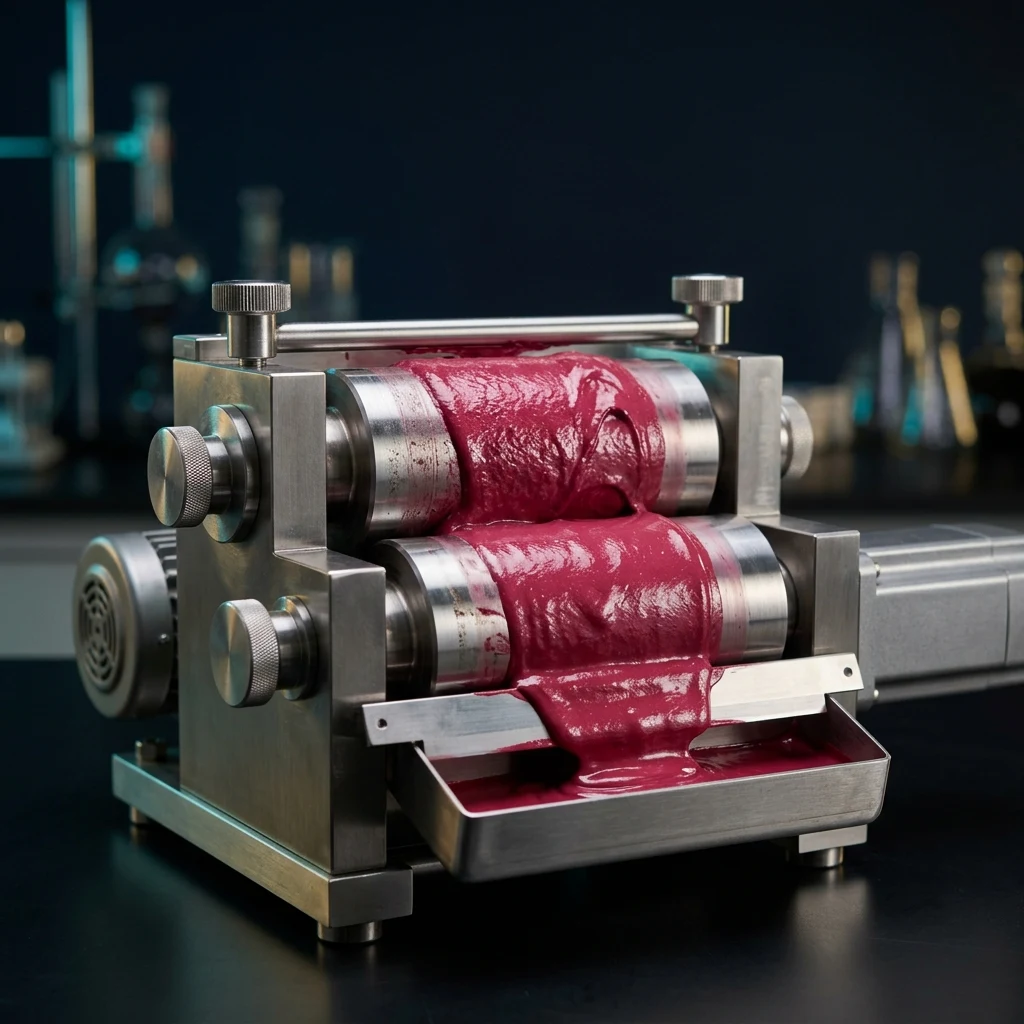
- Three-roll mills — pass a viscous paste between three counter-rotating rollers running at progressively increasing speeds, generating intense shear ideal for high-viscosity anhydrous pastes like lipstick and cream color bases
- Bead (media) mills — circulate small grinding media through the pigment slurry inside a milling chamber, well suited to lower-viscosity liquid and aqueous dispersions requiring a very fine, narrow particle size distribution
- High-shear rotor-stator mixers — draw the batch through a narrow rotor-stator gap at high rotational speed, effective for initial wetting and coarse deagglomeration ahead of finer milling
- Ball mills — tumble grinding media with the pigment slurry in a rotating chamber, producing good fineness for batch processing but with longer processing times than continuous media mills
Equipment choice determines how fine and how uniform a dispersion can become, but fineness by itself is not useful information unless it is measured and verified against a defined target — which is exactly the role dispersion-quality testing plays before a batch is released.
Measuring Dispersion Quality: Fineness of Grind and Color Strength
A pigment dispersion is only as good as a manufacturer's ability to verify it, and visual inspection alone is not a reliable quality-control method — grit invisible to the naked eye at low concentration can still cause texture defects or inconsistent color development once diluted into the final base. Standardized fineness-of-grind and color-strength testing give formulators and quality teams an objective, repeatable measurement that can be compared against a target specification and tracked from batch to batch.
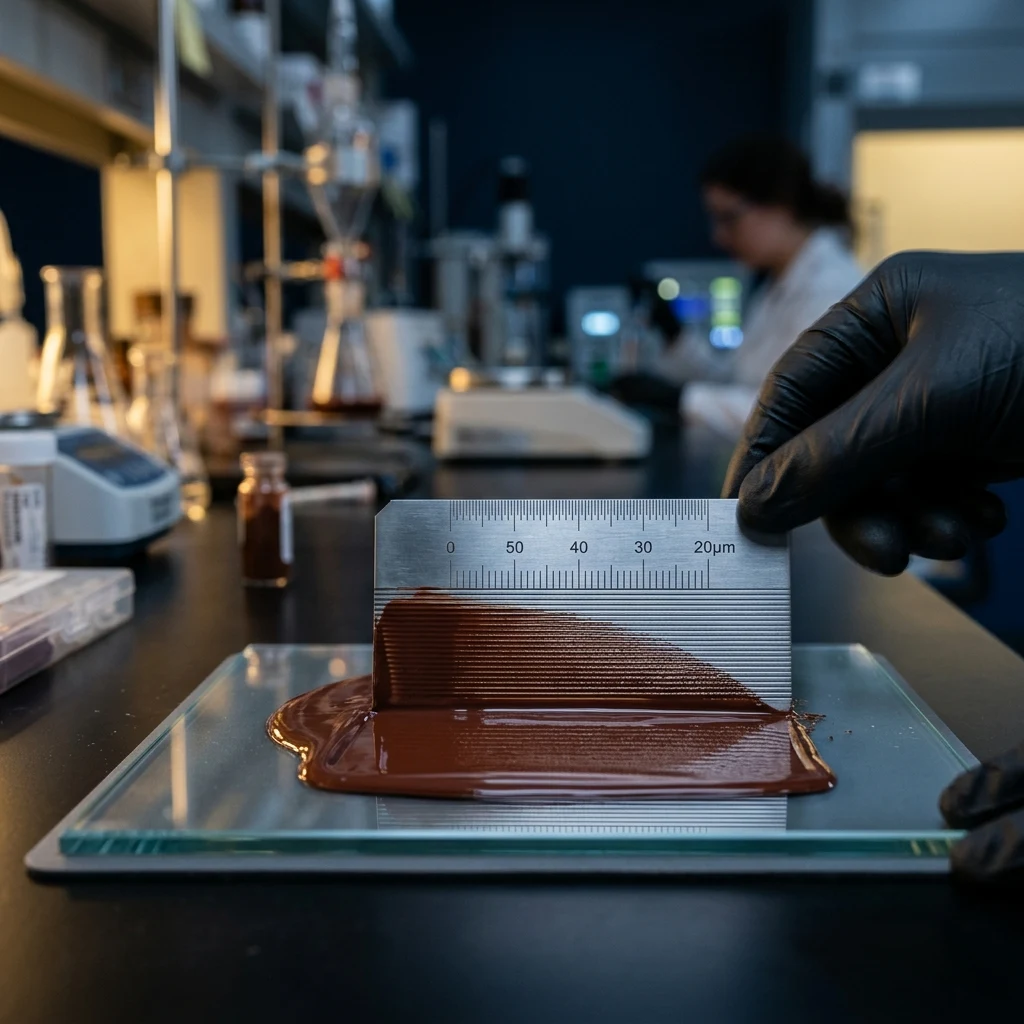
- Fineness of grind (Hegman gauge) — a calibrated wedge-shaped gauge measures the point at which visible scratches or grit appear as a drawdown blade passes through the dispersion, expressed in microns or a Hegman/NS scale reading, following methods such as ASTM D1210
- Color strength (tinting strength) — compares the color development of a test batch against a reference standard at matched dilution, verifying that milling has released the pigment's full optical potential rather than trapping color inside undispersed agglomerates
- Particle size distribution analysis — laser diffraction or microscopy quantifies the actual particle size population, distinguishing a genuinely fine, narrow distribution from one with a fine average but a problematic tail of oversized particles
- Drawdown and gloss evaluation — a wet film drawn down on a contrast card or glass plate under controlled thickness reveals streaking, specking, or uneven color development that numeric fineness readings alone might miss
Because a numeric fineness reading and a visual drawdown assessment each catch defects the other can miss, a rigorous dispersion QC program uses both together rather than relying on a single pass/fail metric before a batch is approved for the next production stage. Meeting a fineness and color-strength target during development is one milestone — holding that same result consistently across every subsequent production batch depends on a separate set of formulation and process variables that are easy to overlook.
Formulation and Process Variables That Affect Dispersion Stability
Achieving an excellent dispersion in a single development batch is not the same as being able to reproduce that dispersion reliably at full production scale, and the gap between the two is usually explained by a handful of process variables that are easy to overlook until a batch fails. Vehicle viscosity, order of addition, dispersant dosage, and milling time all interact with each other, which means changing one variable without re-evaluating the others is a common source of unexpected batch-to-batch variation. In emulsified liquid foundations and tinted bases specifically, the choice of primary cosmetic emulsifier compounds the problem further, since the emulsifier system must remain compatible with the pigment dispersion's stabilization chemistry rather than competing with it at the particle surface.
| Process Variable | Effect on Dispersion | Formulation Note |
|---|---|---|
| Vehicle viscosity during milling | Higher viscosity increases shear transfer to particles but raises energy demand and can limit throughput | Predispersion viscosity is often adjusted independently of the finished product's target viscosity |
| Order of addition | Adding pigment before the dispersant is fully distributed risks localized agglomeration that later milling may not fully correct | Dispersant is typically incorporated into the vehicle first, with pigment added gradually under agitation |
| Milling time and pass count | Longer or repeated milling improves fineness up to a point, beyond which returns diminish and platelet damage risk rises | Fineness should be checked at intervals rather than assuming a fixed milling time suits every batch |
| Storage temperature and later shear history | Elevated temperature or downstream high-shear steps, such as emulsification, can disrupt dispersant stabilization | Predispersions are validated for stability through the full downstream process, not just at the point of milling |
Holding these interacting variables steady, batch after batch, is what separates a color range that matches its original swatch a year into production from one that quietly drifts off-shade without anyone noticing until customer complaints arrive. Even a formulation and process design that performs flawlessly in one market can still stall at launch if the pigments themselves are not cleared for cosmetic use in that market — which is where regulatory status becomes the final gate before a shade range can ship.
Regulatory Considerations for Color Additives in Cosmetics
Color additives face a stricter regulatory framework than most other cosmetic ingredients, because both the pigment's chemical identity and its permitted use category are explicitly controlled rather than left to general ingredient safety assessment. A dispersion that performs beautifully in the lab is not launch-ready until the underlying pigments are confirmed compliant with the specific target market's positive list and use restrictions.
In the United States, color additives other than coal-tar hair dyes require FDA listing, with many pigments — including most iron oxides — exempt from batch certification but still subject to defined purity specifications and approved use categories such as eye area, lip, or general application, as outlined in the FDA's color additives and cosmetics guidance. In the European Union, permitted colorants are listed in Annex IV to the EU Cosmetics Regulation (EC) No. 1223/2009, which specifies allowed Colour Index numbers, purity criteria, and in some cases restricts use to particular product categories. Brands formulating toward natural or organic cosmetic certification such as COSMOS or NATRUE typically find mineral pigments like iron oxides and micas broadly acceptable, while many bright synthetic organic lake pigments are restricted or excluded under those certification standards, which often steers natural-positioned shade ranges toward mineral-pigment-dominant palettes from the outset.
Confirming pigment-level regulatory status before finalizing a shade range avoids the costly scenario of reformulating an otherwise successful dispersion because a chosen pigment cannot legally be sold in a target market — a check best performed in parallel with early dispersion development, not after a formula is already locked.
Frequently Asked Questions
What's the difference between a pigment dispersion and a pigment predispersion (masterbatch)?
A pigment dispersion is the general process of wetting, deagglomerating, and stabilizing pigment particles within a vehicle. A predispersion, sometimes called a masterbatch, is a specific intermediate product — pigment already fully dispersed at a defined concentration in a compatible carrier — that is manufactured separately and then let down into the final formulation at the blending stage.
Working from a well-characterized predispersion gives formulators a consistent, pre-tested color input to build shades from, rather than dispersing raw pigment powder fresh in every single batch, which significantly improves shade-to-shade reproducibility across a color range and reduces the risk of under-milled pigment reaching the finished product.
Why do pearlescent mica pigments need gentler processing than iron oxides?
Mica-based pearlescent pigments derive their shimmer and color-travel effect from thin, flat platelets coated with metal oxide layers that reflect and interfere light in a specific way, and that optical effect depends entirely on the platelets staying intact and reasonably large. High-intensity milling equipment, such as a bead mill tuned for iron oxide fineness, applies enough shear to fracture those platelets, which reduces particle size in a way that looks good on a fineness gauge but actually destroys the pearlescent effect the pigment was chosen for.
Iron oxides and other solid inorganic pigments have no comparable fragile microstructure, so they can tolerate more aggressive milling to reach a fine, uniform particle size without losing functional performance.
How is dispersant dosage decided for a color cosmetic batch?
Dispersant dosage is determined experimentally for each pigment-vehicle combination rather than applied as a fixed universal ratio, because the correct amount depends on the pigment's specific surface area, its surface chemistry, and the vehicle's polarity. Too little dispersant leaves some particle surface unprotected, allowing those particles to reflocculate after milling; too much can leave excess free dispersant in the continuous phase, which can affect viscosity, gloss, or compatibility with other formulation components.
Formulators typically run a dosage titration during development, measuring fineness of grind and dispersion stability over time at several dispersant levels, and select the lowest dosage that reliably meets the fineness and stability specification with an appropriate safety margin.
Can a formulator switch pigment suppliers without redoing dispersion development?
Not safely. Two pigment lots sharing the same Colour Index number and nominal grade can still differ meaningfully in particle size distribution, surface treatment, and residual moisture depending on the manufacturer's process, and any of those differences can shift how the pigment wets, mills, and stabilizes in a given vehicle.
A supplier change should trigger a re-verification of fineness of grind, color strength against the existing reference standard, and dispersion stability over time before the new material is approved for production, even when the technical data sheet looks identical to the original grade on paper.
What causes a color cosmetic product to fade or shift shade after it's on the shelf?
Shelf-life shade shift in a properly dispersed product is most often caused by slow reflocculation of incompletely stabilized pigment particles, which changes how light scatters off the dispersion and can make a shade look duller or patchier than at the point of manufacture. Separate causes include photodegradation of certain organic lake pigments under prolonged light exposure, pH drift in the base formulation affecting pigment surface charge and stabilization, or physical settling of denser pigments like titanium dioxide in low-viscosity liquid formulations without adequate suspension support.
Distinguishing between these causes requires comparing fresh-batch and aged-batch samples using the same fineness and color-strength methods used during original development, rather than relying on visual impression alone.
Is a Hegman gauge fineness reading enough to guarantee a good dispersion?
No — a Hegman gauge reading confirms the absence of oversized grit above the gauge's detection threshold, but it does not confirm color strength, particle size distribution below that threshold, or long-term dispersion stability. A batch can pass a fineness-of-grind check while still being under-dispersed in terms of the pigment's full optical development, or while containing dispersant levels too low to prevent reflocculation over the coming weeks.
A complete dispersion QC program pairs fineness testing with color-strength comparison against a reference standard and, ideally, a short accelerated-stability check before a batch is released to bulk production.
When should a color cosmetics brand bring in a formulation consultant for pigment dispersion work?
A formulation consultant adds the most value at three points in color cosmetic development. First, during pigment and wetting-agent selection, where surface chemistry must be matched correctly to the vehicle system for each pigment class in a shade range. Second, during equipment and process design, where milling method, dispersant dosage, and order of addition are established and validated for scale-up rather than left to trial and error on the production floor.
Third, during quality-control method design, where fineness, color-strength, and stability testing protocols need to be built around the brand's specific pigment palette. Bringing in that expertise before a shade range is finalized avoids the common and costly scenario of reformulating an entire color line after inconsistent batches reach the market.
Developing a Color Cosmetics Line?
Global Formulation provides cosmetic formulation consultancy, pigment dispersion process design, shade-matching support, and contract development services for makeup brands and manufacturers worldwide.
Talk to Our Formulation Team