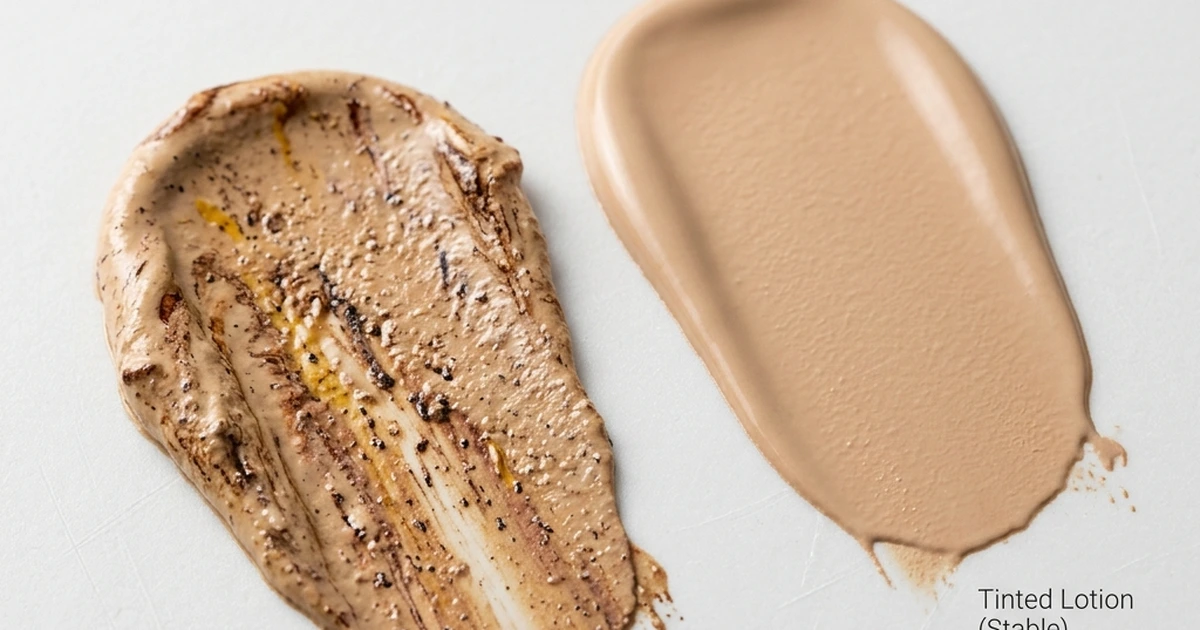
Pigment instability in cosmetic cream formulation is the defect that quietly erodes consumer trust in a shade-matched product line. A tinted moisturiser or BB cream that looked perfectly uniform coming off the filling line can develop visible blotches, darker streaks, or an overall duller shade within weeks on the shelf — and the change is rarely caused by the pigment simply "wearing out." It is almost always a physical or chemical event happening inside the formulation matrix: reagglomeration of particles that were never permanently locked apart, a pH shift moving a pH-sensitive colourant outside its stable range, or an interaction between the pigment surface and another ingredient in the base. Left undiagnosed, colour instability generates returns, shade-match complaints, and — for brands making specific colour claims — genuine regulatory exposure. This article explains what causes pigmented creams and lotions to shift, blotch, or fade, how to confirm the exact mechanism at work, and which corrective strategies actually resolve it rather than merely delaying the next batch failure.
Understanding the Problem: What Pigment Instability Looks Like in Cosmetic Creams
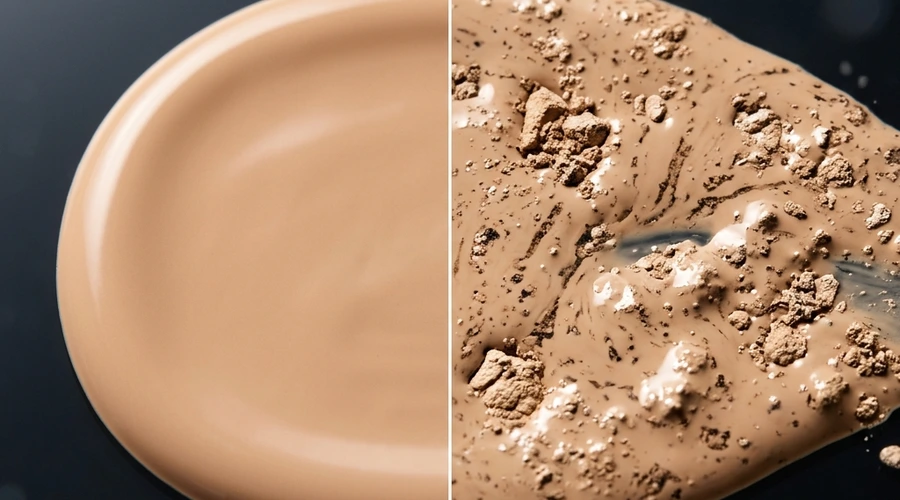
Pigment instability rarely presents as a single, obvious event. It typically appears as visible colour blotches or streaking within an otherwise smooth cream base, a gradual dulling or greying of the overall shade compared to a reference standard, colour bleeding at the product's surface or into surrounding packaging, or a gritty texture change that accompanies the visual colour shift because pigment reagglomeration and texture degradation frequently share the same root cause. In tinted moisturisers, BB creams, and coloured sunscreens, these changes are especially damaging because the product's entire value proposition rests on a specific, repeatable shade match to a consumer's skin tone.
The commercial cost of colour instability extends well past a single batch. Shade drift between production lots creates inconsistent retail shelf presentation, damages a brand's shade-matching reputation, and — in markets where cosmetic colour claims are formally registered or where a product is marketed as part of a matched foundation-and-concealer shade family — can trigger compliance review under regional cosmetic labelling requirements. Returns and complaints tend to cluster around specific batches or storage conditions, which is itself useful diagnostic information rather than simply a quality control headache.
What makes pigment instability particularly tricky to diagnose is that the visible symptom — a colour change — can result from mechanisms that are entirely physical (particles moving or clumping, no chemistry changed) or entirely chemical (the pigment or its surrounding matrix has genuinely reacted), and the corrective strategy for each is completely different. Confusing the two is the single most common reason a "fix" fails to resolve the problem on the next production run.
Root Causes: The Mechanisms Behind Pigment Instability in Cosmetic Formulations
Colour instability in a pigmented cream or lotion is the visible output of a small number of underlying mechanisms, and correctly separating physical pigment migration from genuine chemical change is the foundation of every successful correction. Most real-world failures involve one dominant mechanism reinforced by a secondary contributing factor, which is why single-variable troubleshooting so often falls short.
Pigment Agglomeration and Flocculation
Inorganic pigments such as iron oxides and titanium dioxide are fine particles with naturally high surface energy, and they require an effective dispersant or surfactant system to remain separated once incorporated into the cream base. When the dispersing system is under-dosed, poorly matched to the pigment's specific surface treatment, or destabilised over shelf life by a shift in the emulsion's ionic strength, individual particles begin to attract one another and reform into larger aggregates. Because larger particles scatter and absorb light differently than the same pigment finely dispersed, agglomeration produces a visible colour and texture change even though the total pigment content in the jar has not decreased at all.
pH-Driven Shade Shift in Sensitive Colourants
Many organic pigments and lake colourants are chromophores whose absorbed wavelength depends on their protonation state, meaning their apparent hue genuinely changes as formulation pH moves outside their stable window. A lake pigment built on a carboxylic acid dye backbone, for example, can shift from a vibrant warm tone at a lower pH to a duller or cooler tone as the formulation drifts toward neutral or alkaline pH over its shelf life. This mechanism is a true chemical event, not a physical redistribution, and it typically produces a uniform shade change across the entire product rather than the patchy blotching characteristic of agglomeration.
Emulsion Phase Instability Carrying Pigment With It
Pigments in an oil-in-water emulsion are rarely distributed with perfect uniformity between the continuous and dispersed phases — some pigment grades preferentially associate with the oil phase, others with the aqueous phase or with specific emulsifier micelles. When the emulsion itself begins to destabilise through creaming, coalescence, or partial phase separation, the pigment travels with whichever phase it was preferentially associated with, producing a visible colour gradient that tracks the underlying emulsion instability rather than a pigment-specific failure. In these cases the colour defect is a downstream symptom of a broader emulsion stability problem.
Pigment–Ingredient Chemical Interactions
Certain formulation ingredients react directly with pigment surfaces or with the dye chemistry of organic colourants. Chelating agents and certain acids can alter the surface charge of inorganic pigment particles enough to compromise an electrostatically stabilised dispersion, while oxidising or reducing agents present in some active ingredients can chemically degrade sensitive organic dye chromophores, producing a genuine, irreversible colour fade rather than a physical redistribution.
Milling and Pre-Dispersion Inconsistency at Manufacture
A meaningful fraction of colour instability traces back not to shelf-life change at all, but to inconsistent pigment pre-dispersion during original manufacture. Pigment that was inadequately milled or incompletely wetted before incorporation into the base starts life with a wider particle size distribution and weaker initial dispersion stability, making it far more prone to agglomeration during subsequent storage even under otherwise well-controlled conditions.
| Mechanism | Typical Visual Signature | Physical or Chemical | Key Trigger |
|---|---|---|---|
| Pigment agglomeration/flocculation | Patchy blotches, darker specks, gritty texture | Physical — reversible on remixing | Weak or mismatched dispersant system |
| pH-driven shade shift | Uniform dulling or hue change across product | Chemical — not reversible on mixing | Formulation pH drift over shelf life |
| Emulsion phase instability | Colour gradient tracking oil/water separation | Physical — tied to broader emulsion failure | Emulsifier depletion, temperature cycling |
| Pigment–ingredient interaction | Gradual, irreversible fade or colour change | Chemical | Chelators, oxidising/reducing actives |
| Milling/pre-dispersion inconsistency | Inconsistent instability across supposedly identical batches | Physical — rooted in manufacturing process | Inadequate mill pass count or wetting time |

Diagnosis: How to Confirm the Root Cause of Colour Instability
Diagnosing pigment instability starts with a deceptively simple question: has the pigment physically moved, or has it chemically changed? Answering that question correctly narrows the investigation dramatically and prevents the common mistake of reformulating the pigment system when the actual fault lies in emulsion stability, or vice versa. A structured sequence of tests, most of which require only basic laboratory equipment, resolves the great majority of cases.
Step 1 — The Remix Reversibility Test
Take a visibly blotched or streaked sample and thoroughly remix or homogenise it by hand or with a bench mixer. If uniform colour returns immediately and holds, the pigment was still fully present but had physically reagglomerated or migrated — pointing toward a dispersion or emulsion stability mechanism. If the colour remains faded, dulled, or shifted after thorough remixing, the pigment itself has undergone a genuine chemical change, and the investigation should shift toward pH history and ingredient interaction.
Step 2 — pH Tracking Across Batch History
Measure pH at manufacture, immediately post-fill, and at defined intervals through accelerated and real-time shelf-life storage. Compare the measured pH trajectory against the documented stable pH window for every pH-sensitive colourant in the formulation. A pH excursion outside a lake pigment's stable range that correlates with the onset of shade shift is strong confirmatory evidence for a pH-driven chemical mechanism.
Step 3 — Particle Size Distribution Analysis
Where the remix test suggests a physical mechanism, laser diffraction or microscopy-based particle size analysis on both a fresh reference batch and the destabilised sample will typically show a clear shift toward larger particle sizes or a broader distribution in the failed sample — direct evidence of agglomeration. Comparing this against the original pigment's certificate of analysis particle size specification confirms whether the dispersion process itself, rather than shelf-life instability, is the origin point.
Step 4 — Emulsion Stability Cross-Check
Because pigment migration frequently rides on top of underlying emulsion instability, run standard emulsion stability assessments — centrifugation, freeze-thaw cycling, and elevated temperature storage — alongside the colour assessment. A colour gradient that correlates spatially and temporally with visible creaming or phase separation confirms that the emulsion, not the pigment dispersion in isolation, is the primary root cause requiring correction.
Step 5 — Isolated Ingredient Interaction Screening
Where chemical fading is confirmed but not explained by pH alone, prepare simplified base formulas that sequentially remove suspect ingredients — chelating agents, specific actives with known oxidising or reducing character, or particular preservative chemistries — and monitor colour stability in each variant under accelerated storage. A restored stable shade upon removal of a specific ingredient isolates the interaction responsible.
Solution Strategies: Corrective Approaches to Pigment Instability
Correcting pigment instability requires matching the fix to the confirmed mechanism rather than defaulting to a higher pigment loading or a different colourant altogether, both of which are expensive and frequently ineffective if the true fault lies in dispersion or emulsion stability. The strategies below map to the five root cause mechanisms described above and focus on addressing the underlying physical or chemical driver.
Strengthening the Dispersion System
Where agglomeration is confirmed, the corrective focus is the dispersant and surfactant system responsible for keeping pigment particles separated — selecting a dispersing agent whose chemistry is matched to the pigment's specific surface treatment, and confirming that the electrostatic or steric stabilisation mechanism it relies on remains effective across the formulation's expected pH and ionic strength range through shelf life. In many cases the existing dispersant is adequate at manufacture but was never validated against long-term storage conditions, which is why accelerated ageing testing on the dispersion specifically, not just the finished emulsion, is an important addition to development protocols.
Buffering Against pH-Driven Shade Shift
For pH-sensitive colourants, correction centres on tightening the formulation's buffer capacity to hold pH reliably within the pigment's stable window across the full projected shelf life, accounting for the pH drift that many surfactant and preservative systems introduce over time. Where the product's functional pH requirement cannot be adjusted to suit the pigment, selecting a chemically distinct colourant with a wider stable pH range for the same visual shade is the more durable long-term correction.
Resolving Colour Instability Tied to Emulsion Failure
Where pigment migration is confirmed to be riding on underlying emulsion instability, the corrective path runs through standard emulsion stabilisation strategies — reviewing emulsifier system adequacy, HLB matching to the oil phase, and viscosity modifier performance — rather than through pigment-specific changes. Resolving the emulsion's own creaming or coalescence tendency typically resolves the associated colour gradient as a direct consequence, since the pigment was never the primary point of failure.
Eliminating Pigment–Ingredient Interactions
Once a specific interacting ingredient has been isolated through screening, correction generally involves either reformulating around a chemically compatible alternative ingredient, adjusting the order or method of addition during manufacture to reduce direct contact time between the reactive species, or introducing a stabiliser specific to the interaction mechanism identified, such as an antioxidant where oxidative fading of an organic dye has been confirmed.
Tightening Manufacturing Process Control
Where inconsistent pre-dispersion is implicated, the fix is procedural rather than formulaic: validating mill pass count, residence time, and wetting-out procedure for the pigment premix, and confirming particle size distribution meets specification before the premix is introduced into the main batch, rather than relying on visual assessment alone at the point of manufacture.
Prevention: Process Controls and Formulation Strategies to Avoid Recurrence
Preventing pigment instability is substantially cheaper than correcting it after shade-match complaints reach the market, and it requires treating colour stability as a designed and validated formulation property rather than an assumption based on how the product looks immediately after manufacture. A durable prevention programme spans pigment selection, dispersion process control, and ongoing shelf-life monitoring.
Formulators should validate colour stability under worst-case realistic conditions rather than idealised bench batches — accelerated storage at elevated temperature, freeze-thaw cycling, and real-time shelf-life tracking against a fixed colour reference standard using objective instrumental measurement rather than visual assessment alone.
- Instrumental colour measurement — track Delta E against a reference standard at defined shelf-life intervals using a spectrophotometer, rather than relying on visual comparison alone.
- Particle size specification on incoming pigment — set and verify a maximum particle size distribution for each pigment lot before it enters production.
- Dispersion validation at production scale — confirm dispersant performance on plant-manufactured batches, not only laboratory pre-dispersions.
- pH stability mapping — document the stable pH range for every pH-sensitive colourant used and confirm formulation pH holds within that range across full shelf life.
Pigment Selection and Supplier Qualification
Selecting pigment grades with surface treatments specifically matched to the formulation's emulsion type — hydrophobically treated grades for oil-continuous systems, hydrophilically treated grades for water-continuous systems — reduces the baseline tendency toward agglomeration before any dispersant is even added. Supplier qualification should include a review of particle size distribution consistency across lots, since batch-to-batch variation in incoming pigment particle size is a frequent, underappreciated driver of inconsistent colour stability performance across otherwise identical production runs.
Manufacturing Process Discipline
Standardising and validating the pigment pre-dispersion process — mill type, pass count, residence time, and in-process particle size verification — closes the most common process-level root cause of colour instability. Where multiple pigments are combined in a single shade, the order and method of addition during manufacture should be fixed and documented, since introducing pigments in an inconsistent sequence can produce batch-to-batch variability in initial dispersion quality even when the formula itself is unchanged.
When to Escalate to a Specialist
Many pigment instability cases resolve cleanly once the physical-versus-chemical distinction is established and the corresponding dispersant, buffering, or process correction is applied. But certain situations exceed what an in-house formulation or quality team can reliably resolve within normal development timelines.
Escalate to a specialist when a reformulated dispersion or buffering system still shows colour drift after one or two corrective iterations, since repeated empirical adjustment without a confirmed mechanism wastes development cycles and risks masking rather than resolving the underlying issue. Escalate as well when instability appears only at full production scale and cannot be reproduced in laboratory bench batches, which usually points to a scale-dependent process variable — shear profile, batch hold time, or cooling rate — that is difficult to isolate without direct process observation. Multi-pigment shade systems, where several colourants with different surface chemistries and stability profiles must remain co-stable in a single base, are especially prone to interactions that require systematic, designed-experiment investigation rather than single-variable troubleshooting.
Products carrying a formally registered or externally audited shade-match claim, or those manufactured across multiple sites that must maintain consistent colour within tight tolerance, warrant specialist-level rigour in both the investigation and its documentation from the outset, since the commercial cost of an unresolved recurrence is materially higher than for a single-site, non-claims-driven product line.
Colour instability in pigmented creams and lotions is solvable once the specific mechanism — agglomeration, pH-driven shade shift, emulsion-linked migration, ingredient interaction, or process inconsistency — has been correctly identified. For broader formulation context, explore Global Formulation's guide to emulsion science for creams and lotions and the fundamentals of physical and chemical UV filter formulation, where pigment-grade titanium dioxide dispersion stability follows closely related principles, or return to the cosmetics and personal care knowledge hub. For ingredient safety substantiation, the Cosmetic Ingredient Review (CIR) maintains an independent safety assessment database, and the European Commission cosmetics regulatory portal documents colourant approval status across major markets.