The Complete Guide to Wood Coatings: Stains, Varnishes, and UV-Cure Systems
Wood coatings form one of the oldest yet most technically demanding categories in the entire coatings industry, spanning everything from a hand-rubbed antique furniture finish to a UV-cured factory topcoat racing down a flooring production line at speed. Getting a wood coating right means reconciling several genuinely competing goals at once: the coating must let the wood's natural grain and colour show through, build a film tough enough to survive decades of handling, moisture, and UV exposure, and still apply cleanly across wildly different substrates, from open-pore oak to dense tropical hardwood. A finisher, product developer, or facility owner who treats wood coating selection as an afterthought after the woodworking is done routinely discovers the expensive way that stain compatibility, moisture content, and cure chemistry decide whether a finish lasts twenty years or peels within two seasons. This guide is the complete reference on wood coating technology: the chemistry that separates penetrating stains from film-forming varnishes, the full classification of alkyd, waterborne, and UV-cure systems, the performance properties that actually predict field durability, a practical selection framework for interior and exterior wood, the application and curing processes used in shop and factory settings, the testing standards the industry relies on, regulatory and environmental pressures reshaping the category, common failure modes, and where wood coating technology is heading next. It draws on the perspective of coatings formulators and finishing engineers who specify and troubleshoot these systems across furniture, flooring, cabinetry, and exterior wood products.
In This Guide
- What Are Wood Coatings and Why They Matter in Industry
- The Science Behind Wood Coatings: Key Chemistry and Mechanisms
- Types and Classification: A Complete Overview
- Key Performance Properties and Specifications
- Selection Guide: Choosing the Right Wood Coating for Your Application
- Application and Curing Process
- Testing Methods and Industry Standards
- Regulatory and Environmental Considerations
- Common Problems and How to Address Them
- Industry Trends and Future Outlook
What Are Wood Coatings and Why They Matter in Industry
Wood coatings are the broad family of stains, sealers, varnishes, and topcoats formulated to colour, protect, and finish wood surfaces across furniture, flooring, cabinetry, and construction millwork. They sit within the wider discipline of paints and coatings chemistry, but wood presents a substrate unlike metal or masonry: it is porous, anisotropic, hygroscopic, and dimensionally alive, expanding and contracting with humidity long after a coating has cured. A finish that ignores this behaviour — treating wood as if it were an inert panel — is the single most common root cause of coating failure in the category, regardless of how well-formulated the resin chemistry itself might be. For product developers and finishing engineers, understanding how a coating system interacts with wood's cellular structure and ongoing moisture movement is the foundation everything else in this guide builds on, from stain penetration to long-term exterior durability.
The Science Behind Wood Coatings: Key Chemistry and Mechanisms
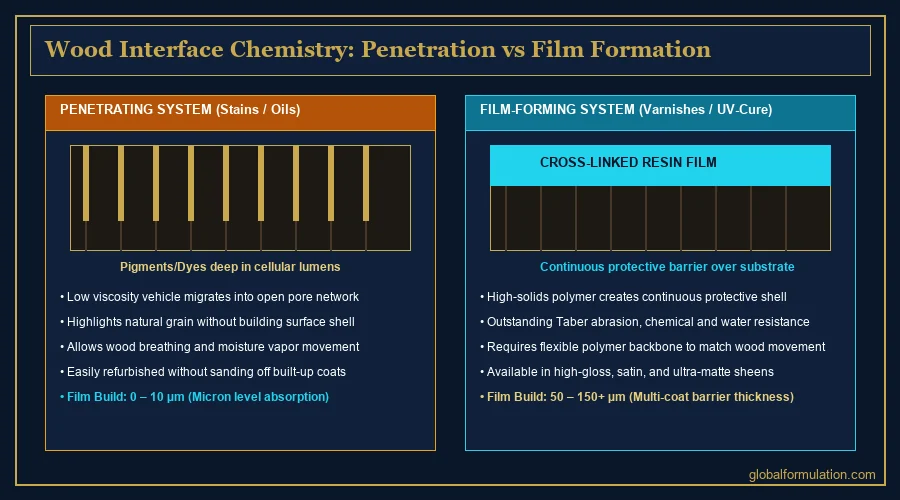
Every wood coating formulation has to resolve the same underlying tension: the product must wet and, in many cases, penetrate an irregular porous substrate while still building a controlled, defect-free film or colour layer on top of it. Stains rely on pigment or dye carried in a low-viscosity vehicle that migrates into open wood cells and surface checking, developing colour that follows the grain rather than sitting uniformly across the surface. Varnishes and topcoats instead prioritise film formation — through solvent evaporation, oxidative crosslinking, or radiation-initiated polymerisation — to build a continuous, adherent layer with defined hardness, gloss, and chemical resistance.
A handful of governing principles recur across nearly every wood coating chemistry, and recognising them is what allows a formulator to reason about a new resin system rather than memorising it from a datasheet:
- Penetration versus film build — low-viscosity, low-solids products penetrate and colour the wood; higher-solids, higher-viscosity products build a protective surface film.
- Cure mechanism — alkyds cure by slow oxidative crosslinking, waterborne acrylics dry by coalescence as water evaporates, and UV systems polymerise almost instantly under radiation exposure.
- Substrate moisture interaction — the coating must accommodate ongoing wood expansion and contraction rather than resist it rigidly, or the film cracks at the first significant humidity swing.
- Grain and pore behaviour — open-grained species like oak and ash absorb and show finish differently than closed-grained species like maple and cherry, changing both stain uptake and film clarity.
These mechanisms are precisely what separate the major wood coating chemistry classes, and mapping them onto the classification system that follows turns an abstract chemistry lesson into a practical specification tool.
Types and Classification: A Complete Overview
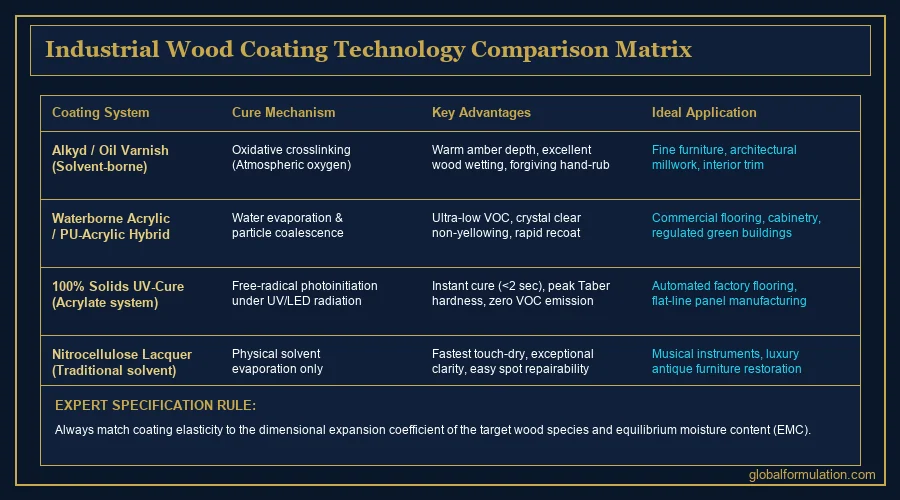
Wood coatings are classified primarily by resin chemistry and cure mechanism, and each class occupies a distinct, well-understood position on the cost, appearance, and durability spectrum. Solvent-based alkyd varnishes remain the traditional standard for their warm colour development and forgiving application; waterborne acrylic and polyurethane-acrylic hybrids have become the regulatory default in most markets; UV-cure systems dominate high-volume factory finishing; and penetrating oils and waxes occupy a smaller but persistent niche where a natural, low-sheen hand-feel is prioritised over maximum film protection. The table below summarises the major wood coating classes a specifier is likely to encounter.
No single class is universally superior — each exists because a specific production volume, regulatory environment, or aesthetic outcome demands it — which is exactly why the properties section that follows treats wood coating performance as application-specific rather than universally rankable.
Key Performance Properties and Specifications
Wood coating performance is specified against a set of interdependent properties that predict how a finish will behave in real service long before a field failure would otherwise reveal a mismatch. Because appearance, hardness, and flexibility often trade off against one another within a single formulation, no property can be optimised in isolation without weighing its effect on the coating's other requirements. The table below outlines the properties most consistently used to specify and monitor wood coating chemistry.
A finish can look flawless on the day it is applied and still fail within a season if flexibility or UV resistance was never validated for the intended exposure. Carrying that interconnected view directly into the selection process is what separates a specification that survives first-year field service from one that only survives the showroom.
Selection Guide: Choosing the Right Wood Coating for Your Application
Selecting the right wood coating starts with correctly characterising three things the application actually demands: the exposure environment, the required film hardness and appearance, and the production method available for application and cure. Treating wood coating selection as a single "best varnish" purchase, without weighing these application-specific factors, is one of the most common and costly mistakes in both furniture manufacturing and site finishing work. The practical decision sequence below reflects how experienced finishers and formulators typically approach a new wood coating specification.
- Define the exposure environment — interior versus exterior, UV exposure, and moisture cycling narrow the chemistry class before appearance is even considered.
- Establish appearance requirements — desired colour development, gloss level, and grain visibility determine stain and topcoat pairing.
- Assess production method — hand application, spray booth, or UV-cure conveyor line dictates which chemistries are practically viable.
- Confirm regulatory requirements — VOC limits and indoor air quality certifications can eliminate solvent-based options in regulated markets or facilities.
- Validate with application-specific testing — abrasion, adhesion, and weathering testing on the actual wood species and finishing schedule, not generic reference panels.
This selection logic only pays off if the chosen chemistry can actually be applied and cured correctly on the shop floor or job site, which is where the application and curing process becomes the deciding factor in real-world performance.
Application and Curing Process
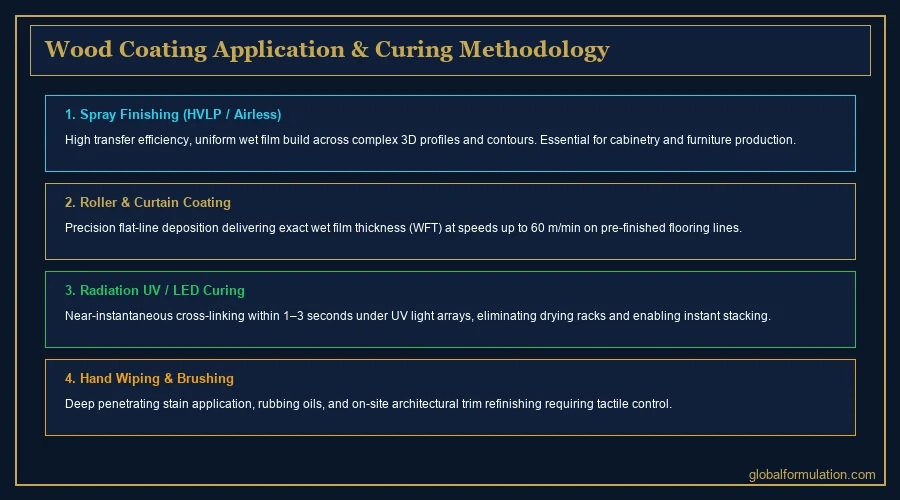
Wood coating application hinges on depositing a controlled, defect-free wet film onto a porous, irregular substrate, and the method chosen has a direct effect on achievable film build, surface levelling, and production speed. Brush and wipe application remain standard for furniture refinishing and small-shop work, spray application dominates factory and higher-volume furniture finishing for its speed and film uniformity, and UV-cure systems are applied by roller or curtain coater on a conveyorized line ahead of near-instant lamp curing. Substrate moisture content is the single most under-controlled process variable in wood finishing, because coating over wood outside its target moisture range all but guarantees adhesion or cracking problems once the wood re-equilibrates with ambient humidity.
Testing Methods and Industry Standards
Wood coating testing has to validate appearance, hardness, and durability simultaneously because a formulation can pass one test comfortably while failing the application outright on another axis, and the industry relies on a small set of standardised methods that make results comparable across suppliers and finishing shops. ASTM standards form the backbone of wood coating specification in North America, supplemented by European standards for markets governed by EN classification.
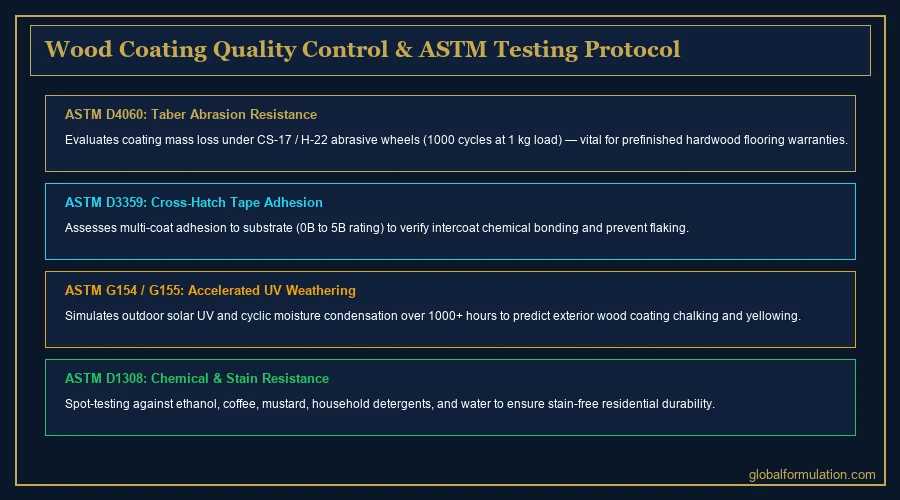
- ASTM D4060 — Taber abrasion resistance, the standard method for quantifying wear performance under a rotating abrasive wheel, essential for flooring specification.
- ASTM D3359 — cross-hatch adhesion testing, confirming film bond strength to the wood substrate and between coating layers in a multi-coat system.
- ASTM G154 / G155 — accelerated UV and xenon-arc weathering, simulating years of exterior UV and moisture exposure in an accelerated laboratory timeframe.
- ASTM D1308 — chemical spot testing, verifying resistance to household chemicals, beverages, and cleaning agents without visible marking or softening.
Layering these standardised tests across formulation development, incoming raw material QC, and finished-product release testing is what allows manufacturers to demonstrate consistent, auditable performance to furniture, flooring, and construction customers rather than relying on formulation intent alone.
Regulatory and Environmental Considerations
Regulatory pressure on wood coatings centres overwhelmingly on volatile organic compound emissions, and treating every wood coating application under a single compliance framework is a common specification error that surfaces late in product development. Solvent-based alkyd varnishes and nitrocellulose lacquers face progressively tighter VOC limits across North America, Europe, and increasingly Asia, pushing manufacturers toward waterborne and UV-cure alternatives that can meet indoor air quality certifications required for schools, healthcare facilities, and green-building projects. Indoor air quality standards, including formaldehyde and total VOC emission limits for finished furniture and flooring products, have become a de facto gating requirement for institutional and commercial specification well beyond what generic consumer regulation demands. Industry bodies such as the coatings industry press and the European Coatings technical community track this shifting regulatory landscape closely, and formulators who stay ahead of it typically hold a meaningful competitive advantage in regulated markets.
Common Problems and How to Address Them
Most wood coating field failures trace back to a small set of recurring root causes rather than a genuinely novel chemistry problem, and experienced finishers develop a mental checklist of likely culprits before committing to a full reformulation or refinishing job. Recognising the pattern early is often the difference between a targeted process fix and an expensive strip-and-refinish cycle.
- Peeling and delamination — usually indicates substrate contamination from wax, silicone, or oil, or a finish applied over wood outside its target moisture content.
- Blushing and haze — often caused by moisture condensing into a solvent-based film during application in high-humidity conditions, trapping water within the curing coating.
- Cracking on exterior wood — points to an under-specified UV additive package or a film system too rigid to accommodate the wood substrate's ongoing seasonal movement.
- Uneven stain uptake — reflects inconsistent wood porosity or grain raise across the substrate, often solved by pre-conditioning with a wash coat or sealer before staining.
Reading these failure patterns correctly during a troubleshooting investigation is itself a specialised skill, and it is exactly this diagnostic capability that determines whether a wood coating issue gets resolved with a targeted moisture-content or application-technique fix or escalates into a full refinishing job. With these failure mechanisms understood, the natural next question is how the technology itself is evolving to reduce their frequency.
Industry Trends and Future Outlook
The wood coating industry is being reshaped by three converging pressures: tightening VOC and indoor air quality regulation that continues accelerating the shift from solvent-based alkyds and lacquers to waterborne and UV-cure systems, growing demand for bio-based resin content in response to sustainability procurement criteria, and factory automation that is pushing UV-cure and robotic spray application deeper into furniture and flooring production even at mid-scale volumes. Nanotechnology-enhanced coatings that improve scratch and abrasion resistance without sacrificing the natural clarity finishers and consumers expect from a wood finish are moving from research into commercial flooring and cabinetry products. Formulators and finishing engineers who build technical fluency in low-VOC waterborne chemistry, UV-cure application processes, and bio-based resin formulation now will be positioned to lead product development as regulation and sustainability procurement continue reshaping the wood coating landscape.
Frequently Asked Questions
1. What is the difference between a wood stain, a varnish, and a sealer?
A wood stain is a penetrating, pigmented or dye-based product designed to change or enhance the colour of wood while leaving the surface largely open to the grain, and on its own it provides minimal protective film. A varnish is a film-forming, typically clear coating — most often an alkyd, polyurethane, or waterborne acrylic resin — that cures or dries on top of the wood surface to build a continuous protective layer with defined gloss, hardness, and chemical resistance. A sealer sits functionally between the two: it is usually the first coat applied over raw or stained wood, formulated to control grain raise, even out absorbency across the substrate, and promote adhesion for the topcoats that follow, rather than to deliver final-film performance on its own. Understanding this distinction matters because these three product types are almost always used together in a coordinated system — stain for colour, sealer for substrate preparation, varnish or topcoat for the durable protective film — and substituting one for another usually produces a visibly and functionally inferior result.
2. How do I choose between waterborne, solvent-based alkyd, and UV-cure wood coatings?
Solvent-based alkyd varnishes remain popular for their warm amber colour development, excellent wood wetting, and forgiving hand-application characteristics, making them well suited to furniture refinishing and smaller shops without spray or curing infrastructure. Waterborne acrylic and polyurethane-acrylic hybrid coatings have become the default choice in regulated markets because of dramatically lower VOC emissions, faster recoat times, and non-yellowing clarity, though they typically demand tighter application humidity and temperature control than alkyds. UV-cure coatings are essentially reserved for factory-finish, high-volume flat-line production — flooring, cabinetry, and furniture components — because the technology needs UV lamp curing equipment and a conveyorized line, but in exchange delivers near-instant cure, exceptional hardness, and zero solvent emissions during cure. The right choice depends far more on production volume, VOC regulation exposure, and available equipment than on any single performance ranking between the three chemistries.
3. What is the difference between a penetrating finish and a film-forming finish?
A penetrating finish — oils, waxes, and most stains — soaks into the wood's cellular structure and cures or dries within the substrate itself, leaving the wood's natural texture and grain fully open to touch rather than building a continuous surface layer. A film-forming finish — varnish, lacquer, polyurethane, and UV-cure coatings — cures on top of the wood as a continuous, measurable dry film that provides the bulk of the coating system's scratch, chemical, and moisture resistance. Penetrating finishes generally offer easier spot repair and a more natural hand-feel but weaker abrasion and liquid resistance, while film-forming finishes deliver much higher protection and gloss control but show wear, scratching, and edge chipping more visibly since damage occurs at the visible surface layer. Most professional wood finishing schedules combine both approaches deliberately, using a penetrating stain or oil for colour and substrate protection beneath a film-forming topcoat for durability.
4. Why does wood grain raise after applying a waterborne coating, and how is it managed?
Grain raise happens because water in a waterborne coating swells the wood's cut cellulose fibres, causing them to stand up from the surface as the coating is applied and dries, which leaves the finished surface feeling rough or fuzzy to the touch. This effect is far more pronounced with waterborne systems than with solvent-based alkyds because water is a stronger cellulose swelling agent than most organic solvents used in varnish formulation. The standard remedy is to pre-raise the grain deliberately with a light water or sealer application before finish coating, then sand the raised fibres smooth once dry, so that the actual finish coats encounter a substrate that will not raise further. Skipping this step is one of the most common causes of a rough-feeling waterborne wood finish, and it is a preparation failure rather than a formulation defect in the coating itself.
5. How do interior and exterior wood coating requirements differ?
Interior wood coatings are formulated primarily around abrasion resistance, chemical and stain resistance, and appearance retention under artificial and indirect natural light, since interior wood rarely experiences direct UV exposure or significant moisture cycling. Exterior wood coatings must additionally survive direct UV degradation, repeated wet-dry and freeze-thaw moisture cycling, and dimensional movement in the wood substrate itself as it absorbs and releases moisture with the seasons, which is why exterior systems rely heavily on UV-absorbing additives and more flexible film-forming resins. A coating formulated for interior furniture that is applied outdoors will typically fail within one to two seasons through chalking, cracking, or peeling, because its resin system and additive package were never engineered for UV and moisture cycling stress. This is why exterior-rated wood stains and varnishes are formulated as a genuinely distinct product category rather than a stronger version of an interior product.
6. What causes common wood coating failures like peeling, blushing, or poor adhesion?
Poor adhesion and peeling most often trace back to substrate contamination — residual wax, silicone, or oil on the wood surface — or to applying a finish coat before a previous coat or the wood itself has reached an appropriate moisture content. Blushing, the hazy white clouding that can appear in solvent-based lacquers and varnishes, is typically caused by moisture condensing into the film during application in high-humidity conditions, trapping water within the curing coating. Cracking and premature UV degradation on exterior wood usually indicate an under-specified UV additive package or a film system too rigid to accommodate the wood substrate's ongoing seasonal expansion and contraction. Correctly diagnosing which of these root causes is responsible is essential before attempting a fix, because a formulation change will not resolve a surface-preparation or environmental-application problem, and vice versa.
7. What testing standards and methods are used to evaluate wood coating performance?
Abrasion and wear resistance are most commonly evaluated using Taber abrasion testing under ASTM D4060, which quantifies material loss under a rotating abrasive wheel and is especially critical for flooring and high-traffic furniture coatings. Adhesion is verified through cross-hatch or pull-off testing under ASTM D3359, confirming the film bonds securely to the substrate and between coating layers in a multi-coat system. Exterior durability is assessed through accelerated weathering under ASTM G154 or G155, which simulates UV exposure and moisture cycling in an accelerated timeframe to predict multi-year exterior performance. Chemical and stain resistance testing, often following ASTM D1308 or manufacturer-specific spot tests using household chemicals and beverages, confirms a finish will resist common household and commercial contact exposure without visible marking or softening.
Absar Khan
Absar Khan is a senior industrial consultant with cross-disciplinary expertise spanning pharmaceutical manufacturing, cosmetics and personal care, home and institutional care chemicals, aerosols, lubricants, and advanced process engineering. His work integrates formulation chemistry, GMP facility design, validation science, quality systems, regulatory compliance, and large-scale manufacturing optimization.
LinkedIn Portfolio: Connect with Absar Khan on LinkedIn
Need Expert Guidance on Wood Coatings?
Our team provides end-to-end technical consultancy — from formulation development and chemistry selection through to scale-up, process engineering, and regulatory strategy.