Construction Chemical Scale-Up: From Lab Batch to Plant Production
A construction chemical company signs its first large supply contract, runs the formula it perfected in the lab through the plant for the first time, and the first full batch fails a viscosity check — or gels in the vessel, or separates in the drum within a week. This is one of the most common and most expensive setbacks a growing formulator faces, because a failed plant batch ties up capacity, wastes raw material by the tonne, and can put a delivery commitment at risk. The uncomfortable truth is that construction chemical scale-up is a process-engineering problem, not a recipe problem: the formula that worked at one litre is almost always still correct, but the way a plant mixes, heats, and handles that formula is nothing like a beaker on a hotplate. This article explains why lab batches systematically mislead, which physical variables change with scale and how they bite, how a staged lab-to-pilot-to-plant transfer de-risks the move, and what a complete technology transfer package has to contain. Read it and you will be able to plan a scale-up around the mechanisms that actually cause failures, instead of discovering them one plant batch at a time.
Why Lab Batches Mislead in Construction Chemical Scale-Up
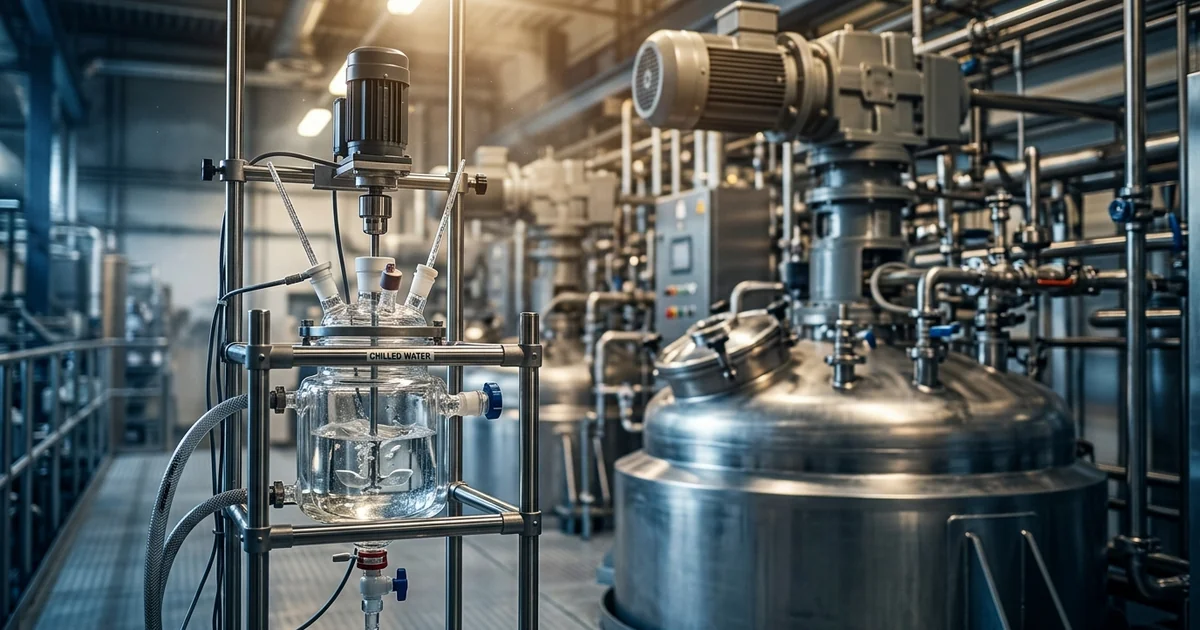
The lab is not a small plant — it is a different physical environment that happens to make the same product. A one-litre batch under a high-shear lab mixer is agitated intensely and uniformly everywhere, reaches thermal equilibrium with the room in minutes, and receives each addition almost instantly compared with the timescale of any reaction or hydration taking place. None of those three things is true in a two-tonne production vessel, and each difference changes how the product forms. Recognising that the bench conditions themselves are unrepresentative is the starting point for a scale-up that works.
- Uniform mixing — in a beaker the whole batch is well mixed; in a large tank, shear is high near the impeller and low at the walls and base, so dispersion and reaction are not uniform across the batch.
- Fast heat exchange — a small batch loses or gains heat quickly through its large surface-area-to-volume ratio; a large batch has a small ratio, so exothermic heat accumulates and cooling takes hours.
- Instant additions — tipping in a gram of powder is instantaneous relative to the chemistry; adding a 25 kg bag, or metering a stream over ten minutes, is not, and the local concentration during that window can drive side reactions or lumping.
- Idealised raw materials — lab work usually uses one hand-picked lot of each ingredient, hiding the supplier-to-supplier and lot-to-lot variation that production will meet.
Because these factors interact, a formula can pass every lab test and still fail its first plant batch on rheology, open time, or storage stability. The way to get ahead of that is to identify, before any plant time is booked, exactly which variables the product is sensitive to.
The Scale-Sensitive Variables That Decide the Outcome
Scale-up failures are not random — they cluster around a short list of physical variables that behave differently as batch size grows. Knowing this list turns scale-up from guesswork into a structured investigation: each variable can be probed at pilot scale and pinned down before it causes a full-size loss. The variables that matter most for construction chemicals are mixing intensity, heat removal, addition sequence and rate, and the shear and time history the product experiences on its way to the drum.
| Variable | What changes with scale | Typical construction-chemical failure |
|---|---|---|
| Mixing intensity & uniformity | Shear concentrates near the impeller; dead zones form at walls and base; blend time grows disproportionately | Incomplete cellulose ether hydration, poor pigment or filler dispersion, streaky admixture |
| Heat removal | Surface-to-volume ratio falls, so exothermic heat accumulates and cooling is slow | Runaway temperature in superplasticiser polymerisation; molecular weight and performance drift |
| Addition rate & sequence | Additions take minutes not seconds; local over-concentration persists | Latex coagulation on acid or salt addition; lumping of thickeners; premature gelation |
| Shear history to packaging | Pumps, transfer lines, and filling heads impose extra shear the beaker never applied | Shear-thinning that does not recover; viscosity out of spec in the drum |
| Hold time | Large batches sit in the vessel and in storage far longer before use | Settling, syneresis, or biological growth not seen in a same-day lab batch |
Each of these variables can be characterised at a fraction of full scale, which is exactly what the pilot stage is for — and why a disciplined, staged transfer beats jumping straight to the plant.
A Staged Transfer: Lab to Pilot to Plant
The reliable way to scale a construction chemical is to move through defined stages, each answering a specific question, rather than doubling batch size until something breaks. A staged transfer costs a few weeks and some pilot material, but it converts the unknowns into measured parameters before any full-size batch — and any customer commitment — is at risk. In a construction chemical manufacturing consultant engagement, this staged programme is usually the core of the work.
- Finalise and characterise the lab formula — lock the formula, define the target and limit values for every in-process and finished-product property, and record the lab process in full detail.
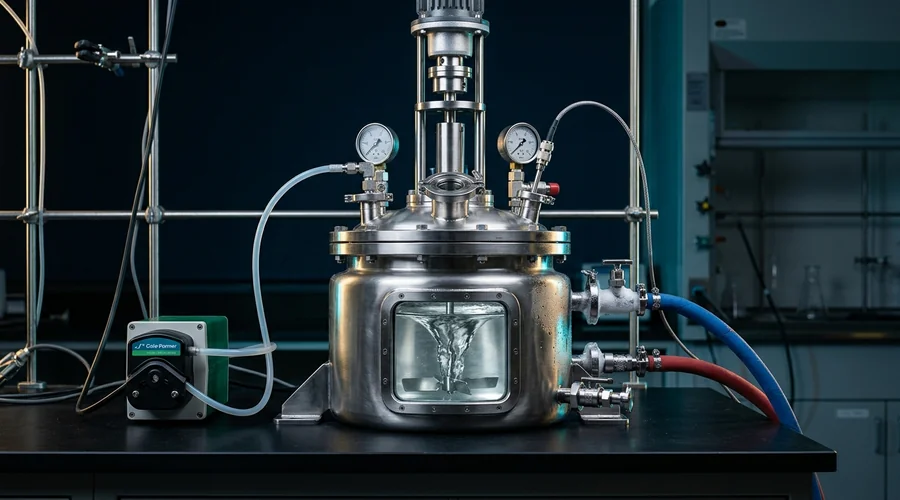
- Run pilot batches — typically 20–200 L or kg on equipment geometrically similar to the plant, deliberately varying mixing time, addition rate, and temperature to map the sensitive windows.
- Design the plant procedure — translate the pilot findings into plant instructions: impeller speeds, addition durations, jacket temperatures, transfer and filling conditions.
- Execute a plant trial — the first full batch on production equipment with production raw material lots, put through the complete quality-control regime.
- Run a production validation — several consecutive full batches to confirm reproducibility, plus stability studies on the plant-made material to support the shelf life.
This structure also matches how a formulation partner works with an external manufacturer, where the same discipline underpins any polycarboxylate ether superplasticiser production transfer or admixture plant commissioning. With the process staged, the next risk to close down is the one hiding in the raw materials.
Raw Material Variation at Production Volume
Lab development quietly assumes ideal ingredients. Each raw material is usually a single, often premium, lot bought once and used throughout the project, so batch-to-batch and supplier-to-supplier variation stays invisible until production draws on many lots over many months. In construction chemicals this variation is real and consequential: cement and mineral fillers shift in fineness, alkali content, and moisture between deliveries; technical-grade polymers, solvents, and surfactants carry impurity and additive profiles that differ by source. A formulation that depends on one perfect lot is fragile by design.
- Cement and fillers — variation in Blaine fineness, C3A content, and alkalis changes how admixtures adsorb and perform; pre-qualify each source and re-test the formula against the range.
- Polymers and dispersions — solids content, particle size, and residual monomer or surfactant vary by supplier plant; set acceptance specifications, not just a trade name.
- Cellulose ethers and redispersible powders — substitution level, viscosity grade, and moisture pickup in bulk handling affect water retention and rheology.
- Powder handling in bulk — materials that flow from a small bag can bridge in a silo, segregate in a large mixer, or absorb atmospheric moisture, changing the effective dose.
A robust scale-up writes acceptance criteria for every critical raw material, tests the formulation across the lot range it will actually see, and where possible builds tolerance to normal supplier variation into the formula itself. The regulatory context for those raw material choices — REACH registration status and VOC content limits among them — also has to be confirmed at production volumes, not assumed from lab quantities. Getting the raw material framework right is what keeps batch three behaving like batch one.
Scale-Up Difficulty by Product Class
Not every construction chemical is equally hard to scale, and knowing where a given product sits on that spectrum sets realistic expectations for time and cost. The difficulty tracks one thing above all: how strongly the finished product depends on the mixing process rather than just the ingredient list. Reactive and shear-sensitive systems are demanding; simple blends are not. This is also reflected in the way unit operations such as mixing, dispersion, and heat transfer dominate the engineering of the harder classes.
- Hardest — reactive polymers — polycarboxylate ether superplasticisers and similar systems, where an exothermic polymerisation makes molecular weight sensitive to temperature and mixing uniformity.
- Hard — water-based dispersions — SBR and acrylic bonding agents and admixtures, destabilised by shear, by additive order, and by freeze-thaw during finished-product storage.
- Moderate — dry-mix mortars and tile adhesives — cellulose ether and redispersible powder systems that are sensitive to blend uniformity and to powder segregation in large mixers and silos.
- Easier — simple solvent or water blends — curing compounds, some sealers and primers with no reaction and no shear-sensitive component usually scale with little trouble.
Placing a product on this spectrum early tells the team whether scale-up is a few weeks of confirmation work or a multi-month programme with pilot batching, a plant trial, and stability studies — and it prevents a demanding product being scheduled as if it were a simple one. That judgement then feeds directly into the document that carries the whole effort: the technology transfer package.
The Technology Transfer Package
Whether a product moves from an in-house lab to an in-house plant, or from a formulation consultant to a contract manufacturer, the transfer succeeds or fails on the quality of the document that goes with it. A transfer package that is just an ingredient list and a rough method guarantees questions, guesswork, and drifting batches at the receiving end. A thorough one lets the plant reproduce and troubleshoot the product without going back to the originator for every deviation. This is a core deliverable of working with a construction chemicals formulation consultant and a defining feature of practical construction chemicals development.
- Formula with ranges — permitted minimum and maximum for each component, not a single target figure.
- Manufacturing procedure — addition order, addition rates and durations, mixing speeds and times, and target plus limit temperatures for every stage.
- Raw material definitions — each material specified by property acceptance criteria and qualified supplier lots, not trade name alone.
- In-process controls — the checks made during manufacture and the acceptance window for each, with the decision rule if a check is out.
- Finished-product specification — every release property, its test method, and its limits, plus packaging and storage requirements.
- Failure modes and corrective actions — the known ways the product can go wrong, their root causes, and how to recover or reject the batch.
- Scale-up history — what changed between lab, pilot, and plant, and the reasoning behind each change.
A package built to this standard is the difference between a scale-up that ends when the validation batches pass and one that generates support calls and field complaints for years. Treat the transfer document as the deliverable, not an afterthought, and the plant inherits a product it can actually run — which is the whole point of getting scale-up right.
Frequently Asked Questions
Why does a construction chemical formulation that works in the lab often fail at plant scale?
The formula itself rarely changes, but the physical process that produces it does. In a one-litre beaker with a high-shear lab mixer, every part of the batch sees intense, uniform agitation, the mixture reaches temperature equilibrium in minutes, and additions happen almost instantly relative to the reactions taking place.
In a two-tonne plant vessel, shear is concentrated near the impeller and weak at the walls, heat generated by hydration or polymerisation takes hours to dissipate, and a bag of powder added over ten minutes behaves differently from the same powder tipped in at once. Polymer dispersions can shear-thicken or coagulate, cellulose ethers can form lumps that never fully hydrate, and exothermic reactions can run hotter than the lab ever showed. The result is a product that meets specification on paper but fails a viscosity, open-time, or stability check in the drum.
What is the difference between a pilot batch and a plant trial in construction chemical scale-up?
A pilot batch is an intermediate step, typically 20 to 200 litres or kilograms, run on equipment that mimics the geometry and mixing action of the full plant but at a size where a failed batch is cheap to discard. Its purpose is to expose the scale-sensitive variables such as mixing time, addition rate, and heat build-up before committing plant capacity.
A plant trial is the first full-size batch made on the actual production equipment, using production raw material lots and the intended operators. It confirms that the parameters identified at pilot scale hold at full scale, checks that the plant's real mixing, heating, and transfer systems behave as expected, and produces material that can be put through the complete quality-control regime. Skipping the pilot stage and going straight to a plant trial is possible for simple blends but risky for anything involving dispersions, reactions, or tight rheology targets.
Which construction chemical products are hardest to scale up?
The difficulty tracks how strongly the product depends on the mixing process rather than just the ingredient list. Polycarboxylate ether superplasticisers and other reactive polymer systems are among the hardest, because the polymerisation is exothermic and molecular weight is sensitive to temperature and mixing uniformity.
Water-based polymer dispersions such as SBR and acrylic bonding agents are difficult because they can be destabilised by shear, by the order additives are introduced, and by freeze-thaw during storage of the finished product. Dry-mix mortars and tile adhesives that rely on cellulose ethers and redispersible polymer powders are sensitive to blending uniformity and to powder segregation in large mixers and silos. By contrast, simple solvent or water blends with no reaction and no shear-sensitive component usually scale with little trouble.
How long does construction chemical scale-up typically take?
For a straightforward blend with a well-characterised formula and no reactive chemistry, a competent team can move from a finalised lab formulation to a validated plant batch in a few weeks, mostly limited by raw material procurement and quality-control lead times.
For a reactive product such as a superplasticiser, or a shear-sensitive dispersion, a realistic timeline runs several months once pilot batching, a plant trial, stability studies on the finished product, and a short production validation run of consecutive batches are all included. The stability work is often the longest single item, because accelerated and real-time storage data on the plant-made material has to accumulate before the product can be released with a supported shelf life. Rushing this stage is the most common cause of a product being recalled or reformulated after launch.
What raw material issues appear during scale-up that the lab never showed?
Lab development is usually done with a single, often premium, lot of each raw material, so batch-to-batch variation is invisible until production draws on multiple supplier lots. Cement and mineral fillers vary in fineness, alkali content, and moisture between deliveries, and admixtures interact differently with each. Technical-grade solvents, polymers, and surfactants carry impurity profiles and additive packages that differ by supplier and sometimes by plant.
Powders that flowed freely in small bags can bridge, segregate, or absorb atmospheric moisture when handled in bulk. A robust scale-up specifies acceptance criteria for each critical raw material, tests the formulation against the range of lots it will actually see, and where possible designs the formula to tolerate normal supplier variation rather than depending on one ideal lot.
Do I need a formulation consultant for construction chemical scale-up, or can my plant handle it?
A plant with an experienced process team and equipment similar to previous products can often scale a familiar product class in-house. The value of a formulation consultant is greatest when the product is new to the plant, involves reactive or shear-sensitive chemistry, or when the formula was developed elsewhere and handed over without full process detail.
A consultant bridges the gap between what the formula does chemically and what the plant equipment can actually deliver, identifies the scale-sensitive variables before capacity is committed, designs the pilot and trial programme, and sets the quality-control regime that catches a drifting batch before it ships. Engaging that support early, during formula finalisation rather than after a failed plant trial, is consistently cheaper than tracing and fixing field complaints after distribution.
What should a technology transfer package for a construction chemical contain?
A complete transfer package goes well beyond the ingredient list. It should include the full formula with permitted ranges rather than single values, the manufacturing procedure with addition order, addition rates, mixing speeds and times, and target and limit temperatures for each stage. It should define each raw material by specification and acceptable supplier lots, not just trade name.
It should carry the in-process checks and their acceptance windows, the finished-product specification with test methods, the packaging and storage requirements, and the known failure modes with their causes and corrective actions. It should also record the scale-up history: what changed between lab, pilot, and plant, and why. A package this thorough lets a receiving plant reproduce the product reliably and troubleshoot it without going back to the originator for every question.
Planning a Construction Chemical Scale-Up?
Global Formulation acts as a formulation scale-up partner for construction chemicals — mapping scale-sensitive variables, running pilot and plant-trial programmes, and building the technology transfer package your plant needs to run the product reliably.
Talk to Our Formulation Team