Cosmetic Packaging Compatibility Testing: Preventing Ingredient-Container Interactions
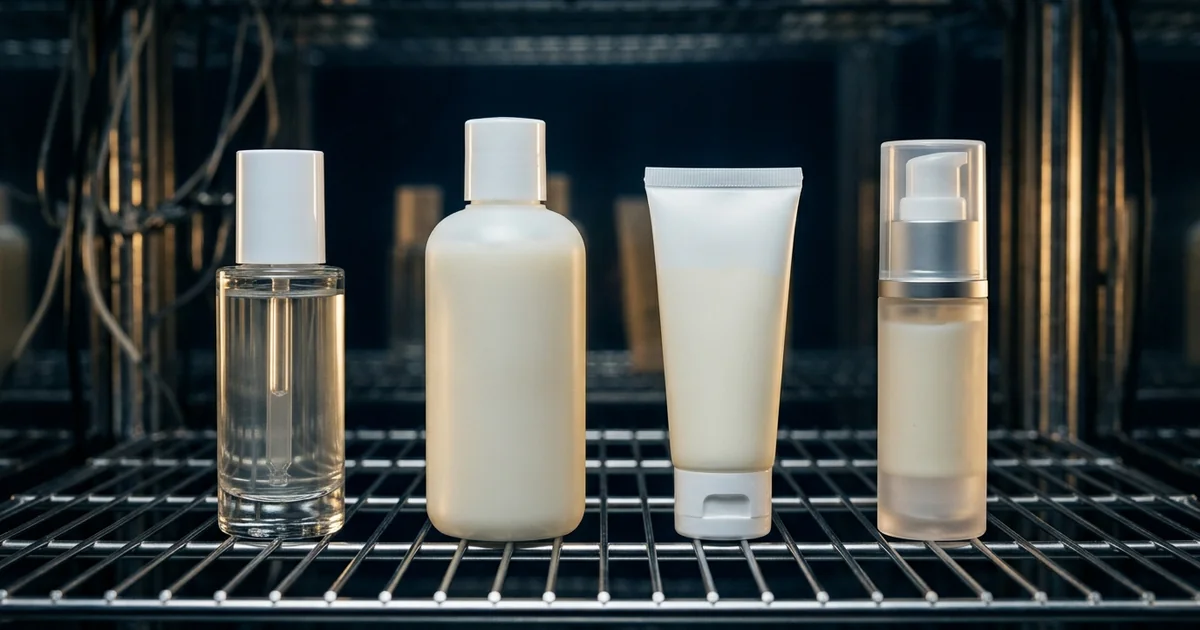
A serum that passed every stability test in the lab, then arrived on shelf six months later brown, thin, and smelling faintly of the plastic bottle it was filled into, is a failure that costs a brand a production run, a launch window, and often a retailer relationship. The problem is almost never the formula alone — it is the interaction between the formula and its container, and it is invisible until the two have spent months together. This is exactly what cosmetic packaging compatibility testing is designed to catch: the leaching, absorption, oxidation, and mechanical failures that only appear once a specific formulation meets a specific bottle, tube, jar, or pump. This article explains the four ways a formula and its packaging damage each other, how to select container materials around a formula's known sensitivities, what leachables and extractables testing actually involves, when a product needs airless or barrier packaging, and how to build a compatibility protocol that fits alongside standard stability work. The goal is a packed product that still meets every specification at the end of its shelf life, not just at fill.
Why Cosmetic Packaging Compatibility Matters
Formula stability testing traditionally runs in inert glass, which tells you whether the chemistry holds together but says nothing about the container the consumer will actually hold. The moment a real formulation is filled into a real plastic bottle, the two begin exchanging material and stress, and the effects compound over months of storage in a warehouse that may sit well above room temperature. A compatibility failure is expensive precisely because it surfaces late — after the formula is locked, the packaging is tooled, and the first production batch is filled.
The commercial consequences of skipping or rushing this work are consistent across the industry:
- Discolouration and odour — the most common visible failure, usually from oxidation or from packaging components migrating into the formula
- Active loss — oxidation-sensitive actives such as vitamin C or retinol degrading faster in the pack than in glass, so the product underperforms its label claim
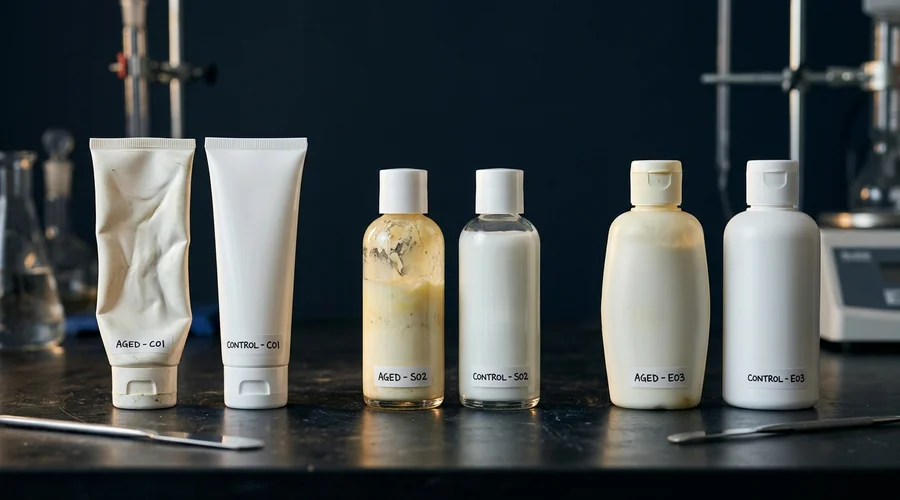
- Mechanical failure — tubes panelling, bottles stress-cracking, pumps seizing, or labels lifting once the formula has attacked the container wall or adhesive
- Preservative depletion — preservatives absorbing into plastic or a closure liner, dropping below the level needed to pass a challenge test late in shelf life
Because packaging compatibility overlaps with formula stability, the two studies are best designed together rather than sequentially — an approach covered in our guide to cosmetic stability and shelf-life testing. Understanding the specific mechanisms of interaction is what lets a formulator predict which pairings are risky before committing to a stability run.
The Four Types of Ingredient-Container Interaction
Every packaging compatibility problem falls into one of four mechanisms, and naming them is the first step to designing a study that will actually detect them. The interactions run in both directions — some are the packaging affecting the formula, others are the formula affecting the packaging — and a single product can suffer more than one at once. Knowing which mechanisms a given formula is prone to tells you what to measure and how aggressively to accelerate the test.
| Interaction | Direction | What Happens | Typical Trigger |
|---|---|---|---|
| Leaching / migration | Packaging → formula | Additives, monomers, colourants or slip agents move out of the plastic into the product | Solvent-rich, high-oil, or high-surfactant formulas; elevated temperature |
| Sorption / absorption | Formula → packaging | Fragrance, actives, or preservatives soak into the container wall and are lost from the product | Fragrance and essential oils into polyolefins; preservatives into liners |
| Permeation | Through the wall, both ways | Oxygen or moisture enters; water or volatiles escape | Thin-walled or single-layer plastics; oxidation-sensitive or aqueous systems |
| Chemical / physical attack | Formula → packaging | Wall softening, stress cracking, panelling, corrosion of metal parts, adhesive failure | Low pH, high ethanol, aggressive solvents, or strong surfactants |
The practical takeaway is that a formula's ingredient profile predicts its interaction risk before any packaging is chosen — a fragranced, ethanol-based toner and an unfragranced aqueous gel face completely different compatibility questions. Chemical or physical attack on rigid plastics most often shows up as environmental stress cracking, a brittle failure that appears only under the combination of stress and a specific chemical environment. That predictive step is what turns material selection from guesswork into a shortlist.
Packaging Material Selection Around the Formula
Container materials are not ranked from best to worst in absolute terms — each has a compatibility profile that suits some formulas and fails others. Glass is chemically inert but heavy, breakable, and offers no light protection unless tinted or coated. Plastics vary enormously: the same fragrance that is fine in PET can swell polyethylene and crack polypropylene. Choosing well means matching the material's known weaknesses against the formula's known aggressors, then confirming the match with testing rather than assuming it.
| Material | Strengths | Watch For |
|---|---|---|
| Glass (Type I / Type III) | Chemically inert, excellent barrier, premium feel | Weight, breakage, no inherent light protection, closure and liner still need testing |
| PET / PETG | Good clarity, decent barrier, resistant to many oils and surfactants | Sensitive to some solvents and high pH; stress cracking under certain actives |
| HDPE | Good chemical resistance, low moisture permeability, low cost | Fragrance and essential-oil sorption; oxygen permeability for sensitive actives |
| LDPE (tubes, squeeze bottles) | Soft, squeezable, good for creams and gels | High sorption of fragrance and oils; panelling; oxygen ingress |
| PP (caps, jars, closures) | Rigid, heat-resistant, good acid resistance | Environmental stress cracking with some surfactant and solvent systems |
| Multi-layer / barrier laminate tubes | Oxygen and light barrier, low sorption inner layer | Higher cost, more complex leachables picture, seam integrity |
Closures, liners, gaskets, pump components, and label adhesives are all part of the primary pack and all contact the formula or its vapour, so every one of them is inside the scope of the study. A preservative system that performs perfectly in the bottle can still fail if it partitions into a closure liner, which is why preservative work and packaging work are linked — a relationship explored in our guide to cosmetic preservative systems. Once a material shortlist exists, the sharpest tool for separating a safe choice from a risky one is a leachables and extractables assessment.
Leachables and Extractables in Cosmetic Packaging
Leachables and extractables testing answers a specific question: what chemistry does the packaging release, and how much of it ends up in the product? The concepts are borrowed from pharmaceutical packaging science, where they are heavily regulated, and adapted to the proportionate risk level of a cosmetic. The distinction between the two terms is not academic — it determines how aggressive the test is and how the data is used.
- Extractables — compounds forced out of a material under exaggerated conditions (strong solvents, high heat, long contact) to build a worst-case inventory of what the material could release
- Leachables — the subset that actually migrates into the specific formulation under real storage and use conditions over the product's shelf life
- Simulants — standardised test liquids (aqueous, acidic, alcoholic, fatty) used to model classes of formula when testing the real product at every stage is impractical
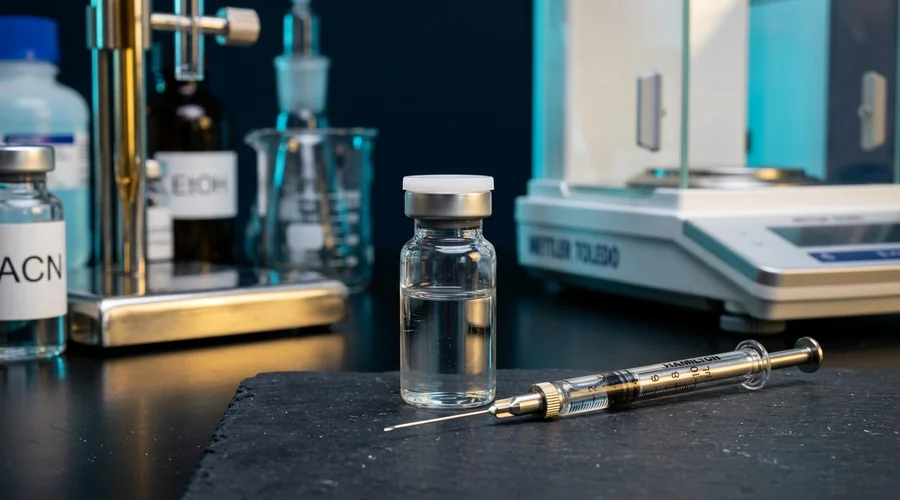
- Screening vs targeted analysis — broad chromatography-mass spectrometry screening to find unknowns, followed by targeted quantification of any compound of toxicological concern
The analytical work is specialised and usually outsourced to a contract lab, but the formulator's job is to define the risk level, choose the simulants or real formula to test, and interpret whether a detected leachable matters for that product's exposure profile. A detected compound is only a problem if its level, combined with how the product is used, crosses a toxicological threshold — which is a safety-assessment judgement, not a pass-fail number. Where oxidation rather than leaching is the dominant risk, the answer often lies in the dispensing system itself.
Airless and Barrier Packaging for Sensitive Formulas
When a formula's main vulnerability is oxygen — as it is for vitamin C, retinoids, unsaturated oils, and many botanical actives — the packaging decision shifts from "which plastic" to "which dispensing mechanism". Conventional jars and dip-tube pumps admit a fresh charge of air every time the consumer opens or pumps the product, so the active is exposed to oxygen throughout its in-use life, not only at manufacture. Airless and barrier systems are engineered to break that exposure.
- Piston airless — a rigid outer with an internal piston that rises to follow the product down as it is dispensed, leaving no growing air headspace
- Collapsing-pouch airless — a flexible inner pouch inside a rigid shell that collapses as product leaves, isolating the formula from air entirely
- Barrier laminate tubes — multi-layer walls with an EVOH or foil layer that sharply reduces oxygen and light transmission compared with a single-layer polyethylene tube
- Coated or tinted glass — where inertness matters most and a suitable pump or dropper closure can be qualified alongside
Moving to airless can also permit a lighter preservative system, because far less airborne contamination is drawn back into the container during use, though this must be proven with a challenge test on the actual pack rather than assumed. Whatever packaging direction a formula takes, the decision only holds up if it is backed by a structured compatibility study.
Building a Cosmetic Packaging Compatibility Testing Protocol
A compatibility protocol is essentially a stability study with the real packaging substituted for glass and a few extra measurements added. It runs the packed product through the same temperature conditions and pull points as formula stability, then checks both the product and the container at each interval. Designing it well means deciding upfront what "fail" looks like for this specific product, so the study can actually detect it.
- Fill the real pack — production-representative containers, closures, and dispensers, filled with the final formula at production fill weight and stored upright and inverted
- Run parallel conditions — real-time at ambient for the full intended shelf life, plus accelerated (around 40 °C, sometimes with elevated humidity) for three to six months for an early read
- Add stress protocols — freeze-thaw cycling and light exposure as separate shorter studies where the formula or pack is vulnerable
- Measure the product — appearance, odour, colour, pH, viscosity, active content, and preservative efficacy against the release specification at each pull point
- Measure the pack — weight loss (permeation), wall thickness and panelling, closure torque, pump function, label adhesion, and any visible distortion or crazing
- Close with leachables — a targeted leachables check on the aged product where the risk assessment calls for it
The single most common protocol weakness is a vague appearance specification — "no significant change" gives a study nothing objective to fail against. Defining acceptable colour shift, odour change, and weight loss numerically before the study starts is what makes the data decision-ready when the launch date is close. A well-run protocol also feeds directly into the regulatory file the product needs to reach market.
Regulatory Context and Scale-Up Considerations
Packaging compatibility is not a standalone regulatory requirement with its own checklist, but it underpins several things regulators do expect. Under the EU Cosmetic Products Regulation, the product safety report and stability documentation must reflect the packaging actually placed on the market, and the safety assessor is expected to consider packaging interactions and any relevant leachables. Similar expectations apply in other major markets through general product-safety and stability obligations.
- Safety report alignment — the packaging in the compatibility and stability data must match the current bill of materials, every time
- Change control — any change to a contact material, resin grade, colourant, liner, pump supplier, or moulding site triggers a fresh compatibility and stability evaluation
- Period-after-opening and shelf life — supported by the real-time packed-product data, not by formula-in-glass data alone
- Supplier documentation — food-contact or pharmacopoeial compliance statements and extractables data retained as part of the technical file
For brands scaling from a few SKUs to a full range, the efficient path is a standard compatibility protocol plus a pre-qualified list of packaging materials and suppliers, so each new product draws on existing data rather than starting from zero. General cosmetics and personal care formulation programmes benefit from treating packaging as a development workstream that runs in parallel with the formula, not a procurement task bolted on at the end. Building that discipline early is what keeps a growing range out of the recurring, expensive cycle of post-launch packaging failures.
Frequently Asked Questions
What is cosmetic packaging compatibility testing?
Cosmetic packaging compatibility testing is the structured evaluation of how a finished formulation and its primary packaging affect each other over the product's intended shelf life. It runs alongside standard formula stability testing but adds the container into the experiment, because a formula that is perfectly stable in inert glass can degrade, discolour, lose fragrance, or leach unwanted substances when filled into a specific plastic bottle, tube, jar, or pump.
The testing looks in both directions: what the packaging gives up to the formula (leachables), and what the formula pulls out of or does to the packaging (absorption, sorption, stress cracking, panelling). A pass means the packed product still meets its appearance, odour, pH, viscosity, preservative efficacy, and active-content specifications at the end of the study, at realistic storage temperatures.
What is the difference between leachables and extractables?
Extractables are the compounds that can be forced out of a packaging material under deliberately aggressive laboratory conditions, using strong solvents, elevated temperature, and extended contact time to map the worst-case chemical inventory of that material. Leachables are the subset of those compounds that actually migrate into the specific formulation under normal, real-world storage and use conditions over the product's shelf life.
Extractables studies are a screening tool that tells you what a material could release; leachables studies tell you what it does release into your product. For most cosmetic programmes, a supplier's extractables data plus a targeted leachables check on the real formula at the end of a stability study is a proportionate approach, with fuller leachables work reserved for higher-risk cases such as products with sensitive actives or prolonged skin contact.
Which cosmetic ingredients are most likely to cause packaging interactions?
Fragrance and essential oils are among the most common culprits, because many fragrance components are effective solvents that swell polyethylene and polypropylene, migrate into the wall of a bottle, and can cause it to soften, crack, or lose fragrance strength over time. High levels of ethanol or other volatile solvents attack certain plastics and adhesives and can escape through permeable walls.
Low-pH formulations and organic acids can corrode metal components and interact with some closure liners. Essential-oil-rich, high-surfactant, or high-oil systems tend to absorb into low-density polyethylene. Oxidation-sensitive actives such as vitamin C, retinoids, and many botanical extracts are vulnerable wherever the packaging allows oxygen ingress, which is why those formulas often move to airless or barrier packaging.
How long does a cosmetic packaging compatibility study take?
A full study typically mirrors the formula's stability protocol, so real-time evaluation at ambient conditions runs for the intended shelf life, commonly two to three years, with pull points at defined intervals. Accelerated conditions, usually around forty degrees Celsius and sometimes with elevated humidity, are run in parallel for a shorter period, often three to six months, to give an early read on likely problems.
Most brands make launch decisions on a combination of three-month and six-month accelerated data plus early real-time points, then continue the real-time study to confirm the shelf life and support any regulatory or retailer requirements. Freeze-thaw cycling and light-exposure testing are usually added as separate shorter protocols.
Why do oxidation-sensitive formulas often need airless packaging?
Conventional jars and dip-tube pumps let air back into the container every time product is removed, so an oxidation-sensitive active is exposed to a fresh headspace of oxygen throughout the product's in-use life, not just at manufacture. Airless systems use a collapsing pouch or a piston that follows the product down as it is dispensed, so the formulation is never in contact with a growing air headspace and back-suction of air is minimised.
This substantially reduces oxidative degradation of actives such as ascorbic acid and retinol, slows rancidity in oil-rich systems, and can allow a lighter preservative system because less microbial contamination is drawn in during use. The trade-off is higher unit cost, more complex compatibility testing of the multi-component dispenser, and the need to confirm the formula's rheology works with the specific pump mechanism.
Can a formulator change packaging after a product has launched without retesting?
No. Any change to the primary packaging that contacts the formula is treated as a new packaging configuration and requires its own compatibility and stability evaluation, even when the change looks minor. A different resin grade, a new colourant or masterbatch, a switched closure liner, a different pump supplier, or a move of moulding site can all change the leachables profile, the barrier performance, or the mechanical fit.
Regulators in the EU and elsewhere expect the safety assessment and stability data to reflect the packaging actually on the market. The practical rule is that the product safety report and stability file must always match the current bill of materials, so packaging changes are planned with the same lead time as a reformulation.
When should a brand bring in a consultant for packaging compatibility work?
The highest-value point is before packaging is finalised, when material choices, barrier requirements, and the dispensing system can still be adjusted around the formula's known sensitivities rather than discovered as failures six months into a stability study. A consultant is also valuable when an accelerated study has flagged an interaction and the team needs to decide quickly between reformulating, changing the resin, adding a barrier layer, or moving to airless.
For brands scaling from a handful of SKUs to a broad range, establishing a standard compatibility testing protocol and a pre-qualified list of packaging materials avoids repeating the same investigations product by product. Engaging early is particularly important for indie brands whose packaging is often selected for aesthetics first, with chemical compatibility considered too late.
Selecting Packaging for a New Cosmetic Product?
Global Formulation provides cosmetic formulation consultancy, packaging compatibility protocol design, leachables risk assessment, and stability programme support for beauty brands and manufacturers worldwide.
Talk to Our Formulation Team