Cosmetic Product Development Timeline: From Concept to Shelf-Ready Formula
A founder books a launch date, tells their retail buyer the product will ship in ten weeks, and only then calls a formulation lab to ask how fast a custom serum can be built. The lab's honest answer — six to nine months, once stability and safety testing are counted — arrives after the marketing plan is already locked, the influencer campaign is booked, and the buyer is expecting product on shelf. This mismatch between marketing timelines and formulation reality is the single most common reason cosmetic launches slip. A realistic cosmetic product development timeline is not a guess measured in weeks; it is a sequence of stages, several of which have hard scientific minimums that cannot be compressed no matter how much budget or urgency a brand applies. This article walks through what actually happens between a concept and a shelf-ready formula, where the real time goes, and how to build a timeline that survives contact with a testing lab. It draws on the stage-by-stage process used across custom formulation and private-label development for entrepreneurs and beauty brands.
Why Cosmetic Product Development Timelines Get Underestimated
Most timeline failures trace back to one root cause: brands plan a cosmetic launch the way they would plan a marketing campaign, on a calendar built around events and deadlines, rather than the way a chemist plans it, around processes that have fixed scientific durations. A social media campaign can be compressed by working weekends. An accelerated stability protocol cannot — the degradation data it produces is only meaningful after a minimum real elapsed time at controlled temperature, and no amount of urgency changes the chemistry.
- Stability testing has a scientific floor — a minimum number of weeks is required to generate a defensible shelf-life claim, independent of team size or budget.
- Iteration is assumed away — brands frequently plan around the first sample being launch-ready, when three to six rounds is the realistic norm.
- Regulatory and packaging work is treated as an afterthought — safety assessment and packaging compatibility are often scoped as the last step, when they need to run in parallel with formulation.
- Private label and custom formulation get conflated — an 8-week timeline that is realistic for a private-label reorder gets applied, incorrectly, to a custom formulation brief.
Understanding these failure points is the first step toward a timeline that holds. The remaining sections walk through the stages in the order a formulation project actually moves through them, starting with the brief that sets everything else in motion. For a broader look at the cosmetics formulation landscape this timeline sits within, see the cosmetics and personal care knowledge base.
Stage 1: Brief and Feasibility
Every development timeline starts with a brief, and the quality of that brief determines how many of the later stages need to be repeated. A brief that specifies texture, target cost, claims, packaging format, and target market up front lets a formulator identify feasibility problems on paper — before a single gram of raw material is weighed — rather than after months of bench work. This stage typically runs one to three weeks and is the cheapest place in the entire process to catch a problem.
- Claims feasibility check — confirming a desired claim (e.g., "24-hour hydration," "reef-safe") is actually substantiable with realistic ingredient choices and budget before formulation begins.
- Cost-of-goods modeling — a target retail price implies a maximum raw-material cost, and checking that math early avoids building a formula the brand cannot afford to manufacture.
- Regulatory market scan — identifying any ingredient restrictions or labeling requirements in the target market (EU, US, or elsewhere) that will constrain formulation choices from day one.
- Packaging format lock — deciding early whether the product will ship in an airless pump, a jar, or a tube, since packaging choice affects viscosity targets and preservation strategy.
With feasibility confirmed on paper, the project moves into the stage most people picture when they imagine cosmetic development: the formulator's bench.
Stage 2: Bench Formulation and Iteration
Bench formulation is where the brief becomes a physical product for the first time, and it is rarely a single attempt. A formulator builds an initial trial batch, the brand evaluates it against the brief's texture, scent, and performance criteria, and that feedback drives the next version — a loop that repeats until the formula genuinely matches what was promised on paper. Most projects go through three to six iterations, and building that expectation into the schedule up front prevents the whole timeline from feeling like it is "running late" when it is actually running normally.
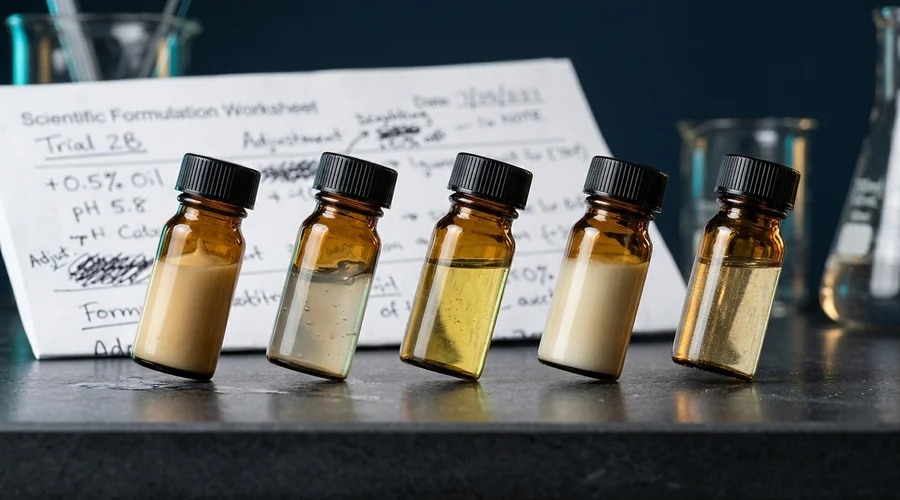
- Initial trial batch — the formulator builds a first version from the brief, prioritizing the core performance and texture targets.
- Sensory and performance evaluation — the brand assesses spreadability, absorption, scent, and stated performance against the original brief.
- Feedback translation — the formulator converts subjective feedback ("too heavy," "not moisturizing enough") into specific ingredient or ratio adjustments.
- Cost and manufacturability check — each revised version is re-checked against the target cost of goods and whether it can be produced at the intended batch scale.
Each iteration cycle commonly takes one to three weeks depending on how quickly the brand returns feedback, which means this stage alone can span two to four months before a version is approved for stability testing. Once a version passes that approval, the clock starts on the stage most people underestimate the most.
Stage 3: Stability and Safety Testing
Stability and safety testing is where a good-looking bench sample earns the right to become a real product, and it is the stage with the hardest scientific floor in the entire timeline. No formulator can honestly certify a shelf life or a preservative system's adequacy without running the actual protocols for their actual minimum durations — this is not conservatism, it is the only way the resulting claim is defensible.
- Accelerated aging — samples held at elevated temperatures (commonly 40°C and 45°C) alongside a room-temperature control for a minimum of 8 to 12 weeks, using the standard approximation that each accelerated week represents roughly one month of real-time aging.
- Freeze-thaw cycling — repeated cycling between freezing and room temperature to check for phase separation, crystallization, or texture change, typically run in parallel with accelerated aging rather than adding sequential time.
- Preservative efficacy (challenge) testing — inoculating the finished formula with a standard panel of bacteria, yeast, and mold and confirming the preservative system reduces the population within specified timeframes, a protocol that itself runs several weeks.
- Microbiological and physical release testing — confirming the batch meets microbial limits and physical specifications (pH, viscosity, appearance) before it is cleared for the next stage.
With stability and safety data in hand, the formula has scientific evidence behind it — but evidence alone does not make a product legal to sell, which is where regulatory review comes in.
Stage 4: Regulatory Review and Claims
Regulatory review determines whether the finished formula and its intended claims can actually be sold in the target market, and treating it as a final rubber-stamp step rather than a parallel workstream is one of the most expensive planning mistakes a brand can make. Ingredient restrictions, concentration limits, and labeling rules differ by market, and discovering a conflict after stability testing is complete can force a formulation change that restarts the stability clock entirely.
- Ingredient legality check — confirming every ingredient and its concentration is permitted in every market the product will be sold into, since restricted-ingredient lists vary meaningfully between regions.
- Cosmetic Product Safety Report (EU) — under EU Regulation 1223/2009, a qualified safety assessor must review the finished formula, its stability data, and its microbiology results before the product can be placed on the EU market, and this review needs the stage-3 data as an input.
- Claims substantiation file — every performance claim on the label or in marketing needs supporting evidence, whether that is an ingredient's published clinical data or the brand's own in-house testing.
- Labeling and INCI compliance — the ingredient list, warnings, and required symbols (such as the period-after-opening jar icon) must match the target market's specific labeling regulation.
Running this review in parallel with formulation and stability work — rather than waiting until both are finished — is what keeps a launch date intact. Once the formula is scientifically validated and cleared for the target market, the project shifts from lab quantities to something that can actually be sold at volume.
Stage 5: Scale-Up and Packaging
Scale-up takes a formula that worked perfectly in a one- or five-kilogram lab batch and proves it still works at a production batch size of hundreds of kilograms, and this step is not a simple multiplication of the recipe. Mixing shear, heat transfer, and ingredient addition sequencing all behave differently in a production vessel than in a lab beaker, and any of them can shift the final product's viscosity, appearance, or long-term stability if not managed deliberately.
- Pilot batch trial — an intermediate-scale batch run before full production commit, used to catch scale-sensitive problems while they are still cheap to fix.
- Packaging compatibility testing — confirming the finished formula does not interact adversely with its intended container (an airless pump, a specific plastic resin, a metal tube) over weeks of real contact time, since incompatibility can appear only after extended exposure.
- Fill-line trial — verifying the formula fills, caps, and labels correctly on the actual production equipment, catching viscosity or foaming issues that a hand-fill in the lab would never reveal.
- Final batch release — the scaled batch undergoes its own release testing against the approved specification before it is cleared to ship as finished goods.
Any adjustment made during scale-up — even a seemingly minor one — technically requires the stability confirmation to be re-checked against the scaled formula, since lab-batch data does not automatically transfer to a production batch. Pulling all five stages together into calendar time is easiest with a concrete range by product type, which is where the numbers actually land.
Realistic Timeline by Product Type
Abstract stage descriptions are useful, but brands planning an actual launch date need concrete ranges to work against. The table below reflects typical, not best-case, timelines — a rushed project can beat these numbers on a simple product, but a technically demanding one will often exceed them, especially if any stage triggers a restart.
| Development Path | Typical Timeline | Primary Time Driver |
|---|---|---|
| Private label (existing base formula) | 8–12 weeks | Fragrance/color customization + packaging lead time |
| Custom formulation, simple product (lotion, basic cleanser) | 6–9 months | Bench iteration + stability testing |
| Custom formulation, active-ingredient product (serum, treatment) | 9–14 months | Iteration complexity + claims substantiation |
| Custom formulation, novel packaging or format | 12–18+ months | Packaging compatibility testing + fill-line qualification |
These ranges assume the brief stays fixed once formulation begins and that regulatory review runs in parallel rather than as an afterthought — both of which are within a brand's direct control, unlike the fixed scientific minimums of stability testing itself. A timeline built from this table, rather than from a marketing deadline, is one that a brand can actually commit to publicly without having to walk it back later.
Frequently Asked Questions
How long does a typical cosmetic product development timeline take from concept to launch?
A realistic cosmetic product development timeline runs 6 to 12 months for a straightforward product built on an established base — a body lotion, a basic cleanser, a simple lip balm — and 12 to 18 months or longer for a product with active ingredients, novel claims, or a packaging format that needs its own compatibility testing. The single biggest variable is stability testing, because accelerated aging protocols alone typically take 8 to 12 weeks and cannot be meaningfully shortened without weakening the shelf-life claim they support.
Brands that budget 8 to 10 weeks for the entire project are almost always working from a private-label catalog rather than a genuinely custom formulation, and it helps to be clear at the outset about which of those two paths you are actually on.
What is the difference between private label and custom cosmetic formulation timelines?
Private label means selecting from a manufacturer's existing, already-stabilized formulas and customizing only the fragrance, color, or packaging, which can move from order to delivered product in as little as 8 to 12 weeks because the stability and safety work was already completed on the base formula. Custom formulation means building a new formula from raw materials specifically for your brief, which requires its own bench iteration, its own stability program, and often its own safety assessment, pushing the realistic timeline to 6 to 12 months or more.
Neither path is wrong — private label suits brands prioritizing speed to market with a differentiated but proven formula, while custom formulation suits brands whose product claims, texture, or ingredient story cannot be met by an existing base.
Why does cosmetic stability testing take so long, and can it be skipped?
Stability testing cannot be meaningfully skipped because it is the evidence base for the shelf-life date and period-after-opening symbol printed on the product, and most regulatory frameworks expect a brand to be able to substantiate those claims if challenged. Accelerated aging protocols typically hold samples at elevated temperatures such as 40°C and 45°C alongside a room-temperature control for a minimum of 8 to 12 weeks, using the accepted approximation that each week at accelerated temperature corresponds to roughly one month of real-time shelf life.
Freeze-thaw cycling, centrifuge testing, and preservative efficacy (challenge) testing typically run in parallel rather than adding sequential time, but none of them can be compressed below the minimum duration needed to generate statistically meaningful degradation data.
What causes the most delays in a cosmetic product's development timeline?
The most common source of delay is a late-stage change to the product brief — a new claim, a new active ingredient, or a packaging switch — introduced after formulation and stability testing have already started, which frequently forces some or all of the stability program to restart. Ingredient sourcing is the second most common cause, particularly for actives, natural extracts, or certified organic materials with long lead times or minimum order quantities that do not match a startup's initial batch size.
Packaging compatibility testing is the most underestimated timeline item: an airless pump or a specific plastic resin can interact with a formulation in ways that only appear after weeks of contact, and discovering incompatibility late in development can force a packaging change that resets the stability clock.
How many formulation iterations does a typical cosmetic product need before it is ready?
Most products go through three to six bench iterations before reaching a version that meets the brief on texture, scent, performance, and cost simultaneously, though a technically demanding formulation with active ingredients or an unusual texture goal can require more. Each iteration cycle typically involves the formulator adjusting the formula, the brand evaluating a sample against sensory and performance criteria, and feedback being translated back into the next bench version, a loop that commonly takes one to three weeks per cycle depending on how quickly feedback is returned.
Building in realistic time for this iterative loop — rather than assuming the first or second sample will be launch-ready — is one of the most reliable ways a brand can protect its overall timeline.
When does regulatory and safety review happen in the cosmetic development timeline?
Regulatory and safety review should start as early as the formulation brief is finalized, not after the formula is complete, because ingredient restrictions, concentration limits, and labeling requirements in the target market can force formulation changes that are far cheaper to make on paper than after a formula has already been through stability testing. In markets governed by EU Regulation 1223/2009, this includes commissioning a Cosmetic Product Safety Report from a qualified safety assessor before the product can legally be placed on the market, a step that typically requires the finished formula, its stability data, and its microbiology results as inputs.
Building safety assessment into the timeline as a parallel, not final, workstream is what separates a launch date that holds from one that slips by months.
How does scale-up from a lab batch affect the overall product development timeline?
Scale-up from a one- or five-kilogram lab batch to a production-size batch of several hundred kilograms is not a simple multiplication of quantities, because mixing shear, heat transfer rates, and addition sequencing all behave differently at production scale and can shift the final product's viscosity, appearance, or stability. A trial or pilot batch at an intermediate scale is standard practice before committing to a full production run, and any adjustment made at that stage — even a minor one — technically restarts the clock on stability confirmation for the scaled formula, since accelerated aging data from the lab batch does not automatically transfer.
Brands that skip the pilot-batch step to save time most often pay for it later, either in a failed production run or in a product that behaves differently on the shelf than the lab samples predicted.
Should a cosmetic startup work with a formulation consultant or go directly to a manufacturer?
A formulation consultant is most valuable in the early stages — translating a marketing brief into a technically achievable formulation strategy, vetting manufacturers, and catching regulatory or stability risks before they become expensive — while a contract manufacturer executes the actual production run once the formula is finalized. Many manufacturers offer in-house formulation services, but their incentive is generally to move a brand toward their existing base formulas and standard timelines rather than to solve an unusual technical problem or negotiate scope on the brand's behalf.
For a first product with a straightforward brief, going directly to a reputable manufacturer can work well; for a product with novel actives, an unusual claim, or a brand that needs an independent technical advocate through the entire process, a consultant earns their fee by shortening the path rather than lengthening it.
Planning a Cosmetic Product Launch?
Global Formulation provides cosmetic product development services, concept-to-launch formulation consulting, and contract partner support for indie beauty brands and manufacturers building custom or private-label products.
Talk to Our Formulation Team