Cosmetic Rheology Modifier Guide: Carbomers vs Gums
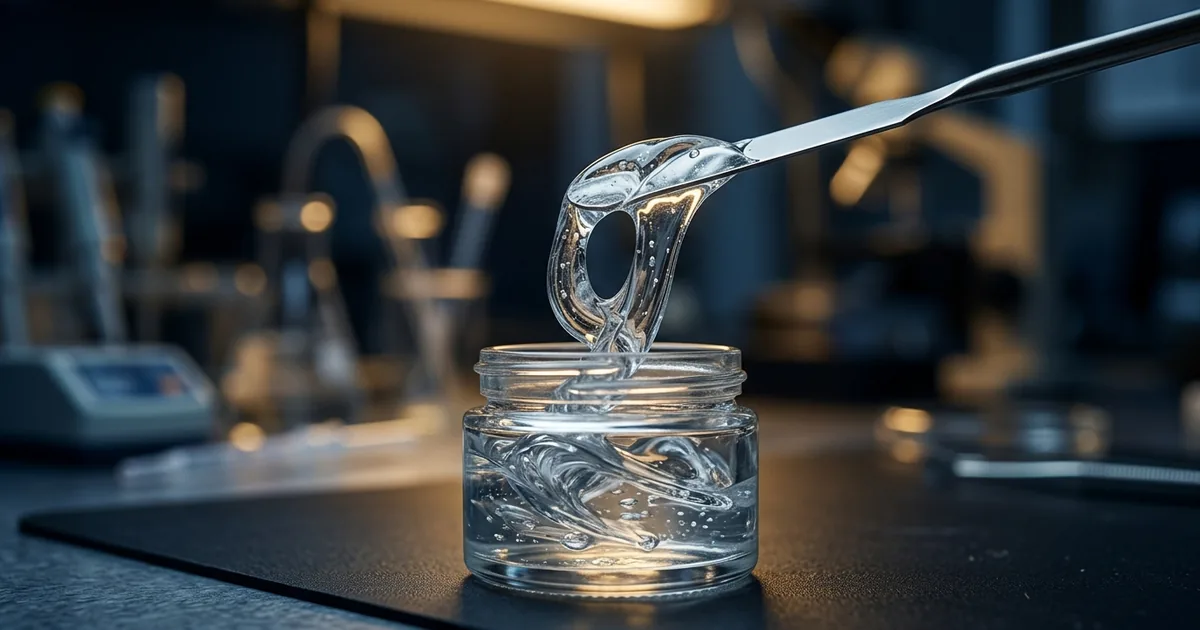
A cream that glides on beautifully in the jar can turn watery and thin the moment a formulator swaps one thickener for another, and the reformulation that follows often costs more development time than the original project did. Rheology modifiers are the single ingredient class most responsible for how a cosmetic product feels on skin, whether it stays suspended on the shelf, and whether it survives temperature swings in transit. Choosing the right cosmetic rheology modifier means understanding two very different chemistries: synthetic carbomers that build viscosity through polymer-chain neutralization, and natural or semi-synthetic gums that thicken through hydration and molecular entanglement. This guide works through how carbomers and gums each build viscosity, how their rheology profiles differ in real-world use, and where natural-certification requirements rule one class out entirely. Whether you're troubleshooting a gel that won't set or specifying a thickener for a new natural-positioned line, the mechanism behind the rheology modifier determines far more about the finished product than its INCI name alone.
Why Rheology Modifier Choice Shapes the Whole Product
Rheology modifiers do more work in a formula than their small use level suggests, because they govern nearly every physical property a consumer notices before the active ingredients ever get a chance to perform. The same active-ingredient package can feel luxurious or thin, cushioned or sticky, depending entirely on which thickener carries it. Getting rheology wrong doesn't just hurt sensory scores in consumer testing — it can cause a product to fail on the shelf long before anyone applies it.
- Viscosity at rest — determines whether a product pours, scoops, or pumps, and sets first impressions in a consumer trial
- Flow under applied shear — governs how the product spreads and absorbs during actual use on skin or hair
- Suspension stability — keeps dispersed particles like exfoliating beads, pigments, or emulsion droplets from settling or creaming over shelf life
- Sensory character — contributes the "cushion," slip, or tackiness a consumer associates with a premium formula
Two chemistries dominate how formulators solve for these properties, and they build viscosity through fundamentally different mechanisms — which is exactly where the real formulation decision begins.
Carbomers: Neutralization Chemistry and Sensitivities
Carbomers are high-molecular-weight, crosslinked polyacrylic acid polymers, listed under the INCI name Carbomer and long associated with the Carbopol trade name that first commercialized the chemistry. In their as-supplied acidic state, carbomer particles are tightly coiled and disperse into water as a low-viscosity, slightly cloudy suspension — the thickening effect that makes carbomers useful hasn't happened yet at this stage. Neutralizing the polymer's carboxylic acid groups with a base is what triggers the transformation, and understanding that trigger is the key to using carbomers reliably.
- Neutralizing agents — triethanolamine, sodium hydroxide, and aminomethyl propanol (AMP) are the most common bases used to ionize the polymer backbone
- Chain uncoiling mechanism — ionizing the carboxylic acid groups creates like negative charges along the polymer backbone; electrostatic repulsion between those charges forces the coiled chain to unfold and expand dramatically in hydrodynamic volume
- Viscosity and clarity result — the expanded, uncoiled network is what produces both the sharp viscosity increase and the glass-clear gel appearance carbomers are known for
- Electrolyte sensitivity — dissolved salts screen the ionic charges holding the chains extended, which can re-coil the polymer and collapse viscosity even after full neutralization
Carbomers solve for clarity and cushion extremely well, but that electrolyte sensitivity is exactly the weakness that natural and semi-synthetic gums were built to avoid.
Natural & Semi-Synthetic Gums
Where carbomers rely on ionic charge to build viscosity, natural and semi-synthetic gums thicken primarily through hydration and molecular entanglement — long polysaccharide chains absorb water, swell, and physically tangle with one another to resist flow. That different mechanism is precisely why gums behave so differently from carbomers under real formulation conditions, particularly around pH tolerance, electrolyte exposure, and natural-certification eligibility.
| Rheology modifier | Origin | Key rheological trait | Typical formulation role |
|---|---|---|---|
| Xanthan gum | Microbial fermentation of Xanthomonas campestris | Strong shear-thinning, good electrolyte tolerance across a broad pH range | Broad-spectrum thickener and suspending agent |
| Guar gum | Galactomannan extracted from guar bean endosperm | High viscosity at low use levels; natural lot-to-lot variability | Conditioning shampoos and rinse-off thickening |
| Hydroxyethylcellulose (HEC) | Semi-synthetic cellulose derivative | Non-ionic; broad pH and electrolyte tolerance; compatible with cationic surfactants | Clear gels and cationic-conditioning formulas |
Because most gums carry little to no ionic charge of their own, they largely sidestep the electrolyte sensitivity that defines carbomer formulation — a trade-off that comes with its own new set of variables, starting with how their flow behavior actually performs under use.

Shear-Thinning, Yield Stress, and Testing
A cosmetic gel needs to behave in two seemingly contradictory ways at once: thick enough at rest to look and feel substantial, yet thin enough under shear to spread easily across skin. Rheology modifiers achieve this through pseudoplastic, or shear-thinning, behavior — a property that a viscosity number alone cannot describe. Understanding the underlying flow curve, not just a single viscosity reading, is what separates a texture that was engineered from one that was guessed at.
- Shear-thinning (pseudoplastic) behavior — viscosity drops as shear rate increases (during rubbing or pumping) and recovers once shear stops, which is why a gel feels thick in the jar but spreads thin on skin
- Yield stress — the minimum stress required before a formula begins to flow at all; a high yield stress is what keeps suspended particles from settling at rest
- Thixotropy — time-dependent viscosity recovery after shear is removed, relevant to how quickly a product "sets" back up after application or pumping
These properties are measured directly with a rotational rheometer or viscometer, which characterizes a formula's full flow curve rather than a single spot-check number — the difference between engineering a texture and hoping one turns out right.

Choosing Between Carbomer and Gum Systems
No single rheology modifier wins on every criterion, so the decision usually comes down to which two or three factors matter most for a given product and brand position. Natural certification requirements, electrolyte exposure from other formula ingredients, and target clarity each pull the decision in a different direction, and getting the priority order wrong is a common source of late-stage reformulation. For any product sold in the European Union, the choice also has to clear the ingredient safety framework set out in EU Regulation (EC) No 1223/2009, independent of whichever rheology system is selected.
| Criterion | Carbomer | Xanthan / guar / HEC gums |
|---|---|---|
| Natural certification (COSMOS/NATRUE) | Not eligible — synthetic acrylate polymer | Generally eligible for gums of natural origin; verify each specific ingredient |
| Electrolyte tolerance | Sensitive — can lose viscosity with salts or ionic actives | Generally more tolerant, though it varies by gum type |
| Clarity | Excellent — glass-clear gels are readily achievable | Variable; xanthan and guar can add haze, HEC stays very clear |
| pH sensitivity | Requires neutralization near-neutral pH for full thickening | Broad pH stability across most common gum systems |
Once the rheology system is chosen on paper, the real test is whether it holds up through stability testing and production scale-up — which is where formulation theory meets manufacturing reality.
Stability, Compatibility & Scale-Up
A rheology modifier that performs perfectly on the bench can still fail once it meets the rest of the formula, the packaging, and the production line. Compatibility screening against other charged ingredients, accelerated stability testing across temperature cycling, and raw-material lot verification are what catch these failures before a batch ships rather than after a customer complains.
- Charge compatibility — anionic carbomer systems can conflict with cationic conditioning agents or surfactants, while non-ionic gums like HEC are typically compatible with both
- Temperature cycling — accelerated stability protocols expose the formula to elevated and freeze-thaw temperature swings to confirm viscosity holds over shelf life, not just at time zero
- Raw-material lot verification — natural gums in particular need viscosity re-confirmation on each new raw-material lot, given the batch-to-batch variability inherent to agricultural and fermentation-derived materials
- Scale-up mixing verification — shear input during production-scale mixing differs from bench mixing, and both carbomer neutralization and gum hydration are sensitive to how thoroughly and how fast that shear is applied
The decision framework, condensed: start from certification and electrolyte requirements, confirm the rheology profile with real testing rather than a single viscosity number, and re-verify raw-material lots before every production run. Our deeper comparison of gel formulation systems and our guide to emulsifier selection both build directly on the rheology principles covered here, and our cosmetics and personal care practice page shows how Global Formulation structures texture-engineering projects end to end.
Frequently Asked Questions
Why does a carbomer gel need to be neutralized before it thickens?
Carbomers ship as tightly coiled, low-viscosity acidic polymer dispersions. Neutralizing the carboxylic acid groups with a base such as triethanolamine, sodium hydroxide, or aminomethyl propanol ionizes the polymer backbone, and electrostatic repulsion between the resulting negative charges forces the chains to uncoil and expand.
That uncoiling is what builds the gel's viscosity and its characteristic glass-clear appearance — an unneutralized carbomer dispersion looks like cloudy, thin liquid.
What causes a carbomer gel to suddenly lose viscosity?
Electrolytes, or dissolved salts, screen the ionic charges that keep a neutralized carbomer's polymer chains extended. Adding a high-electrolyte ingredient, a salt-based active, or even hard water during processing can re-coil the chains and collapse viscosity within minutes.
This electrolyte sensitivity is why carbomer-thickened formulas are usually the most fragile rheology system a formulator has to manage, and why raw-material compatibility screening matters before committing to a carbomer base.
Is xanthan gum a good substitute for carbomer in a natural-certified product?
Xanthan gum, as a microbial fermentation product, is broadly eligible under most natural cosmetic certification schemes, where carbomer — a synthetic crosslinked polyacrylic acid polymer — is not. Xanthan won't replicate a carbomer gel's glass-clear appearance one-for-one, and it carries a slightly different, more cohesive sensory profile.
Its strong shear-thinning behavior and better electrolyte tolerance still make it a workable substitute across many gel and lotion formats once the formula is retested.
What's the difference between viscosity and yield stress in a cosmetic gel?
Viscosity describes resistance to flow under an applied shear rate. Yield stress is the minimum stress a formula must experience before it begins to flow at all. A gel can carry a yield stress high enough to keep dispersed particles like exfoliating beads or pigments permanently suspended at rest, while still thinning enough under the shear of rubbing to spread easily on skin.
The two properties describe different points on the same flow curve, and a formulator needs both numbers, not just one, to specify a rheology target.
Can carbomers and natural gums be combined in the same formula?
Yes, and combining a carbomer with a small amount of natural gum is a common way to build a hybrid rheology profile — layering a carbomer's clarity and cushioned feel with a gum's electrolyte tolerance or suspending power.
The combination has to be tested together rather than assumed compatible, because a gum's own ionic character, or electrolytes it may carry as a raw material, can interact with the carbomer's neutralization sensitivity and shift the final viscosity unpredictably.
Why do natural gums show more batch-to-batch variation than carbomers?
Natural gums are agricultural or fermentation-derived, so molecular weight and purity can vary with growing conditions, harvest timing, or fermentation run parameters. That variability shows up as viscosity drift between raw-material lots, requiring a formulator to re-verify viscosity on each new batch of gum received.
Carbomers, being synthetically polymerized under tightly controlled reaction conditions, typically show much tighter batch-to-batch consistency, which is one reason large-scale manufacturers often default to them where natural certification isn't a requirement.
Which rheology modifier is best for suspending exfoliating particles or pigments?
A formula needs meaningful yield stress to keep heavier dispersed particles like exfoliating beads or pigment powders from settling over shelf life. Carbomer gels are a common choice for this task because neutralization builds a strong yield stress alongside high viscosity in a single, well-characterized system.
Certain gum combinations, particularly xanthan blended with a secondary thickener, can achieve comparable suspension performance, but the suspension behavior needs to be confirmed with real particles under accelerated stability conditions rather than assumed from viscosity alone.
Does a cellulose-derivative thickener like hydroxyethylcellulose count as "natural" for certification purposes?
Cellulose-derivative thickeners such as hydroxyethylcellulose are semi-synthetic: they start from a natural cellulose backbone that is then chemically modified to make it water-soluble. Certification eligibility depends on the specific scheme and the degree of chemical modification involved.
Formulators targeting COSMOS or NATRUE certification need to verify each specific INCI ingredient against that scheme's approved ingredient list rather than assuming any cellulose-derived material automatically qualifies as natural.
Engineering Texture for a Cosmetic Product?
Global Formulation provides cosmetic rheology and texture-engineering consultancy — thickener system selection, stability and compatibility testing, and manufacturing handoff for indie brands and personal care manufacturers.
Talk to Our Formulation Team