Cosmetic Stability Testing Protocol: Accelerated Aging
A cream that looks perfect on launch day can separate, discolor, or lose its preservative punch within months on a retailer's shelf — and by the time that failure shows up in a customer's bathroom, the damage to a brand's reputation is already done. Every cosmetic formulation carries hidden risk until it has been through a proper cosmetic stability testing protocol, because heat, light, humidity, and time interact with emulsions, actives, and preservative systems in ways a single lab batch rarely reveals on its own. This guide walks through how accelerated aging testing predicts shelf-life risk early, what the standard test battery actually measures, how to read failure modes correctly, and how real-time testing confirms the period-after-opening date that ends up on the package. Global Formulation has guided indie brands and established manufacturers alike through exactly this validation process, and the protocols below reflect what actually holds up under a retailer's or regulator's scrutiny — not just what looks good in a lab notebook.
Why Stability Testing Decides Whether a Product Ships
Skipping or rushing stability testing is one of the most expensive mistakes an emerging cosmetic brand can make, because the cost of failure rarely shows up until inventory is already sitting in a warehouse or on a store shelf. A formulation that passes visual inspection on day one can still be carrying an unstable emulsion, a marginal preservative system, or a light-sensitive active that only reveals its weakness weeks or months later. Retailers increasingly require documented stability data before listing a product, and regulators expect the shelf-life and period-after-opening claims on the label to be substantiated by real testing, not estimation. Understanding what stability testing actually protects against is the first step toward building it into a product timeline instead of treating it as an afterthought.
- Batch rejection and recall exposure — instability discovered post-launch forces costly recalls or quiet SKU discontinuation, both of which damage brand trust far more than a delayed launch would
- Wasted formulation and packaging investment — reformulating after a failed production run means scrapping filled inventory and printed packaging, not just adjusting a formula sheet
- Retailer and marketplace delisting — major retailers and marketplaces increasingly request stability and challenge-test documentation before onboarding a new SKU
- Regulatory non-compliance — shelf-life and PAO claims printed on the label must be substantiated by data under regulations like EU 1223/2009, not simply estimated
None of these consequences are abstract risks — they're the direct, predictable result of skipping a step that a properly sequenced stability program is designed to catch early. That's exactly what accelerated aging testing exists to do.
How Accelerated Aging Testing Actually Works
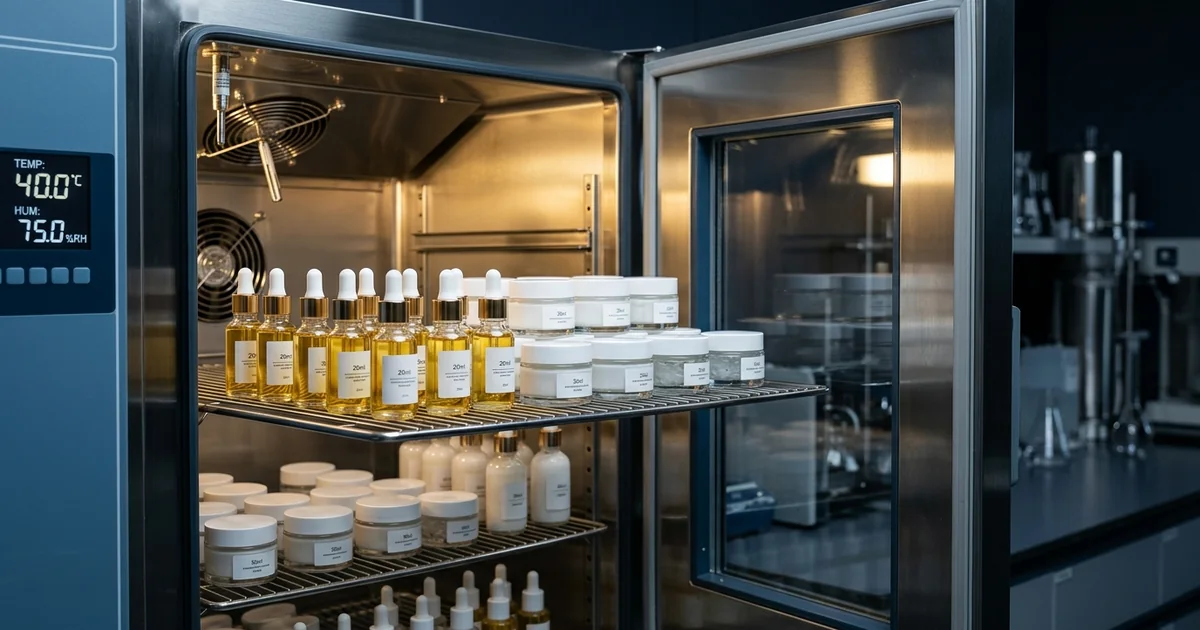
Accelerated aging testing exposes a formulation to elevated temperature, and sometimes elevated humidity or light, for a shorter period to approximate the degradation it would experience over a much longer time at normal storage conditions. The science behind this approach traces back to the Arrhenius equation, which describes how chemical reaction rates increase with temperature, and to the related "Q10 rule of thumb" — the approximation that many reaction rates roughly double for every 10°C rise. Most cosmetic labs run accelerated chambers at 40°C to 45°C, sometimes with a paired humidity setting, over a period of four to twelve weeks, tracking the same physical, chemical, and microbiological parameters that a real-time study would track over a much longer window. The appeal is speed: a formulation with a real problem often reveals it within weeks under accelerated conditions instead of months.
Because of that limitation, accelerated aging works best as the first filter in a multi-stage test battery rather than a standalone verdict — which is exactly how the standard stability test battery is structured.
The Standard Cosmetic Stability Test Battery
No single test can confirm that a cosmetic formulation is stable, which is why every credible stability program runs a battery of complementary methods rather than relying on one pass/fail check. Each test is designed to surface a different category of failure — physical, chemical, or microbiological — and skipping any one of them leaves a blind spot that can surface after launch instead of before it. The table below outlines the core methods most cosmetic stability programs run, from the fastest initial screen through the long-term study that ultimately substantiates the shelf-life claim on the label. Running these in the right sequence, rather than jumping straight to a 12-month real-time study, keeps a stability program both thorough and affordable.
| Test | Typical Conditions | What It Reveals | Role in the Program |
|---|---|---|---|
| Centrifuge test | High-speed spin shortly after manufacture | Early emulsion instability that would otherwise take weeks to appear | Fast, low-cost initial screen |
| Accelerated aging | 40–45°C, several weeks to 3 months | Early risk signal via accelerated reaction kinetics | Second-stage screen before committing to long-term testing |
| Freeze-thaw cycling | Repeated cycles between roughly -15°C and room/elevated temperature | Emulsion breakdown, crystallization, packaging stress | Physical robustness check for shipping and storage extremes |
| Photostability | Controlled UV/visible light exposure | Color, odor, and active-ingredient degradation from light | Relevant for light-sensitive actives and clear packaging |
| Microbial challenge (PET) | Inoculation with representative bacteria, yeast, and mould | Preservative system efficacy across organism classes | Confirms the formulation resists real contamination risk |
| Real-time (long-term) storage | Ambient/controlled room conditions over 12–24 months | Actual shelf-life and PAO confirmation | Final substantiation for label claims |
Centrifuge and freeze-thaw testing sit early in this sequence because they're fast and inexpensive relative to the risk they catch — and freeze-thaw cycling in particular is worth a closer look at exactly what it's stressing inside a formulation.
Freeze-Thaw Cycling and Temperature Extremes
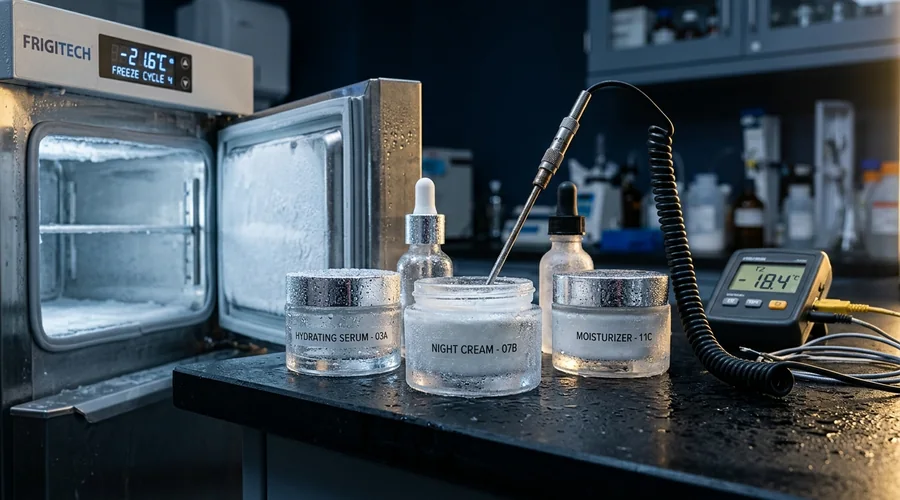
Freeze-thaw cycling puts a formulation through repeated transitions between a low temperature, often around -15°C to -20°C, and room or elevated temperature, typically across three to five complete cycles spaced a day or more apart. The test exists because shipping, warehousing, and even a customer's car trunk in winter can expose a product to genuine freezing conditions that a standard room-temperature or heat-aging protocol never simulates. Emulsions are particularly vulnerable during this test, because ice crystal formation and subsequent thawing physically disrupts the droplet structure holding oil and water phases together. A formulation that survives freeze-thaw cycling intact has demonstrated a meaningfully different kind of robustness than one that has only been heat-aged.
- Emulsion breakdown — ice crystal formation ruptures droplet interfaces, and repeated cycles can cause visible phase separation or oiling-out that heat aging alone would never trigger
- Wax and fatty alcohol crystallization — structuring ingredients that set correctly at room temperature can recrystallize in a different, less stable form after freeze-thaw stress, changing texture or causing graininess
- Viscosity change — some rheology modifiers, particularly certain natural gums and polymers, lose thickening performance after repeated freeze-thaw cycles
- Packaging compatibility — freezing can also reveal container cracking or cap-seal loosening that a stability program needs to catch alongside the formulation itself
Freeze-thaw failures and heat-aging failures both eventually show up as a visible symptom on the sample — but correctly tracing that symptom back to its actual cause is what separates a useful diagnosis from a guess.
Reading Failure Modes Correctly
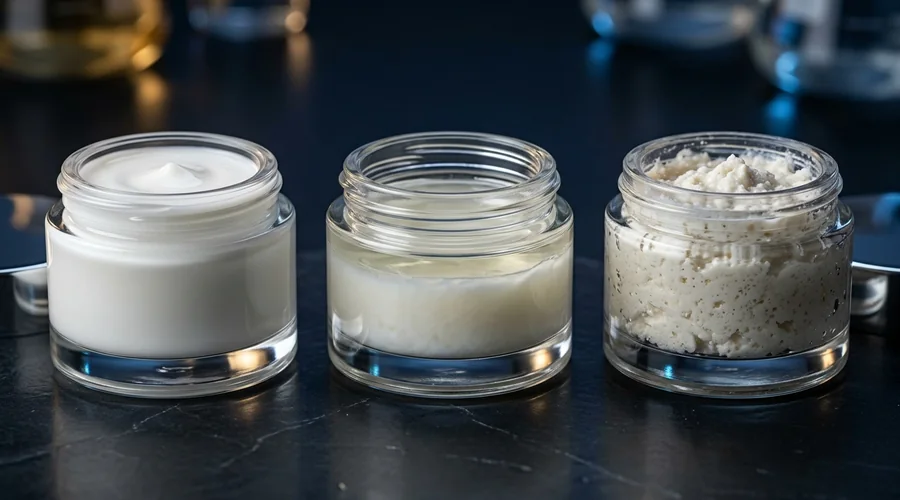
A failed stability test only becomes useful information once the failure mode is correctly diagnosed, because the same visible symptom can point to entirely different root causes depending on the rest of the formulation. Treating every failure as "needs more preservative" or "needs a stronger emulsifier" without diagnosing the actual mechanism wastes reformulation cycles chasing the wrong variable. Experienced formulators build a mental map connecting each visible symptom to its most likely underlying cause before touching the formula sheet. The table below is a starting diagnostic reference, not a substitute for testing the specific hypothesis against the actual formulation.
| Symptom | Likely Root Cause | Where to Look |
|---|---|---|
| Phase separation / oiling out | Emulsifier system undersized for the oil phase, or exceeded its thermal/mechanical tolerance | Emulsifier selection and HLB matching |
| Viscosity thinning or thickening | Rheology modifier shear or thermal sensitivity, polymer degradation | Rheology modifier chemistry and processing shear history |
| Discoloration | Oxidation of unsaturated oils or actives, light exposure, trace metal contamination | Antioxidant system, packaging opacity, raw material sourcing |
| Off-odor development | Oxidative rancidity of lipids, preservative breakdown byproducts | Antioxidant system, preservative selection |
| pH drift | Hydrolysis reactions, buffer system exhaustion, ingredient interactions | Buffer capacity and ingredient compatibility |
| Preservative challenge test failure | Formulation pH shifted the active/inactive preservative ratio, or raw materials bound part of the preservative | Preservative pH-dependence and raw material bioburden |
Phase separation and viscosity failures both trace back to emulsifier and rheology modifier selection more often than any other single variable, which is why getting that system right from the start matters more than reformulating after a failed batch — a decision our guide to HLB-based emulsifier selection and stability engineering covers in depth. Preservative challenge failures follow a similarly traceable logic, usually rooted in pH rather than raw preservative concentration alone.
Diagnosing a failure correctly tells a formulator what to fix. Confirming the fix actually worked is what real-time testing and an accurate PAO claim are built to verify.
Real-Time Confirmation and Setting an Accurate PAO
Accelerated data earns a formulation the right to proceed toward launch, but it's real-time testing, conducted at normal storage conditions over months rather than weeks, that actually confirms the shelf-life and period-after-opening claims that end up on the package. Real-time studies typically run for 12 to 24 months, tracking the same physical, chemical, and microbiological parameters checked during accelerated testing at defined intervals such as one, three, six, twelve, and twenty-four months. A separate open-jar, or in-use, study simulates repeated consumer handling after the container has already been opened, which is the specific data set that substantiates a PAO number rather than the sealed-product shelf life alone.
- Real-time interval tracking — the same parameters checked under accelerated conditions, re-checked at defined intervals under actual ambient or controlled storage
- Open-jar (in-use) stability — separate testing that simulates repeated consumer-style opening and use, the specific evidence base for a PAO number
- PAO labeling requirement — EU Regulation 1223/2009 Annex VII requires the PAO symbol unless minimum durability exceeds 30 months and opening the package doesn't meaningfully affect safety or performance
- Shelf-life claim substantiation — any "best used within X months" or expiry statement on packaging must trace back to documented real-time, not solely accelerated, data
A PAO or shelf-life number that isn't backed by this real-time and open-jar data isn't a claim — it's a guess with a symbol attached, and that's precisely the gap a well-designed stability program is built to close before the product ever reaches a shelf.
Building a Stability Program That Scales
Designing a stability program that actually fits a product line, rather than copying a generic checklist, is where many emerging brands either overspend on unnecessary testing or underspend and inherit real risk after launch. The right program depends on formulation type, company stage, and target retail channel — a single-SKU indie brand and a manufacturer launching a twelve-item range don't need identical testing scopes, even though both need the same underlying rigor. Access to properly calibrated stability chambers and accredited microbiology labs for challenge testing is often the practical bottleneck, since most emerging brands don't have either in-house.
Global Formulation supports manufacturers and entrepreneurs building cosmetic and personal care product lines from formulation through validated stability programs, including coordinating the accredited challenge testing covered in our preservative system guide. That combination of formulation expertise and testing-partner access is what turns a stability program from a compliance box-check into a genuine safeguard for the product launch.
Every decision covered in this guide — accelerated screening, freeze-thaw robustness, failure-mode diagnosis, and real-time confirmation — exists to answer one question with real evidence instead of an assumption: will this formulation still be the product a customer expects, months after it leaves the factory.
Frequently Asked Questions
What temperature is typically used for accelerated aging testing of cosmetics?
Most cosmetic stability programs run accelerated aging chambers at 40°C to 45°C (104°F to 113°F), sometimes paired with controlled humidity around 75% RH, because that range reliably accelerates degradation kinetics without pushing the formulation into temperatures so extreme that irrelevant failure modes appear. Chamber conditions modeled on this range are widely used across the industry even though cosmetics regulations, unlike pharmaceutical ICH guidelines, do not mandate a single fixed protocol.
Formulators typically run accelerated samples alongside a real-time control stored at ambient conditions so the two data sets can be compared directly rather than relying on the accelerated result alone.
How does the Arrhenius equation relate to cosmetic shelf-life prediction?
The Arrhenius equation describes how a chemical reaction's rate increases with temperature, and it underlies the "Q10 rule" commonly used as a rough guide in stability testing — the approximation that a reaction rate roughly doubles for every 10°C increase in temperature. Applied to cosmetics, this means storing a sample at an elevated temperature for a shorter period can approximate the degradation a formulation would experience over a much longer period at room temperature.
That approximation is a useful early screening tool, not a guaranteed conversion factor, because actual activation energies vary by degradation pathway and formulation, which is exactly why accelerated results always need real-time confirmation before a shelf-life claim is finalized.
What is freeze-thaw cycling and what does it reveal?
Freeze-thaw cycling repeatedly moves a formulation sample between a low temperature, often around -15°C to -20°C, and room or elevated temperature, typically across three to five complete cycles, to simulate the thermal stress a product may encounter during shipping, warehousing, or seasonal storage. The test is particularly revealing for emulsions, because repeated freezing and thawing can break emulsifier systems, trigger crystallization of waxes or fatty alcohols, and cause visible phase separation that a single room-temperature stability sample would never show.
A formulation that survives freeze-thaw cycling intact has demonstrated meaningfully more physical robustness than one tested only under static ambient storage.
Do accelerated aging results replace the need for real-time stability testing?
No — accelerated aging is an early risk-screening tool, not a substitute for real-time testing, and no credible stability program treats it as a final answer. Accelerated data lets a formulator catch a failing formulation early, often within weeks, long before a 12-month real-time study would flag the same problem, which saves significant time and cost during development.
But the shelf-life and period-after-opening claims that actually go on a product label must be substantiated by real-time data collected under normal storage conditions, because accelerated conditions can occasionally trigger failure modes — or mask others — that don't reflect how the product actually behaves in a customer's home.
What is the PAO symbol and when is a cosmetic product required to carry one?
The Period After Opening symbol, an open jar icon with a number followed by "M" for months, tells consumers how long a product remains safe and effective to use after it is first opened, and it's a labeling requirement under EU Regulation 1223/2009 Annex VII for products sold in the European Union. The regulation exempts products only where the minimum durability exceeds 30 months and where opening the package does not meaningfully affect the product's safety or performance, such as certain single-use or non-reactive items.
The number on the PAO symbol has to be substantiated by actual open-jar stability and microbiological testing after the product has been exposed to repeated consumer-style use, not simply estimated from the sealed-product shelf life.
What most commonly causes a cosmetic formulation to fail stability testing?
Emulsion instability is one of the most frequent causes of stability failure, typically showing up as phase separation, oiling out, or creaming when the emulsifier system was undersized for the oil phase or wasn't robust enough against the thermal stress of accelerated or freeze-thaw testing. Preservative efficacy failure is a close second, often traced to a formulation pH that shifted the preservative's active-to-inactive ratio, or to raw materials that bound and inactivated part of the preservative system.
Viscosity drift, color change from oxidation, and off-odor development from rancid oils round out the most common failure modes, and each one points to a different part of the formula that needs rework rather than a simple redo of the entire product.
Why should a manufacturer work with a stability testing consultant rather than running the program independently?
Designing a stability program that actually protects a product launch requires more than following a generic checklist — it means selecting the right test battery for the specific formulation type, interpreting borderline results correctly, and knowing which failure modes are acceptable risk versus which ones demand reformulation before launch. A consultant experienced in cosmetic stability testing can also help a manufacturer access proper chamber facilities and accredited microbiology labs for challenge testing, which most emerging brands don't have in-house.
That guidance is often the difference between catching a formulation problem during a six-week accelerated screen and discovering it after a full production run has already shipped to retailers.
Building or Validating a Cosmetic Product Line?
Stability program design, accelerated and real-time testing coordination, preservative and emulsifier troubleshooting, and PAO substantiation. Global Formulation supports cosmetic brands and manufacturers from formulation through documented, retailer-ready stability data.
Talk to Our Formulation Team