Crystallisation Fundamentals: Nucleation and Crystal Growth

A batch that filtered in forty minutes last month takes six hours this month, and nothing in the recipe changed. The chemistry is identical, the yield is identical, and yet the plant is losing a shift per batch to a filter that will not drain. Almost always the answer is upstream of the filter entirely: the crystals came out wrong. Industrial crystallisation is simultaneously a separation step, a purification step, and the operation that sets the physical properties of the finished solid. Yet it is routinely treated as the step that simply happens after the reaction is finished. That neglect is expensive, because crystal size and form govern filtration rate, drying time, purity, bulk density and dissolution behaviour all at once. This guide covers the mechanisms that actually control the outcome: supersaturation as the driving force, the metastable zone that defines the operating window, and the competition between nucleation and growth. It also covers how seeding converts an erratic process into a reproducible one. It reflects the approach we take in chemical reaction engineering work where the workup matters as much as the reaction.
Supersaturation: The Driving Force Behind Industrial Crystallisation
Nothing crystallises from a solution at equilibrium. A crystal forms only when the solution holds more dissolved material than it thermodynamically should at that temperature, and that excess is supersaturation. It is the single variable that drives both nucleation and growth, which is why controlling crystallisation means controlling how supersaturation is generated and consumed. Every design decision in the unit operation traces back to this one quantity.
Four routes generate supersaturation industrially, and the choice among them is usually dictated by the solubility behaviour of the compound rather than by preference:
- Cooling crystallisation — reducing temperature to drop solubility below the dissolved concentration. Requires a solubility curve with meaningful temperature dependence.
- Antisolvent crystallisation — adding a miscible solvent in which the solute is poorly soluble. Used where solubility barely changes with temperature.
- Evaporative crystallisation — removing solvent to concentrate the solution. Common for inorganic salts with flat solubility curves.
- Reactive crystallisation — forming a less soluble species in situ, as in a salt formation or neutralisation step. Supersaturation appears wherever the reagents meet, which makes mixing critical.
The critical insight is that supersaturation is not a target to maximise. High supersaturation produces crystals faster, but it produces them as a shower of tiny nuclei rather than as growth on existing surfaces. A well-run process generates supersaturation slowly enough that existing crystal surface can consume it — a rate balance, not a set point.
The Metastable Zone: Where a Controlled Process Lives
Between the solubility curve and the point where crystals spontaneously appear lies a region where a solution can be genuinely supersaturated yet remain stubbornly clear. This is the metastable zone, and it is where every controlled crystallisation operates. Inside it, existing crystals grow readily but new nuclei do not form easily. That asymmetry is the whole basis of process control: it creates a window in which growth can be encouraged while nucleation is suppressed.
The metastable zone width is the distance across that region, usually expressed as degrees of undercooling or as a concentration difference. It is emphatically not a fixed physical property of a compound. The same material shows a different zone width depending on cooling rate, agitation intensity, the presence of dust or seed, the solvent system, and impurity profile. A width measured in a clean 1 L laboratory flask is frequently narrower in a 2000 L production vessel, with its weld seams and years of surface history. This scale dependence is why crystallisation is one of the unit operations most prone to surprising a team on transfer.
Because the zone width is system-specific and scale-sensitive, it is measured rather than assumed. Determining it for the actual solvent system, at realistic cooling rates and agitation, is one of the highest-value experiments in a purification development programme. It defines the operating window that every subsequent decision depends on.
Nucleation: Primary and Secondary Mechanisms
Nucleation is the birth of new crystals, and the mechanism by which it happens determines whether a process is reproducible or a lottery. The distinction that matters industrially is between crystals formed where none existed and crystals generated from crystals already present. These two routes behave completely differently in a plant vessel.
Primary nucleation occurs in a solution containing no existing crystals of the solute. It subdivides into two forms. In homogeneous nucleation, clusters form spontaneously in the bulk liquid. In heterogeneous nucleation, foreign surfaces — vessel walls, weld lines, dust, an agitator shaft — lower the energy barrier and provide a template. In practice, industrial primary nucleation is nearly always heterogeneous. That is precisely why it is so hard to reproduce: it depends on the surface condition and cleanliness of a specific vessel on a specific day.
Secondary nucleation generates new crystals from existing ones, predominantly by attrition. Crystals collide with the impeller, the baffles, the vessel wall, and each other, and fragments break off to become new growing crystals. Because it scales with the amount of crystal present and the agitation intensity, secondary nucleation is far more predictable — and it is controllable through seed loading and impeller design.
| Characteristic | Primary Nucleation | Secondary Nucleation |
|---|---|---|
| Requires existing crystals | No | Yes |
| Supersaturation needed | High — at the metastable limit | Low — within the metastable zone |
| Dominant mechanism in plant | Heterogeneous, on surfaces | Attrition from crystal collisions |
| Batch-to-batch reproducibility | Poor — erratic onset | Good — scales with seed and agitation |
| Sensitivity to vessel history | High — surface condition matters | Low |
| Typical consequence if dominant | Fines shower, uncontrolled size | Controlled size distribution |
| Design intent | Suppress it | Control and use it |
The strategic conclusion is consistent across most industrial processes: suppress primary nucleation by staying inside the metastable zone, and rely on seeded, controlled secondary nucleation instead. A process that depends on spontaneous nucleation to start is a process that will drift.
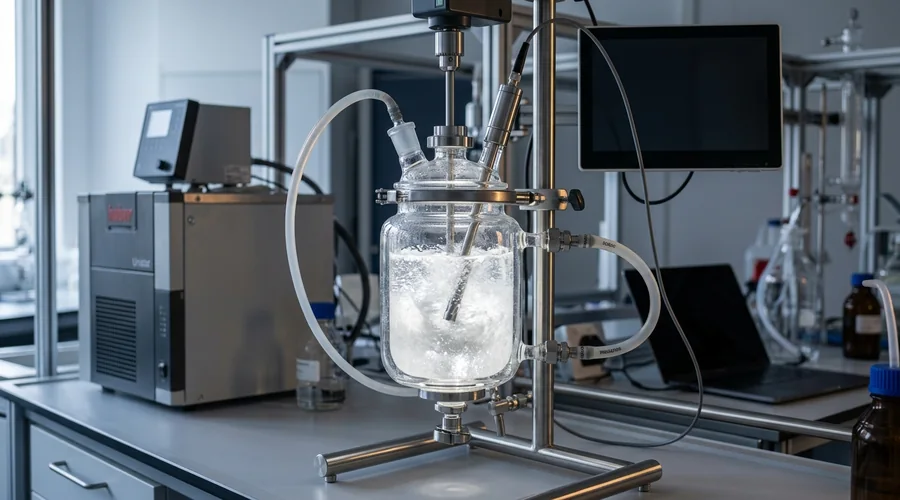
Crystal Growth, Habit and Polymorphic Form
Once a nucleus exists, dissolved molecules add to its surface and the crystal grows. Growth proceeds in two linked steps: molecules diffuse from the bulk solution to the crystal surface, and then integrate into the crystal lattice at a growth site. Either step can be rate-limiting, and which one dominates has direct plant consequences — diffusion-limited growth responds to agitation, while integration-limited growth does not. The Burton–Cabrera–Frank (BCF) theory describes how screw dislocations provide the growth sites that make integration possible at low supersaturation.
Growth rate is not uniform across a crystal. Different crystallographic faces grow at different rates, and the relative rates determine crystal habit — the external shape. The same compound, in the same polymorphic form, can be produced as compact blocks, elongated needles, or thin plates depending on solvent, supersaturation and the presence of impurities. That distinction matters enormously in a plant:
- Blocky or equant crystals — filter and wash efficiently, flow well, resist breakage during handling and drying.
- Needles — form mats that blind filter cloths, hold mother liquor tenaciously, and break during agitation to generate fines.
- Plates — pack densely and filter poorly, often producing cakes that crack rather than drain evenly.
Distinct from habit is polymorphism — different crystal lattice arrangements of the identical molecule. Polymorphs are genuinely different solids with different melting points, solubilities, dissolution rates and stability, even though the chemistry is unchanged. Getting a different polymorph is not a cosmetic variation. It changes how a material performs. In regulated sectors such as pharmaceuticals and healthcare, form is a controlled attribute that must be demonstrated consistently. The ICH Q6A guideline sets out how polymorphic form is handled as a specification. Since a metastable polymorph can convert to a more stable one during processing or storage, form control belongs in the process design rather than in the final QC test.
Nucleation vs Growth: The Balance That Sets Crystal Size
Crystal size distribution is decided by one competition: how much of the available supersaturation is consumed by making new crystals rather than growing existing ones. There is a fixed mass of solute to come out of solution, and the only question is how many crystals it gets divided among. Understanding this makes most crystallisation problems immediately diagnosable.
The relationship is straightforward. Nucleation rate rises far more steeply with supersaturation than growth rate does. At low supersaturation, growth dominates and the existing crystals get larger. At high supersaturation, nucleation overwhelms growth, the same mass of solute is shared among a vast number of nuclei, and the product is fine. This single relationship explains the majority of crystal size failures in production.
| Operating Condition | Dominant Mechanism | Resulting Product | Downstream Consequence |
|---|---|---|---|
| Low, controlled supersaturation with seed | Growth | Coarse, uniform crystals | Fast filtration, efficient washing, even drying |
| High supersaturation, unseeded | Primary nucleation | Fines shower, broad distribution | Slow filtration, high impurity retention |
| Rapid cooling or fast antisolvent addition | Nucleation | Fine, often agglomerated | Poor washing, solvent retained in agglomerates |
| Excessive agitation intensity | Attrition (secondary) | Fines generated from good crystals | Progressive size loss over batch time |
| Very high supersaturation near a miscibility gap | Phase separation | Oiling out, no crystals | Batch requires redissolution and repeat |
Read as a design rule, this table says something simple. If larger crystals are wanted, reduce the rate at which supersaturation is created, and give the existing surface time to consume it. Crystal size is bought with time, and the cost of a longer crystallisation is almost always repaid at the filter.
Seeding: Turning Crystallisation Into a Controlled Operation
Seeding is the intervention that converts crystallisation from something that happens to something that is designed. A known quantity of crystals of the correct form is added at a chosen moment. That gives the process a defined crystal surface to grow on, and primary nucleation never gets the chance to fire. It is the single most effective lever available for reproducibility, and it is inexpensive.
Effective seeding depends on getting four things right together:
- Timing — seed must be added once the solution is inside the metastable zone. Added while undersaturated, the seed simply dissolves; added after spontaneous nucleation, it arrives too late to control anything.
- Polymorphic form — the seed must be the target form, since it templates what grows. Seeding with the wrong form reliably produces the wrong form.
- Quantity and size — seed loading sets the total surface available for growth, which in turn sets the final crystal size for a given yield.
- Subsequent supersaturation profile — after seeding, cooling or antisolvent addition must be paced so supersaturation stays inside the metastable zone, rather than climbing out of it later in the batch.
That fourth point is where otherwise well-designed processes commonly fail. A linear cooling ramp generates supersaturation fastest early on, when there is least crystal surface available to consume it. That is exactly backwards. Controlled cooling profiles start slowly and accelerate as crystal surface area grows, keeping the batch inside the metastable zone for the whole operation. It is a change in the recipe's shape, not its endpoints — and one of the cheapest improvements available when a scale-up is producing off-spec solids.
Troubleshooting Crystallisation Failures
Crystallisation problems announce themselves downstream — at the filter, the dryer, or the QC laboratory — which is why they are so often misdiagnosed as filtration or drying problems. The failures below account for most of what actually goes wrong in production, and nearly all of them trace back to the rate at which supersaturation was generated.
- Crystals too fine to filter — nucleation outran growth. Cooling or antisolvent addition was too fast, seeding was absent or mistimed, or agitation was generating attrition fines. Slow the supersaturation profile and seed properly before touching the filter specification.
- Filter cake cracking during washing — a symptom of a broad size distribution and a compressible cake. Wash solvent channels through the cracks instead of displacing mother liquor, so impurities stay in the product despite an apparently completed wash.
- Oiling out instead of crystallising — supersaturation generated far too quickly, or operation near a liquid–liquid miscibility gap. The oil traps impurities and solvent, and usually requires redissolution and a slower repeat.
- Crystal fouling on reactor walls and coils — encrustation where local supersaturation is highest, typically at a cold jacket wall. It reduces heat transfer progressively through the batch, which slows cooling and changes the profile the process was designed around.
- Product fails purity despite correct chemistry — rapid growth trapped mother liquor as inclusions inside the crystals. No amount of washing removes an impurity that is inside the crystal; only a slower growth rate prevents it.
- Batch-to-batch size variability — the process is relying on spontaneous primary nucleation, whose onset varies with vessel surface condition and cleaning history. This is the classic signature of an unseeded process.
- Yield drops after a solvent or supplier change — an altered impurity profile has shifted the metastable zone width or the solubility curve. The operating window moved, but the recipe did not.
The common thread is that the filter and the dryer report the symptom while the crystalliser causes the disease. Diagnosis should start with the supersaturation profile and the seeding protocol before any downstream equipment is modified.
Why Crystal Size Decides Everything Downstream
The reason crystallisation deserves engineering attention out of proportion to its apparent simplicity is that it fixes the physical properties of the solid for every step that follows. Once the crystals are formed, the downstream equipment is largely reacting to a decision already made. A separation train designed around coarse crystals cannot be rescued by better filters when the crystalliser delivers fines.
Particle size distribution is therefore a product attribute in its own right, measured against recognised methods. ISO 13320 covers laser diffraction particle size analysis, the technique most commonly used to characterise crystalline product. The dependencies run through the whole isolation sequence:
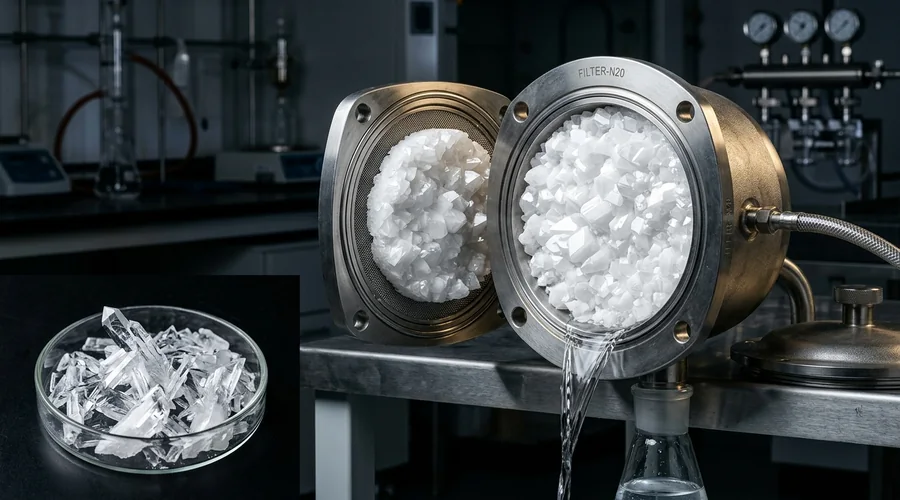
- Filtration rate — cake permeability falls sharply as particle size decreases, so fines can extend a filtration from under an hour to most of a shift. This applies whether the isolation uses a nutsche filter, a filter press or a centrifuge.
- Washing efficiency — fine and agglomerated cakes retain mother liquor and resist displacement washing, directly degrading final purity.
- Drying time and uniformity — dense beds of fine material impede vapour escape, extending drying and risking localised overheating or residual solvent above specification.
- Bulk density and flow — habit and size govern whether the dried solid discharges cleanly or bridges in hoppers and bags.
- Dissolution rate — surface area determines how quickly the product dissolves in the customer's application, which for many products is a specification in its own right.
Treating crystallisation as a well-instrumented design step, rather than a hold-and-cool operation, is consistently one of the highest-return interventions in a purification train. Where a plant is fighting filtration times, off-spec purity, or variable product form, the crystalliser is the first place to look. That is exactly the kind of work our process engineering consulting takes on — from metastable zone determination and seeding protocol design through to separation train specification. It connects directly upstream too: the route and reactor choices covered in our guide to reactor selection determine the impurity profile the crystallisation then has to cope with. For manufacturers in India, the Gulf and Southeast Asia scaling specialty products, crystallisation frequently separates a process that works on paper from one that runs.
Frequently Asked Questions
What is supersaturation in crystallisation?
Supersaturation is the difference between how much solute is actually dissolved and how much the solvent can hold at equilibrium at that temperature. It is the driving force for the entire process. With no supersaturation, nothing crystallises; with too much, crystals form uncontrollably.
Every method of generating crystals works by creating supersaturation somehow, whether by cooling the solution, adding an antisolvent, evaporating solvent, or forming a less soluble product through reaction. The whole discipline of crystallisation process design comes down to generating supersaturation at a rate the system can consume in a controlled way.
What is the difference between primary and secondary nucleation?
Primary nucleation is the formation of the first crystals in a solution containing none. It happens either spontaneously in the bulk liquid, or on foreign surfaces such as vessel walls and dust particles. Secondary nucleation is the generation of new crystals from crystals already present, most often through attrition when existing crystals collide with the impeller, the vessel wall, or each other.
The practical distinction matters because primary nucleation is erratic and difficult to reproduce between batches. Secondary nucleation is more predictable and can be deliberately controlled through seeding and agitation, so most well-designed industrial processes suppress primary nucleation and rely on controlled secondary nucleation instead.
Why are my crystals too fine to filter?
Fine crystals almost always mean nucleation dominated growth, which happens when supersaturation was generated faster than the existing crystal surface could consume it. Common causes include cooling too quickly, or adding antisolvent too fast. Failing to seed lets primary nucleation fire late and all at once, and excessive agitation generates attrition fragments.
The result is a large number of very small crystals with enormous total surface area, which forms a dense, low-permeability filter cake that drains slowly and retains mother liquor. The fix is nearly always to slow supersaturation generation and to seed properly, rather than to change the filter.
What is the metastable zone width?
The metastable zone is the region between the solubility curve and the point at which spontaneous nucleation actually occurs. Its width is how far a solution can be pushed into supersaturation before crystals appear on their own. It matters because it defines the operating window: within the metastable zone, existing crystals grow but new ones do not readily form.
The width is not a fixed physical constant. It varies with cooling rate, agitation, solvent, impurity profile, and even vessel scale. That is why it must be measured for the actual system, rather than taken from literature for a similar compound.
How does seeding improve crystallisation?
Seeding introduces a known quantity of crystals of the correct form at a controlled point. That gives the dissolved material an existing surface to grow onto, instead of waiting for spontaneous nucleation. This removes the single largest source of batch-to-batch variability, because uncontrolled primary nucleation is inherently erratic in both timing and extent.
Effective seeding depends on three things. The seed must go in while the solution is inside the metastable zone, it must be the correct polymorphic form, and its quantity and size distribution must be controlled. Seed added too early simply dissolves, and seed added after spontaneous nucleation has already fired arrives too late to control anything.
What is oiling out in crystallisation?
Oiling out is liquid–liquid phase separation occurring instead of crystallisation, where the solute separates as a second liquid phase rather than forming an ordered solid. It typically happens when supersaturation is generated far too quickly, or when the system is operated near a temperature where a liquid–liquid miscibility gap exists.
The consequence is serious because the oil phase traps impurities and solvent, and any crystals that eventually form from it are often poorly defined and hard to purify. Recovery usually means redissolving and repeating the crystallisation with a slower supersaturation profile, which is why identifying the oiling-out boundary during development is worth the effort.
Does crystal size affect product quality beyond filtration?
Yes, and this is routinely underestimated. Crystal size and habit affect purity, because rapidly grown crystals are more likely to trap mother liquor and its impurities as inclusions. A fast crystallisation can therefore produce material that fails specification despite a correct chemical route.
Size also governs drying behaviour, since fine material forms dense beds that resist vapour escape and dry unevenly. It further affects flow, bulk density, dust generation and dissolution rate in the finished product. For any material where dissolution rate or handling matters downstream, the crystallisation step is effectively setting product performance, not just isolating the compound.
Crystallisation Not Delivering the Solid You Need?
Global Formulation provides purification route selection, separation train design and workup development — from metastable zone determination and seeding protocols through to filtration and drying specification.
Talk to Our Process Team