Antiperspirant Formulation: Aluminum Salts and Alternatives
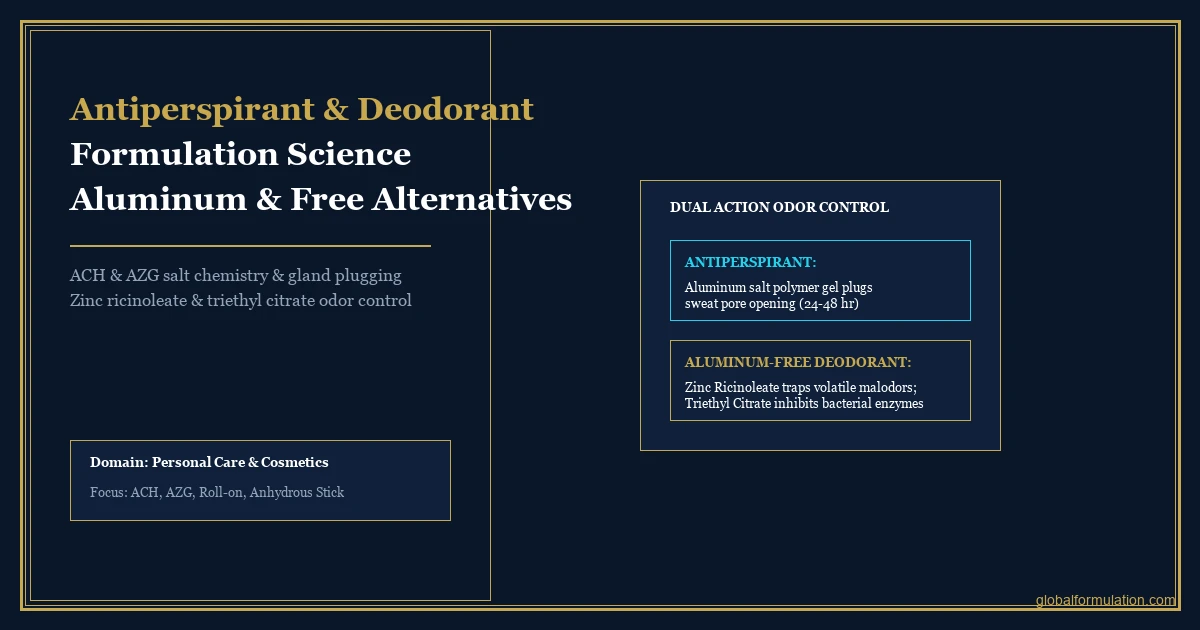
A new personal care brand launching an antiperspirant discovers fast that "just add aluminum chlorohydrate" is nowhere near the whole formulation problem. Aluminum salts are reactive, hygroscopic, and chemically demanding ingredients that interact with nearly everything else in the formula, and a poorly executed antiperspirant stick shows it immediately as grit, poor set, or a product that simply doesn't control sweat the way the label promises. Antiperspirant formulation aluminum salts chemistry determines not just efficacy but manufacturability, shelf stability, and which regulatory pathway a finished product falls under. This guide covers how aluminum salts physically occlude sweat glands, how to choose between the major salt types, when an aluminum-free alternative is the better product strategy, and the manufacturing details that separate a smooth, reliable stick from a batch that fails quality control. It draws on the kind of formulation and process guidance Global Formulation provides to cosmetic manufacturers developing antiperspirant and deodorant lines.
How Aluminum Salts Occlude Sweat Glands
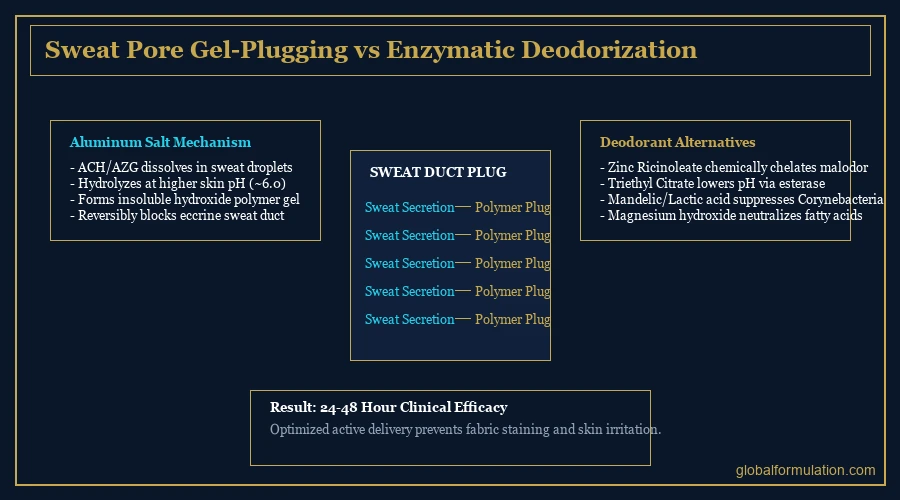
Antiperspirant efficacy depends on a genuinely physical mechanism, not a chemical shutdown of the sweat gland itself, and understanding that distinction shapes almost every formulation decision that follows. Aluminum salts dissolve in the moisture present at the skin surface and around the eccrine duct opening, and the resulting aluminum ions interact with mucopolysaccharides lining the upper sweat duct, precipitating a hydrated gel plug that physically narrows the duct. This occlusion reduces the volume of sweat that reaches the skin surface without permanently damaging or disabling the gland, which is why antiperspirant effects are temporary and require daily reapplication for continued efficacy.
- Duct occlusion — Aluminum-mucopolysaccharide gel physically narrows the eccrine duct opening rather than blocking the gland at its source
- Temporary mechanism — The gel plug is shed and reformed with each application cycle, not a permanent structural change
- Concentration dependence — Efficacy scales with aluminum salt concentration up to regulatory and formulation limits, which is why OTC monograph systems specify minimum active percentages for antiperspirant claims
That delivery requirement is exactly where salt selection starts to matter, since not all aluminum salts dissolve, perform, or feel the same once formulated into a finished product.
Choosing Between Aluminum Chlorohydrate, Aluminum Zirconium, and Other Salts
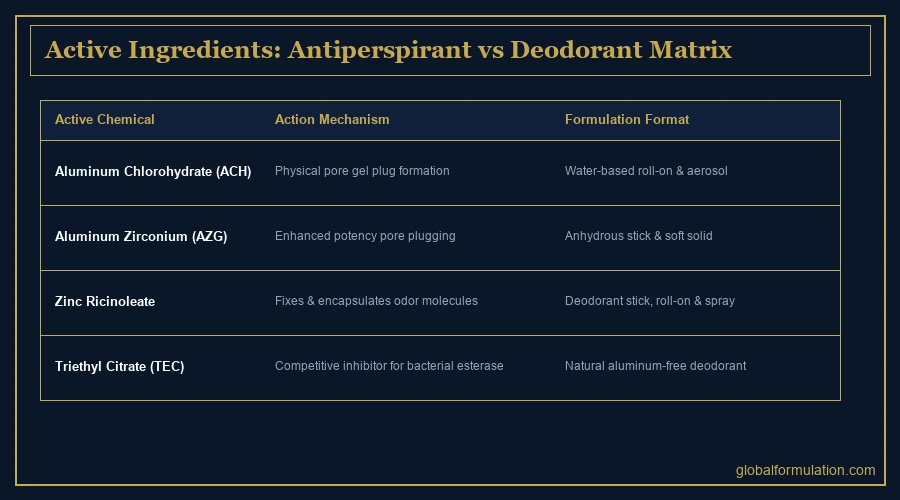
Salt selection is one of the first and most consequential decisions in antiperspirant formulation, because it affects efficacy claims, cost, skin sensitivity risk, and formulation compatibility all at once. Aluminum chlorohydrate (ACH) is the longest-established and most widely used active, valued for its cost efficiency, broad regulatory familiarity, and reliable occlusion performance across a wide range of formulation types. Aluminum zirconium tetrachlorohydrex glycine (AZG) complexes combine aluminum with zirconium and are generally associated in published research with faster onset and stronger measured sweat reduction, which positions them as the active of choice for clinical-strength or premium product tiers.
| Salt Type | Relative Efficacy | Relative Cost | Typical Positioning |
|---|---|---|---|
| Aluminum chlorohydrate (ACH) | Established, reliable | Lower | Mainstream mass-market formulations |
| Aluminum zirconium tetrachlorohydrex glycine (AZG) | Higher, faster onset | Higher | Clinical-strength and premium positioning |
| Activated aluminum chlorohydrate | Enhanced solubility profile | Moderate | Roll-on and clear formulations needing faster dissolution |
Salt choice sets the efficacy and cost baseline for the product, but it doesn't determine the entire formulation strategy — brands positioning around a "no aluminum" claim need a fundamentally different chemical approach built around odor control instead of sweat occlusion.
Aluminum-Free Odor Control Alternatives
The growing aluminum-free deodorant category isn't chasing the same efficacy target as an antiperspirant, and setting that expectation correctly with consumers is central to formulating a product that actually satisfies them. Fresh eccrine sweat is largely odorless — body odor is produced when skin-resident bacteria metabolize proteins and lipids secreted by apocrine glands into volatile compounds, so an aluminum-free deodorant's job is to interrupt that bacterial process rather than reduce sweat volume. Effective aluminum-free formulations combine several complementary mechanisms rather than relying on a single active ingredient.
- Broad-spectrum antibacterial actives — Reduce the bacterial population responsible for metabolizing sweat into odor-causing compounds
- Odor-neutralizing technology — Ingredients like cyclodextrins or zinc-based compounds that chemically trap odor molecules rather than simply masking them
- Fragrance systems — Provide immediate sensory freshness and mask residual odor while the antibacterial system works over time
- pH adjustment — Mildly acidic formulations can suppress bacterial growth conditions on the skin surface
Formulating a genuinely effective aluminum-free deodorant is a legitimate chemistry challenge in its own right, not a simplified version of an antiperspirant, and it requires just as much attention to actives selection and stability as an aluminum-based product — considerations shared closely with preservative system design in leave-on personal care products.
Stick and Roll-On Manufacturing Considerations
Getting the chemistry right on paper doesn't guarantee a stable, well-performing product once it hits production, and antiperspirant manufacturing carries several process-specific risks that catch new formulators off guard. Anhydrous stick formulations, built on a wax and silicone base, are particularly sensitive to processing conditions because aluminum salts are hygroscopic and can absorb ambient moisture during handling, disrupting the crystalline structure that gives a finished stick its smooth glide and clean set. This same anhydrous-base logic applies broadly across waterless stick and balm formulations, where moisture control during manufacturing is a recurring theme.
- Dissolution temperature control — Aluminum salts need to be fully and evenly dissolved or dispersed in the base before cooling begins
- Cooling rate management — Uncontrolled or uneven cooling promotes recrystallization, which shows up as grit or a rough, unstable stick surface
- Moisture exclusion — Processing environment humidity needs active control given the hygroscopic nature of aluminum salts
- Roll-on emulsion stability — Water-based roll-on systems require compatibility testing between the aluminum salt and the emulsifier system to avoid destabilization or salt precipitation over shelf life
Manufacturing discipline is what turns a correct formula on paper into a product that survives real-world shelf life and reaches the consumer performing as designed, which is exactly where a contract formulation partner earns its value on a new antiperspirant launch.
Regulatory Pathways and Stability Testing
Antiperspirants occupy a different regulatory category than deodorants in several major markets, and that classification has direct consequences for how a formulation gets developed, tested, and labeled. In the United States, aluminum-based antiperspirant actives fall under FDA over-the-counter drug monograph requirements, which specify approved active concentrations and mandate specific labeling language — a materially different compliance burden than a standard cosmetic. In the European Union, aluminum compounds used in cosmetic products are governed by Regulation (EC) No 1223/2009, which places restrictions on permitted aluminum concentration in leave-on underarm products.
- OTC drug monograph compliance (US) — Active concentration limits and required labeling apply specifically to aluminum-based antiperspirant claims
- EU cosmetics regulation — Concentration restrictions apply to aluminum compounds in leave-on underarm formulations
- Stability testing — Aluminum salt formulations need shelf-life testing under real and accelerated conditions to confirm the active remains stable and the base doesn't destabilize or separate over time
Confirming the correct regulatory pathway before finalizing a formula's active concentration avoids a costly reformulation cycle later, and it's one of the first questions a formulation consultancy walks through with a new antiperspirant brand.
Choosing a Format: Stick, Roll-On, or Aerosol
Format choice shapes nearly every subsequent formulation decision, from how the aluminum salt gets incorporated to what manufacturing equipment a production run requires, and it's typically driven as much by target market preference as by the chemistry itself. Sticks dominate in markets that favor a mess-free, no-wet-feel application, roll-ons remain popular where a cooling, liquid sensory experience is preferred, and aerosol sprays serve markets prioritizing fast-drying, no-touch application. Each format demands a distinct approach to dissolving or suspending the aluminum salt while still delivering the sensory qualities — glide, dry-down time, residue level — that drive repeat purchase.
- Anhydrous sticks — Wax and silicone base; requires careful salt dissolution and cooling control as covered above
- Roll-on emulsions — Water-based or silicone emulsion system; requires emulsifier compatibility testing with the aluminum salt
- Aerosol sprays — Active suspended in a volatile propellant-carrier system; requires particle size and suspension stability control
Choosing the right format for a target market and manufacturing capability, alongside the right salt and delivery chemistry, determines whether a new antiperspirant launch reaches shelf as a stable, effective product or gets stuck in reformulation cycles — the kind of decision best made early, in partnership with a cosmetics and personal care formulation consultancy, rather than after a first production run reveals a problem.
Frequently Asked Questions
How do aluminum salts actually stop sweating in an antiperspirant?
Aluminum salts like aluminum chlorohydrate form a temporary gel plug within the upper portion of the eccrine sweat duct, physically occluding sweat flow to the skin surface rather than switching off the gland itself. The aluminum ions interact with mucopolysaccharides in the duct lining, precipitating a hydrated gel that narrows the duct opening.
This occlusion is temporary and reduces sweat reaching the surface, which is why antiperspirant efficacy is usually re-applied daily rather than being a one-time permanent effect.
What is the difference between aluminum chlorohydrate and aluminum zirconium salts?
Aluminum chlorohydrate (ACH) is a well-established, cost-effective antiperspirant active with a long formulation history and broad regulatory acceptance, forming its occlusive gel plug through aluminum-hydroxide chemistry alone. Aluminum zirconium tetrachlorohydrex glycine (AZG) complexes combine aluminum with zirconium, which many published studies associate with faster onset and stronger sweat-reduction efficacy at comparable use levels.
AZG salts are generally costlier and require more careful formulation around potential skin sensitivity, which is why product positioning often determines which salt a brand selects.
Are aluminum-free deodorants actually effective, or just a marketing claim?
Aluminum-free deodorants can be genuinely effective at their intended function, but that function is different from an antiperspirant's — deodorants control odor rather than reduce sweat volume, so comparing the two on sweat reduction alone misrepresents what an aluminum-free product is formulated to do. Well-formulated aluminum-free products combine broad-spectrum antibacterial actives, odor-neutralizing technology, and fragrance masking to control the bacterial breakdown of sweat that actually causes odor.
The realistic expectation to set with consumers is odor control, not the sweat-volume reduction that only aluminum-based antiperspirants deliver.
What causes body odor if sweat itself is nearly odorless?
Fresh eccrine sweat is largely odorless water, salts, and trace organic compounds, but apocrine gland secretions in the underarm area contain proteins and lipids that skin-resident bacteria metabolize into volatile, odor-causing compounds. This bacterial breakdown, not the sweat itself, is the actual source of body odor.
Understanding this mechanism is central to formulating an effective aluminum-free deodorant, since odor control succeeds or fails based on how well the antibacterial and odor-neutralizing system performs.
Why do some antiperspirant sticks feel gritty or fail to set properly?
Grittiness and poor set in antiperspirant sticks usually trace back to incomplete or improper dissolution of the aluminum salt within the wax and silicone base, or to recrystallization of the active during cooling if the pour temperature and cooling rate weren't controlled correctly. Aluminum salts are hygroscopic and can absorb ambient moisture during processing, which disrupts the crystalline structure that gives a stick its smooth glide and clean set.
Careful control of dissolution temperature, cooling rate, and moisture exposure during manufacturing is what separates a smooth, reliably-setting stick from a batch with visible grit or a soft, unstable set.
What regulatory considerations apply to aluminum-based antiperspirants?
Aluminum-based antiperspirant actives are regulated as over-the-counter drug actives in some jurisdictions, including under FDA monograph requirements in the United States, which means formulations must use approved active concentrations and carry required labeling. In the EU, aluminum compounds in cosmetics fall under Regulation (EC) No 1223/2009 with restrictions on permitted concentration in leave-on underarm products.
Manufacturers developing new antiperspirant formulations need to confirm which regulatory pathway applies in each target market before finalizing active levels, since requirements differ meaningfully between an OTC drug classification and a standard cosmetic classification.
Can antiperspirants and deodorants be combined into a single product?
Yes, and most mainstream commercial products on the market are exactly this kind of combination formula, pairing an aluminum salt for sweat occlusion with antibacterial and fragrance actives for odor control in a single stick, roll-on, or aerosol base. Formulating a combination product requires confirming that the aluminum salt is chemically compatible with the antibacterial actives and fragrance system chosen.
Aluminum salts are reactive species that can interact with certain preservatives or actives in ways that affect stability or efficacy, so this compatibility screening is a standard part of antiperspirant-deodorant combination product development.
What formats are aluminum salt antiperspirants typically formulated into?
The three dominant formats are anhydrous sticks built on a wax and silicone base, roll-on emulsions where the aluminum salt is dispersed or dissolved in a water-based or silicone emulsion system, and aerosol sprays where the active is suspended in a volatile propellant-carrier system. Each format demands a distinct approach to dissolving or suspending the aluminum salt while still delivering the sensory qualities that drive repeat purchase.
Format choice is typically driven by target market preference and manufacturing capability as much as by the active itself.
Developing an Antiperspirant or Deodorant Product?
Global Formulation provides cosmetic formulation consultancy — active-ingredient selection, stick and roll-on process development, and contract formulation for personal care manufacturers.
Talk to Our Formulation Team