Dry Mix Mortar Manufacturing: Raw Material Selection and Blending
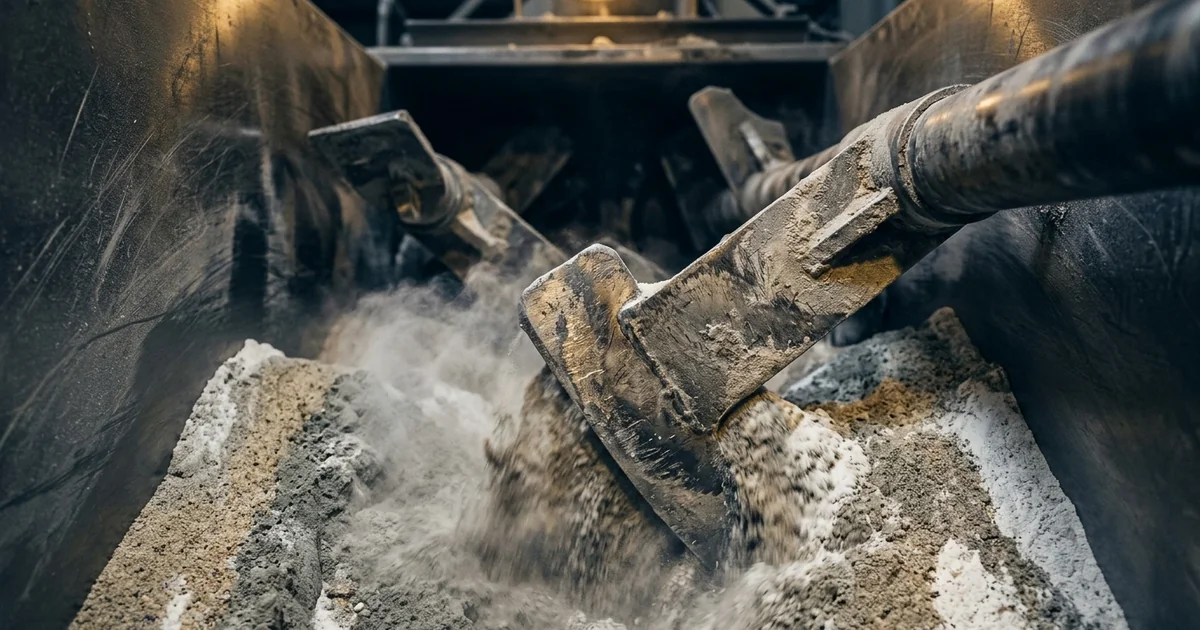
A builder opens two bags of the same rendering mortar from the same brand a month apart, mixes both to the instructions, and gets two different results — one workable and creamy, the other stiff and prone to cracking. For a mortar producer, that is the reputational risk that never goes away, and it usually has nothing to do with the recipe on paper. Dry mix mortar manufacturing is a materials-handling and blending problem before it is a chemistry problem: the same formulation will pass or fail depending on whether the plant can dry its sand, hold a grading curve, dose a fraction of a percent of cellulose ether accurately, and distribute it evenly through tonnes of aggregate. This article walks through the raw material classes that go into a factory-blended mortar, how sand is processed, why the low-dose additive package is the hardest part to get right, what the plant actually does, and how the finished product is tested against EN and ASTM standards. It is written for people specifying or running a dry mortar line, not just buying the bags.
Why Dry Mix Mortar Manufacturing Lives or Dies on Consistency
A dry mix mortar is a finished product the customer completes by adding water, which means every property the builder experiences on site was decided in the plant. Unlike site-mixed mortar, where a skilled hand can compensate for a wet or gap-graded sand, a bagged product has no second chance — the grading, the binder content, and the additive dosing are locked in when the bag is sealed. That shifts the whole burden of quality onto raw material control and blend uniformity. The producers who succeed treat consistency as the core deliverable, not the formulation.
- No site correction — the contractor follows a fixed water addition and mix time, so any variation in the powder shows up directly in workability, open time, or strength.
- Small additives, large effect — the components that control water retention, sag, and adhesion are dosed at low levels, so a small dosing error is a large performance error.
- Segregation risk — differences in particle size and density between cement, sand, and fillers drive separation during storage and transport if the plant is not designed against it.
- Raw material drift — cement, sand, and polymer powders all move within supplier tolerances, and a formulation has to absorb that without the customer noticing.
Everything that follows in this article is really about closing those gaps. It starts with knowing exactly what each raw material class contributes and where it can vary.
What Goes Into the Bag: Raw Material Classes
A dry mix mortar is built from four functional groups of raw materials: binders, aggregates and fillers, mineral additions, and the functional additive package. Each group has a defined job, and each has properties that must be specified and checked on delivery because they move between batches. Understanding this structure is the basis for both formulation and raw material purchasing, and it maps directly onto the silo layout of the plant. The chemistry of these components is covered in depth across the construction chemicals knowledge base.
| Raw material class | Typical examples | Primary function | Key property to control |
|---|---|---|---|
| Hydraulic binders | Portland cement, calcium aluminate cement, calcium sulfate binders, hydrated lime | Strength development, set, adhesion | Fineness, aluminate and alkali content, sulfate balance, reactivity |
| Aggregates | Graded silica sand, crushed limestone sand, dolomite | Volume, dimensional stability, load transfer | Particle size distribution, moisture, clay and fines content |
| Fillers and lightweight fillers | Limestone powder, expanded perlite, vermiculite, expanded clay, hollow spheres | Packing, density control, workability, thermal performance | Fineness, purity, bulk density, crush resistance |
| Mineral additions | Fly ash, ground granulated blast-furnace slag, silica fume, metakaolin | Durability, cost, later-age strength, rheology | Reactivity, carbon content, consistency of supply |
| Functional additives | Cellulose ethers, redispersible polymer powders, starch ethers, air entrainers, accelerators, retarders, water repellents | Water retention, adhesion, flexibility, sag control, set control | Grade and viscosity band, film-forming behaviour, dosing accuracy |
The binder and aggregate decide the mortar's class and cost; the additive package decides whether it performs as a thin-bed, polymer-modified, or technical product. A masonry mortar may use little more than cement, lime, and sand, while a deformable tile adhesive or a self-levelling compound carries a carefully balanced set of polymers and rheology modifiers. The next constraint is that the largest component by mass — the sand — has to arrive at the mixer in a controlled state.
Sand Drying, Screening, and Grading
Sand is usually the majority of a mortar by weight, so its condition sets the ceiling on product quality. Two things matter: how dry it is, and how its particle sizes are distributed. Wet sand cannot be dosed accurately, it prehydrates the cement in storage, and it blocks screens; poorly graded sand produces a mortar that is either harsh and water-hungry or over-fine and prone to shrinkage. A dry mortar plant therefore invests heavily in a sand processing line before the material ever reaches a mixer.
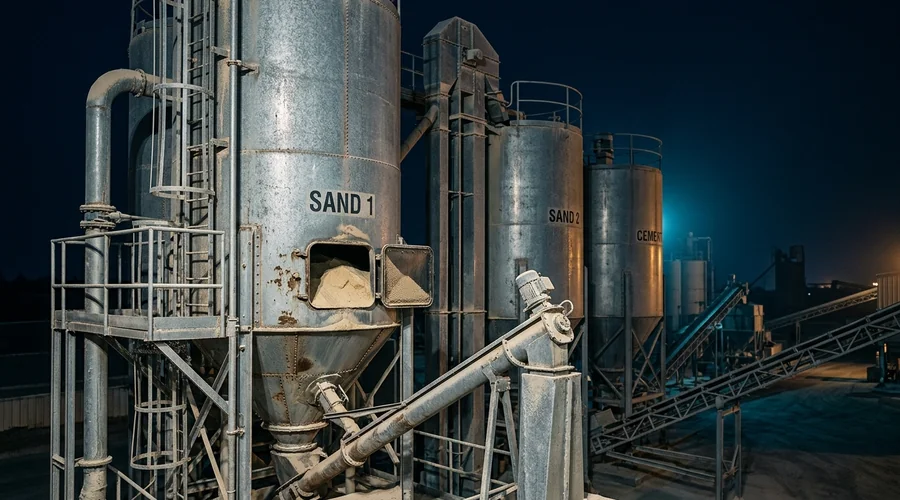
- Drying — the sand passes through a rotary or fluidised-bed dryer to bring its residual moisture down to a low, stable level so it flows, doses, and stores without prehydrating the cement.
- Screening — vibrating screens separate the dried sand into several size fractions, removing oversize and, where needed, isolating the finest dust.
- Fraction storage — each fraction goes to its own silo, so the formulation can call for a defined proportion of coarse, medium, and fine material.
- Recombination — the weigh system rebuilds the target grading curve from the fractions for every batch, correcting for any drift in the incoming sand.
- Fines and clay control — incoming sand is checked for clay content, commonly with a methylene blue test, because excess clay raises water demand and disrupts admixtures.
With clean, dried, graded fractions in silo, the plant can assemble a reproducible aggregate skeleton. The harder task is adding the components that make the mortar behave — and doing it uniformly.
Functional Additives and the Homogeneity Problem
The additive package is where a plain cement-sand mix becomes a modern mortar, and it is also where manufacturing is hardest. These materials are dosed at low levels but they control the properties customers judge the product on: water retention, open time, sag resistance, adhesion, flexibility, and set. Because the mass added is small relative to the aggregate, distributing it evenly is a genuine engineering challenge, and an uneven blend shows up as bag-to-bag and even within-bag variation. The cellulose ether and rheology side of this is explored further in the piece on grout and tile adhesive rheology control.
- Cellulose ethers (HPMC, HEMC) — hold mixing water in the mortar so a thin layer on an absorbent substrate can hydrate fully; also build sag resistance and workability.
- Redispersible polymer powders — form a polymer film on drying that adds flexibility, cohesion, and adhesion to smooth or low-porosity surfaces and cuts water uptake.
- Starch ethers — fine-tune anti-sag and non-slip behaviour, letting a tile sit without sliding.
- Air-entraining agents — adjust workability and lower density, useful in masonry and rendering mortars.
- Set accelerators and retarders — shift working time and early strength, essential in rapid-set repair mortars and calcium aluminate systems.
- Water repellents and defoamers — reduce capillary water uptake and control entrained air where the product needs it.
To make low-dose additives controllable, plants often pre-blend them into an additive concentrate that is dosed as a larger, more reliably metered mass, and they choose a mixer that disperses fine powder quickly. That equipment choice is part of the wider plant design.
The Plant: Dosing, Mixing, and Packing
A dry mortar plant is a sequence of storage, weighing, mixing, and packing steps arranged to move powder without segregating it. The major components are drawn from silos by screw conveyors into gravimetric weigh hoppers; minor additives are metered by loss-in-weight or precision volumetric feeders. Everything drops into a batch mixer, is blended for a short defined time, and is then either packed immediately or held briefly in a finished-product silo. The layout is deliberately compact and low, because every drop and every transfer is a chance for dense and fine particles to separate.
- Storage — separate silos for cement, lime, each sand fraction, fillers, and mineral additions, plus a bagged-additive store kept dry.
- Dosing — gravimetric weighing for major components; loss-in-weight micro-feeders or a pre-blended additive concentrate for the minor package.
- Mixing — a batch paddle, ploughshare, or gravity-free mixer sized to disperse the additive through the aggregate in a short cycle without crushing lightweight fillers or fibres.
- Packing — form-fill-seal valve bags with a moisture barrier, big bags, or bulk delivery to site silos, with in-line check-weighing.
- Dust and exposure control — enclosed transfer, filtration, and handling procedures to manage bag dust and respirable crystalline silica.
A well-designed plant makes the same mortar every batch almost regardless of who is operating it. Proving that it does is the job of the quality system.
Quality Control and Product Standards
Dry mix mortars are sold against declared performance classes, and both the incoming materials and the finished product are tested to keep those declarations true. Incoming control catches raw material drift before it reaches a batch; finished-product control confirms the blend behaves as specified when water is added. The applicable standards depend on the product type and the market, but the logic is the same everywhere: measure the fresh and hardened properties that define the class, and keep the records that let you trace a deviation back to its cause.
| Product type | Core European standard | North American / international reference |
|---|---|---|
| Rendering and plastering mortar | EN 998-1 | ASTM C926 (application), ASTM C1714 |
| Masonry mortar | EN 998-2 | ASTM C270, ASTM C1714 |
| Tile adhesive | EN 12004 (with EN 1348, EN 12002) | ISO 13007, ANSI A118 series |
| Tile grout | EN 13888 | ISO 13007-3 |
| Self-levelling screed / underlayment | EN 13813 | ASTM C1708 |
| Cement (binder) | EN 197-1, EN 196-10 (chromium VI) | ASTM C150 / C595 |
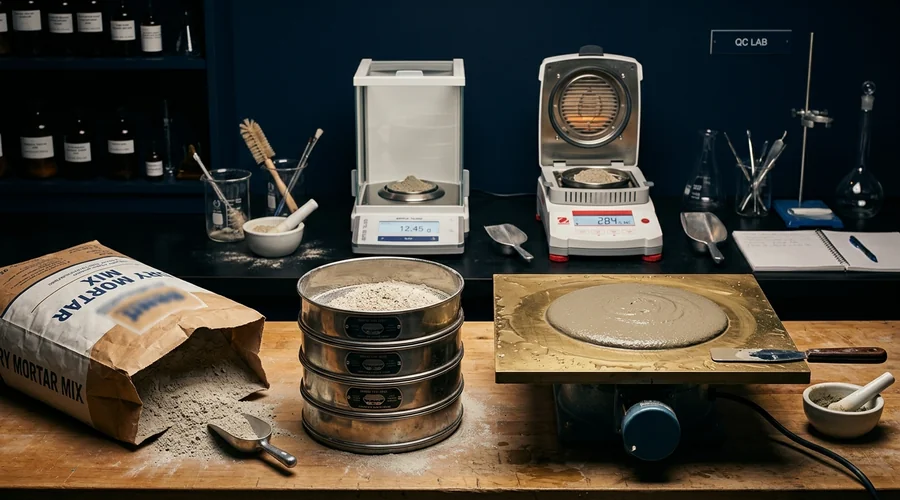
- Incoming checks — sieve analysis and moisture on sand, methylene blue value for clay, supplier certificates and spot verification on cement fineness and on additive grade.
- Fresh mortar tests — consistence or flow, water retention, air content, open time and adjustability for tile adhesives, working and setting time.
- Hardened tests — compressive and flexural strength, adhesion or tensile bond, shrinkage, and for tile adhesives the deformation class.
- Shelf-life monitoring — periodic re-test of stored product for strength loss, lump formation, and, for cement-based products, the continued effectiveness of the chromium-VI reducing agent.
The hexavalent chromium point is worth emphasising because it is a regulatory limit rather than a performance preference: cement naturally contains traces of hexavalent chromium, a skin sensitiser, and EU rules cap the soluble content, so a reducing agent is added and its shelf-life stability is tracked. With the control system in place, the remaining risk is the transition from an approved lab formula to full plant production.
Scaling a Formula From Lab to Plant
A mortar developed in a small laboratory mixer does not automatically behave the same way in a plant batch mixer, and the gap surprises new producers. Lab mixing is intense and complete; plant mixing is shorter, gentler, and works with a much larger mass. Raw materials at production volume also carry more variation than the hand-selected bags used in development. Bridging that gap deliberately is the difference between a smooth launch and months of firefighting, and it follows the same principles as any construction chemical scale-up from lab to plant.
- Match the mixing energy — confirm that the plant mixer and cycle time actually disperse the additive package as well as the lab mixer did, and adjust the cycle if not.
- Use production raw materials — repeat the final lab trials with the sand, cement, and additives that the plant will buy in bulk, not development samples.
- Run staged trials — validate on a pilot or small production batch before a full campaign, testing fresh and hardened properties against the approved profile.
- Build in tolerance — design the formulation with enough margin that normal raw material drift does not move the product out of class.
- Document the transfer — a written package covering formulation, raw material specifications, mixer settings, and acceptance criteria lets the plant reproduce the result and troubleshoot later.
Done properly, the first plant batches match the lab formula and the product holds its class from launch. The decision framework for a producer is straightforward: control the sand, respect the additive homogeneity problem, test against the right standard, and treat the lab-to-plant transfer as a project in its own right. Get those four right and dry mix mortar manufacturing becomes a repeatable process rather than a recurring gamble.
Frequently Asked Questions
What is dry mix mortar and how does it differ from site-mixed mortar?
Dry mix mortar, also called premixed or factory-blended mortar, is a complete powdered building material made in a plant by combining a binder, graded mineral aggregate and fillers, and a small amount of functional additives. The contractor only adds a controlled quantity of water on site and mixes for a set time.
Site-mixed mortar, by contrast, is batched by hand or in a small mixer from separately delivered cement, sand and water, with the proportions and the sand quality varying from batch to batch. The factory route gives consistent grading, consistent binder content, and access to additives such as cellulose ethers and polymer powders that cannot practically be dosed on site, which is why thin-bed tile adhesives, renders, self-levelling compounds and repair mortars are almost always supplied as dry mix.
Why is sand drying and screening so important in a dry mortar plant?
Sand is the largest single component of most mortars by mass, so its moisture and its particle size distribution have an outsized effect on the finished product. Any residual moisture left in the sand will slowly prehydrate the cement inside the bag, causing lumping, strength loss and a shortened shelf life, and it also interferes with how cellulose ethers and redispersible polymer powders perform later.
Screening the sand into separate fractions and recombining them to a target grading curve controls the packing density of the aggregate skeleton, which in turn sets the water demand, the workability and the tendency to sag or bleed. A plant that cannot dry sand to a low, stable residual moisture and cannot hold a consistent grading will struggle to make a consistent mortar regardless of how good the formulation is.
What are the main functional additives in dry mix mortar and what do they do?
The additive package is small in mass but decisive in performance. Cellulose ethers provide water retention and workability, keeping a thin layer of mortar from drying out on an absorbent substrate before the cement can hydrate, and they also build sag resistance. Redispersible polymer powders add flexibility, cohesion and adhesion to smooth or low-porosity substrates, and they reduce water uptake in the hardened mortar.
Starch ethers tune the anti-sag and non-slip behaviour, air-entraining agents adjust workability and density, and set accelerators or retarders shift the working and hardening times. Water repellents, defoamers, shrinkage reducers, fibres and pigments are added where the product needs them. Because each of these is used at a low level, distributing them evenly through tonnes of aggregate is the central manufacturing challenge.
How is homogeneity achieved when additives are dosed at such low levels?
Homogeneity comes from a combination of accurate dosing, the right mixer, and control of segregation before and after mixing. Minor additives are metered by loss-in-weight or precision volumetric feeders, and are often pre-blended into an additive concentrate so the quantity added to the main mix is large enough to dose reliably.
The main mix is usually made in a batch paddle or ploughshare mixer, or a gravity-free fluidised-zone mixer, chosen to disperse a small mass of fine powder through a large mass of coarser aggregate quickly without degrading lightweight fillers or fibres. After mixing, differences in particle size and density between components can drive segregation during silo storage, transfer and transport, so the plant layout minimises drop heights, free fall and long storage of the finished blend. Verifying uniformity with routine sampling and testing across a batch is part of the control strategy.
Which standards govern dry mix mortar products?
In Europe the core product standards are EN 998-1 for rendering and plastering mortar, EN 998-2 for masonry mortar, EN 12004 for tile adhesives, EN 13888 for tile grouts and EN 13813 for screed material, each with declared performance classes. The test methods sit mainly in the EN 1015 series for masonry mortars and in EN 1348 and related standards for tile adhesive adhesion.
In North America, ASTM C270 covers mortar for unit masonry, ASTM C1714 covers preblended dry mortar, and ISO 13007 is the international reference for tile adhesives and grouts. Cement itself is controlled by EN 197-1 or ASTM C150, and the hexavalent chromium content of cement is limited in the EU, which is why a reducing agent is added and its effectiveness is monitored over the shelf life.
What causes batch-to-batch variation in a dry mortar plant, and how is it controlled?
Most variation traces back to raw material properties rather than the mixing step. Cement can shift in fineness, aluminate and alkali content, and sulfate balance between deliveries; sand can vary in grading and in its clay and fines content; limestone filler can vary in purity and fineness; and cellulose ethers and polymer powders are supplied to a viscosity or film-formation grade that has its own tolerance band.
A robust formulation is designed with enough margin to absorb normal raw material swings, and the plant backs that up with incoming inspection — sieve analysis, moisture, methylene blue value on sand, and supplier certificates on the binder and additives — plus finished-product testing of fresh and hardened properties. When a property drifts, the traceable records let the team identify which input moved.
When should a company bring in a formulation consultant for a dry mix mortar line?
The most valuable point is before the plant is specified, because the mixer type, the number of sand fractions, the additive dosing system and the packing line all depend on which products the company intends to make and at what performance level. A consultant can define the product range, develop the formulations against the relevant standards, specify raw material requirements and acceptance criteria, and design the lab-to-plant transfer so the first production batches match the approved lab formula.
Engagement is also useful when an existing plant wants to add a technically demanding product such as a self-levelling compound or a deformable tile adhesive, or when raw material supply changes and formulations need to be re-optimised. Building that expertise in early avoids commissioning a plant that cannot make the products the business plan depends on.
Planning or Upgrading a Dry Mortar Line?
Global Formulation provides dry mix plant product development, premixed mortar formulation consulting, mortar manufacturing contract services, aggregate blending technology support, and construction chemical formulation outsourcing for producers and entrepreneurs.
Talk to Our Formulation Team