Ethoxylation Reactor Design and Ethylene Oxide Safety
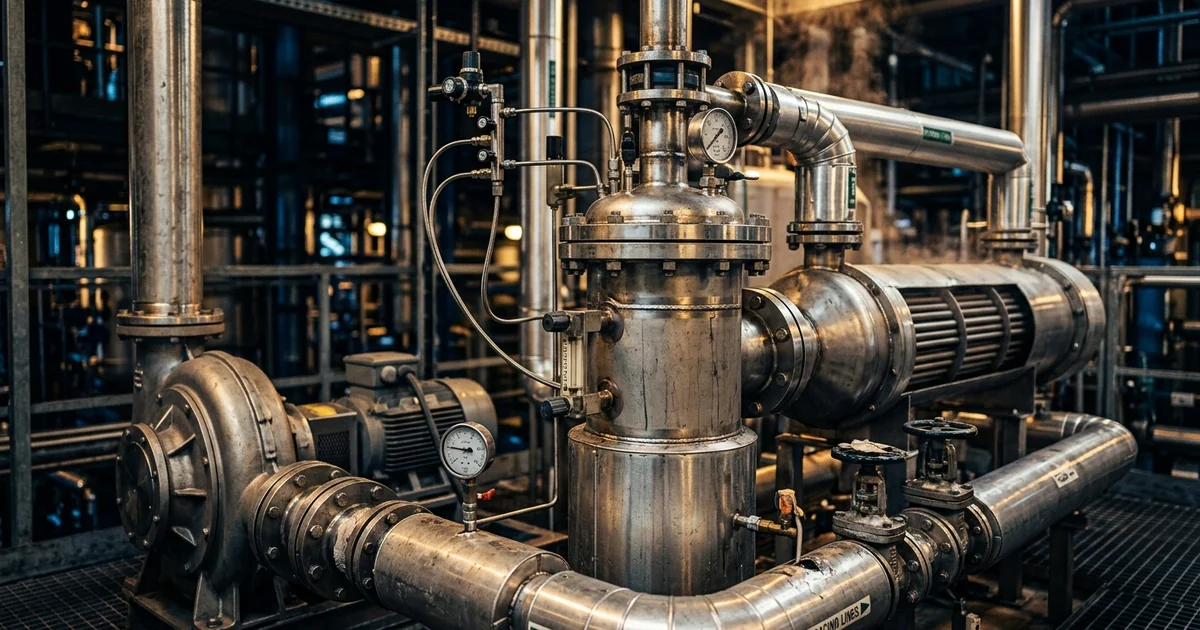
A nonionic surfactant that ethoxylated smoothly in a 2 L autoclave reaches a 20 m³ reactor, and the first campaign runs at half the expected rate because the plant cannot pull the reaction heat out fast enough. The chemistry did not change. The heat-transfer area per unit volume collapsed on scale-up, and with ethylene oxide that is not only a productivity problem — it is a safety one. Ethoxylation reactor design is the discipline of adding a violently exothermic gas to a liquid at a rate the cooling system can always match, while holding the unreacted ethylene oxide inventory low enough that a cooling failure cannot become a runaway. Get it wrong and the cost is plain: a stalled campaign ties up a capital-intensive asset, an off-distribution batch is downgraded, and an ethylene oxide deflagration is a loss-of-plant event. This guide covers what ethoxylation is, why ethylene oxide is uniquely hazardous, how the main reactor types remove heat, how catalyst choice shapes the product, and where ethoxylation batches actually go wrong. It reflects the approach we take in our chemical reaction engineering practice when an alkoxylation process moves from bench to plant.
What Ethoxylation Is and Why the Reactor Sets the Product
Ethoxylation looks like a single reaction and behaves like a population. Ethylene oxide is added, one strained three-membered ring at a time, onto a substrate that carries an active hydrogen — a fatty alcohol, an alkylphenol, a fatty acid or a fatty amine — and the base catalyst turns that active hydrogen into an alkoxide that opens each successive ring. Because every chain end competes for the same ethylene oxide, the product is a distribution of adducts spread around an average degree of ethoxylation, and that distribution matters to performance as much as the average does. The reactor is what controls the distribution, because the flask cannot: it sets the ethylene oxide addition profile and the temperature history that together decide how wide the spread is.
The common substrates and their products are:
- Fatty alcohols — give alcohol ethoxylates, the workhorse nonionic surfactants for laundry, hard-surface and agrochemical use, and the feedstock for ether sulfates.
- Alkylphenols — give alkylphenol ethoxylates, still used industrially but in regulatory decline for consumer use on aquatic-toxicity grounds.
- Fatty acids, glycerides, amines and amides — give ester ethoxylates, ethoxylated glycerides and ethoxylated amines used as emulsifiers, antistats and foam stabilisers.
Replacing ethylene oxide with propylene oxide gives propoxylation, which builds a more hydrophobic chain; feeding both in sequence builds the EO/PO block copolymers used as low-foam surfactants and polyether polyols. The plant consequence is that two reactors running the same recipe can make product that meets the average EO number but fails on cloud point, free polyethylene glycol or residual substrate, purely because temperature control and mixing during the feed differed. That is why the reactor, not the recipe, is the subject here — and why the hazard of the reagent comes first.
Why Ethylene Oxide Is a Different Class of Hazard
Ethylene oxide is why an ethoxylation plant is engineered like a hazardous-gas facility rather than a resin kettle: it carries four independent hazards at once. Most flammable liquids give you one problem; ethylene oxide gives you a gas that burns without air, ignites on almost nothing, poisons at low concentration, and feeds a reaction that heats itself. Understanding each one is what makes the protective design logical rather than arbitrary.
- Flammability — the flammable range is exceptionally wide, with a lower explosive limit (LEL) near 2.6% by volume in air and effectively no upper limit, and the published minimum ignition energy is well below that of hydrocarbon vapours.
- Vapour-phase decomposition — once initiated by heat or a catalytic surface, ethylene oxide gas can propagate a decomposition flame to carbon monoxide, methane, hydrogen and carbon with no oxygen present, which is why headspace ethylene oxide is kept diluted with nitrogen and hot spots are designed out.
- Reaction exotherm — ring-opening onto the alkoxide releases published heat of reaction (ΔHr) near 92 kJ per mole of ethylene oxide, roughly 2 MJ per kg, so a batch that accumulates unreacted oxide has a large adiabatic temperature rise (ΔTad) waiting in it if cooling is lost.
- Toxicity — ethylene oxide is a recognised human carcinogen and mutagen, regulated in the United States under a specific substance standard, so closed handling and exposure monitoring are compliance requirements, not optional good practice.
Put those together and the safe operating envelope is narrow: the reaction has to be fast enough that ethylene oxide does not build up, cool enough that it does not decompose or run away, and contained tightly enough that no one is exposed. The maximum temperature of the synthesis reaction (MTSR) — the peak a batch would reach if the feed stopped and cooling failed with the accumulated oxide reacting out — is the number that governs how much unreacted ethylene oxide the process can safely tolerate. The reactor's first job is to keep the batch inside that envelope, and the reactor types differ mainly in how well they do it.
Ethoxylation Reactor Design: Reactor Types and Heat Removal
Ethoxylation reactor design comes down to a heat-and-mass-transfer question. Ethylene oxide has to dissolve into the liquid and react, and the heat has to leave, both faster than fresh oxide is fed. The three configurations in industrial use solve that problem in increasingly capable ways, and the choice between them decides how large a plant can be built on one vessel and how much its productivity falls as the batch fills.
| Feature | Stirred autoclave | Spray-tower reactor | Venturi loop reactor |
|---|---|---|---|
| Heat removal path | Jacket only | External cooler on circulating liquid | External cooler on circulating liquid |
| Gas–liquid contact | Impeller dispersion of headspace gas | Liquid sprayed through recirculated gas | Venturi entrains gas into pumped liquid — very high interfacial area |
| Ethylene oxide headspace inventory | Higher | Moderate | Lower |
| Productivity vs batch fill | Falls as volume grows (area/volume drops) | Largely constant | Largely constant |
| Typical scale | Small to medium, multi-product | Medium to large | Large, multi-product |
| Capital and complexity | Lowest | Moderate | Highest — pump, venturi, external loop |
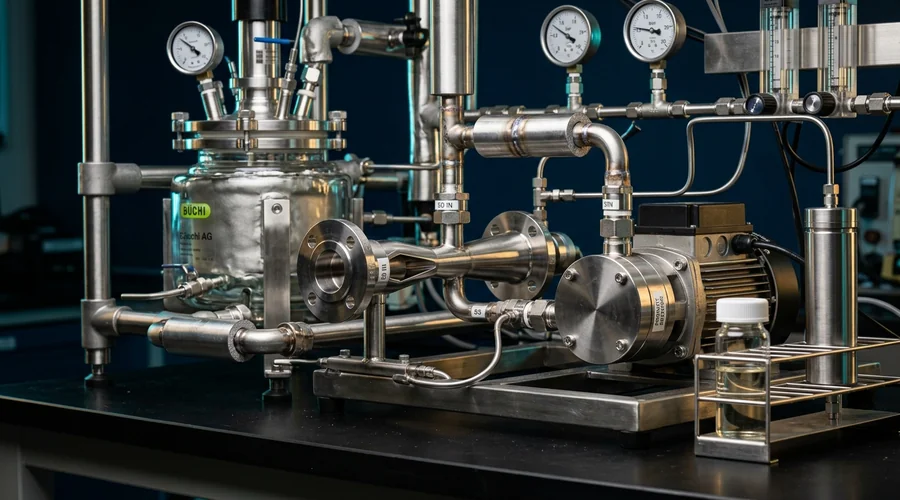
The loop reactor, of which the BUSS design is the best known, is where modern large-scale capacity has concentrated. An external pump drives the reacting liquid through a venturi nozzle that entrains ethylene-oxide-rich gas from the headspace, and the same circulating stream passes through an external heat exchanger whose duty is set by the exchanger, not the vessel wall. That decoupling is the point: on a jacket-only stirred autoclave the semi-batch feed rate has to fall as the batch grows, because the heat-transfer area per unit volume (A/V) drops, so a scale-up that keeps the same recipe silently lengthens every cycle. A loop reactor holds a high, roughly constant feed rate across the whole batch. Continuous ethoxylation exists for very narrow, high-volume slates, but the multi-product reality of most surfactant plants keeps them semi-batch. The next section covers how that feed is run.
The Semi-Batch Ethylene Oxide Dosing Strategy
Ethylene oxide is never charged in one shot. It is fed semi-batch into the pre-heated, catalysed substrate, and the feed rate is the single most important control variable in the whole process — more important than the temperature set point, because it is the fastest safety action available and it directly limits the energy stored in the batch. The rate is set so that the heat generation never exceeds the installed cooling capacity, with margin held back for a partial loss of cooling. Everything else in the control scheme exists to protect that principle.
The dosing strategy is built around four linked variables:
- Accumulation — the mass of unreacted ethylene oxide dissolved in the liquid and present in the headspace at any instant. The lower it is kept, the smaller ΔTad and MTSR become, and the more benign a cooling failure is.
- Feed interlocks — the ethylene oxide feed trips closed automatically on high temperature, high pressure, low agitation or circulation, low nitrogen pressure, or loss of cooling water. Closing the feed stops the heat input within seconds.
- Temperature window — held in a band where the catalyst is active and the reaction consumes ethylene oxide as fast as it arrives, but not so hot that decomposition or side reactions start.
- Pressure — a proxy for headspace ethylene oxide partial pressure. A pressure that rises during a constant feed means the reaction is falling behind and oxide is accumulating.
The data that underpin all of this — the heat-release rate against conversion and temperature, and how much ethylene oxide accumulates before it reacts — come from reaction calorimetry on the actual substrate and catalyst, covered in our guide to what reaction calorimetry measures and why scale-up needs it. The criticality classification and relief sizing that use those data are process-safety engineering work, outside this article's scope. The takeaway for the reactor engineer is blunt: a reactor showing a slow pressure creep during the feed is accumulating ethylene oxide, and feeding into that condition is the sequence that precedes most alkoxylation runaways.
The Basis of Safety for Ethylene Oxide Handling
The basis of safety is the documented set of measures that together make an ethylene oxide process tolerable to run, and it is what a competent authority actually signs off. For ethoxylation it rests on four pillars: prevent ignition, prevent decomposition, limit accumulation, and contain the consequences of the credible failure. Each pillar is a design philosophy, not a single device, and the detail below is descriptive — it is not a set of operating parameters.
- Inerting — the reactor and the ethylene oxide supply system are held under nitrogen so the vapour space stays outside the flammable envelope, with oxygen controlled below a defined limiting concentration. The principles of inerting and oxygen-concentration control are set out in NFPA 69; the specific limiting value for a given system is established from test data, and OSHA's ethylene oxide guidance summarises the wider control expectations.
- Ignition and decomposition control — copper, silver, mercury and their alloys are excluded from ethylene oxide service because they can form unstable compounds or catalyse decomposition; acids, alkalis and rust that catalyse ethylene oxide polymerisation are kept out; and surfaces that could become hot are eliminated or monitored.
- Accumulation limits — the feed-rate and interlock philosophy described above caps the unreacted ethylene oxide inventory, which caps the energy available to any runaway.
- Relief and containment — emergency relief and effluent handling are designed for the credible runaway and decomposition scenarios, following recognised methodology such as that of the Design Institute for Emergency Relief Systems (DIERS).
- Occupational exposure — closed sampling, continuous leak detection and area monitoring keep worker exposure within the regulated limit.
In the United States, ethylene oxide above threshold quantities falls under OSHA Process Safety Management and, in parallel, the EPA Risk Management Program; equivalent major-hazard regimes apply elsewhere, and industry bodies such as CCPS and the European Industrial Gases Association publish the recognised guidance. The methodology those regimes require — calorimetry, criticality classification, HAZOP, layer-of-protection analysis and relief sizing — is process-safety engineering work in its own right.
Catalyst Choice: KOH, DMC and the Oligomer Distribution
The catalyst does more than set the rate — it sets the shape of the product. Conventional base catalysis with potassium hydroxide, sometimes sodium hydroxide or the corresponding alkoxides, gives a broad, near-statistical distribution of ethylene oxide adducts and a measurable tail of polyethylene glycol from ethoxylation of trace water. Double metal cyanide (DMC) catalysts give a much narrower, more Poisson-like distribution, less free polyethylene glycol, and less unreacted starting alcohol. That difference is not cosmetic: it changes cold handling, odour, foam and the level of 1,4-dioxane that can form downstream when an alcohol ethoxylate is sulfated to an ether sulfate.
| Attribute | KOH (broad-range) | DMC (narrow-range) |
|---|---|---|
| Adduct distribution | Broad, near-statistical | Narrow, near-Poisson |
| Free polyethylene glycol | Higher | Lower |
| Unreacted alcohol | Higher at low EO numbers | Lower |
| Induction period | Short, predictable | Needs activation; sensitive to poisons |
| Catalyst work-up | Neutralise and often filter the salt | Very low loading; often left in or lightly treated |
| Product benefits | Lower cost, well understood | Lower pour point, less odour, milder, lower dioxane potential |
The catalyst also carries a residue question: base catalysts have to be neutralised and the salt usually filtered off, adding a unit operation and a waste stream, whereas the very low loadings typical of DMC systems often need only light treatment. The soluble-versus-heterogeneous trade-offs — recovery, residue, batch-to-batch consistency — are the ones set out in our guide to homogeneous versus heterogeneous catalysis. A plant switching from broad-range to narrow-range catalysis to hit a lower dioxane limit is changing reaction kinetics, neutralisation load and filtration duty at once — a process change, not a drop-in, and the kind of decision our surfactants process work exists to de-risk.
Where Ethoxylation Batches Go Wrong
Ethoxylation failures split cleanly into two families: heat-and-accumulation problems, which are safety events, and distribution-and-purity problems, which are quality events. They have different root causes and different consequences, but they are usually caught by the same two instruments — the reactor thermocouple and the pressure transmitter during the feed. Recognising the signature of each one early is what keeps a recoverable deviation from becoming a lost batch or worse.
- Ethylene oxide accumulation and pressure excursion — headspace pressure creeps up during a steady feed. Cause: under-active or partly poisoned catalyst, temperature too low, or water and carbon dioxide quenching some of the alkoxide. Consequence: rising runaway potential and, if ignored, relief activation.
- Runaway reaction — temperature and pressure accelerate together. Cause: accumulated ethylene oxide plus a cooling loss or a failed high-temperature feed trip. Consequence: relief discharge, possible vapour-space decomposition, total batch loss.
- Broad molecular-weight distribution — cloud point and wetting drift off specification. Cause: temperature excursions during the feed, poor mixing, or the wrong catalyst for the target. Consequence: downgrade or blend-off.
- High free polyethylene glycol — hazy product and downstream foam issues. Cause: water in the substrate or catalyst ethoxylating to polyethylene glycol. Consequence: off-spec, particularly for personal-care grades.
- High residual substrate — unreacted fatty alcohol odour, low active content. Cause: reaction hold cut short, catalyst deactivation, or feed stopped early. Consequence: rejection or rework.
- 1,4-dioxane above limit — the cyclic by-product exceeds specification. Cause: conditions that favour the back-biting side reaction. Consequence: rejection for cosmetic use and for cleaning products in markets with dioxane limits.
The pattern holds: accumulation-driven failures trace to the reaction not keeping pace with the feed; distribution-driven failures trace to temperature and mixing during the feed. A plant that trends peak temperature and the pressure profile batch-over-batch builds the dataset that makes both diagnoses fast — the same dataset a scale-up or technology-transfer team needs to define the safe operating window.
A Route-Selection Framework for Ethoxylation
Choosing how to build or debottleneck an ethoxylation capacity is a sequence, and working it in order means the constraints that eliminate options are settled before the ones that only rank them. The output of this sequence is also most of the content a technology transfer package needs, so none of the analysis is wasted.
- Fix the product slate and distribution target. Average EO number, cloud point, free polyethylene glycol and 1,4-dioxane limits. This decides the catalyst family before anything else.
- Establish the thermal data. Measured heat of reaction and heat-release rate for the actual substrate, from calorimetry, before any equipment is sized. ΔHr, ΔTad and MTSR come out of this step.
- Set the basis of safety with process-safety engineers. Inerting philosophy, limiting oxygen concentration, accumulation cap, relief and effluent design.
- Select the reactor type. Venturi loop reactor for large multi-product capacity and the best heat removal; stirred autoclave for smaller or highly varied campaigns; spray tower where one is already installed and serviceable.
- Size the cooling and ethylene oxide supply for the safe feed rate, not the average one. The installed cooling capacity, not the vessel volume, is what sets productivity.
- Define the control and interlock philosophy. Feed trips, sampling schedule, and the neutralisation and finishing train that follow the reaction.
Most large alcohol-ethoxylate capacity lands on a loop reactor with conventional base catalysis, moving to DMC catalysis where the specification demands a narrow distribution — but the value is in knowing why a given specification points one way, because that is what makes the process defensible when it is transferred to a new site or a toll manufacturer. Nonionic surfactant capacity in India, the Middle East and Southeast Asia has grown with regional detergent and agrochemical demand, and much of that build-out turns on exactly these reactor and catalyst decisions. If you are taking an ethoxylate toward production, our scale-up and process development service covers this route selection and the ethoxylation reactor design behind it, and the wider path is set out in our guide to going from lab to market. The downstream side — how these surfactants are formulated — runs through our household and industrial cleaners resources.
Frequently Asked Questions
What is ethoxylation?
Ethoxylation is the base-catalysed addition of ethylene oxide onto a molecule that carries an active hydrogen, such as a fatty alcohol, an alkylphenol, a fatty acid or a fatty amine. Each ethylene oxide unit opens onto the growing alkoxide chain and adds an ethylene-oxy group, so the product is not a single compound but a distribution of adducts with different chain lengths around an average.
That average degree of ethoxylation sets the hydrophilic-lipophilic balance, water solubility and cloud point of the finished nonionic surfactant. The reaction is strongly exothermic and is run semi-batch, with ethylene oxide fed gradually into the heated substrate rather than charged all at once.
Why is ethylene oxide so hazardous?
Ethylene oxide combines several hazards that rarely occur together. It has an exceptionally wide flammable range, with a lower explosive limit near 2.6 percent by volume in air and effectively no upper limit, because the vapour can propagate a decomposition flame even without oxygen. Its minimum ignition energy is far below that of common hydrocarbon vapours, so almost any spark or hot surface will ignite it.
It is also a recognised human carcinogen regulated under a specific occupational standard, and the ethoxylation reaction itself releases a large amount of heat, so an uncontrolled batch can accelerate into a runaway. An ethoxylation plant is therefore engineered like a hazardous-gas facility, not a simple reactor.
What reactor is used for ethoxylation?
Three configurations dominate. The stirred pressure autoclave is the simplest and is common at smaller scale and for frequently changed campaigns, but its heat removal is limited to the jacket and it holds more ethylene oxide in the headspace. The spray-tower reactor sprays liquid down through a recirculated gas atmosphere and cools the circulating liquid externally.
The venturi loop reactor, of which the BUSS design is the best known, pumps liquid through a venturi that entrains headspace gas, giving very high gas-liquid contact area and moving the cooling duty to an external heat exchanger sized independently of the vessel. Loop reactors dominate modern large-scale ethoxylation because heat removal no longer scales with vessel geometry.
Why is nitrogen inerting required for ethylene oxide?
Nitrogen keeps the reactor and the ethylene oxide supply system outside the flammable envelope by holding the oxygen concentration below a defined limiting value. Because ethylene oxide has almost no upper flammable limit, a vapour space containing the gas is dangerous whenever an ignition source is present, and inerting removes the oxygen side of that risk.
Inerting also dilutes the headspace ethylene oxide so that a decomposition flame is harder to initiate and sustain. The principles for inerting and oxygen-concentration control are set out in NFPA 69, and the specific limiting oxygen concentration for a given system has to be established from data, not assumed.
How is heat removed during ethoxylation?
The ring-opening of ethylene oxide onto an alkoxide releases published heat of around 92 kilojoules per mole reacted, roughly 2 megajoules per kilogram of ethylene oxide, so heat removal is the limiting design factor. In a stirred autoclave the jacket does the work, and the safe ethylene oxide feed rate falls as the batch volume grows and the heat-transfer area per unit volume shrinks.
In loop and spray-tower reactors the reacting liquid is circulated through an external heat exchanger whose duty is set by the exchanger, not the vessel, so a much higher and more constant feed rate can be sustained. The feed rate is always set below the installed cooling capacity, with margin for a partial cooling loss.
What is the difference between ethoxylation and propoxylation?
Ethoxylation adds ethylene oxide, which introduces a hydrophilic ethylene-oxy group and makes the product more water soluble. Propoxylation adds propylene oxide, which carries an extra methyl group, is more hydrophobic, and lowers the cloud point and foam of the product.
Many commercial surfactants and polyols are made by adding both in sequence or as a mixed feed to build block or random EO/PO copolymers with tailored solubility, wetting and defoaming behaviour. Propylene oxide is less hazardous than ethylene oxide, but the reactor still has to manage a strong exotherm and a flammable oxide, so the same reactor types and basis-of-safety principles apply.
What causes a runaway reaction in an ethoxylation reactor?
A runaway needs accumulated unreacted ethylene oxide plus a loss of temperature control. Accumulation builds when the feed rate exceeds the reaction rate, which happens if the catalyst is under-active, the temperature is too low, or water and carbon dioxide have partly neutralised the alkoxide.
If cooling is then lost, or a high-temperature feed trip fails, the stored ethylene oxide reacts adiabatically, the temperature rises, the rate increases, and the batch accelerates. At high enough temperature the headspace ethylene oxide can also decompose. Continuing to feed into a slowly rising pressure is the exact sequence that precedes most alkoxylation runaways, which is why pressure and temperature during the feed are the signals plants watch most closely.
Developing or Scaling an Ethoxylation Process?
Global Formulation provides route selection, reactor design and scale-up partnership for ethoxylation and alkoxylation — from catalyst and distribution strategy to the reactor, cooling and control philosophy and a defensible technology transfer package built around your process-safety basis. For a costed India-basis feasibility study of the downstream surfactant — the full ethoxylation, sulfation and neutralisation route with its ethylene-oxide Major Accident Hazard infrastructure — see the SLES Manufacturing Standard Project Report.
Talk to Our Process Team