EVA Foam Bonding Adhesives: Footwear & Sports Equipment Chemistry
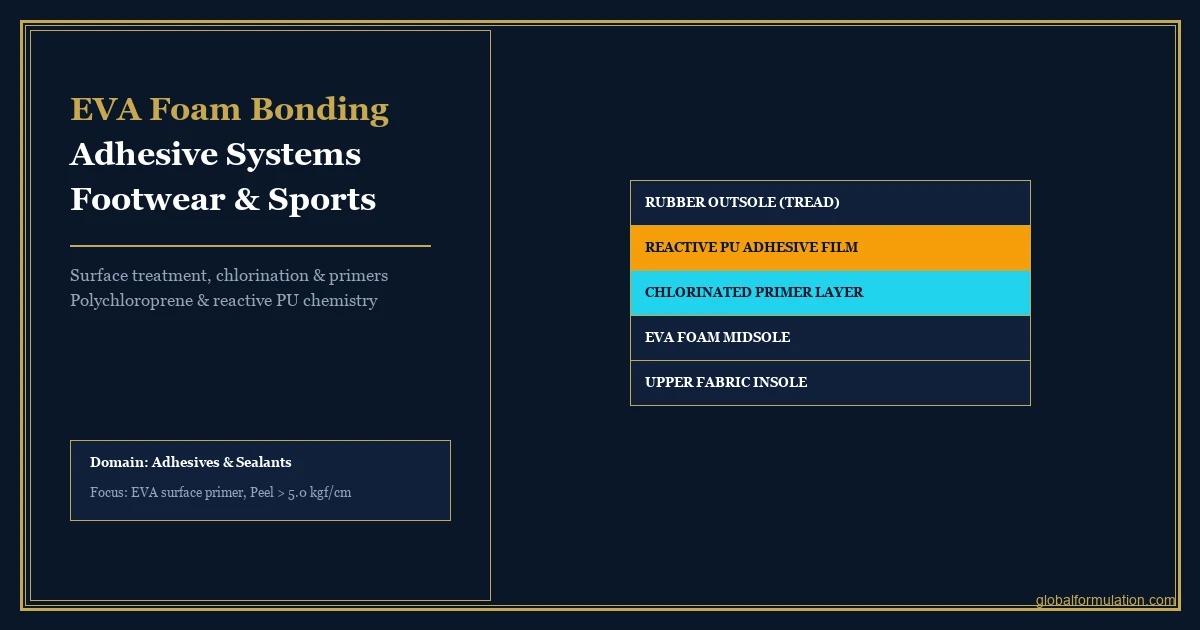
A shoe that delaminates at the midsole within its first month of wear is one of the most expensive quality failures a footwear brand can face — it triggers warranty claims, retailer chargebacks, and a wave of returns no marketing budget can offset. The root cause is almost never a weak adhesive on paper; it's an EVA foam bonding adhesive system that was never matched to the surface chemistry of the foam it's supposed to hold. Ethylene-vinyl acetate (EVA) foam is inherently difficult to bond because of its low surface energy and the waxy processing residues that migrate to its surface during molding. This guide explains why EVA resists adhesion, how footwear manufacturers prepare the surface before bonding, and which adhesive chemistries — solvent-based, reactive polyurethane, and hot melt — actually survive the flex fatigue of a walking or running shoe. It's written for footwear engineers, component suppliers, and manufacturers sourcing bonding systems through the broader adhesives and sealants supply chain.
The EVA Foam Bonding Adhesive Challenge: Why This Foam Resists Adhesion
EVA is a copolymer of ethylene and vinyl acetate, and the ratio between the two monomers controls the foam's flexibility, cushioning, and — critically — its surface chemistry. Because EVA is largely non-polar, its surface sits well below the energy level most adhesives need to wet out and form a strong interfacial bond. Foam manufacturers cross-link EVA with peroxide initiators such as dicumyl peroxide and expand it with chemical blowing agents like azodicarbonamide, and residues from both processes concentrate at the molded surface. That surface layer, along with mold-release agents such as zinc stearate, forms what adhesion engineers call a weak boundary layer — a thin film that has to be removed or chemically altered before any adhesive can grip the polymer underneath.
- Non-polar backbone — The ethylene segments in EVA behave like polyethylene, resisting the polar interactions most structural adhesives depend on
- Blowing agent residue — Chemical foaming agents such as azodicarbonamide leave decomposition by-products at the molded skin
- Mold-release bloom — Zinc stearate and similar release agents migrate to the surface during molding and cooling
- Molded skin — The outer surface forms a denser, smoother layer than the open cellular core, reducing the mechanical interlock available to an adhesive
None of these surface barriers are permanent. Footwear manufacturers have developed reliable ways to strip or chemically alter that boundary layer before adhesive ever touches the foam.
Surface Preparation: Buffing, Halogenation, and Corona Treatment
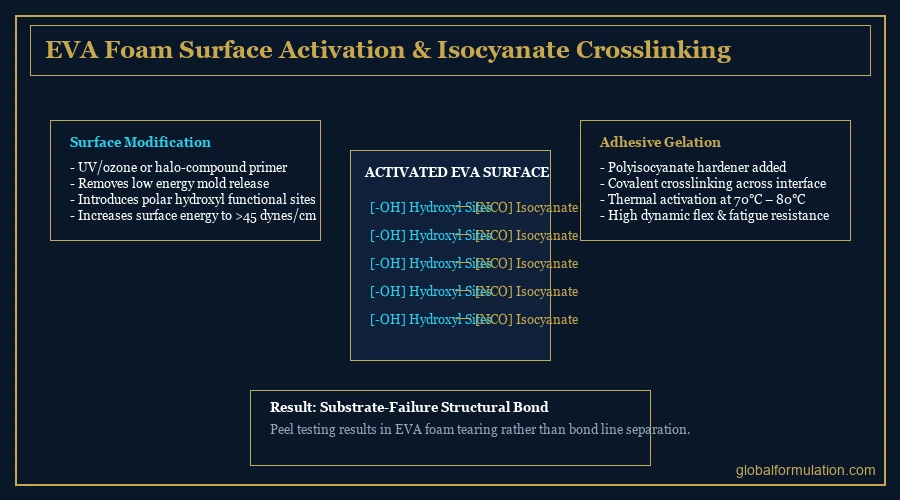
Surface preparation is the step that determines whether an EVA foam bonding adhesive has any real chance of forming a durable bond, and footwear factories typically combine a mechanical step with a chemical or physical one. Buffing removes the molded skin and the weak boundary layer sitting on top of it, exposing fresh polymer and increasing the surface area available for mechanical interlock. Because buffing alone doesn't change the foam's underlying non-polar chemistry, it's almost always paired with a second treatment that raises surface energy through oxidation. The two most established chemical routes for that second step are halogenation and corona or plasma treatment, each suited to slightly different production environments.
| Method | Mechanism | Typical Role |
|---|---|---|
| Buffing / abrasion | Mechanical removal of molded skin; increases surface roughness | Standard first step on nearly every footwear bonding line |
| Halogenation | Chlorinating agent (e.g. trichloroisocyanuric acid) introduces polar C–Cl and carbonyl groups | Wet-chemistry treatment for high-adhesion outsole and midsole bonds |
| Corona / plasma treatment | Ionized gas oxidizes the polymer chain, adding polar functional groups | Dry, solvent-free treatment on automated lines |
| Primer coat | Isocyanate- or polyurethane-based interfacial layer applied after treatment | Bridges treated foam and the final adhesive coat |
Getting the surface right creates the opportunity for a strong bond, but the adhesive chemistry applied on top of it is what actually has to survive years of flexing, weight-bearing, and temperature cycling.
Polychloroprene Contact Adhesives: The Traditional Footwear Standard
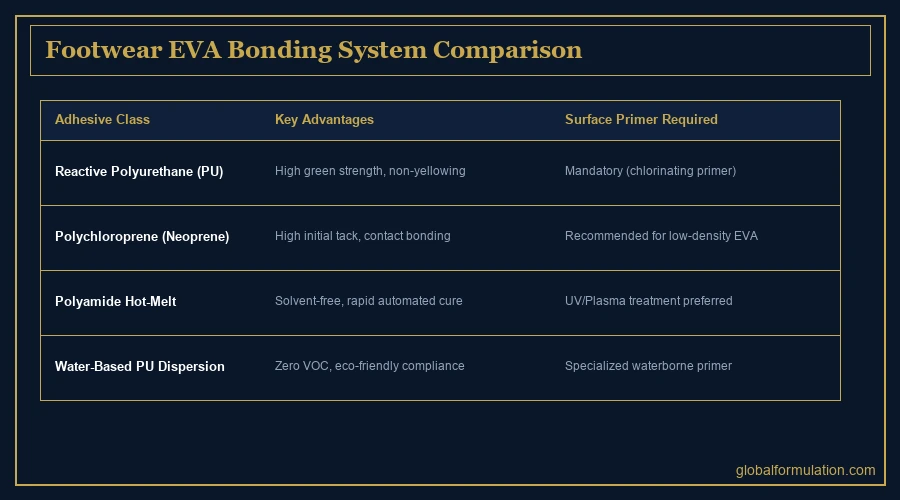
Polychloroprene, commonly known by its trade name neoprene, has been the default footwear sole bonding adhesive for decades, and understanding why explains a lot about how shoe assembly lines are still built today. As a contact adhesive, polychloroprene is coated onto both the EVA foam and the mating substrate, allowed to flash off its solvent until tacky, and then pressed together to form an immediate bond through polymer chain interdiffusion. That instant "green strength" — high bond strength before the adhesive has fully cured — is exactly what high-speed lasting operations need, since the shoe has to hold its shape the moment it comes off the last.
| Adhesive Type | Application Method | Cure Mechanism | Best Suited For |
|---|---|---|---|
| Polychloroprene solvent cement | Brush or spray, contact bonding | Solvent evaporation + crystallization | High-speed lasting, general footwear assembly |
| Reactive polyurethane (PUR) | Hot-melt bead or roll coat | Moisture-cure cross-linking | Athletic footwear needing flex fatigue resistance |
| Thermoplastic hot melt | Automated hot-melt dispensing | Cooling / solidification (non-reactive) | Automated lamination of pre-fabricated components |
| Water-based PU dispersion | Roll or spray coat | Water evaporation + film coalescence | Low-VOC production lines, regulated markets |
Solvent cements built on polychloroprene get their strength from a semi-crystalline structure that forms as the polymer chains reorganize after bonding, similar to how natural rubber develops strength through strain-induced crystallization. Toluene and methyl ethyl ketone have historically been the primary carrier solvents, chosen for their fast flash-off and strong solvency for the chlorinated polymer backbone.
Polychloroprene still dominates lower-cost, high-volume footwear lines, but its VOC profile and manual application steps have pushed premium and performance brands toward chemistries that cure differently and perform better under repeated flexing.
Reactive Polyurethane Adhesives for Flex-Fatigue Resistance
Athletic and performance footwear places EVA foam under a punishing cyclic load — every stride flexes the midsole through thousands of compression and extension cycles over the life of the shoe. Reactive polyurethane foam adhesive systems for shoes, applied as one-part moisture-cure hot melts, were developed specifically to survive that fatigue environment better than solvent-based cements can. The adhesive goes on hot as an NCO-terminated prepolymer, forms an initial physical bond as it cools and solidifies, and then keeps curing over hours or days as atmospheric moisture reacts with the remaining isocyanate groups to build a cross-linked network.
- Initial set — Physical bond forms within seconds of cooling, allowing immediate downstream handling on the production line
- Moisture cure — Residual isocyanate groups react with ambient humidity over hours to days, building the final cross-linked network
- Flex fatigue resistance — The cured polyurethane network tolerates repeated bending and compression better than a solvent-crystallized polychloroprene bond
- Heat resistance — Cross-linked PUR bonds tolerate the elevated temperatures used in some downstream lasting and finishing operations better than uncross-linked contact cements
That combination of fast handling strength and long-term flex durability is why reactive polyurethane has become the standard for premium running and performance footwear — but it comes with handling requirements solvent cements don't share, starting with careful moisture control during storage and application.
Hot Melt and Water-Based Systems for Automated Production Lines
Footwear brands producing at high volume increasingly design their bonding process around automated dispensing rather than manual brush or spray application, and that shift has favored chemistries built for consistent, machine-metered application. Thermoplastic hot melt adhesives — non-reactive systems based on EVA or polyurethane block copolymers — are metered through heated nozzles onto foam or textile components and bond simply by cooling and solidifying, with no solvent flash-off or moisture-cure waiting period. Water-based polyurethane dispersions serve a related but distinct role: they replace the toluene- and MEK-based carrier solvents in traditional cements with water, cutting VOC emissions while still allowing roll or spray application on conventional equipment.
- Thermoplastic hot melts — Fast-cycling and non-reactive, ideal for pre-laminating sports equipment components before final assembly
- Water-based PU dispersions — Lower-VOC replacement for solvent cements, suited to markets with tightening solvent-emission regulation
- Automated metering — Consistent bead width and coat weight reduce the bonding variability that comes with manual spray or brush application
Whichever chemistry a line is built around, none of it matters on the sales floor unless the finished bond survives the way the shoe is actually tested — and worn — which is where quality control takes over.
Testing, Failure Modes, and Quality Control
A footwear bonding line is only as reliable as its testing program, because a bond that looks fine coming off the line can still fail after weeks of flexing in the field. Peel and shear testing on production samples reveals not just whether a bond holds, but how it fails, and the failure mode itself is diagnostic information rather than a simple pass or fail result. Distinguishing between cohesive, adhesive, and substrate failure tells a quality engineer exactly where in the bonding process to look for the root cause.
- Substrate (foam tear) failure — The EVA foam itself tears before the bond releases; the target outcome, indicating the adhesive bond exceeds the foam's own tensile strength
- Cohesive failure — The adhesive layer splits internally, pointing to under-cure, contamination, or an incompatible adhesive formulation
- Adhesive (interfacial) failure — The bond releases cleanly at the foam or substrate surface, almost always tracing back to inadequate surface treatment
Reading failure mode data back against the surface-treatment and adhesive-selection decisions covered above is what turns a bonding line from a source of recurring warranty claims into a predictable, controllable process.
Frequently Asked Questions
Why does EVA foam bond so much worse than rubber or leather in footwear assembly?
Because EVA's surface chemistry is fundamentally different from rubber or leather — it's a non-polar copolymer whose molded surface accumulates blowing-agent residue and mold-release compounds that block adhesive wetting. Rubber and leather substrates typically carry more polar surface chemistry or a naturally more porous structure that gives adhesives a mechanical or chemical foothold without extensive pretreatment.
This is exactly why EVA-specific surface preparation — buffing plus halogenation or corona treatment — has become a standard, non-optional step in footwear manufacturing rather than an occasional upgrade.
Is buffing alone enough to bond EVA foam reliably?
No — buffing addresses the mechanical side of the problem, removing the weak molded skin and adding surface roughness, but it does nothing to change EVA's underlying non-polar chemistry. Without a chemical or physical treatment step like halogenation or corona treatment afterward, the freshly buffed surface still has too low a surface energy for most adhesives to wet properly.
Reliable footwear bonding lines nearly always pair buffing with one of those secondary treatments rather than relying on abrasion by itself.
How long does surface treatment on EVA foam remain effective before bonding?
Treated EVA surfaces have a limited working window because plasticizers, residual mold-release compounds, and other low-molecular-weight species continue migrating to the surface after treatment, gradually lowering the surface energy the treatment just raised. Manufacturers control this by scheduling bonding operations shortly after buffing or halogenation rather than treating large batches of components far in advance.
Exactly how long that window lasts depends on the specific foam formulation and treatment method, which is why footwear factories validate their own process timing instead of relying on generic guidelines.
Why are footwear manufacturers moving away from solvent-based polychloroprene cements?
The main driver is occupational and environmental regulation around the toluene and methyl ethyl ketone solvents that polychloroprene cements traditionally use as carriers. These solvents are subject to workplace exposure limits and increasing VOC-emission restrictions in many markets, which raises both compliance cost and ventilation requirements on the factory floor.
Reactive polyurethane hot melts and water-based dispersions address this by cutting or eliminating solvent content while still delivering bonds that meet footwear-industry flex and peel requirements.
What makes reactive polyurethane adhesives better suited to athletic footwear than contact cements?
Reactive polyurethane adhesives cure into a cross-linked polymer network through their moisture-cure mechanism, which gives the finished bond significantly better resistance to the repeated flexing and compression a running or athletic shoe experiences with every stride. Solvent-based polychloroprene bonds rely on crystallization rather than cross-linking, which makes them more prone to gradual fatigue-related bond weakening under sustained cyclic loading.
That durability difference is why premium and performance footwear brands specify reactive polyurethane even though it requires more careful handling than a contact cement.
What does it mean if a peel test shows adhesive failure instead of foam tear?
Adhesive, or interfacial, failure means the bond released cleanly at the surface of the foam or the mating substrate, rather than the foam itself tearing apart — and it's almost always traceable back to inadequate or expired surface treatment rather than a problem with the adhesive chemistry itself. Foam tear, by contrast, is the result quality engineers want to see, because it means the bond is stronger than the foam's own internal structure.
Seeing adhesive failure on a production sample should trigger an immediate review of the buffing, halogenation, or corona-treatment step rather than a change of adhesive.
Can the same EVA foam bonding adhesive be used for both midsole-to-outsole and upper-to-midsole bonds?
Not usually, because the two bonds join different substrate pairs under different mechanical demands — midsole-to-outsole bonds typically join EVA foam to rubber or another EVA compound, while upper-to-midsole bonds often join foam to textile, synthetic leather, or genuine leather. Each substrate combination has its own surface chemistry and its own flex, peel, and heat-resistance requirements.
Footwear manufacturers commonly qualify separate adhesive systems, sometimes even separate chemistries, for each bond location. Treating all bonds on a shoe as interchangeable is a common source of unexpected field failures.
Developing a Footwear or Sports Equipment Bonding Process?
Global Formulation provides adhesive and bonding-process consultancy — surface treatment selection, adhesive chemistry, and production-line qualification for footwear and sports equipment manufacturers.
Talk to Our Formulation Team