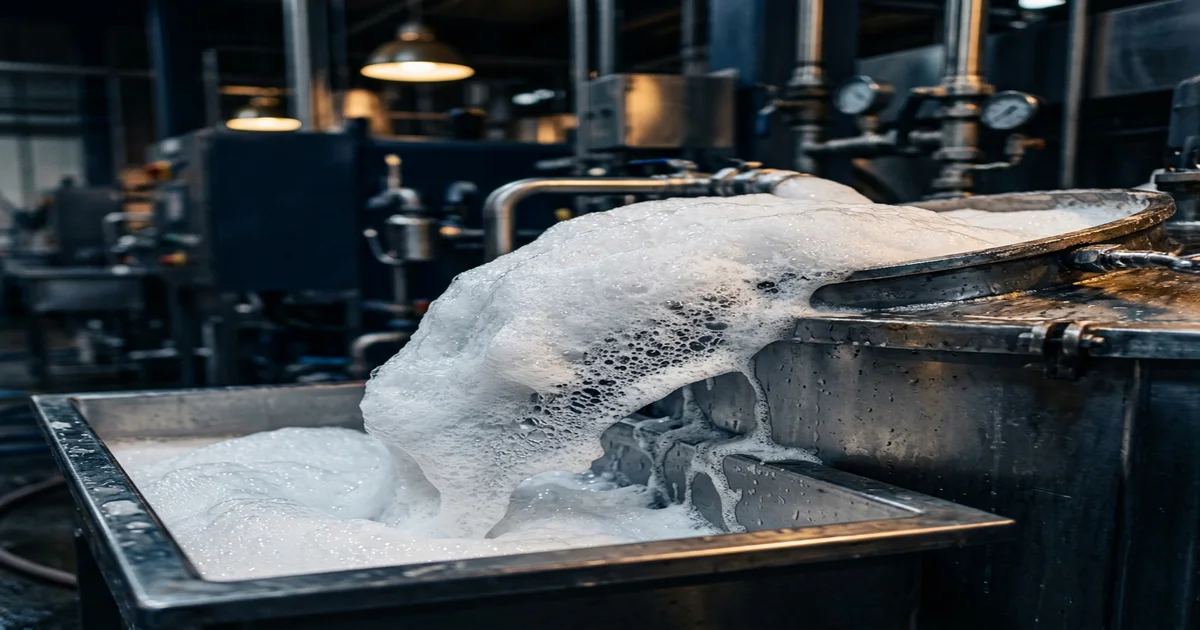
Excessive foaming in industrial cleaning applications is one of the most disruptive — and most misunderstood — performance failures a formulator or plant operator will encounter. A cleaner that performed perfectly in bench testing can generate foam that overwhelms a spray return trough, cavitates a centrifugal pump, or blinds a flow sensor within minutes of full-scale deployment. The cost is immediate: halted production lines, extended CIP cycle times, and cleaning validation failures that trigger rework. This article explains why foam forms disproportionately in high-shear industrial systems, how to diagnose whether the surfactant chemistry or the process design is the real driver, and what corrective strategies address the root cause rather than simply suppressing the symptom.
Understanding the Problem: What You Are Seeing and Why It Matters
Excessive foaming presents as visible foam accumulation that exceeds the working capacity of a tank, trough, or return line — foam that spills over equipment edges, fills sight glasses, or persists long after agitation stops. In spray wash and clean-in-place (CIP) systems, the foam problem is rarely just cosmetic: it changes the physical behaviour of the cleaning fluid itself, replacing dense, fast-moving liquid with a lower-density, compressible foam layer that moves differently through pipework and impinges differently on soiled surfaces.
The operational impact compounds quickly. Foam entrained in a CIP return line reduces the accuracy of flow and conductivity sensors used to confirm rinse completion, which can trigger false rejects or, worse, false passes on a cleaning validation cycle. Centrifugal pumps handling foam-laden fluid are prone to cavitation because the pump impeller cannot maintain the net positive suction head it needs against a compressible, air-entrained fluid — this leads to pump damage and unplanned maintenance. In open spray applications, uncontrolled foam creates housekeeping and slip hazards on production floors, and in food and beverage plants, persistent foam can harbour and shield microorganisms from full cleaning contact.
Foam-related complaints are widespread precisely because foam performance is not an intrinsic, fixed property of a surfactant blend — it depends heavily on mechanical energy input, water hardness, temperature, and soil load, all of which vary between the bench and the plant floor. A formulation validated with gentle bench-top testing frequently behaves very differently once exposed to the turbulent flow of a real spray nozzle or centrifugal pump circuit.
Root Causes: The Mechanisms Behind Excessive Foaming
Foam forms when surfactant molecules migrate to an air-water interface and orient themselves so that hydrophilic head groups face the water phase and hydrophobic tails face the air phase, creating a stabilised thin film around entrained air bubbles. Understanding which factors strengthen or destabilise that film explains why some formulations foam persistently while others collapse quickly — and points directly at the corrective lever available to formulators and process engineers.
Surfactant Class Selection
Different surfactant chemistries have intrinsically different foam-generating tendencies based on molecular structure. Anionic surfactants such as alkyl sulfates, alkyl ether sulfates, and linear alkylbenzene sulfonates typically produce copious, stable foam because their charged head groups create strong electrostatic repulsion between adjacent molecules at the interface, resisting bubble coalescence. Amphoteric surfactants like cocamidopropyl betaine similarly boost foam volume and stability, often used deliberately in hand dishwashing products for consumer foam expectations. Nonionic surfactants — alcohol ethoxylates, alkyl polyglucosides — generally generate substantially less foam because their head groups lack the charge repulsion that stabilises anionic foam films, making them a common substitution target for industrial low-foam formulations.
Mechanical Agitation and Shear
Foam generation is fundamentally an air-entrainment process, and the rate of air entrainment scales directly with mechanical energy input. Spray nozzles, centrifugal pump impellers, and turbulent CIP flow all introduce far more shear and air-liquid interfacial area per unit time than a bench-scale shake test or gentle immersion wash. A surfactant blend that produces acceptable, low, short-lived foam under hand-agitated bench conditions can generate substantially more foam once deployed through a high-pressure spray nozzle or turbulent pump-driven circuit, simply because the process itself is a far more efficient foam generator.
Water Hardness and Temperature
Water hardness has a direct and sometimes counterintuitive effect on foam behaviour. Calcium and magnesium ions in hard water react with anionic surfactant head groups to form insoluble calcium/magnesium-surfactant complexes, which reduces the concentration of foam-active surfactant monomers available at the interface and suppresses foam. A formulation developed and validated using hard process water may therefore foam unexpectedly aggressively when deployed at a facility with softer water, even though the formulation itself is unchanged. Temperature also plays a role: most surfactants show reduced foam stability at elevated temperature because increased molecular motion destabilises the thin liquid film between bubbles, which is why hot CIP cycles sometimes foam less than cold rinse steps using the identical product.
Soil Load and Protein Contamination
Residual protein, fat, and particulate soil can act as co-surfactants or foam stabilisers in their own right. In food processing environments particularly, protein residues denature at the air-water interface and form additional stabilising films around air bubbles, independent of the surfactant system's inherent foam tendency. This is why a cleaning product can perform predictably on a clean rinse test yet foam unexpectedly during first-pass cleaning of heavily soiled equipment — the soil itself is contributing foam-stabilising material to the system.
| Factor | Effect on Foam | Typical Trigger |
|---|---|---|
| Anionic/amphoteric surfactant selection | Increases foam volume and stability | AES, LAS, betaine-based systems at high shear |
| High mechanical shear | Sharply increases air entrainment | Spray nozzles, centrifugal pumps, turbulent CIP flow |
| Soft process water | Increases foam versus hard-water validation | Site water hardness lower than development water |
| Low temperature cycles | Increases foam stability | Cold pre-rinse steps in CIP sequences |
| Protein/fat soil load | Adds independent foam-stabilising film | Heavily soiled first-pass cleaning |
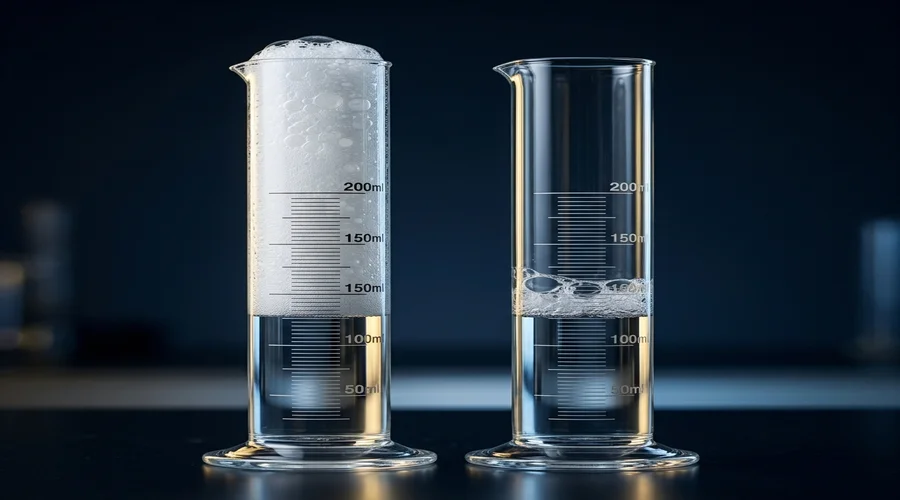
Diagnosis: How to Confirm the Root Cause of Excessive Foaming
Accurate diagnosis separates foam problems rooted in formulation chemistry from those rooted in process conditions — and the corrective path differs sharply depending on which is dominant. Testing under the actual mechanical and water conditions of the deployment site, rather than relying on bench-scale shake tests, is the single most important step in getting a reliable diagnostic picture.
Step 1 — Standardised Foam Height Testing
Run a Ross-Miles or cylinder shake foam test at the actual use concentration, use temperature, and site water hardness — not the development laboratory's water supply. Record initial foam height and foam height at defined intervals (1, 5, 10 minutes) to characterise both foam volume and foam persistence. A high initial foam height that collapses quickly points toward a process-tolerable foam profile; persistent foam that does not decay indicates a stability problem requiring surfactant-level correction.
Step 2 — Water Hardness and Temperature Mapping
Test the identical formulation across a range of water hardness values bracketing the site's actual process water, and across the temperature range used in the real cleaning cycle. If foam height varies dramatically with hardness or temperature, the formulation's foam behaviour is highly sensitive to site conditions and any process change — a water softener going offline, a boiler temperature drift — will produce inconsistent foam complaints even without any formulation change.
Step 3 — Mechanical Simulation
Where possible, test the formulation through a bench-scale recirculating pump loop or spray rig that better approximates the shear profile of the actual CIP or spray system, rather than relying solely on static shake tests. Formulations that pass static foam testing but fail in dynamic recirculation testing confirm that mechanical shear, not surfactant chemistry alone, is the dominant driver — pointing toward defoamer dosing or process modification rather than a full reformulation.
Step 4 — Soil Load Contribution Isolation
Repeat foam testing with and without representative soil (fat, protein, or particulate matter typical of the application) added to the test solution. A significant foam increase in the presence of soil confirms that soil-derived co-stabilisation is contributing to the complaint, which means foam behaviour will vary with soil load across the production schedule and any fix must remain effective across that full soil range, not just on clean rinse water.
Solution Strategies: Corrective Approaches to Foam Control
Correcting excessive foam requires choosing between two fundamentally different strategies — suppressing foam with an additive, or removing the underlying tendency to foam through surfactant reformulation — and the right choice depends on how severe and how structural the mismatch between chemistry and process actually is. Treating every foam complaint as a defoamer dosing problem risks masking a surfactant selection that was never suited to the application.
Defoamer and Antifoam Selection
Defoamers work by physically disrupting the stabilised air-water interface — spreading across the foam film, locally reducing surface tension, and causing bubble film rupture and coalescence. Silicone-based defoamers offer strong, low-dose efficacy across a broad range of surfactant systems but can leave hydrophobic residue if overdosed, which is a concern for subsequent coating or printing operations on cleaned surfaces. Mineral oil-based and fatty alcohol/ester-based defoamers are common alternatives, with the latter often preferred where food-contact compatibility or rinse-off cleanliness is a priority. The defoamer must be compatible with the surfactant system and process temperature — some defoamers lose efficacy or destabilise at elevated CIP temperatures.
Surfactant System Reformulation
Where foam is structurally excessive for the mechanical environment — not simply a matter of fine-tuning — replacing or supplementing the primary anionic surfactant with lower-foaming nonionic or specialty low-foam anionic chemistry addresses the root cause. Low-foam nonionic surfactants such as certain alcohol ethoxylates and alkyl polyglucosides can deliver comparable or superior cleaning performance to high-foaming anionics in industrial soil-removal applications, since cleaning efficacy is driven by interfacial soil displacement rather than foam volume. Reformulation is the more durable fix for CIP and high-shear spray systems where foam is a recurring, structural problem rather than an occasional site-specific complaint.
Process and Equipment Adjustment
Where reformulation is impractical — for example, in a validated pharmaceutical or food-contact formulation that cannot be easily changed — process-level controls can reduce foam generation without touching the chemistry. Reducing pump speed or spray pressure at points where foam generation is worst, redesigning return line geometry to allow foam to break naturally before reaching pump inlets, and installing mechanical foam breakers or defoaming trays in tanks are all viable engineering controls that work alongside chemical defoamers rather than replacing sound formulation practice.
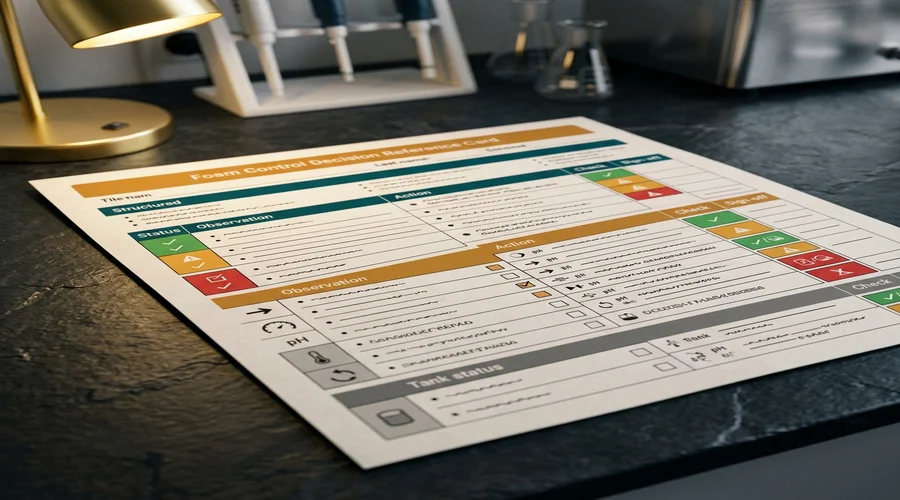
Prevention: Process Controls and Formulation Strategies to Avoid Recurrence
Preventing recurring foam complaints requires validating formulations against the real mechanical and water conditions of deployment before launch, not after the first field complaint arrives. Building foam robustness into both the formulation specification and the qualification protocol closes the gap between bench performance and plant floor reality.
Application-Matched Validation Testing
Foam testing protocols should be matched to end-use conditions from the earliest development stage — using site-representative water hardness ranges, use-temperature, and where feasible, dynamic recirculation or spray-simulation testing rather than static bench shake tests alone. Products intended for deployment across multiple sites with varying water hardness should be validated across the full expected hardness range, with foam specifications set against the worst-case (typically softest water) condition.
Surfactant System Documentation
Maintain clear internal documentation of the intrinsic foam tendency of each surfactant class used across the product portfolio, including known interactions with hardness, temperature, and typical soil types for the target application. This reference allows formulators to anticipate foam risk during early-stage development rather than discovering it during scale-up trials, and supports faster root cause triage when a foam complaint does arise.
Defoamer Compatibility Pre-Screening
For formulations expected to require defoamer support, pre-screen defoamer compatibility and dosing response during development rather than as a reactive fix. This includes verifying defoamer stability through the product's full shelf life, since some defoamer chemistries can separate, cream, or lose efficacy in storage — a defoamer that performs well when freshly blended may fail silently by the time the product reaches the customer's cleaning line.
Site Commissioning Protocol
When introducing a new cleaning product to a facility, include a foam behaviour check as a standard part of site commissioning — running the actual CIP or spray cycle with site water and observing foam behaviour under real production conditions before full rollout. This catches site-specific mismatches (unusually soft water, unusually high shear equipment) before they become recurring operational complaints.
When to Escalate to a Specialist
Most excessive foaming complaints in industrial cleaning are resolvable through the diagnostic and corrective sequence described above — foam height testing, water and temperature mapping, and appropriately targeted defoamer or reformulation intervention. Certain situations, however, indicate a more complex underlying problem that benefits from specialist formulation review.
Escalate when foam behaviour is inconsistent across multiple sites using the identical product batch, since this pattern usually signals a sensitivity to water chemistry, temperature, or equipment shear that requires systematic multi-variable testing to fully characterise rather than single-site troubleshooting. Similarly, escalate when defoamer dosing has been increased repeatedly without achieving stable control — this pattern often indicates that the defoamer is being consumed or destabilised by an interaction with another formulation component, which requires compatibility investigation beyond simple dose adjustment. In regulated food, beverage, or pharmaceutical cleaning validation contexts, any foam-related deviation that affects validated CIP cycle parameters may require formal root cause documentation and revalidation, which is best handled with specialist support experienced in both the chemistry and the regulatory documentation requirements.
Finally, if foam problems emerge for the first time during scale-up from pilot batch to full production, the cause may lie in scale-dependent variables — mixing shear during manufacture, raw material lot variability, or process water differences between pilot and production sites — that are difficult to isolate without direct process observation and a structured design-of-experiment approach. A formulation specialist with industrial process experience is best positioned to separate genuine chemistry issues from scale-dependent artefacts.
Excessive foaming in industrial cleaning is a solvable problem once the balance between surfactant chemistry, mechanical shear, and site water conditions is correctly diagnosed. For deeper background on the surfactant interactions that influence foam and cleaning performance together, see foam control in cleaning product formulation, or for foundational context on household and industrial cleaner formulation strategy, the Global Formulation knowledge base provides the technical grounding for building foam-appropriate cleaning systems from the outset. For independent guidance on surfactant safety and performance data, the Cleaning Institute's Cleaning 101 resource offers accessible technical references on surfactant chemistry in cleaning applications.