Floor Cleaner Formulation: Neutral, Alkaline & Disinfectant Systems
Walk into any facility management complaint file and floor cleaner shows up constantly — either it stripped the wax finish off the lobby tile, it left a streaky film under fluorescent light, or it simply didn't cut the grease in the kitchen. Floor cleaner formulation looks deceptively simple from the outside: surfactant, water, maybe a builder. In practice, it's one of the few cleaning categories where the wrong pH choice causes visible, expensive damage to a customer's floor rather than just underperforming. This guide walks through how neutral, alkaline, and disinfectant floor cleaner platforms are actually built — which surfactants belong in each, why quaternary ammonium actives fight with the wrong surfactant chemistry, and how dilution control determines whether a formula performs the way its lab data says it should. It's written for formulators and manufacturers building products for the household and industrial cleaners market.
Choosing the Right pH Platform for the Floor Surface
Every floor cleaner formulation decision starts with the floor itself, not the soil. Sealed and waxed floors carry a polymer or acrylic finish layer whose entire purpose is to protect the substrate underneath and give the floor its shine — and that finish layer is itself vulnerable to chemical attack, most commonly from alkalinity. Unfinished floors have no such layer to protect, which flips the formulation priority from finish preservation to raw cleaning power.
An alkaline cleaner repeatedly applied to a waxed VCT or sealed hardwood floor will slowly saponify and soften the finish, leaving it dull, cloudy, or prone to black-heel-mark buildup long before the floor itself is actually dirty again. A neutral cleaner applied to a heavily soiled unfinished concrete loading dock, on the other hand, often can't generate enough cleaning power to cut baked-on grease or mineral scale, leaving the customer to conclude the product simply doesn't work.
| Floor Type | Recommended pH Range | Primary Formulation Concern |
|---|---|---|
| Waxed/sealed VCT, sealed hardwood | 6 – 8 (neutral) | Preserving the finish layer; avoiding residue buildup |
| Unsealed concrete, quarry tile | 9 – 12 (alkaline) | Maximum grease and soil removal; no finish to protect |
| Terrazzo, natural stone | 6 – 8 (neutral, pH-buffered) | Preventing acid or high-alkali etching of the stone surface |
| Institutional/healthcare hard surfaces | Varies with active | Disinfectant active compatibility takes priority over finish |
Once the target floor type sets the pH ceiling and floor, the rest of the formulation — surfactant class, builder load, even fragrance stability — has to work within that window rather than around it.
Neutral Cleaner Chemistry for Finished and Sealed Floors
Neutral floor cleaners have to do something genuinely difficult: clean effectively at a pH gentle enough to leave a polymer finish untouched, using surfactants concentrated enough to lift soil but mild enough to rinse away without leaving a film. That balance is why the surfactant selection in this category looks different from a general-purpose degreaser.
Alkyl polyglucosides (APGs), derived from renewable fatty alcohols and glucose, are common in neutral floor formulas because they clean effectively near neutral pH and biodegrade readily without the harshness of anionic surfactants. Amine oxides are frequently blended alongside them as secondary surfactants — they boost cleaning and foam stability at low use levels without pushing the formula's pH away from the neutral target.
- Alkyl polyglucosides (APGs) — Mild, biodegradable primary surfactant that cleans effectively at neutral pH without attacking floor finish
- Amine oxides — Secondary surfactant that boosts cleaning and mild foam without shifting formula pH
- Low-foam nonionic ethoxylates — Used when the product is rated for auto-scrubber machines rather than mop-bucket-only use
- pH buffers (citrate or phosphate-based) — Hold the finished dilution within the 6–8 target range across a range of water hardness levels
Getting the neutral chemistry right protects the floor, but it does nothing for the far tougher soil loads that show up on floors with no finish left to protect — which is where an entirely different builder strategy takes over.
Alkaline Systems for Heavy Soil and Unfinished Surfaces
When there's no finish to preserve, the formulation calculus flips entirely toward raw cleaning power. Alkaline floor cleaners lean on builders — compounds that boost surfactant efficiency and directly attack soil chemistry — in a way neutral formulas simply can't, because those same builders are what would damage a finished floor.
Sodium metasilicate and sodium carbonate are classic alkalinity sources in this category: they raise pH into the range where fatty and oily soils undergo saponification, converting greasy residue into water-soluble soap that rinses away rather than smearing across the floor. Chelating agents like EDTA or sodium citrate are added to sequester calcium and magnesium from hard water and from mineral-based soil itself, preventing those ions from re-depositing as a hazy film once the water evaporates.
| Builder/Component | Function | Typical Use Case |
|---|---|---|
| Sodium metasilicate | High alkalinity, grease saponification, some corrosion inhibition | Heavy industrial floor cleaners, degreasers |
| Sodium carbonate | Moderate alkalinity, water softening | General-purpose alkaline floor cleaners |
| EDTA / sodium citrate | Chelation of hardness minerals | Preventing mineral film in hard-water regions |
| Anionic surfactants (LAS, alcohol sulfates) | Primary soil and grease removal | High-soil-load alkaline formulas without disinfectant claims |
Alkaline systems solve the heavy-soil problem well, but they introduce a formulation complication the moment a manufacturer wants to add a disinfectant claim to the same bottle.
Disinfectant Floor Cleaners: Balancing Cleaning and Kill Claims
Adding an antimicrobial claim to a floor cleaner isn't just a marketing decision — it fundamentally constrains which surfactants can be used, because the most common disinfectant actives in this category are chemically incompatible with the surfactant chemistry that alkaline degreasers otherwise rely on.
Quaternary ammonium compounds (quats) are cationic, meaning they carry a positive charge that's essential to how they disrupt microbial cell membranes. Anionic surfactants like LAS carry a negative charge, and mixing the two causes ion pairing — the quat's active site binds to the anionic surfactant instead of the target microorganism, which can visibly cloud the formula and, more importantly, quietly destroy the product's disinfectant efficacy without any obvious sign in the bottle. Disinfectant floor cleaners built around quats have to use nonionic or amphoteric surfactants instead, and the finished formula needs efficacy testing against the specific claim, not just the raw actives.
Phenolic disinfectants such as ortho-phenylphenol are the other major active family in this space and don't carry the same cationic-anionic conflict, which is why some heavy-duty alkaline floor disinfectants use phenolics rather than quats when a strong alkaline cleaning base is also required. In the United States, any product carrying a kill or disinfection claim is regulated as a pesticide under FIFRA and must be EPA-registered with efficacy data supporting that specific claim — a formulation detail that shapes label copy as much as it shapes the raw material list.
Getting the active-surfactant chemistry right on paper still isn't the end of the story, because how the product is actually applied in the field changes what the formula needs to tolerate.
Application Method and Dilution Control
A floor cleaner's lab performance data is only meaningful at the dilution it was tested at, and the application method a facility actually uses has a direct effect on whether that dilution — and therefore that performance — is reliably reached in the field.
Mop-bucket application is comparatively forgiving: moderate foam doesn't interfere with the mopping process itself, though excess suds still look unprofessional and can slow rinsing. Auto-scrubber machines are far less forgiving, because they mechanically vacuum the cleaning solution back into a recovery tank through a squeegee immediately after applying it. High-foaming surfactants build suds inside that recovery tank, can interfere with the vacuum recovery mechanism, and in some cases trigger machine faults — which is why any formula intended for auto-scrubber use is specifically built around low-foam nonionic surfactants.
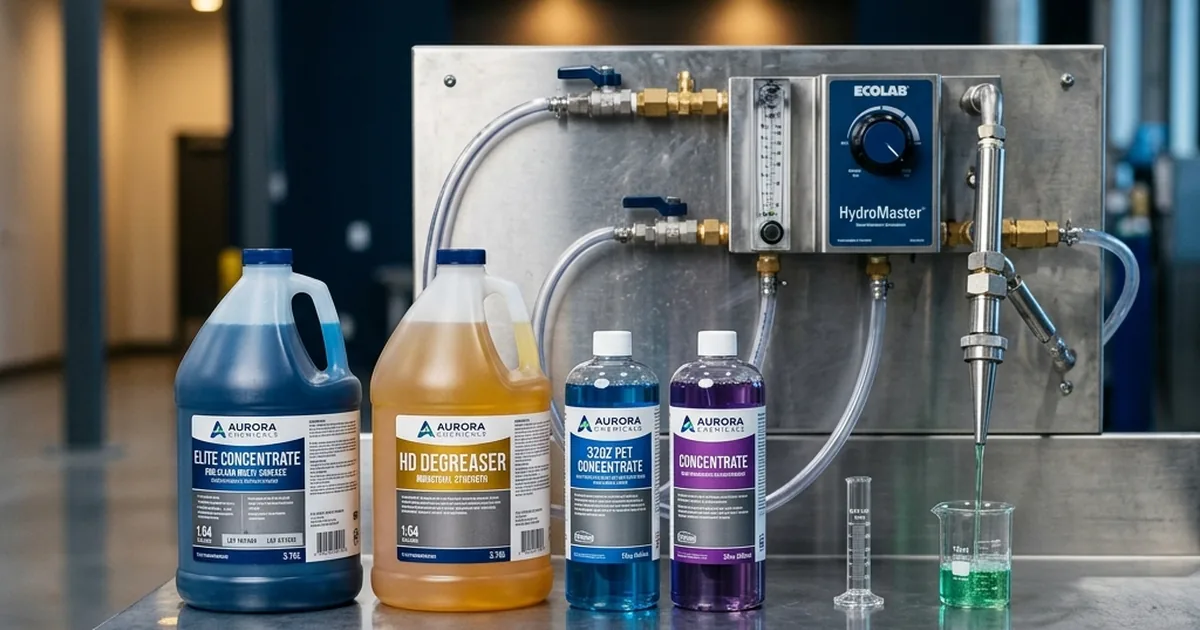
- Concentrate dilution range — Institutional products are formulated as concentrates with a labeled use-dilution, often delivered through a wall-mounted proportioning dispenser rather than manual pouring
- Under-dilution — Wastes product and can leave excess residue or streaking on the finished floor
- Over-dilution — Under-doses both cleaning surfactants and any disinfectant active, directly undermining the labeled performance claim
- Foam profile — Must be validated against the more foam-sensitive application method (auto-scrubber) if the product is marketed for both mop and machine use
Dilution accuracy is what connects a formula's validated lab performance to what actually happens on the floor — and it's just as relevant to how the finished product looks and smells after it dries.
Fragrance, Residue, and Long-Term Stability Considerations
The last mile of floor cleaner formulation is making sure the product still performs and smells right after months on a warehouse shelf or a facility's supply closet, not just fresh off the production line. Alkaline pH and fragrance chemistry don't always coexist peacefully, and residue that isn't visible on day one can become a real complaint after weeks of repeated mopping.
Fragrance oils formulated for neutral or acidic products can hydrolyze or discolor in a high-alkalinity base over time, so fragrances used in alkaline floor cleaners need to be selected and stability-tested specifically at that pH and at realistic storage temperatures. Packaging compatibility matters just as much: an alkaline concentrate stored in the wrong plastic resin can slowly degrade the container or leach plasticizers, which is why formulators cross-check packaging against the finished formula's pH and solvent content before finalizing a product.
Residue buildup is a slower-moving problem — a formula that looks clean in a single-use lab test can leave a cumulative film after dozens of mopping cycles if its surfactant system doesn't rinse fully at the labeled dilution. Facilities that notice a floor "graying" over months, even with consistent cleaning, are often seeing exactly this kind of long-term residue accumulation rather than a sudden formulation defect.
Getting fragrance and residue behavior right over the full shelf life and use life of the product is what separates a floor cleaner that performs in a lab test from one that holds up to the way facilities actually use it every day.
Frequently Asked Questions
Why can't I just use one floor cleaner formula for every floor type?
Because floor finishes and substrates respond very differently to pH, and a formula that works safely on one will damage another. Waxed vinyl composition tile (VCT) and sealed hardwood carry a polymer or acrylic finish layer that alkaline cleaners will slowly dull, haze, or strip with repeated use, so those floors need a neutral pH formula in the 6-8 range. Unfinished concrete, quarry tile, and heavily soiled industrial floors have no finish to protect and often carry baked-on grease or mineral soil that a neutral formula simply can't cut.
Matching the pH platform to the floor is the single biggest formulation decision that determines whether a product succeeds or generates complaints.
What actually keeps a neutral floor cleaner from leaving streaks or a sticky residue?
Streaking and residue mostly come down to surfactant choice and rinse behavior, not just pH. Traditional soap-based cleaners leave a fatty residue that dulls floor finish over repeated mopping, which is why modern neutral formulas are built on synthetic surfactants like alkyl polyglucosides and amine oxides that don't leave that film behind. Low-foam nonionic surfactants also matter for auto-scrubber use, since excess foam interferes with the machine's squeegee recovery.
A well-formulated neutral cleaner is designed to evaporate cleanly at typical dilution rates without needing a separate rinse step.
Can I add a quaternary ammonium disinfectant to any floor cleaner base?
No, and this is one of the most common formulation mistakes in this category. Quaternary ammonium compounds are cationic, and anionic surfactants like linear alkylbenzene sulfonate (LAS) will ion-pair with the quat's positively charged nitrogen, neutralizing its antimicrobial activity and often causing the formula to cloud or precipitate.
A quat-based disinfectant floor cleaner has to be built around nonionic or amphoteric surfactants instead, with the finished formula tested against the specific quat's efficacy data.
Do floor disinfectant claims actually require EPA registration?
In the United States, yes — any product marketed with a claim to kill or reduce specific microorganisms on a surface is a pesticide under FIFRA and must carry EPA registration with efficacy data supporting that exact claim. A cleaner that only claims to clean, without a kill or disinfection claim, doesn't need this registration.
Once a formulator adds language like "kills 99.9% of germs" or "disinfects," the product needs to be registered and tested against the relevant AOAC or EPA efficacy protocol for that claim to be legally supportable.
Why does hard water reduce how well a disinfectant floor cleaner performs?
Calcium and magnesium ions in hard water can bind to both surfactants and cationic actives like quats, effectively removing them from solution before they reach the floor and the microorganisms on it. This is why disinfectant floor cleaner formulas built for institutional use typically include a chelating agent such as EDTA or a citrate salt to sequester those hardness ions.
Skipping this step doesn't cause an obvious formulation failure in the bottle — it shows up later as inconsistent disinfection performance in hard-water regions.
What's the difference between formulating for mop-bucket use versus an auto-scrubber machine?
Mop-bucket application tolerates moderate foam and doesn't need to account for mechanical recovery, but auto-scrubbers actively vacuum the cleaning solution back through a squeegee and recovery tank immediately after applying it. A formula with high-foaming surfactants will build suds inside that recovery tank and can interfere with the vacuum recovery system.
Auto-scrubber-rated floor cleaners are specifically formulated with low-foam nonionic surfactants, and a formula intended for both application methods has to be validated on the more foam-sensitive auto-scrubber case.
How does dilution control affect real-world floor cleaner performance?
Institutional floor cleaners are almost always sold as concentrates that get diluted on-site, often through a wall-mounted proportioning dispenser, and the entire formula's surfactant and builder levels are calculated around hitting the labeled use-dilution. Under-dilution wastes product and can leave excess residue, while over-dilution under-doses the active surfactants and any disinfectant actives.
This is why formulators specify an exact use-dilution range on the label and why facilities are trained to rely on calibrated dosing equipment rather than eyeballing a pour.
Developing a Floor Cleaner Formulation?
Global Formulation provides cleaning-product consultancy — pH platform selection, surfactant-active compatibility, and regulatory-ready disinfectant formulation. For the commercial planning side, the Phenyl Manufacturing Standard Project Report is a costed India-basis feasibility study of a phenolic disinfectant-fluid unit — three investment configurations, a five-year financial model and the BIS / statutory roadmap.
Talk to Our Formulation Team