Food Contact Compliance for Adhesives: EU Regulation 10/2011 and FDA 21 CFR 175

Food contact adhesive compliance is the difference between a laminate that clears customs and ships to a food brand's line, and one that gets rejected at supplier qualification because nobody can produce a matching Declaration of Compliance. The exposure is real — a food packaging converter caught using an unlisted adhesive component can lose the account, trigger a recall of finished packaging, or face a shipment held at the border while paperwork is sorted out. This guide walks through how EU Regulation 10/2011 and FDA 21 CFR 175 actually apply to adhesives — including where each framework's authority stops — the documentation a formulator needs to hold, and a realistic compliance timeline, current to how both systems are administered in 2026.
What EU Regulation 10/2011 and FDA 21 CFR 175 Cover — and What They Don't
Adhesives occupy an odd position in food-contact law because neither major regulatory system treats them the way it treats plastics. Formulators who assume the two frameworks mirror each other end up building a compliance file around the wrong regulation, then discovering the gap during a customer audit rather than before it.
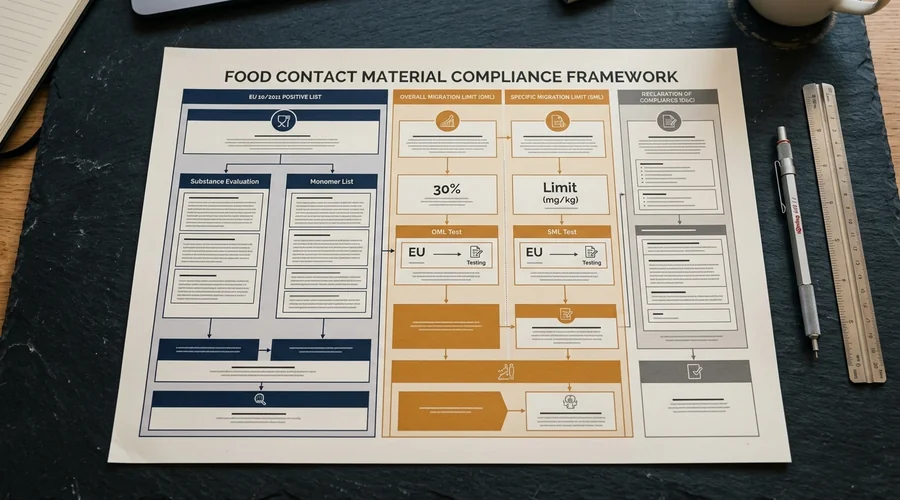
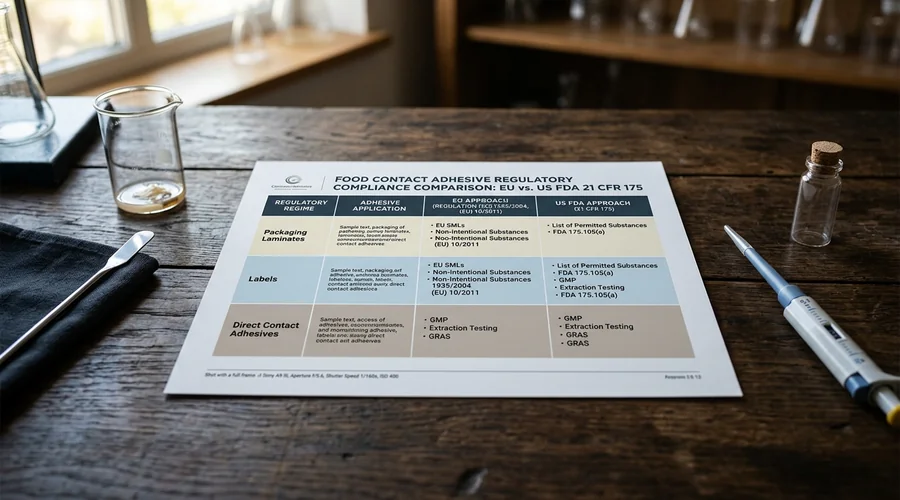
In the EU, Regulation (EU) No 10/2011 — the Plastics Regulation — is the specific implementing measure for plastic materials and articles, carrying a Union positive list of authorised monomers and additives, an overall migration limit, and substance-specific migration limits. Adhesives have no equivalent EU-harmonised measure of their own; they remain governed by the general Framework Regulation (EC) No 1935/2004, which sets a broad safety standard rather than a substance list. In the US, FDA addresses adhesives directly through 21 CFR Part 175, Subpart B — specifically 175.105 for general adhesives and 175.125 for pressure-sensitive adhesives — giving US formulators a dedicated positive list that EU formulators simply don't have.
Scope: Who It Applies To and Which Adhesive Applications Are Covered
Scope confusion is where most compliance files go wrong first, because "food-contact adhesive" covers several distinct product types that sit under different rules depending on whether the adhesive touches food directly or sits behind a barrier layer.
Any adhesive used to bond a laminate film, apply a label, seal a lid, or fix a liner in packaging destined for food falls into scope the moment that packaging will hold food. This spans lamination adhesives bonding foil to plastic film in flexible snack and confectionery packaging, pressure-sensitive label adhesives on jars and bottles, can-seam and cap-liner adhesives, and carton-sealing adhesives on paperboard. The table below maps which framework governs which piece of that picture.
| Framework | Governs | Administered By | Typical Adhesive Application |
|---|---|---|---|
| EU Framework Regulation 1935/2004 | General safety requirement, traceability, and Declaration of Compliance for every food-contact material group, including adhesives | European Commission & member state authorities | All food-contact adhesives sold into the EU |
| EU Regulation 10/2011 (Plastics Regulation) | Positive list, overall and specific migration limits for plastic layers in a laminate structure | European Commission & national competent authorities | Plastic film layers bonded by adhesive in flexible laminates |
| German BfR Recommendations (national reference) | De facto positive-list benchmark widely used pending an EU-specific adhesives measure | Germany's Federal Institute for Risk Assessment (BfR) | Adhesive raw material screening across the EU market |
| FDA 21 CFR 175.105 / 175.125 | Positive list of permitted adhesive components, conditions of use, functional-barrier expectations | U.S. Food and Drug Administration | Lamination adhesives, PSA labels, can and cap-liner adhesives sold in the US |
Key Requirements: What EU and FDA Compliance Demands
Compliance for a food-contact adhesive rests on matching the right raw materials to the right positive list for the market you're selling into, then proving the finished assembly stays within migration limits. Missing the distinction between the adhesive's own listing status and the assembled laminate's migration result is where most non-compliant packaging originates.
- Framework-level safety compliance — no transfer of substances to food in quantities that endanger health or unacceptably change taste, odour, or composition, under EU 1935/2004
- Positive-list raw material screening — every adhesive component checked against the Union list (for plastic-laminate use), BfR recommendations, or FDA 175.105/175.125 and GRAS status, depending on the target market
- Functional barrier assessment — determining whether the adhesive sits behind a barrier that separates it from direct food contact, which changes which substances may be used
- Assembly-level migration testing — overall and specific migration data generated on the finished laminate or packaging construction, not the adhesive raw material alone
- GMP compliance — a documented quality management system at the adhesive manufacturing site under Regulation (EC) No 2023/2006
- Supply-chain documentation — a Declaration of Compliance or letter of guarantee passed from raw-material supplier to adhesive maker to converter to brand owner
A formulator who screens raw materials correctly but never tests the finished laminate, or who assumes an FDA-cleared component is automatically valid in the EU, still ends up with packaging that cannot legally ship — the requirements only work when applied together. Formulators building the underlying hot-melt adhesive systems or pressure-sensitive adhesive formulations used in these applications need this screening built into the raw-material selection stage, not bolted on afterward.
Testing and Documentation Requirements
The documentation burden here is heavier than it looks at first glance, because a compliant food-contact laminate needs evidence at three separate levels — the raw material, the adhesive formulation, and the finished assembled structure. Manufacturers who only keep raw-material paperwork are missing the piece an auditor asks for first.
Migration testing under EU law uses standardised food simulants — aqueous, acidic, alcoholic, and fatty simulants representing different food types — under defined time-temperature conditions, commonly ten days at 40°C to represent long-term room- temperature or chilled storage contact, following methods aligned with the EN 1186 test series. FDA compliance for adhesives is built around matching the raw materials and conditions of use to the specific listing in 175.105 or 175.125, supported by extraction or migration data appropriate to the food type and processing conditions the packaging will see, such as hot-fill, retort, or refrigerated storage.
- Raw-material Declarations of Compliance — from every adhesive component supplier, confirming positive-list or GRAS status and any use restrictions
- Functional barrier assessment record — documenting whether the adhesive is separated from direct food contact and by what layer
- Migration test reports — overall and specific migration results generated on the finished laminate or packaging construction under the relevant food simulants
- GMP records — quality management documentation for the adhesive manufacturing site under Regulation 2023/2006
- Positive-list cross-reference — a formulation-level record mapping each adhesive component to its Union list, BfR, or FDA CFR listing
- Finished-product Declaration of Compliance — issued down the supply chain to the converter and brand owner, citing the applicable regulations and test data behind it
Keeping this three-tier documentation current matters most at renewal — a supplier audit that can only produce raw-material paperwork, with no assembly-level migration data, is treated the same as having no testing at all.
Step-by-Step Compliance Pathway
Bringing a food-contact adhesive application to market follows a defined sequence, and skipping the functional barrier assessment early is the single most common reason formulators end up re-testing a laminate they'd already committed to production.
- Identify the contact scenario. Determine whether the adhesive will be in direct food contact or sits behind a functional barrier, and identify the intended food type and storage or process conditions.
- Screen raw materials against the applicable positive lists. Cross-check every adhesive component against the EU Union list, BfR recommendations, or FDA 175.105/175.125 and GRAS status, depending on target market.
- Confirm functional barrier status where relevant. If any component isn't independently listed, verify the barrier layer's thickness and migration performance meets the applicable detection threshold and CMR exclusion.
- Commission migration testing on the finished laminate. Test the assembled packaging structure — not the adhesive alone — using the food simulants and time-temperature conditions matching its intended use.
- Assemble supply-chain documentation. Collect raw-material DoCs, compile the positive-list cross-reference, and issue a finished-product Declaration of Compliance or letter of guarantee.
- Monitor for regulatory and raw-material change. Track Union list updates, new CMR classifications, and any raw-material substitution from suppliers that would invalidate existing test data.
Realistic Timeline and Cost Expectations
For a converter or adhesive formulator building a new food-contact laminate, timeline depends almost entirely on whether the raw materials chosen are already on the applicable positive list with existing test data, or whether new migration testing has to be generated from scratch. Understanding this early prevents committing to a raw material that looks technically ideal but forces a lengthy new testing programme.
A laminate built entirely from raw materials already cleared under the Union list, BfR recommendations, or FDA 175.105/175.125, with an existing functional barrier assessment, can often move through migration testing and documentation in a matter of weeks. A construction using a novel raw material, a direct food-contact adhesive with no barrier, or a food type and storage condition not previously tested typically takes several months, since new simulant migration studies and, in the US, potentially a Food Contact Notification submission may be required. The main cost categories are migration testing fees, raw-material DoC collection, regulatory consultancy for cross-market compliance, and any FDA Food Contact Notification costs where a genuinely new substance is involved.
Manufacturers working within our broader adhesives and sealants formulation practice consistently find that confirming positive-list eligibility and functional barrier status before finalising a laminate structure is the most effective way to avoid a late-stage reformulation after migration testing has already begun.
Common Mistakes Manufacturers Make — and How to Avoid Them
Most compliance failures in this category come from a handful of recurring misunderstandings about how EU and FDA jurisdiction actually divide up a laminate structure, not from obscure technical edge cases. Recognising these patterns early lets a formulator design around them rather than discovering them mid-audit.
- Assuming Regulation 10/2011 covers the adhesive — it covers the plastic layers only; the adhesive itself needs its own Framework Regulation-based compliance file
- Testing the adhesive raw material instead of the finished laminate — migration limits are assessed on the assembled packaging structure, not an isolated component
- Treating FDA clearance as valid in the EU, or vice versa — the two positive lists are independent and neither automatically recognises the other's approvals
- Skipping the functional barrier assessment — using non-listed components without confirming the barrier layer actually meets the migration and CMR-exclusion criteria
- Not updating documentation after a raw-material substitution — a supplier changing a component without notice can silently invalidate an existing DoC or migration test
A disciplined raw-material screening step tied to a documented functional barrier assessment, paired with assembly-level migration testing before production commitment, resolves nearly all of these failure patterns before they reach a customer's audit.
Frequently Asked Questions
Does EU Regulation 10/2011 directly regulate food-contact adhesives?
What is the difference between 21 CFR 175.105 and 21 CFR 175.125?
Do I need to test the adhesive raw material alone or the finished laminate?
What is a functional barrier and does my adhesive need one?
Can I use the same adhesive formulation for EU and US food-contact packaging?
What is a Declaration of Compliance and who needs to issue one?
How often do I need to re-test migration if nothing in my formulation changes?
Need Regulatory Guidance for Your Food-Contact Adhesive Application?
Our team provides end-to-end regulatory strategy — from raw-material screening and functional barrier assessment through to migration testing coordination and Declaration of Compliance documentation.
Get a Free Consultation