Generic Drug Formulation Development: Bioequivalence and Patent Strategy
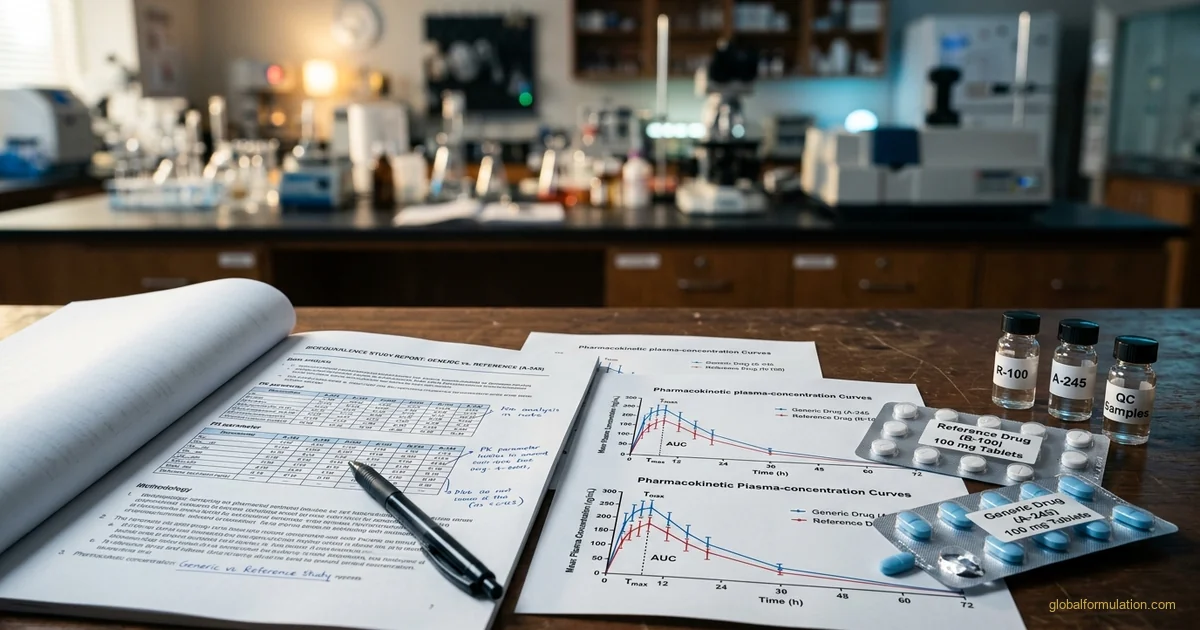
A generic drug company can spend two years and several million dollars building a technically excellent formulation only to fail its pivotal study, or worse, get the pharmacokinetics right and still land in patent litigation. Generic drug formulation bioequivalence is not a copying exercise — it's an independent R&D discipline that requires matching a reference product's clinical performance without access to its exact formula, while simultaneously engineering around active patents that were often drafted specifically to block that path. Get the science wrong and a bioequivalence study fails outright, costing the sponsor a full development cycle. Get the patent analysis wrong and a technically perfect generic still triggers litigation before it ever reaches a pharmacy shelf. This guide walks through how bioequivalence is actually established, how formulators reverse-engineer a reference product responsibly, how ANDA formulation development connects lab work to a filable dossier, and how patent strategy has to be built into formulation decisions from day one. It draws on the same regulatory and formulation science we apply across our pharmaceutical and healthcare consulting work.
What Generic Drug Formulation Bioequivalence Actually Requires
The regulatory bar for a generic drug is narrower than most first-time sponsors expect, and understanding exactly what it does and doesn't require shapes every formulation decision that follows. A generic must match the reference listed drug (RLD) in active ingredient, strength, dosage form, and route of administration, and its rate and extent of absorption into the bloodstream must fall within an accepted statistical range of the reference product's — but the inactive ingredients and their exact quantities are not required to match at all. That distinction is precisely what gives a formulator room to reverse-engineer a workable product without the innovator's proprietary formula, and it's also exactly why two demonstrably bioequivalent products can still contain meaningfully different excipient systems.
- Pharmacokinetic bioequivalence — the standard route for oral solid dosage forms, comparing Cmax and AUC between test and reference products in human subjects
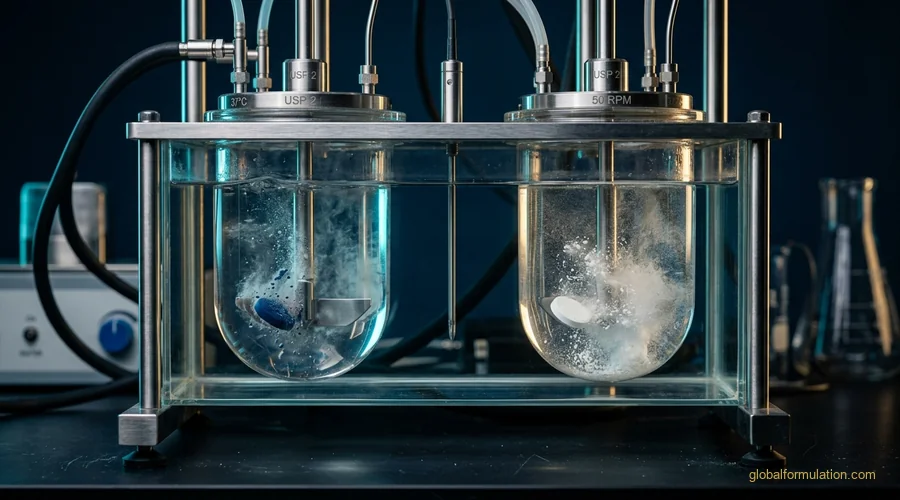
- BCS-based biowaivers — for certain highly soluble, highly permeable drugs, in vitro dissolution comparison can substitute for a full human PK study under FDA and ICH M9 guidance
- Q1/Q2 sameness — for select non-systemic dosage forms such as certain topical and ophthalmic products, regulators require the same inactive ingredients in the same concentrations as a biowaiver condition
| Bioequivalence Approach | What's Actually Compared | Typical Dosage Forms |
|---|---|---|
| PK-based BE study | Cmax and AUC, 90% CI within 80.00–125.00% | Oral tablets, capsules |
| BCS biowaiver | In vitro dissolution profile comparison | Highly soluble/permeable oral drugs |
| Q1/Q2 sameness | Identical inactive ingredients and concentrations | Select topical, ophthalmic, otic products |
Knowing which of these three routes applies to a given product determines almost everything downstream — study cost, timeline, and how much formulation freedom the developer actually has — which is why confirming the applicable bioequivalence pathway is always the first technical decision, not an afterthought.
Reverse Engineering the Reference Drug
The reference product's label discloses which inactive ingredients it contains but withholds the quantities, manufacturing process, and physical form of the drug substance, which means a generic formulator starts from a partial picture rather than a recipe. Analytical deformulation exists to close that gap as far as legitimately possible, using laboratory techniques to characterize the reference product directly rather than guessing. The output is a scientifically informed starting formulation, not a certainty — everything reverse engineering produces still has to survive real bioequivalence testing before it means anything regulatorily.
- HPLC / LC-MS assay — quantifies excipient levels and confirms API content in the reference product
- DSC and X-ray diffraction — identifies the API's crystalline form or polymorph, which can affect both performance and patent exposure
- Particle size analysis — characterizes API particle size distribution, a factor that can meaningfully influence dissolution rate
- Comparative dissolution testing — profiles release behavior across multiple pH media to infer the reference product's release mechanism
Reverse engineering gets a formulator to a defensible starting point, but it is fundamentally a hypothesis-generation exercise — the next step is designing a study rigorous enough to actually prove, or disprove, that the hypothesis holds up in real people.
Designing the Bioequivalence Study
A bioequivalence study is a tightly standardized piece of clinical research, and deviating from established design conventions without good scientific reason mainly just adds regulatory risk without adding useful information. Most BE studies use a two-period, two-sequence crossover design in healthy volunteers: each subject receives both the test and reference product in randomized order, separated by a washout period long enough to clear the first dose entirely, which lets each subject serve as their own control and reduces the variability the study has to account for. Fasting-state studies are standard, and a fed-state study is added whenever food is known or suspected to meaningfully affect absorption of the drug substance.
| Study Element | Standard Design Choice |
|---|---|
| Study design | Two-period, two-sequence crossover |
| Subjects | Healthy adult volunteers, randomized dosing order |
| Sampling | Single-dose PK sampling across a defined time course |
| Acceptance criterion | 90% CI of Cmax and AUC ratio within 80.00–125.00% |
Getting the study design right protects the sponsor's capital as much as it satisfies the regulator, since a failed BE study rarely just means "try again" — it typically means reformulating, re-manufacturing an exhibit batch, and restarting the clock on an already multi-year program.
ANDA Formulation Development: From Bench to Filing
The Abbreviated New Drug Application pathway itself is a legal and regulatory mechanism, covered in depth in our guide to pharmaceutical regulatory pathways — but the formulation science that feeds that submission is a separate body of work, and it's the part that actually determines whether the product can be manufactured reliably at commercial scale. An exhibit (or pilot) batch, manufactured at a scale representative of the intended commercial process, does double duty: its product is what gets used in the pivotal bioequivalence study, and its manufacturing and stability data support the Chemistry, Manufacturing, and Controls section of the dossier.
- Process development and scale-up — translating a lab-scale formulation into a validated, reproducible commercial manufacturing process
- Analytical method development and validation — building assay and dissolution methods capable of reliably distinguishing acceptable from unacceptable product
- Stability protocol execution — generating the real-time and accelerated data a shelf-life claim requires, detailed further in our guide to pharmaceutical stability testing
Formulation science, not paperwork, is what actually makes an ANDA both approvable and commercially manufacturable — which is exactly why sponsors bring in dedicated formulation expertise for this stage rather than treating the CMC section as a documentation exercise layered on top of whatever the lab happened to produce.
Patent Non-Infringement Formulation Strategy
Bioequivalence and patent non-infringement are two entirely separate tests, and a formulation that passes one tells you nothing about the other — a product can match the reference drug's pharmacokinetics precisely while still falling inside the literal scope of a patent claim that has nothing to do with clinical performance. The patent landscape around a reference drug typically layers several distinct claim types, and each demands a different strategic response from the formulation team.
- Composition-of-matter patents — cover the active ingredient itself, generally the hardest and often impossible to design around, expiring on their own fixed timeline
- Formulation and method-of-use patents — cover specific excipient systems, polymorphs, or approved indications, and are frequently narrower in scope, leaving room for a genuine design-around
- Process patents — cover specific manufacturing routes rather than the finished product, sometimes avoidable through an alternative synthesis or formulation process
Under the Hatch-Waxman framework, an ANDA applicant challenging a listed patent files a Paragraph IV certification asserting that patent is invalid or won't be infringed, which typically triggers a 30-month litigation stay if the patent holder sues within 45 days — a certification that only holds up if the formulation was genuinely engineered to sit outside the patent's claims.
A design-around strategy built this way, formulation and patent analysis running in parallel rather than in sequence, is what actually produces a defensible Paragraph IV filing instead of an expensive surprise in litigation.
Generic Pharmaceutical R&D Outsourcing: Build vs Partner
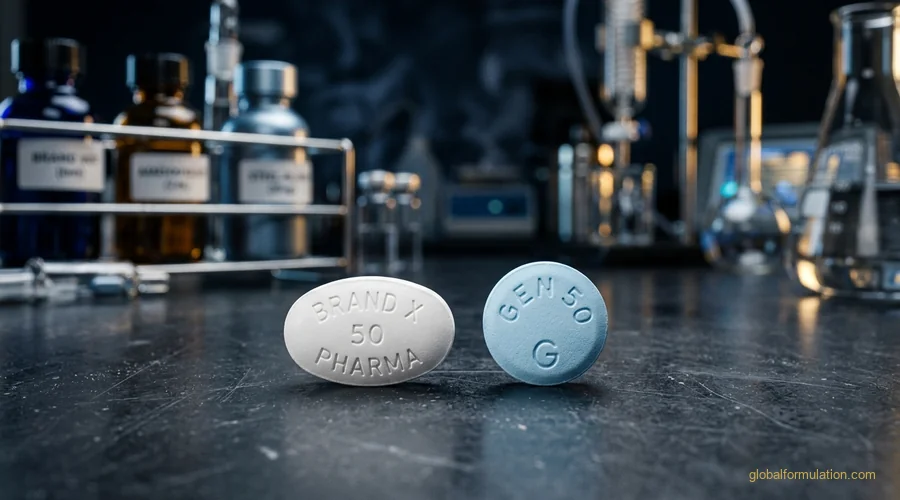
Generic formulation development demands a combination of capabilities that's genuinely expensive to build and maintain in-house for intermittent use: deformulation-capable analytical equipment, bioequivalence-study CRO relationships, ANDA CMC authoring experience, and patent-landscape literacy layered on top of formulation chemistry itself. Many sponsors, particularly smaller and mid-sized generic companies, find it makes more sense to access that full capability on a per-project basis than to staff and equip it permanently.
- Reverse engineering capability — analytical infrastructure and expertise to characterize reference products credibly
- CRO relationships — established pathways to bioequivalence study execution without building that function internally
- ANDA CMC authoring — regulatory writing experience specific to abbreviated application requirements
- Exhibit batch manufacturing — access to commercial-representative manufacturing scale without a dedicated facility
Outsourcing is a genuine build-versus-partner tradeoff, not a shortcut — the sponsor still owns the regulatory approval risk and the patent litigation risk regardless of who performs the bench work, which is exactly why vetting a development partner's track record and IP-assignment terms, covered in our guide to choosing a pharmaceutical formulation consultant, matters just as much as their price or timeline promises.
Frequently Asked Questions
Does a generic drug have to use the exact same formula as the brand-name drug?
No — a generic drug must contain the same active ingredient, strength, dosage form, and route of administration as the reference listed drug, and its rate and extent of absorption into the bloodstream must fall within the accepted bioequivalence range, but the inactive ingredients and their exact quantities are not required to match.
For a small number of non-systemically absorbed dosage forms, such as certain topical or ophthalmic products, regulators do require qualitative and quantitative inactive-ingredient sameness (known as Q1/Q2 sameness) as part of a biowaiver pathway, but this is the exception rather than the rule. For most oral solid dosage forms, the formulator has genuine latitude in excipient selection as long as the finished product performs equivalently in the body.
What is the 80-125% rule in bioequivalence testing?
It refers to the standard statistical acceptance criterion regulators use to declare two products bioequivalent: the 90% confidence interval of the ratio between the generic product's and the reference product's geometric mean values for maximum plasma concentration (Cmax) and total drug exposure (AUC) must fall entirely within 80.00% to 125.00%.
This range isn't arbitrary — it reflects a long-established regulatory judgment about the degree of pharmacokinetic variability that is clinically insignificant for most drugs. Products with unusually high natural variability in their pharmacokinetics sometimes require a modified statistical approach or a larger study population to meet this bar reliably.
How do generic manufacturers figure out a reference drug's formulation without access to the innovator's data?
The reference product's label discloses which inactive ingredients it contains but not their exact quantities, manufacturing process, or physical form, so generic formulators use analytical deformulation to reconstruct a scientifically informed starting point. Techniques include HPLC or LC-MS assay to quantify excipient levels, thermal and X-ray diffraction analysis to identify the API's crystalline form, particle size analysis, and comparative dissolution testing across multiple pH media to infer the release mechanism.
This reverse-engineered formulation is a starting hypothesis, not a guarantee — it still has to be refined and confirmed through actual bioequivalence testing before it can be filed.
What is a Paragraph IV certification, and why does it matter for formulation strategy?
A Paragraph IV certification is a legal declaration, filed as part of an ANDA under the Hatch-Waxman Act, stating that a patent listed against the reference drug in the FDA's Orange Book is either invalid or will not be infringed by the generic product. Filing one typically triggers a 30-month litigation stay if the patent holder sues within 45 days, so the certification is only defensible if the formulation was actually engineered to fall outside the patent's claims.
This is precisely why patent counsel and the formulation team need to work together from the earliest development stages, rather than treating patent review as a late-stage legal check on an already-finished formula.
Can a generic formulation be bioequivalent but still infringe a patent?
Yes, and this is one of the more counterintuitive traps in generic development — bioequivalence and patent non-infringement are two entirely separate legal and scientific tests, and passing one says nothing about the other. A formulation can match the reference product's pharmacokinetic profile precisely while still falling inside the literal scope of a formulation, polymorph, or method-of-use patent claim that has nothing to do with how the drug performs in the body.
That's why a genuine design-around strategy has to check the finished formulation against the actual patent claims, not just against the bioequivalence data package.
What is an exhibit batch, and why does it matter for an ANDA?
An exhibit (or pilot) batch is a manufacturing run made at a scale large enough to represent the intended commercial process, and it serves double duty in a generic filing: its product is what's actually used in the pivotal bioequivalence study, and its manufacturing data and stability results support the Chemistry, Manufacturing, and Controls section of the ANDA.
Because the exhibit batch has to represent commercial-scale manufacturing, formulation and process decisions made at this stage are difficult and expensive to change later without repeating both the batch and the bioequivalence study. Getting the process validated and stable at this stage is what actually determines whether the ANDA is approvable, not just whether the lab-scale formulation worked.
Why do many generic drug companies outsource formulation development instead of building in-house R&D?
Generic formulation development demands capital-intensive analytical equipment, deformulation expertise, relationships with bioequivalence-study CROs, and patent-landscape literacy — a combination that's expensive to build and maintain in-house for a company that may only need it intermittently across a portfolio of products. Outsourcing to a specialist consultant or CDMO lets a sponsor access that full capability on a per-project basis and move faster toward filing, which matters competitively since being an early generic entrant carries real commercial advantages.
The sponsor still owns the regulatory and patent risk regardless of who performs the bench work, though, which is why vetting a development partner's track record and IP-assignment terms matters as much as their price.
Developing a Generic Drug Formulation?
Global Formulation provides pharmaceutical consultancy — bioequivalence-oriented formulation development, reverse-engineering analysis, and ANDA CMC support for generic drug sponsors.
Talk to Our Formulation Team