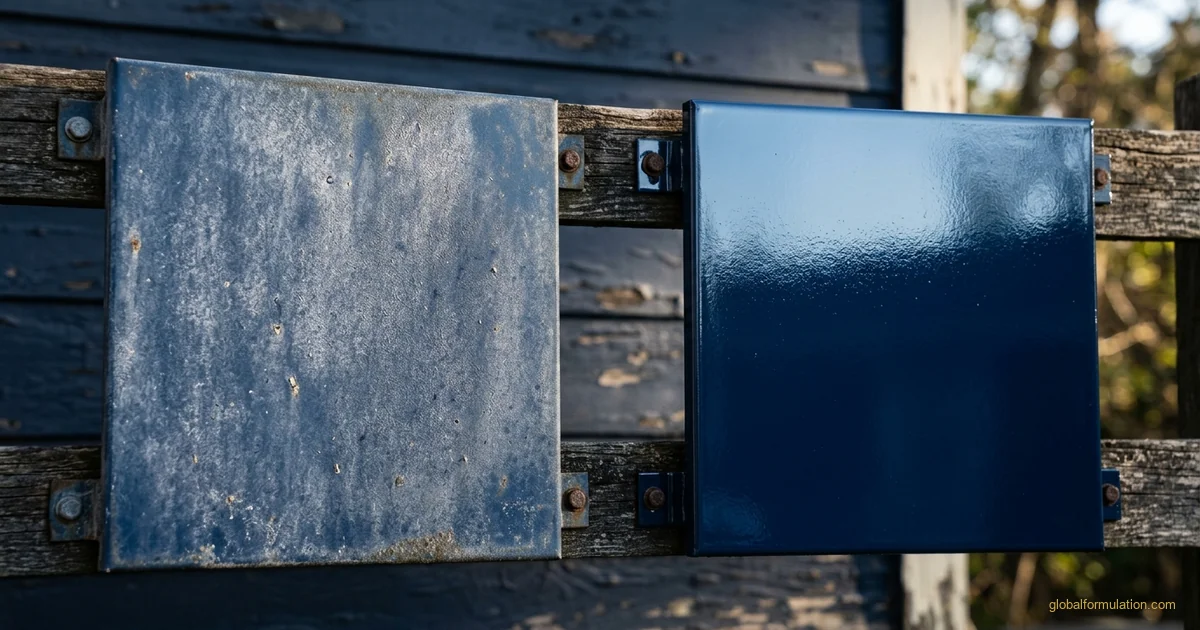
An exterior coating that looked deep and even at application can start looking chalky, hazy, or washed-out within a year or two of sun exposure — and no amount of cleaning brings the shine back. Gloss retention loss in exterior coatings is one of the most visible and most commercially painful coating failures, because it shows up exactly where customers, inspectors, and passersby can see it. A single project that fails to hold its specified gloss level within a warranty period can trigger rejected batches, repainting costs, and disputes over whether the formulation or the application was at fault. This article explains why coatings lose gloss under real-world weathering, how to confirm the mechanism at work before committing to a fix, and which formulation and process levers genuinely restore durability rather than just buying a few more months. The diagnostic path below draws on the same resin degradation chemistry and field assessment methods used across industrial and architectural coating failure investigations.
Understanding the Problem: What Gloss Retention Loss Looks Like in Exterior Coatings
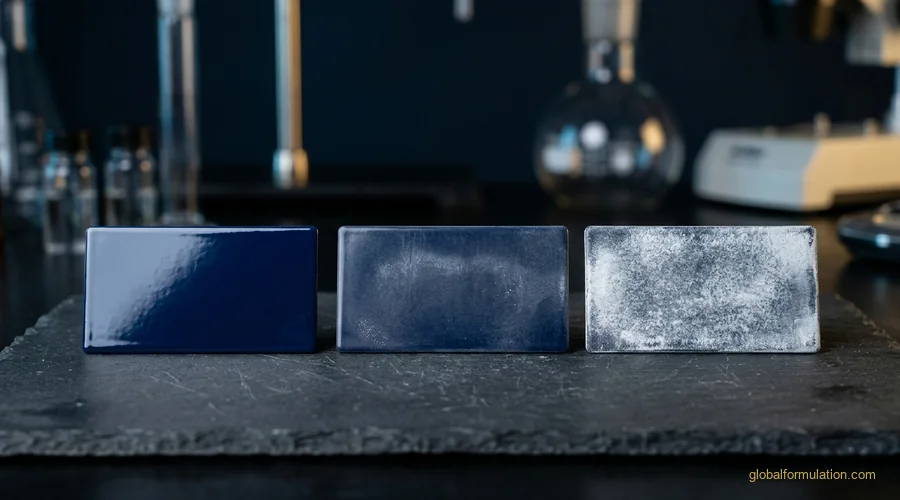
Gloss retention loss rarely announces itself as a single dramatic event; it creeps in over months of sun exposure until the difference from a fresh reference panel becomes impossible to ignore. Early stages show as a slight softening of reflected highlights and a marginally duller appearance under direct light, changes easy enough to dismiss as ordinary dirt pickup. As degradation progresses, the surface develops a visibly hazy or matte cast, sometimes with a fine, powdery chalk residue that transfers onto a finger or dark cloth wiped across it. By the time gloss loss is obvious to an untrained eye, the coating has typically already lost a substantial fraction of its original 60-degree gloss reading.
The commercial stakes are highest wherever coatings carry an explicit gloss or colour-retention warranty — architectural cladding, coil-coated metal roofing, and premium industrial equipment finishes among them. A coating that fails a five- or ten-year gloss retention specification exposes the manufacturer to warranty claims, repainting costs on structures that are often difficult and expensive to access, and reputational damage that outlasts any single project. Gloss loss is also unusually visible to the end customer, who rarely accepts an explanation about resin chemistry as readily as they would for a structural defect they cannot see.
Recognising the difference between reversible surface soiling and irreversible resin degradation is the first and most consequential diagnostic decision a formulator or specifier makes. Getting it wrong sends the investigation chasing the wrong fix from the very first step — which is exactly why understanding what happens inside the coating film matters before anything else.
Root Causes: The Mechanisms Behind Gloss Retention Loss
Gloss loss in exterior coatings is fundamentally a story of ultraviolet photons breaking chemical bonds in the resin binder, not a story of accumulated dirt. Confusing the two leads formulators toward the wrong fix more often than any other single misdiagnosis in exterior coating failure analysis. Several distinct but frequently overlapping mechanisms drive the loss, and the balance between them depends heavily on resin chemistry, pigment loading, and the specific climate the coating faces in service.
UV Photooxidation of the Resin Binder
Ultraviolet radiation, particularly in the UV-B range, carries enough photon energy to break carbon-carbon and carbon-oxygen bonds in most organic resin backbones. This photooxidation generates free radicals that propagate further chain scission, converting the once-continuous polymer network into shorter, more brittle fragments at the coating's surface. As the resin binder breaks down, it can no longer hold pigment particles and the surface itself in a smooth, light-reflecting plane, and the resulting microscopic roughness is what the eye perceives as reduced gloss.
Chalking as the Visible Endpoint of Binder Degradation
Chalking is the specific failure mode where photodegraded resin at the coating surface erodes away faster than it can be replenished from beneath, leaving pigment particles exposed and loosely bound at the surface as a fine, powdery layer. Because chalk sits directly on top of the remaining intact coating, it scatters incoming light diffusely instead of allowing specular reflection, which is why chalking and gloss loss track so closely together in the field. Heavily chalking coatings can keep losing gloss even after UV exposure intensity drops, since the accumulated chalk layer itself continues scattering light.
Resin Chemistry and Inherent UV Resistance
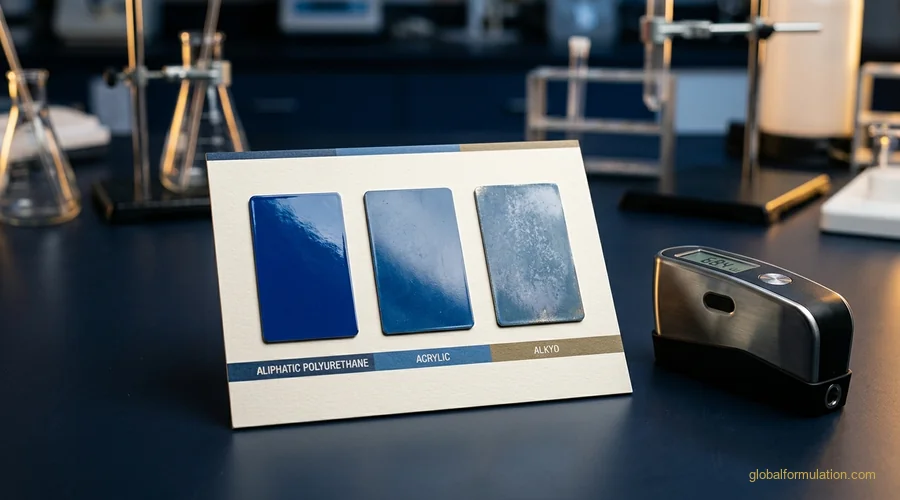
Not every resin class degrades at the same rate under identical UV exposure, and resin selection is frequently the single largest lever available for gloss retention performance. Aliphatic polyurethane and high-durability acrylic systems resist chain scission far better than standard alkyd or aromatic polyurethane chemistries, because their backbone structures either lack the UV-absorbing chromophores that trigger degradation or place them in positions less prone to scission. Aromatic polyurethane and epoxy topcoats, while excellent for chemical and mechanical resistance, are particularly prone to rapid gloss loss and yellowing in direct, unprotected exterior UV exposure — a trade-off that should be a deliberate formulation decision, not an oversight.
Pigment Volume Concentration and Surface Exposure
The ratio of pigment to binder at the coating surface strongly influences how quickly chalking becomes visually apparent once photodegradation begins. A formulation with pigment volume concentration pushed close to or above the critical pigment volume concentration for that binder system leaves less resin available to encapsulate each pigment particle, so pigment reaches the exposed surface sooner as the thin resin layer above it erodes. This is one reason two coatings sharing the identical pigment and resin chemistry can show meaningfully different gloss retention timelines in the field.
Environmental Load: UV Intensity, Temperature, and Moisture Cycling
UV intensity varies substantially with latitude, altitude, and local atmospheric clarity, so identical coatings applied in a high-UV, high-altitude environment will lose gloss on a materially faster timeline than the same product in a temperate, lower-UV climate. Temperature cycling accelerates degradation further by inducing repeated thermal expansion and contraction stress in the film, which can open microscopic surface cracks that increase the effective area exposed to further UV and moisture attack. Humidity and condensation cycling compound this by hydrolysing certain resin chemistries at the same time UV drives oxidative chain scission, producing a combined degradation rate faster than either mechanism alone would predict.
| Mechanism | Typical Visual Signature | Primary Driver | Resin Sensitivity |
|---|---|---|---|
| UV photooxidation | Progressive dulling, loss of specular reflection | UV-B photon energy | All organic resins, degree varies |
| Chalking | Powdery white residue, wipe-off pigment | Surface binder erosion | Higher in high-PVC, lower-durability binders |
| Resin chemistry mismatch | Rapid early gloss loss versus comparable products | Chromophore-rich backbone | Aromatic polyurethane, standard alkyd most sensitive |
| High pigment volume concentration | Faster chalking onset at the same UV dose | Reduced binder encapsulation depth | Formulation-dependent |
| Environmental load | Accelerated timeline versus lab predictions | UV intensity, thermal and humidity cycling | All systems, severity climate-dependent |
None of these mechanisms acts alone in the field. A coating with borderline resin durability, moderate PVC, and high-UV service exposure fails faster than any single factor would suggest — which is exactly why diagnosis has to separate them rather than guess.
Diagnosis: How to Confirm the Root Cause of Gloss Retention Loss
Confirming why a coating has lost gloss is not optional groundwork — it determines whether the fix belongs in the resin system, the pigment loading, the UV stabiliser package, or nowhere in the formulation at all. The most common diagnostic error is assuming visible dulling is chalking without first ruling out simple atmospheric soiling, which cleans off completely and needs no reformulation whatsoever. A short, structured sequence of field and lab checks resolves the great majority of cases without specialised equipment.
Step 1 — The Wash and Wipe Test
Before assuming any resin degradation, wash a representative area with water and a soft cloth and compare it against an adjacent unwashed area. If gloss and colour largely return after washing, the loss is substantially or entirely surface soiling rather than resin breakdown, and no reformulation is warranted. Persistent dulling after a thorough wash confirms the mechanism is happening within or at the coating film itself.
Step 2 — 60-Degree Gloss Measurement Against a Reference
Measure gloss at 60 degrees using a calibrated glossmeter on the exposed surface and compare the reading against an unexposed reference area of the same coating — commonly found under a mounting bracket, sign, or overlap joint shielded from UV since application. Document the percentage gloss retained relative to the original specification value rather than relying on visual judgement alone, since the eye is a poor instrument for quantifying gradual change. A gloss retention curve built from readings taken at defined intervals gives a far more reliable early warning than waiting for a single dramatic-looking inspection.
Step 3 — Chalk Rating by Tape or Finger Wipe
Firmly wipe a clean finger or a strip of dark adhesive tape across the exposed surface and assess the amount and colour of transferred residue against a standard chalk rating scale. A heavy, easily transferred chalk layer confirms active binder erosion at the surface and correlates strongly with accelerated gloss loss going forward, even in areas where gloss has not yet dropped dramatically. Comparing chalk ratings across different orientations of the same structure — south-facing versus north-facing surfaces, for example — often reveals the UV-intensity dependence of the failure directly.
Step 4 — FTIR Surface Analysis for Oxidation Confirmation
Where the mechanism needs confirmation beyond visual and gloss data, Fourier-transform infrared spectroscopy on a thin surface scraping or the intact film surface detects the carbonyl absorption peak that forms as UV-driven photooxidation converts resin backbone carbon into oxidised carbonyl groups. A rising carbonyl index compared against an unexposed reference sample is direct chemical evidence of photooxidative degradation, distinguishing it conclusively from other causes of surface dulling such as incompatible topcoat overspray or contamination.
Step 5 — Cross-Reference Against Resin Type and PVC
Once a genuine resin degradation mechanism is confirmed, cross-check the coating's documented resin chemistry and pigment volume concentration against known durability performance for that class of binder. A standard alkyd or aromatic polyurethane losing gloss within the expected timeline for its chemistry is a formulation-selection issue rather than a manufacturing defect, while a premium aliphatic polyurethane failing well ahead of its expected durability curve points toward a UV stabiliser deficiency, a PVC formulation error, or an application defect such as inadequate film thickness.
Once the mechanism is pinned down — soiling, chalking-driven erosion, oxidative resin breakdown, or a formulation mismatch — the corrective path becomes far narrower and far more likely to actually work on the next batch.
Solution Strategies: Corrective Approaches to Gloss Retention Loss
Correcting gloss retention loss means addressing whichever mechanism the diagnosis actually confirmed, not defaulting to a blanket increase in UV stabiliser dosing or a resin supplier switch without cause. The wrong fix — reformulating pigment loading, say, when the true problem is an under-stabilised resin — wastes development cycles while the underlying failure keeps recurring. The strategies below map to the root causes identified earlier and focus on the mechanism, not the symptom.
Strengthening the UV Stabiliser Package
Where oxidative resin breakdown is confirmed, the corrective focus shifts to the hindered amine light stabiliser and UV absorber system protecting the binder. HALS chemistry works by scavenging the free radicals generated during photooxidation before they can propagate further chain scission, while UV absorbers work upstream by intercepting UV photons before they reach the resin backbone at all — the two mechanisms are complementary rather than interchangeable, and a well-designed stabiliser package typically uses both. Matching stabiliser class and loading to the specific resin chemistry and expected UV exposure severity, rather than using a generic default package, materially changes real-world gloss retention performance.
Resin Chemistry and Topcoat Selection
Where the diagnosis points to an inherently UV-sensitive resin chemistry being pushed beyond its realistic service life, the more durable long-term correction is selecting a resin class with better intrinsic UV resistance for the specific exposure conditions — aliphatic over aromatic polyurethane, or a premium acrylic over a standard alkyd, for applications with defined gloss retention warranties. For projects where the base coat chemistry cannot be changed for cost, colour, or performance reasons, applying a high-durability clear topcoat with its own dedicated UV stabiliser package protects the underlying colour coat from direct UV exposure.
Adjusting Pigment Volume Concentration and Formulation Balance
Where high pigment volume concentration is contributing to premature chalking, reducing PVC relative to the binder's critical pigment volume concentration increases the depth of resin available to encapsulate pigment particles before surface erosion exposes them. This adjustment interacts with cost, opacity, and colour strength, so it is rarely a free change — but for applications carrying a defined gloss retention specification, formulating with adequate margin below the critical PVC threshold is frequently cheaper than the warranty exposure of not doing so.
Application and Film Thickness Correction
Because UV degradation works from the exposed surface inward, an under-built film reaches full-depth degradation and exposes intact substrate-adjacent resin far sooner than a properly specified film thickness would allow. Verifying that applied dry film thickness meets or exceeds specification — not just at spot checks but across edges, corners, and other geometrically difficult areas prone to thin application — closes a surprisingly common gap between a coating's laboratory-tested gloss retention performance and its field results.
Getting the fix right on paper is only half the job. Preventing the same failure from recurring on the next production run or the next project depends on the process controls covered next.
Prevention: Process Controls and Formulation Strategies to Avoid Recurrence
Preventing gloss retention failures is dramatically cheaper than remediating a coating that has already failed a warranty inspection, and it depends on validating gloss durability before a formulation ever reaches full-scale production. A credible prevention programme treats gloss retention as a designed, tested property tied to specific resin, pigment, and stabiliser choices — not an assumption based on how glossy the coating looks the day it cures.
Accelerated weathering testing, run and interpreted correctly, is the single most valuable prevention tool available, but only when its results are validated against real-world field performance for the relevant climate and exposure geometry rather than treated as an absolute predictor on its own.
- Accelerated weathering validation — run QUV or xenon-arc accelerated weathering matched to the coating's expected exposure profile, and correlate results against known field performance benchmarks for similar formulations before relying on lab data alone.
- UV stabiliser certificate verification — confirm HALS and UV absorber grade, loading, and supplier certificate of analysis on every incoming batch, since substitution or under-dosing at the raw material level is a common, easily missed root cause.
- Dry film thickness control — verify applied film thickness meets specification across the full geometry of the coated part, with particular attention to edges and corners prone to thin coverage.
- Gloss retention benchmarking against resin class — set realistic gloss retention targets tied to the specific resin chemistry selected, rather than applying a single blanket specification across chemically different product lines.
Formulation Qualification Before Launch
Before a new formulation reaches production, qualifying it against an established accelerated weathering protocol with defined pass/fail gloss retention thresholds at intermediate exposure intervals catches UV stabiliser and resin durability shortfalls long before field failures accumulate. Running this qualification against the specific climate zone and orientation the product will realistically see in service, rather than a single generic accelerated test, closes the gap between laboratory confidence and field performance that catches many otherwise well-designed formulations.
Ongoing Field Monitoring
For coatings carrying formal gloss retention warranties, periodic field gloss measurement on a representative sample of installed projects — not just complaint-driven inspection — surfaces early-stage degradation trends while there is still time to adjust upcoming production batches or catch a raw material substitution before it becomes a widespread field issue.
A formulation validated this way rarely produces the kind of surprise gloss failure that turns into a warranty dispute. Even well-controlled programmes, though, eventually hit cases that need outside expertise.
When to Escalate to a Specialist
Most gloss retention issues resolve once the physical-versus-chemical distinction is clear and the corresponding stabiliser, resin, or process correction is applied. Certain situations, though, exceed what routine in-house diagnosis and reformulation can reliably resolve.
Escalate when accelerated weathering data and field performance diverge significantly despite a properly run test protocol, since this usually signals that the accelerated test method itself is not correlating well with the coating's real exposure conditions — a problem that needs specialised weathering expertise to resolve rather than further formulation trial and error. Escalate as well when a gloss retention failure appears only at full production scale and cannot be reproduced in laboratory batches, which often points to a process variable such as cure conditions or raw material lot variation that needs direct process investigation.
Products carrying a formally specified, long-duration gloss retention warranty — the kind written into architectural or industrial coating specifications — warrant specialist-level investigation and documentation from the first sign of trouble, because the cost of an unresolved recurrence across a multi-year warranty period is materially higher than the cost of getting the diagnosis right the first time.
Gloss retention loss in exterior coatings is solvable once the specific mechanism — UV photooxidation, PVC-driven chalking, resin chemistry mismatch, or environmental overload — has been correctly separated from simple surface soiling. For related defect analysis, explore Global Formulation's guide to anti-graffiti coating technology and formulation and the comparison of polyurethane versus epoxy coatings, where UV resistance is a central selection criterion, or return to the paints and coatings knowledge hub. For gloss measurement methodology, ISO 2813 defines the 20°, 60°, and 85° gloss geometries referenced throughout this article, and the Association for Materials Protection and Performance (AMPP) maintains field assessment guidance relevant to coating degradation investigations.