Precast Concrete Grout: Non-Shrink Grouting Guide
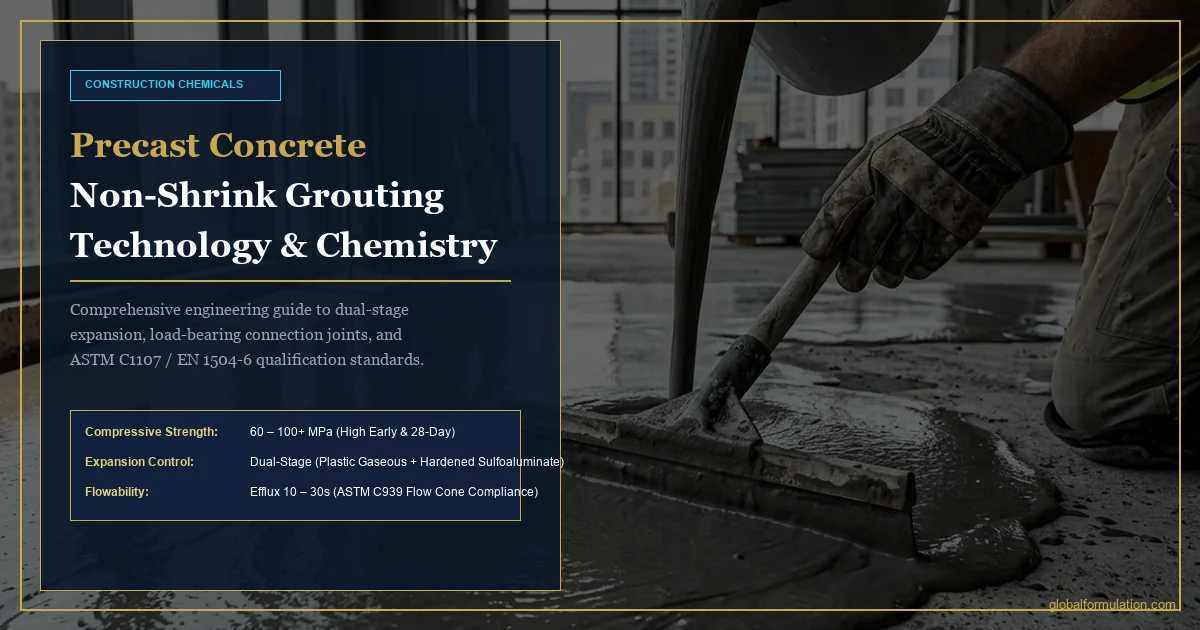
A precast beam that arrives on site with perfect factory tolerances can still fail its connection the moment an under-specified grout shrinks away from the bearing surface, leaving a gap no engineer accounted for in the load path. Precast construction depends on grouted connections to transfer structural load between elements that were cast separately, often weeks or months apart, and that connection is only as reliable as the grout filling it. Choosing the right precast concrete grout means understanding why ordinary concrete or mortar cannot do this job — plain cementitious mixes shrink as they cure, pulling away from the very surfaces they're meant to bond. This guide works through non-shrink grout chemistry, how expansive additive systems counteract drying shrinkage, and the placement and testing practices that determine whether a connection performs for the life of the structure. Whether specifying grout for a precast panel system, a column base plate, or a bridge girder connection, the underlying expansion mechanism and strength-development timeline drive nearly every decision that follows.
Why Connection Grout Is a Structural Element
Grout in a precast connection isn't a cosmetic filler — it's load-bearing material sitting directly in the structural path between two precast elements, and its performance determines whether design loads actually transfer the way the engineer calculated. A connection is only as strong as its weakest material, and an underperforming grout can undermine an otherwise well-engineered precast system regardless of how much care went into the panel or beam design itself.
- Load transfer — grout carries compressive, and sometimes shear, forces directly between bearing surfaces, making its strength and full-contact fill a structural requirement, not a finishing detail
- Dimensional tolerance absorption — precast elements are manufactured with small dimensional variances, and grout fills the resulting gap while maintaining correct final elevation and alignment
- Construction schedule impact — grout strength-gain speed often governs how quickly cranes can be released and subsequent trades can proceed, directly affecting project timelines
- Long-term durability — a poorly filled or shrinkage-cracked grout joint becomes a water-entry and corrosion-initiation point for embedded reinforcement over the structure's service life
Every one of these performance requirements traces back to a single chemistry decision: how the grout manages its own volume change as it cures, which is exactly where non-shrink formulation begins.
Non-Shrink Chemistry: Expansion Mechanisms
Every cementitious material shrinks to some degree as it hydrates and dries — it's an unavoidable consequence of the hydration reaction and moisture loss from the cement paste. Non-shrink grout doesn't eliminate that underlying shrinkage tendency; it counteracts it with a deliberate, engineered expansion mechanism calibrated to offset the shrinkage and leave the grout dimensionally stable or slightly expanded once fully cured. Understanding which expansion mechanism a given product uses explains a great deal about how it needs to be handled on site.
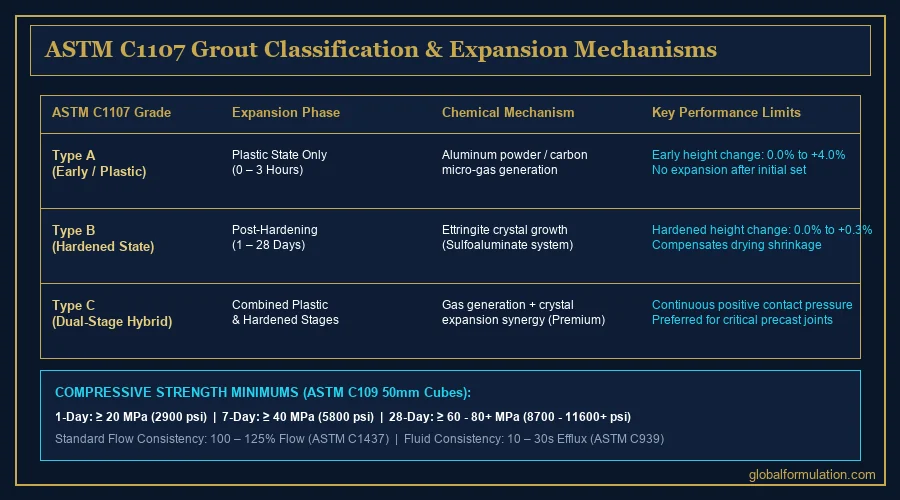
- Gas-releasing (metallic) expansion systems — finely divided aluminum powder reacts with alkaline pore solution to generate tiny hydrogen gas bubbles during the plastic stage, producing controlled expansion before the grout sets
- Expansive cementitious compounds — calcium sulfoaluminate or similar expansive clinker components generate expansion through crystal growth (ettringite formation) during early hydration, offering more temperature-stable expansion than gas-release systems
- Timing sensitivity — expansion has to occur while the grout is still plastic enough to accommodate volume change but has enough early cohesion to contain the expansive force without excessive bleeding or segregation
- Restrained vs. unrestrained expansion — a grout confined within a narrow connection cavity expands differently than the same product tested unrestrained in a laboratory mold, which is why field mock-ups matter for critical connections
Getting the expansion chemistry right solves the dimensional-stability half of the problem; the other half is making sure the grout actually flows into and fills every void in the connection, which is a consistency and placement question.
Flow Consistency & Strength Development
A non-shrink grout has to satisfy two competing demands at once: flow readily enough to fill a narrow, often congested connection cavity without vibration, and develop enough early strength to let the project keep moving on schedule. Both properties are controlled largely through water dosing and mix design within the manufacturer's specified range, and both are frequently misjudged in the field under pressure to speed up placement.
- Flowable consistency — high-slump, self-leveling mix used for confined or hard-to-access joints; relies on gravity and head pressure rather than mechanical consolidation to fill the space
- Plastic (stiff) consistency — lower-slump mix packed or rammed into larger, more accessible bedding areas such as column base plates
- Water dosing discipline — adding water beyond the specified range to improve flow is the single most common field error, and it degrades both compressive strength and the calibrated expansion behavior simultaneously
- Rapid early-strength formulations — fine cement particle-size distribution, accelerating admixtures, and sometimes supplementary cementitious materials allow some proprietary grouts to reach handling strength within a few hours
A grout mixed correctly still has to be placed correctly, and the difference between a laboratory-perfect formulation and a field failure often comes down to how the connection joint itself was designed and prepared before the grout ever arrived.
Joint Design & Placement Practice
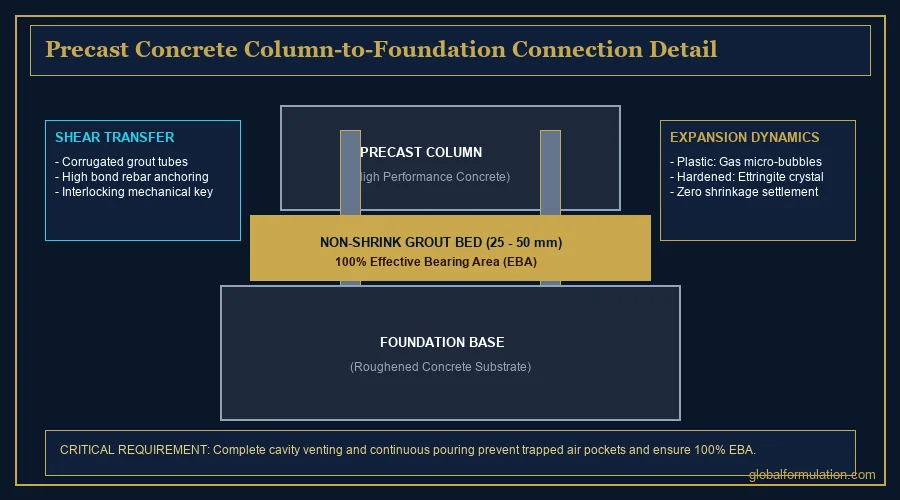
Even a perfectly formulated grout fails if the connection it's poured into wasn't designed and prepared to receive it. Joint width, venting, and surface condition are decided long before the grout truck or bag arrives on site, and retrofitting a placement plan after a connection is already cast is far harder than designing it correctly from the start. Our construction chemicals consultancy work regularly involves reviewing joint details specifically for grout placement feasibility before formwork is finalized.
| Design factor | Requirement | Consequence if ignored |
|---|---|---|
| Joint width | Wide enough for grout aggregate size and flow, per manufacturer minimums | Bridging, incomplete fill, or trapped air pockets |
| Surface preparation | Bearing surfaces clean, sound, and saturated surface-dry before placement | Poor bond, laitance-related weak zones |
| Venting/head pressure | Adequate pour head and vent points to force air and bleed water out ahead of the grout front | Trapped voids reducing effective bearing area |
| Formwork sealing | Leak-tight forms rated for the grout's hydrostatic pressure during pour | Grout loss, honeycombing, uneven fill |
Correct placement gets the grout into the joint; confirming it actually performs to specification is a separate step handled through standardized testing, which is where the industry's test standards come in.
Test Standards & Specification
Non-shrink grout performance isn't judged by appearance or by the manufacturer's marketing claims — it's verified against standardized test methods that measure compressive strength, expansion, and flow consistency under controlled, repeatable conditions. Specifying grout by referencing the correct standard, rather than a generic "non-shrink" description, is what lets an engineer hold a supplier accountable to a measurable performance benchmark.
- ASTM C1107 — the primary U.S. specification for packaged, dry, hydraulic-cement non-shrink grout, defining compressive strength requirements across flow consistencies
- ASTM C827 — the change-in-height (expansion) test method used to verify early-age expansion performance
- ASTM C939 / C1611 — flow consistency measurement methods (flow cone and flow table, respectively) depending on grout type
- EN 1504-6 — the European standard for structural anchoring and connection grouts within the broader EN 1504 concrete repair standards series
A grout that passes every laboratory standard can still underperform in the field if it was mishandled during mixing or placement, which is why quality control has to extend from the specification sheet all the way to the jobsite.
Common Failure Modes & Quality Control
Most precast grout connection failures trace back to a small, recurring set of root causes rather than an exotic or unpredictable chemistry problem. Recognizing these failure modes ahead of time lets a project team build quality-control checkpoints that catch the error before the grout sets, rather than discovering it after a connection is already load-bearing.
- Inadequate surface preparation — laitance, dust, oil, or standing water on bearing surfaces prevents proper bond regardless of grout quality
- Incorrect water dosing — over-watering to improve flow reduces strength and disrupts the calibrated expansion behavior simultaneously
- Trapped air voids — inadequate venting or insufficient head pressure during placement leaves unfilled pockets in the bearing area
- Out-of-range temperature placement — pouring outside a product's specified temperature window without switching to a cold- or hot-weather formulation shifts both strength gain and expansion timing
The decision framework, condensed: select the expansion chemistry appropriate for the temperature range and connection geometry, respect the manufacturer's water and flow specifications without exception, and verify performance against the correct ASTM or EN standard rather than a generic claim. Our guide to repair mortars for concrete restoration and our grout and tile adhesive rheology guide both build on the same rheology and cure-chemistry principles covered here.
Frequently Asked Questions
What makes a grout "non-shrink" rather than just a strong concrete mix?
A non-shrink grout contains an expansive additive system, most commonly gas-releasing metallic powders or expansive cementitious compounds, engineered to counteract the natural drying shrinkage that occurs as any cement-based material cures. Ordinary high-strength concrete or mortar still shrinks as it dries and can pull away from the surrounding precast elements, leaving a gap that compromises load transfer.
Non-shrink grout is formulated so its controlled expansion during the plastic and early hardening stage offsets that shrinkage, keeping the grout in full, continuous contact with both connecting surfaces.
How does temperature affect grout expansion and strength development?
Gas-releasing expansive systems are temperature-sensitive because the chemical reaction generating expansion gas speeds up in warm conditions and slows dramatically in cold weather, which can shift the timing and magnitude of expansion relative to when the grout has enough early strength to safely contain it.
Manufacturers typically publish separate application temperature ranges and, for cold-weather projects, may specify accelerated or winter-grade formulations. Strength development itself also slows in cold temperatures under normal cement hydration kinetics, independent of the expansion mechanism, so both effects have to be accounted for together on a cold-weather pour.
What's the difference between flowable and plastic (stiff) grout consistency?
Flowable grout is mixed to a high-slump, self-leveling consistency that can be poured into a confined connection cavity and flow under its own weight to fully fill the space without vibration, which is essential for narrow or hard-to-access precast joints.
Plastic or stiff-consistency grout is mixed drier and is packed or rammed into place, typically used for larger bedding areas like column base plates where formwork can contain a less fluid mix. The same base grout product can often be mixed to either consistency within the manufacturer's specified water range, but flowability and strength trade off against each other as more water is added.
Why do precast connection grouts need such high early compressive strength?
Precast construction schedules are built around rapid sequencing — cranes, formwork, and following trades often need the connection to carry load again within hours, not the 28 days a standard concrete mix design assumes.
High-early-strength grout formulations use fine cement particle-size distributions, accelerating admixtures, and sometimes supplementary cementitious materials engineered specifically for rapid strength gain, allowing a connection to reach handling or service load capacity in as little as one to three hours in some proprietary rapid-strength products, and reliably within 24 hours for most standard non-shrink grouts.
Can epoxy grout be used instead of cementitious grout for precast connections?
Epoxy grouts are used in precast connections where chemical resistance, very high strength, or minimal cure shrinkage in thin sections is required, such as under heavily loaded machine base plates or in aggressive chemical exposure environments.
They cost significantly more than cementitious non-shrink grout and their working time is temperature-sensitive, but they don't rely on water-cement hydration for strength and can achieve very rapid, very high strength development. For the majority of standard precast panel and beam connections, cementitious non-shrink grout is specified because it's more economical and easier for field crews to place at scale.
How is grout bearing area and bleed water managed in a precast connection?
The grout must achieve full, void-free contact across the entire designed bearing area, since any unfilled void directly reduces the load-transfer surface between the two precast elements and creates a stress concentration point.
Bleed water — water that separates and rises to the surface of a cementitious mix before setting — can create voids or a weak laitance layer if it becomes trapped beneath the top precast element. Non-shrink grout formulations are engineered with controlled bleed characteristics, and correct placement technique, including adequate head pressure and proper venting, is used to force air and excess bleed water out ahead of the advancing grout front.
What test standards apply to precast connection grout?
In the United States, ASTM C1107 is the primary specification for packaged, dry, hydraulic-cement grout (non-shrink), defining compressive strength requirements across flow consistencies and expansion limits. ASTM C827 covers the change-in-height (expansion) test method for early-age grout, and ASTM C939 or C1611 address flow consistency measurement depending on the grout type.
European projects typically reference EN 1504-6 for structural connection grouts within the broader EN 1504 concrete repair standards series, with national annexes adding local requirements.
What causes a precast grout connection to fail after installation?
The most common field failures trace back to inadequate surface preparation — laitance, dust, or standing water left on the precast bearing surfaces before grouting — which prevents proper bond even when the grout itself performs to specification. Incorrect water dosing is the second major cause: adding water beyond the manufacturer's specified range to improve flowability sharply reduces both strength and the engineered expansion characteristics.
Trapped air voids from inadequate venting or head pressure, and grouting outside the product's specified temperature range without adjusting the formulation, round out the most frequent root causes seen in forensic investigations of connection failures.
Formulating or Specifying Precast Connection Grout?
Global Formulation provides construction chemicals consultancy — non-shrink grout formulation, expansion-system selection, and manufacturing scale-up support for precast and specialty grout manufacturers.
Talk to Our Formulation Team