Homogeneous vs Heterogeneous Catalysis in Specialty Chemical Manufacture
A process chemist develops an elegant homogeneous route that hits 98% conversion and near-perfect selectivity in the lab, then discovers at pilot scale that recovering the dissolved metal catalyst costs more than the product is worth. The opposite failure happens just as often: a team switches to a heterogeneous catalyst for easy filtration and finds the fixed-bed reactor gives lower selectivity than anyone budgeted for. Homogeneous vs heterogeneous catalysis is not a preference — it is a decision with direct consequences for recovery cost, product purity, reactor design, and whether the process can even be operated continuously. Getting it wrong is expensive precisely because it surfaces late, after a route has already been optimised around the wrong catalyst phase. This guide sets out what genuinely separates the two approaches, where each earns its place in specialty chemical manufacture, and a sequence for choosing between them before, not after, a process is committed to paper. It reflects the same reasoning we apply in our chemical reaction engineering work.
The Core Distinction: Phase, Not Just Chemistry
The terms homogeneous and heterogeneous catalysis describe a physical fact before they describe any chemistry: whether the catalyst occupies the same phase as the reactants or a different one, a distinction IUPAC nomenclature defines by phase boundary rather than by mechanism. A homogeneous catalyst is dissolved in the liquid reaction mixture alongside everything else — commonly a soluble transition-metal complex with organic ligands. A heterogeneous catalyst is a distinct solid phase, most often a metal or metal oxide dispersed across a porous support such as alumina, silica or activated carbon, with the reaction occurring at the solid's surface.
That phase difference cascades into almost every practical distinction that follows. A dissolved catalyst has every active site equally accessible to reactants diffusing freely through solution, so its kinetics tend to follow straightforward solution chemistry and its activity is well-defined and reproducible from batch to batch. A solid catalyst's activity depends additionally on how effectively reactants reach the surface — through the boundary layer around a particle and into its pores — so mass transfer becomes part of the kinetic picture, not just the intrinsic chemistry.
The distinction also sets up the central trade-off that runs through the rest of this guide: homogeneous systems tend to win on activity and selectivity per unit of catalyst, while heterogeneous systems tend to win on recoverability and reactor simplicity. Understanding why requires looking at each in turn.
Homogeneous Catalysis: Precision at the Cost of Recovery
Homogeneous catalysts dominate reactions demanding tight stereochemical or regiochemical control, because every molecule of catalyst presents an identical, well-defined coordination environment to the substrate. Asymmetric hydrogenation, many carbon-carbon coupling reactions, and a large share of fine chemical and pharmaceutical intermediate synthesis rely on soluble metal complexes for exactly this reason — the selectivity a well-designed ligand system delivers is difficult to match with a solid surface presenting a distribution of site geometries.
The cost of that precision is separation. A dissolved catalyst cannot be filtered out; it has to be removed through a genuine unit operation — distillation if the product is more volatile and thermally stable, extraction into an aqueous or immiscible phase, precipitation, or adsorption onto a scavenging resin. Each route adds process steps, can strip yield, and rarely recovers catalyst at full original activity, which is why many homogeneous processes are run as single-use rather than recycled. Where the metal itself is expensive — rhodium, palladium and ruthenium complexes are common examples — that economics can dominate the entire process cost structure.
Residual metal in the product is the other persistent concern. Even efficient separation steps leave trace catalyst behind, and for pharmaceutical and many specialty applications that residue has to be measured and controlled against a specification, not assumed compliant because the separation step is designed to work. ICP-MS is the standard analytical method for confirming metal levels are within limits.
Heterogeneous Catalysis: Recoverable, but Diffusion-Limited
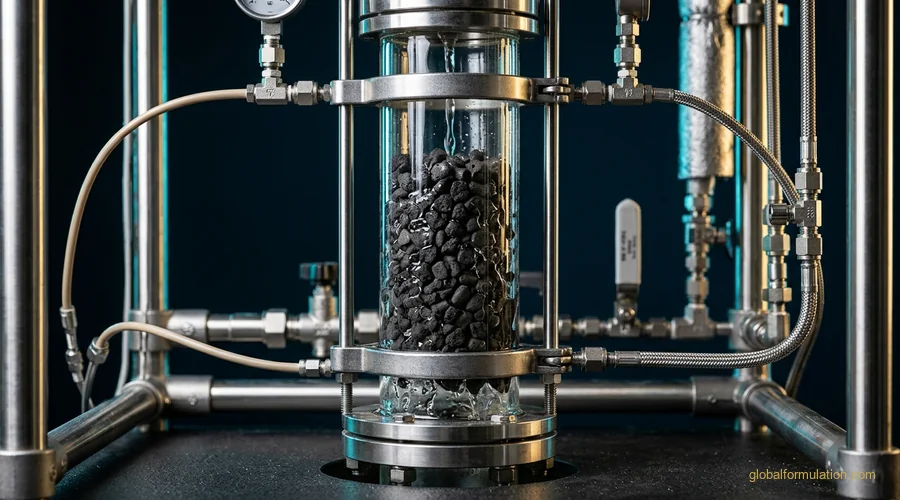
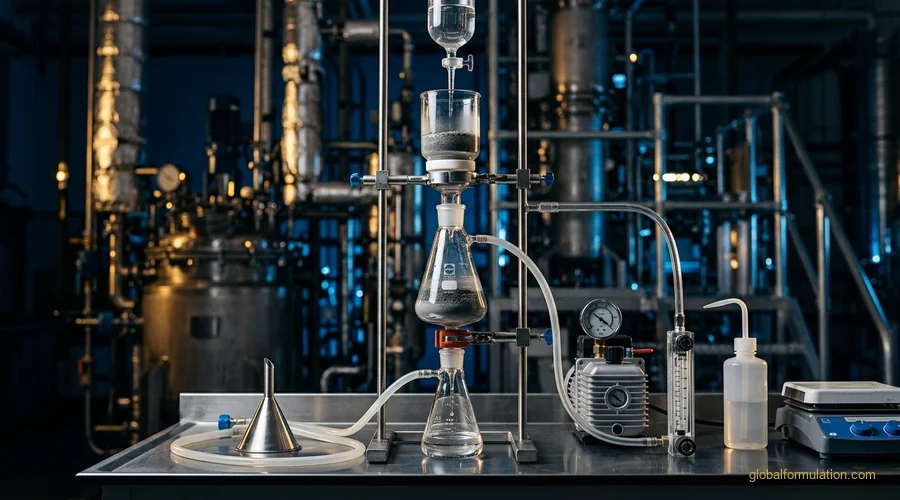
Heterogeneous catalysts are chosen first and foremost for what happens after the reaction: the solid can be removed from a liquid or gas product stream by filtration, or simply left behind when the reactor's fixed bed is drained, with no distillation or extraction step required. That single advantage explains why heterogeneous catalysis dominates continuous and large-volume specialty processes, where repeated homogeneous-style separation would be uneconomic at throughput.
The trade-off is that a solid catalyst's performance now depends on transport as well as chemistry. Reactants have to diffuse to the external particle surface and then into its internal pore structure before reaction can occur, and if that diffusion is slower than the intrinsic surface reaction, the process becomes mass-transfer limited rather than kinetically limited — a distinction covered in depth in our guide to reaction engineering fundamentals. Under those conditions, measured activity says more about particle size and pore geometry than about the catalyst's true chemical potential, and simply switching to a more active catalyst formulation may deliver no improvement at all.
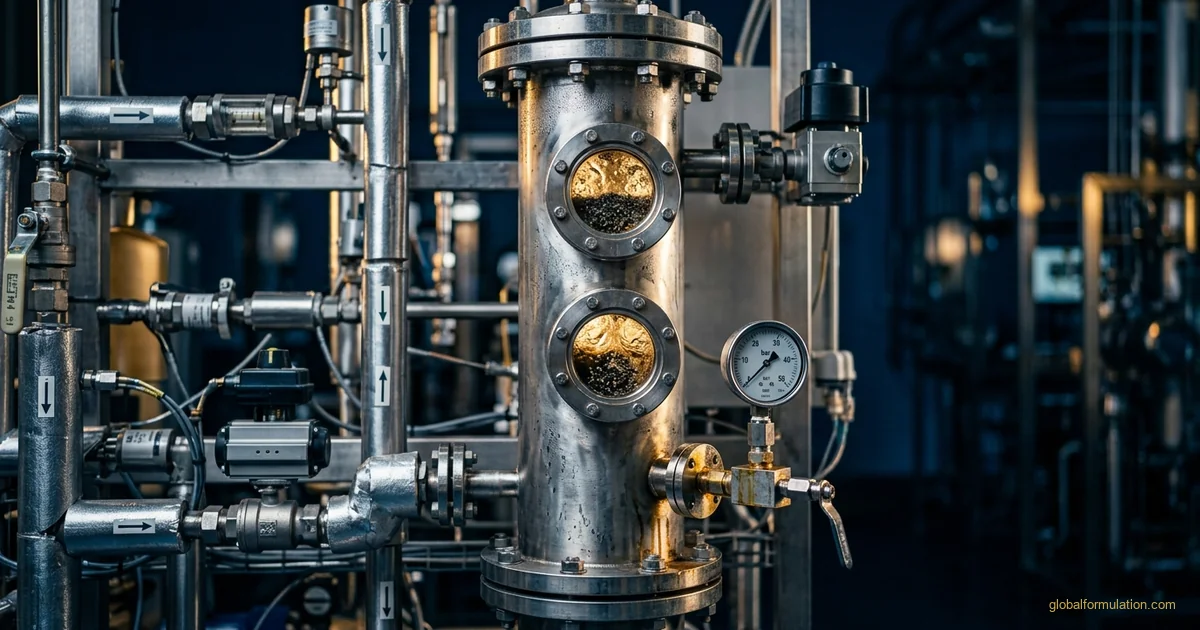
Reactor configuration also becomes a live design choice. Fixed-bed reactors suit robust, non-fouling reactions and are straightforward to operate continuously, but they concentrate all catalyst in one location, so channelling or local deactivation can go undetected. Slurry-phase reactors — a fine catalyst powder suspended in the liquid — offer better mass transfer and easier temperature control but require an additional filtration step to separate catalyst from product, partially eroding the recovery advantage that motivated the heterogeneous choice in the first place.
Catalyst leaching is the failure mode that erodes this advantage silently. Under certain solvents, temperatures, or in the presence of coordinating ligands or acids, active metal can strip from the support into the liquid phase, so the catalyst starts behaving like a slowly forming homogeneous system — metal appears in the product, and the fixed bed loses activity over successive runs. Testing leaching under real process conditions, not just fresh-catalyst performance, is essential before scaling a heterogeneous route.
Homogeneous vs Heterogeneous: Direct Comparison
Set side by side, the two approaches trade the same handful of properties in opposite directions, and no single row in the table below should be read in isolation — a process is rarely won or lost on one criterion alone. The comparison is most useful as a checklist against a specific reaction's actual constraints.
| Criterion | Homogeneous | Heterogeneous |
|---|---|---|
| Active site uniformity | High — every molecule identical | Variable — distribution across support |
| Typical selectivity | Often excellent, especially stereochemistry | Reaction-dependent; can match with careful design |
| Catalyst recovery method | Distillation, extraction, precipitation | Filtration or bed drainage |
| Recovery cost at scale | High — dedicated unit operation | Low — mechanical separation |
| Residual metal risk | Higher — dissolved throughout product | Lower, unless leaching occurs |
| Rate-limiting factor | Intrinsic reaction kinetics | Often mass transfer to/within particle |
| Suitability for continuous operation | Difficult without immobilisation | Well suited — fixed or moving bed |
| Catalyst reuse | Limited, often single-use | Reusable until deactivated or leached |
The pattern is consistent enough to act as a first filter: reactions demanding maximum selectivity per catalyst molecule lean homogeneous, and processes demanding low-cost recovery at continuous scale lean heterogeneous. Where both matter equally, the next section covers the approach built specifically to bridge them.
Bridging the Two: Immobilised and Supported Catalysts
Catalyst immobilisation anchors a homogeneous-style active species onto a solid support — silica, polymer beads, or porous carbon are common choices — so it behaves like a heterogeneous catalyst for separation purposes while aiming to retain the parent complex's molecular selectivity. The appeal is obvious: recover it by filtration, but keep the precision of a well-defined coordination environment.
In practice immobilisation rarely reproduces homogeneous performance exactly. Anchoring can restrict the catalyst's conformational freedom, slow reactant access to the active site through the support's pore network, and create a population of sites with more variable activity than the original soluble species had — the same mass-transfer and site-uniformity issues that affect any heterogeneous catalyst, layered on top of the immobilisation chemistry itself. Leaching risk does not disappear either; a poorly anchored complex can detach from its support under process conditions just as readily as metal can strip from a conventional heterogeneous catalyst.
Immobilised catalysts earn their place when a process genuinely needs both properties and the economics justify the added catalyst development cost — commonly in pharmaceutical intermediate manufacture, where a difficult asymmetric transformation has to run at scale without an expensive homogeneous separation train. They are rarely the first catalyst screened; they are what a process moves to after conventional homogeneous and heterogeneous options have both been evaluated and found wanting on their own.
Where Catalysis Selection Goes Wrong
Catalysis decisions made early in development rarely get revisited with the same rigour once a route is working, which is exactly when the mistakes below become expensive rather than merely inconvenient.
- Optimising lab-scale selectivity without costing recovery — choosing a homogeneous catalyst purely on conversion and selectivity data, then discovering at pilot scale that separation economics make the route unviable.
- Assuming fresh-catalyst activity holds at scale — heterogeneous catalyst performance measured on fresh material rarely accounts for leaching, fouling, or pore diffusion limitation that only appears at larger particle loadings and longer run times.
- Ignoring mass transfer in heterogeneous screening — comparing catalyst formulations under conditions where the reaction is diffusion-limited rather than kinetically limited, which measures particle geometry rather than true catalytic potential.
- Treating immobilisation as a free upgrade — assuming an immobilised catalyst will match its homogeneous parent's selectivity without verifying it experimentally under real process conditions.
- Underestimating residual metal specifications — designing a separation train around expected efficiency rather than measured output, particularly costly for pharmaceutical and food-contact applications with strict metal limits.
- Skipping leaching tests under solvent and temperature extremes — validating a heterogeneous catalyst only under mild screening conditions, then encountering leaching once the process runs at its actual operating temperature or with its actual solvent system.
Each of these is a case of testing the catalyst under conditions that do not represent how it will actually be used — a gap that a modest pilot campaign closes far more cheaply than a failed plant campaign does.
A Practical Decision Framework
Choosing between homogeneous and heterogeneous catalysis is best worked as a sequence of questions rather than a single trade-off, because early answers often eliminate one branch entirely before cost enters the discussion.
- Does the chemistry demand precise stereochemical or regiochemical control? If yes, start with homogeneous options and test whether an immobilised version can later capture the same selectivity.
- Will the process run continuously or at high annual volume? Continuous operation strongly favours heterogeneous or immobilised catalysts, since repeated homogeneous-style recovery does not scale economically.
- What does the product's residual metal specification require? A tight specification raises the bar for any homogeneous route and makes leaching testing non-negotiable for a heterogeneous one.
- Test for mass-transfer limitation before comparing heterogeneous catalyst formulations. Confirm the reaction is kinetically, not diffusion, limited before drawing conclusions about which catalyst is more active.
- Run leaching and recovery trials under actual process conditions — solvent, temperature, and reaction time as they will genuinely be operated, not the mild conditions typical of initial screening.
- Cost the full separation train, not just the catalyst. Compare homogeneous recovery cost against heterogeneous filtration and catalyst replacement cost over the process's real operating life.
Most specialty processes end up making this decision earlier than teams expect — often before the reaction chemistry itself is fully optimised — because catalyst phase constrains which reactor configurations and separation trains are even viable. Working through the sequence above before committing to a route is what keeps that constraint from surfacing as an expensive surprise at pilot scale. If you're evaluating a catalysis route for a new process, our process consulting practice covers exactly this kind of route selection, and our scale-up support service picks up once a catalyst has been chosen and needs validating at pilot scale.
Materials selection for the reactor itself also depends on which catalyst phase is chosen — a fixed-bed system and a stirred homogeneous reactor place different demands on vessel internals and corrosion resistance, which our guide to reactor design and materials covers in more detail.
Frequently Asked Questions
What is the difference between homogeneous and heterogeneous catalysis?
In homogeneous catalysis the catalyst is dissolved in the same phase as the reactants, typically as a soluble metal complex in the liquid reaction mixture, so every catalyst site is equally accessible and reaction rates tend to be high and predictable from solution kinetics. In heterogeneous catalysis the catalyst exists as a separate solid phase — commonly a metal dispersed on an oxide or carbon support — and the reaction occurs at the solid surface, which means the rate depends on how effectively reactants reach that surface as well as on the intrinsic chemistry.
The phase difference is what drives almost every other distinction between the two approaches, from how the catalyst is recovered to what reactor geometry makes sense.
Why is catalyst recovery harder with homogeneous catalysts?
A homogeneous catalyst is molecularly dissolved in the product stream, so separating it requires a genuine unit operation — distillation, extraction, precipitation, or a dedicated scavenging step — rather than a simple mechanical separation. Each of those routes adds cost, can degrade a heat-sensitive product, and rarely recovers the catalyst with full activity intact, so many homogeneous processes are run as single-use rather than recycled.
A heterogeneous catalyst, by contrast, is physically separable from a liquid or gas product stream by filtration or by simply removing the reactor's fixed bed, which is the main commercial argument for choosing it once catalyst cost becomes significant at scale.
Can a homogeneous catalyst be made heterogeneous?
Yes, through immobilisation — anchoring the active molecular species onto a solid support, commonly silica, polymer beads, or a porous carbon, so it behaves like a heterogeneous catalyst for separation purposes while retaining much of its original molecular selectivity. This approach exists precisely to capture the best of both worlds: high, well-defined activity combined with straightforward recovery.
It rarely reproduces homogeneous performance exactly, though, because anchoring can restrict the catalyst's geometry, slow reactant access to the active site, and create a population of sites with more varied activity than the original soluble species had.
Which catalyst type gives higher selectivity?
Neither type is inherently more selective; the comparison depends on the specific chemistry. Homogeneous catalysts often achieve excellent selectivity because every active site has an identical, well-defined molecular environment, which is why they dominate reactions demanding precise stereochemical or regiochemical control.
Heterogeneous catalysts can match or exceed that selectivity in reactions well suited to surface chemistry, but they typically present a distribution of active-site environments across the support, which can produce a broader product spread unless the catalyst has been carefully engineered. The honest answer is that selectivity has to be measured for the actual reaction rather than assumed from the catalyst class.
How do you remove a homogeneous catalyst from a product stream?
The route depends on the catalyst's chemistry and the product's sensitivity, and most processes combine more than one technique. Distillation works when the product is more volatile than the catalyst complex and thermally stable enough for the required temperature. Aqueous or acid extraction can pull certain metal catalysts into a separate phase if the product tolerates the wash conditions. Precipitation, adsorption onto a scavenging resin, or crystallisation of the product away from the dissolved catalyst are common alternatives.
Whichever route is used, residual metal in the final product has to be measured directly — ICP-MS is the standard technique — rather than assumed from the separation step's expected efficiency.
What is catalyst leaching, and why does it matter?
Catalyst leaching is the loss of active metal from a heterogeneous catalyst's support into the surrounding reaction liquid, which erodes the very separation advantage that heterogeneous catalysis is chosen for in the first place. A leaching catalyst behaves like a slow-forming homogeneous system: metal ends up in the product stream, the fixed catalyst loses activity over successive runs, and a process specified around clean solid-liquid separation quietly stops delivering it.
Leaching is usually driven by the reaction's solvent, temperature, or the presence of ligands or acids that can coordinate and strip the metal, so testing for it under actual process conditions — not just fresh catalyst performance — is essential before committing to a heterogeneous route at scale.
Choosing a Catalysis Route for a New Process?
Global Formulation provides reaction engineering and process development support — catalyst route selection, recovery train design, and scale-up from bench data to a defensible plant process.
Talk to Our Process Team