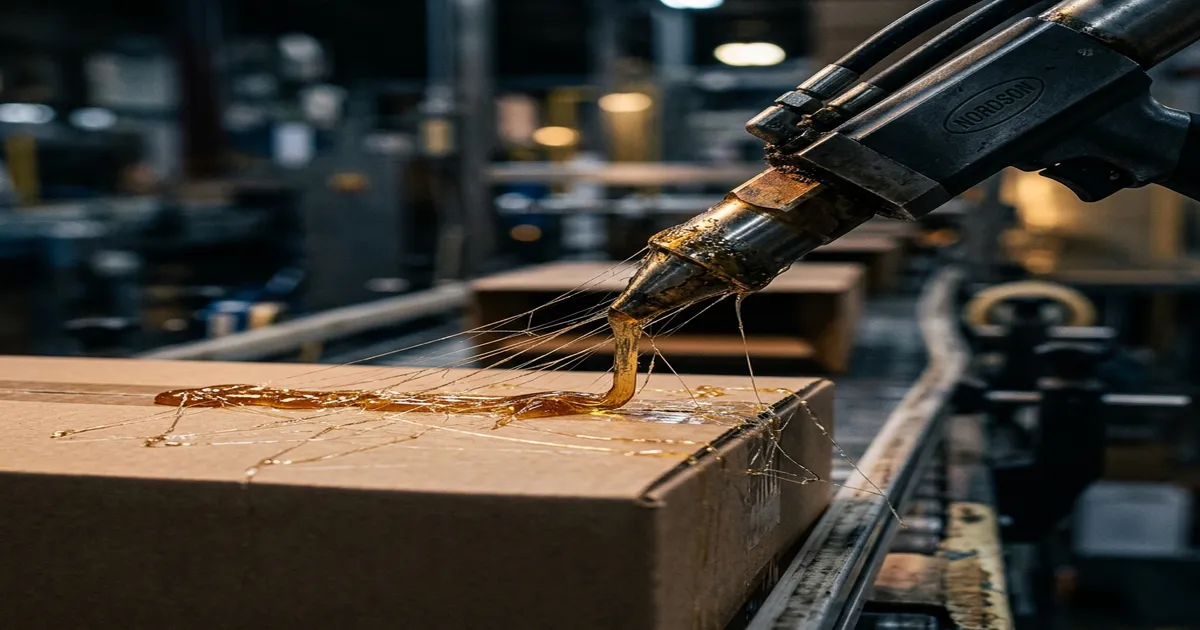
Every hot melt adhesive gun on your packaging line should leave a clean dot, bead, or spray pattern — not a trailing filament draped across a carton flap, tangled around a photo-eye sensor, or clinging to the next product down the conveyor. Hot melt adhesive stringing and webbing is one of the most common complaints packaging engineers bring to a hot melt supplier, and it rarely shows up as a single dramatic failure. Instead it accumulates: sensor faults that force unplanned stops, cosmetic rejects on retail-facing cartons, and stray adhesive fibres migrating into product zones where they trigger quality holds. Most operators reach for the temperature dial first, and are surprised when raising or lowering it barely moves the problem. This article explains why hot melt strings the way it does — the viscoelastic behaviour driving filament formation — how to tell a process-level cause from a formulation-level one, and which corrective levers actually close the gap. Global Formulation supports adhesive formulators and converters through exactly this kind of failure diagnosis, from bench rheology work through to line-side troubleshooting.
Understanding the Problem: What Stringing and Webbing Actually Look Like
Stringing describes a fine, continuous filament of molten adhesive that trails from the nozzle tip or from the trailing edge of a dispensed bead after the gun has moved on or shut off. Webbing, also called cobwebbing, is the same phenomenon at a larger scale — multiple strings crisscrossing between adjacent application points, substrate edges, or exposed machine parts. Tailing refers to a thinner variant that only appears at the very end of a bead, where the gun's cutoff mechanism struggles to break the melt cleanly. All three symptoms trace back to the same underlying property: the adhesive's resistance to breaking cleanly under extension while still molten.
- Sensor and photo-eye fouling — filaments accumulate on optical sensors, laser guides, and encoder wheels, triggering false stops on case sealers and carton formers.
- Cosmetic rejection — visible strings on the outside of retail cartons, folding boxes, or bag closures fail customer inspection even when the bond itself is sound.
- Product contamination — in food, hygiene, and personal-care packaging, stray adhesive fibres landing on product surfaces or inside open containers force quality holds.
- Nozzle and module fouling — strings that never fully detach re-deposit on the gun body and surrounding tooling, accelerating the need for cleaning cycles.
None of these symptoms point to a weak bond — the adhesive usually performs exactly as intended once it sets. The problem lives entirely in the few tenths of a second between when the gun releases the bead and when the melt actually separates, which is where the real mechanism begins.
Root Causes: The Viscoelastic Mechanism Behind Stringing
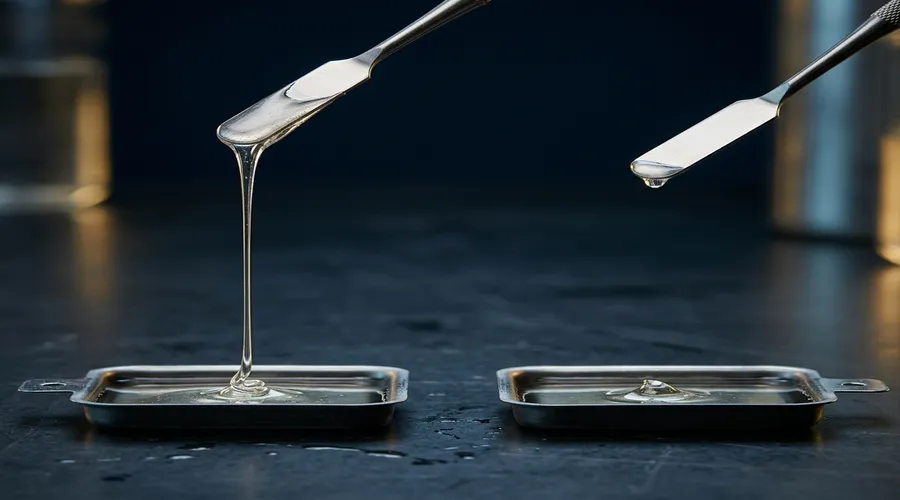
Hot melt adhesives are not simple viscous liquids — they are viscoelastic melts, combining liquid-like flow with rubber-like elastic recovery. When a nozzle lifts away from a substrate or a gun's cutoff valve closes, the thin neck of adhesive connecting the dispensed bead to the nozzle tip is stretched under extensional flow rather than shear flow. A purely viscous fluid would simply thin and detach; a viscoelastic melt resists that thinning because its polymer chains are still entangled and elastically recovering, so the neck draws out into a fine filament before it finally snaps, or in the worst cases never fully separates at all. The degree to which a given hot melt strings is governed far more by its extensional melt elasticity than by its bulk viscosity at application temperature, which is exactly why turning the temperature dial alone so often fails to solve the problem.
Polymer and Formulation Chemistry
Styrenic block copolymers such as SIS and SBS, used as the elastomer base in many packaging and case-sealing hot melts, contribute the rubber-like elastic recovery that gives good peel and shear strength — and that same property drives long extensional filaments. Tackifying resin compatibility and wax content shift that balance directly: wax addition shortens the melt's rheology and reduces elastic recovery, making it one of the most direct chemistry levers against stringing, though excess wax can cost bond flexibility and low-temperature performance. EVA-based hot melts generally string less than rubber-based SIS or SBS systems because EVA has lower elastic recovery, with polyolefin grades sitting in between depending on the specific resin.
Thermal Degradation and Melt Tank Dwell Time
Prolonged residence at elevated temperature in the melt tank — especially in tanks oversized for actual throughput or running without nitrogen blanketing to limit oxygen exposure — drives oxidative degradation that can build long-chain branching and micro-gel structures into the polymer. This is a pathway where degradation increases rather than reduces melt elasticity, so a hot melt that strings acceptably from a fresh drum can worsen measurably over the course of a shift as material sits in a hot tank being repeatedly reheated. Visible darkening or a rise in measured viscosity against the fresh-resin specification is the practical tell for this failure mode.
Gun Design, Cutoff Mechanism, and Application Parameters
The nozzle or gun cutoff mechanism — mechanical needle valve, air-assisted, or vacuum suck-back retraction — determines how cleanly the melt bead separates from the nozzle tip at shot-end. A cutoff that does not retract the melt quickly enough, or a nozzle standoff distance that is too large relative to line speed, gives the elastic filament more time and distance to form before it can break. Line speed mismatches, where the applicator or substrate moves faster than the adhesive's open time allows, compound the same geometry problem from the opposite direction.
| Factor | Effect on Stringing | Typical Trigger |
|---|---|---|
| Elastomer content (SIS/SBS) | Increases filament elasticity and length | High-peel, high-shear case-sealing grades |
| Wax content | Reduces melt elasticity, "shortens" flow | Low-wax or unwaxed rubber-based formulations |
| Melt tank dwell time and temperature | Increases stringing via oxidative degradation | Oversized tanks, no N2 blanket, idle at full heat |
| Nozzle cutoff design | Determines how cleanly the bead detaches | Worn or poorly matched cutoff valve |
| Nozzle standoff and line speed | Gives the filament more time and distance to form | High-speed lines with unmatched gun geometry |
Recognising which of these levers is actually driving a specific stringing complaint is the difference between a five-minute nozzle adjustment and a formulation review that takes weeks — which is exactly what the diagnostic sequence below is built to separate.
Diagnosis: How to Confirm the Root Cause
Accurate diagnosis separates stringing rooted in the adhesive's own chemistry from stringing rooted in equipment setup and process conditions, and the corrective path differs sharply depending on which is dominant. Working through the sequence below in order, rather than jumping straight to a formulation change, avoids the common trap of reformulating around a worn cutoff valve or an overheated melt tank.
- Bracket test fresh versus in-service material — dispense directly from a freshly opened drum or pail alongside material pulled from the working melt tank. If the tank material strings noticeably worse, thermal degradation or dwell time is contributing, not just the base formulation.
- Review melt tank temperature and dwell history — check set point against the manufacturer's specified application window, and estimate how long material has sat at temperature, including standby periods between shifts.
- Inspect the cutoff mechanism and nozzle standoff — confirm the gun's cutoff valve retracts fully and quickly, check for wear or partial blockage at the nozzle tip, and measure standoff distance against the equipment manufacturer's recommendation for the current line speed.
- Run a standardised string-length test — dispense a controlled bead and measure filament length at a fixed lift-off speed and distance, repeating across a shift to see whether stringing worsens as tank dwell time increases.
- Check for visible char or discolouration — darkened material at the nozzle tip or in the tank corners confirms oxidative degradation is underway even if bulk viscosity still reads close to spec.
A pattern where fresh material strings just as badly as tank material, across multiple lines running the same grade, points toward the polymer's intrinsic elasticity. A pattern where stringing worsens through the shift or clears up after a nozzle service points squarely at process and equipment.
Solution Strategies: Corrective Approaches
Correcting stringing means choosing between process-level fixes that address how the adhesive is dispensed and formulation-level fixes that address the melt's own extensional elasticity, and the right starting point follows directly from the diagnostic pattern above. Treating every stringing complaint as a formulation problem risks an expensive reformulation cycle when a worn cutoff valve was the actual cause.
Equipment and Process Adjustments
- Cutoff mechanism upgrade — moving to a vacuum suck-back or better-matched air-assisted cutoff improves how cleanly the melt bead separates from the nozzle at shot-end.
- Standoff and timing correction — reducing nozzle-to-substrate distance and re-synchronising gun timing to actual line speed shortens the window available for a filament to form.
- Melt tank management — right-sizing the tank to real throughput, reducing standby dwell time, and adding nitrogen blanketing all limit the oxidative degradation pathway that worsens stringing over a shift.
- Filter and nozzle cleaning cadence — regular removal of char and micro-gel buildup at the nozzle tip prevents irregular flow patterns that produce inconsistent strings.
Formulation-Level Adjustments
Where process fixes are already optimised and stringing persists, the corrective lever shifts to the polymer system itself. Increasing wax content shortens melt rheology and reduces elastic recovery, while adjusting elastomer type or ratio, or moving toward a lower-elasticity polyolefin base, reduces the extensional behaviour that drives filament formation. Every one of these changes has to be balanced against the bond strength, open time, and low-temperature flexibility the application actually requires, so formulation adjustment should follow, not replace, a proper diagnostic pass.

Prevention: Process Controls and Formulation Strategies to Avoid Recurrence
Preventing recurring stringing complaints means validating both the adhesive grade and the dispensing setup against real production conditions before a line goes live, not after the first sensor fault. Building that validation into commissioning and routine maintenance closes the gap between a clean bench trial and a messy production shift.
- Application-matched grade selection — specify hot melt chemistry against the actual line speed, cutoff mechanism, and standoff geometry the adhesive will run on, not just the bond strength target.
- Melt tank sizing and blanketing — match tank capacity to real throughput and use nitrogen blanketing where extended dwell time is unavoidable, limiting oxidative degradation before it starts.
- Standby temperature setback — reduce tank temperature during idle periods such as shift changes or weekends rather than holding full application temperature continuously.
- Scheduled cutoff and nozzle maintenance — inspect and service cutoff valves and nozzle tips on a fixed interval rather than waiting for visible stringing to trigger a maintenance call.
A hot melt system maintained this way tends to hold its stringing performance for the life of the tooling, catching drift from char buildup or valve wear long before it becomes a line stoppage.
When to Escalate to a Specialist
Most stringing complaints resolve through the diagnostic and corrective sequence above — bracket testing, cutoff and standoff review, melt tank management, and, where needed, a targeted wax or elastomer adjustment. A smaller set of situations point to a more complex underlying issue that benefits from specialist formulation review.
Escalate when fresh material strings just as badly as material that has been sitting in the tank, and equipment adjustments have already been exhausted, since this pattern points to the polymer's intrinsic elasticity rather than anything fixable at the machine. It is also worth escalating when stringing is consistent across multiple lines or multiple manufacturing sites running the same adhesive grade, because that spread rules out a single machine's setup and implicates the resin or formulation batch itself. Finally, escalate when a formulation change to reduce stringing needs to be balanced against bond strength, open time, or low-temperature flexibility requirements that are already tightly specified — this kind of multi-property trade-off is best handled with a formulator who can re-validate the full performance envelope, not just the stringing symptom.
Hot melt stringing and webbing is a solvable problem once the balance between polymer elasticity, thermal history, and dispensing geometry is correctly diagnosed. For deeper background on the polymer systems behind these formulations, see our guide to hot melt adhesive chemistry and industrial applications, and for the pressure-sensitive side of the category, our comparison of acrylic versus rubber pressure-sensitive adhesives. The wider adhesives and sealants knowledge base covers the broader formulation context this failure sits within. For independent industry background on hot melt equipment and packaging line practice, the Adhesive and Sealant Council and Packaging Digest both maintain accessible technical resources.