Kitchen Degreasers: Alkaline Chemistry for Baked-On Grease
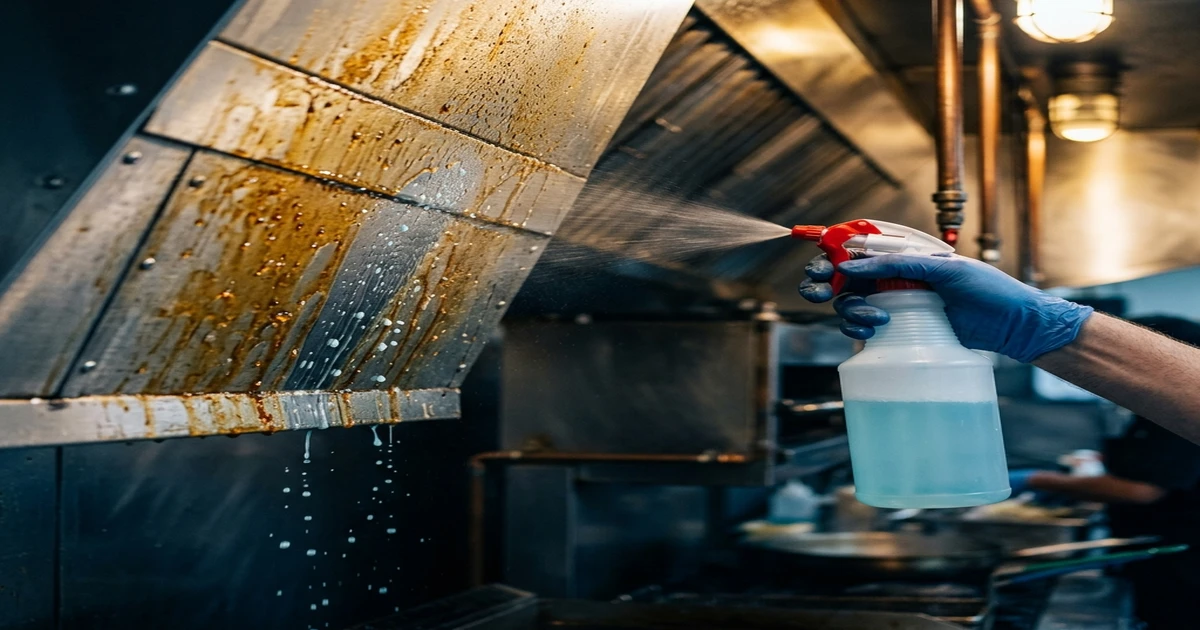
Walk into any commercial kitchen at closing time and the problem is obvious: a film of cooked-on grease coating hoods, filters, ovens, and splash-backs that ordinary cleaners barely touch. Left in place, that layer becomes a fire risk, a hygiene failure, and a labour cost that compounds every shift. Understanding kitchen degreaser formulation — the alkaline chemistry that converts baked-on fat into removable soap — is what separates products that genuinely work from products that merely smell like they do. This guide explains why polymerized grease resists ordinary surfactants, how saponification attacks it, and how formulators build caustic and mild-alkaline products around that reaction. It draws on the same principles we apply across our household and industrial cleaners practice, written for entrepreneurs and technical teams developing degreasers of their own.
Why Baked-On Grease Defies Ordinary Cleaners
Fresh cooking oil and week-old oven soil look related but behave like two different materials, and cleaners that handle one routinely fail on the other. Fresh grease is a liquid triglyceride — animal fat or vegetable oil — that a surfactant can surround, emulsify, and carry away in rinse water. Once that same fat cycles repeatedly through cooking temperatures, it oxidizes and cross-links into a hard, varnish-like polymer film bonded tightly to the metal beneath it. This is the same drying-oil chemistry that seasons a cast-iron pan: useful on cookware, and a serious removal problem everywhere else.
A polymerized film presents no free oil droplets for a surfactant to lift, which is why dish soap and all-purpose sprays slide over baked-on soil without moving it. Mechanical scraping works but scratches surfaces and consumes labour, and hot water alone merely softens the outermost layer. What the soil demands is a cleaner that attacks the fat chemically — breaking the bonds holding the film together rather than trying to float it away intact.
That chemical attack has a name, and it is the single reaction every serious kitchen degreaser is built around.
Saponification: Turning Grease Into Soap
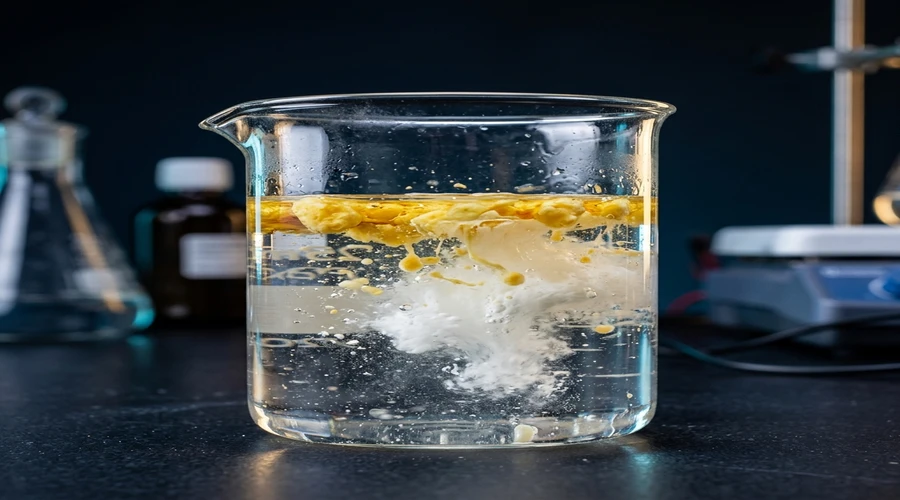
The core reaction in alkaline degreaser grease saponification is centuries old — it is the same chemistry used to make bar soap. Hydroxide ions attack the ester bonds in a triglyceride and hydrolyse them, splitting the fat into glycerol and the alkali-metal salts of its fatty acids. Those fatty acid salts are literally soap, formed in place on the soiled surface, as documented in any treatment of saponification chemistry. Heat accelerates the reaction substantially, which is why self-cleaning cycles and warm-surface application both improve results.
The elegance of this mechanism is that the soil participates in its own removal. As saponification proceeds, the newly formed soap emulsifies neighbouring unreacted grease, water gains access to deeper layers of the film, and the reaction front keeps advancing. The cleaner appears to work faster the longer it sits — not because the surfactants improve, but because the soil is progressively converting into detergent.
One boundary defines where this chemistry applies: only esters saponify. Animal fats and vegetable oils respond because they are triglycerides; mineral oils and petroleum lubricants contain no ester bonds and shrug off alkalinity entirely, which is why industrial degreasers for petroleum soils rely on solvents and surfactancy instead. Knowing which soil you face dictates the entire formulation — and for kitchen fats, the formulation is built from four working parts.
Inside a Kitchen Degreaser Formulation: Four Building Blocks
A commercial kitchen cleaner that performs on baked-on soil is never a single active in water — it is a system of four ingredient classes engineered to reinforce each other. The alkalinity source drives saponification, surfactants wet the soil and hold emulsified grease in suspension, solvents open the polymerized film so hydroxide can penetrate it, and chelants protect the whole system from hard water. Remove any one of the four and the remaining three visibly underperform. Understanding the role each class plays is the fastest way to read a competitor's label — or to diagnose why a prototype is failing.
- Alkalinity sources — sodium and potassium hydroxide for heavy-duty causticity; sodium metasilicate and sodium carbonate for buffered, milder alkalinity with some corrosion inhibition
- Surfactants — low-foam nonionics such as alcohol ethoxylates for spray products, with alkyl polyglucosides increasingly used for their caustic stability and mildness profile
- Solvents — glycol ethers that swell and soften the cross-linked grease film, giving hydroxide ions access to ester bonds buried beneath the surface
- Chelants and builders — EDTA, gluconates, and citrates that sequester calcium and magnesium, preventing hard-water ions from precipitating the soap the reaction just created
Surfactant choice deserves particular care because the alkaline environment is chemically hostile — some surfactant classes hydrolyse or salt out at high pH, taking wetting and emulsification down with them. Our surfactant selection guide for cleaning formulations covers caustic-stable choices in depth. With the four blocks in hand, the defining formulation decision becomes how much alkalinity the product should carry — and that is a genuine strategic fork.
Caustic vs Mild Alkaline Systems: Choosing the Right Strength
Alkalinity in cleaning products spans a spectrum, and where a degreaser sits on it determines both what it can remove and what it can damage. A daily-use spray built on carbonate or silicate builders operates in a moderately alkaline range and handles fresh soils safely on most surfaces. An oven cleaner caustic formulation built on free sodium hydroxide operates near the top of the pH scale and will dissolve carbonized, months-old soil — while also attacking skin, aluminum, and painted finishes with the same indifference. The relationship between pH and cleaning power is covered more broadly in our guide to acid, neutral and alkaline cleaning products.
| System | Typical Alkalinity Source | In-Use pH Range | Best Suited For | Key Limitation |
|---|---|---|---|---|
| Mild alkaline | Sodium carbonate, borate buffers | ~9–10.5 | Daily wipe-downs, fresh liquid grease | Little effect on polymerized films |
| Medium-duty built | Sodium metasilicate, carbonate blends | ~11–12.5 | Weekly hood and filter cleaning, heavy fresh soil | Slow on carbonized oven soil |
| Heavy-duty caustic | Sodium / potassium hydroxide | ~13–14 | Baked-on, carbonized grease; oven and fryer exteriors | Attacks aluminum, skin, painted surfaces |
The hydroxide choice within the caustic tier is itself a formulation lever. Potassium soaps are softer and more water-soluble than sodium soaps, so KOH-based products rinse cleaner and leave less visible residue, while NaOH delivers more causticity per unit cost — the reason it dominates budget heavy-duty products. Handling either demands respect: the NIOSH documentation for sodium hydroxide records severe burn hazards to skin and eyes at the concentrations these products use. Matching strength to soil is only half the product decision, though — the other half is the physical form the chemistry ships in.
Product Formats: Sprays, Foams, Gels and Concentrates
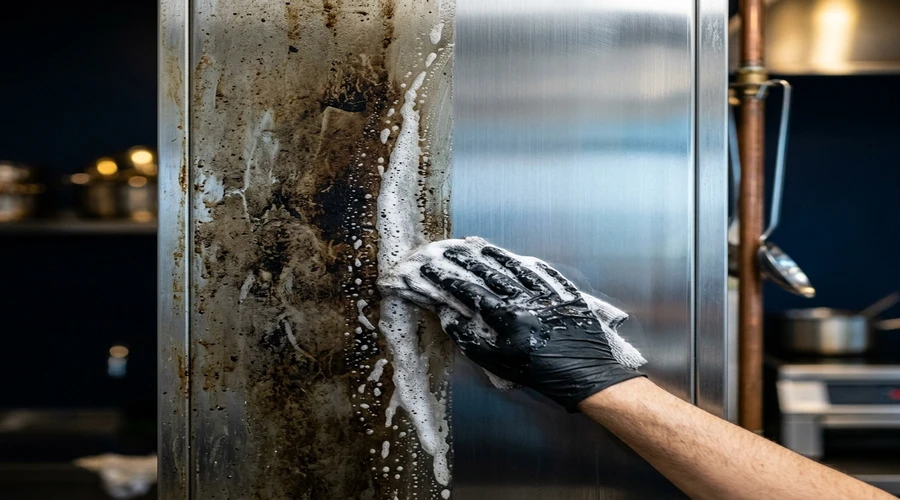
Two products with identical chemistry can perform completely differently depending on their physical format, because format controls the one variable alkaline cleaning cannot do without: contact time. Saponification is a reaction, not an instant dissolution, and a product that runs off a vertical hood in seconds never gets to finish the work its chemistry is capable of. Format also governs safety in practice — mist, splash, and drip behaviour differ enormously between a thin spray and a clinging gel. Choosing the delivery form is therefore a formulation decision of equal weight to choosing the alkalinity tier.
- Trigger sprays — the default for daily commercial kitchen cleaner use; low-foam nonionic systems that wet fast and wipe off without heavy rinsing
- Clinging foams — boosted foam profiles that hold product on vertical stainless panels and hood interiors, extending dwell from seconds to minutes
- Gels — thickened caustic systems for oven interiors, engineered to sit on horizontal and inclined surfaces through long dwell periods with minimal mist hazard
- Aerosol foams — pressurized oven cleaner formats delivering a coarse, low-drift foam; the format of choice where mist inhalation must be minimized
- Dilutable concentrates — the economics backbone of institutional supply, dosed through dilution-control systems that keep in-use strength consistent shift after shift
Format, strength, and chemistry together define the product — but every heavy duty kitchen degreaser still has to answer for what happens after the trigger is pulled: to the user, to the surface, and to the drain.
Safety, Surfaces and the Grease Trap Question
Alkaline degreasers earn their effectiveness through chemical aggression, and that aggression does not distinguish between grease, skin, and soft metals. Caustic products demand chemical-resistant gloves, eye protection, and ventilation for the entire dwell period, not just during application. Surface compatibility is the second hard constraint: aluminum is amphoteric, so strong alkalis dissolve its protective oxide and then etch the metal itself, releasing hydrogen as they go. Painted finishes and galvanized coatings suffer similarly, which is why silicate-inhibited systems — where deposited silicate slows alkaline attack — exist for mixed-metal environments.
Food-contact surfaces add a regulatory layer: degreasing is a cleaning step, not a sanitizing one, and every caustic cleaning of a food-contact surface must be followed by a potable-water rinse before the surface returns to service. The final consideration sits below the floor drain. A grease trap works by letting fats cool, separate, and float for pump-out; caustic emulsifiers push fine grease droplets straight through the trap to re-solidify downstream, which is why municipal fats-oils-grease programs discourage flushing caustic cleaners into them. Grease trap cleaner chemistry is consequently a different discipline — enzymatic and bacterial maintenance products that digest accumulated fat biologically rather than emulsifying it downstream.
The decision framework that falls out of this guide is compact. Identify the soil first: liquid grease calls for surfactancy, polymerized film calls for alkalinity, and carbonized soil calls for caustic plus solvent plus time. Match the alkalinity tier to the most sensitive surface the product will legally touch, then choose the format that delivers the longest safe dwell on that surface. Formulate the drain strategy separately — degreasing the kitchen and maintaining the trap are two products, not one.
Frequently Asked Questions
Why do regular dish soaps fail on baked-on kitchen grease?
Dish soap works by surfactancy alone — its molecules surround liquid oil droplets and lift them into the wash water as emulsified micelles, which works well only while the grease is still a liquid. Baked-on grease is no longer a liquid: repeated heating oxidizes and cross-links the fat into a hard, varnish-like polymer film that is chemically bonded to the surface, so there are no free oil droplets for a surfactant to surround.
Removing that film requires a chemical attack that breaks the fat's ester bonds — the saponification reaction driven by alkalinity — which is exactly what a properly built kitchen degreaser provides and dish soap does not.
What is saponification and why does it matter in a kitchen degreaser?
Saponification is the alkaline hydrolysis of fats: hydroxide ions cleave the ester bonds in triglycerides, splitting them into glycerol and the salts of fatty acids — which are, literally, soap. In a kitchen degreaser this means the alkaline product converts part of the grease itself into a water-soluble cleaning agent in place, so the soil helps remove itself as the reaction proceeds.
This is why alkaline chemistry is uniquely effective on animal fats and vegetable oils, and it is also why the same chemistry does nothing for mineral oils, which contain no ester bonds to attack.
Is sodium hydroxide or potassium hydroxide better for kitchen degreasers?
Both hydroxides drive the same saponification reaction, but the soaps they create behave differently: potassium soaps are softer and more water-soluble than sodium soaps, so KOH-based products tend to rinse away more cleanly and leave less residue. Sodium hydroxide is the lower-cost workhorse and dominates heavy-duty oven cleaner formulations, where maximum causticity per unit cost matters more than rinse elegance.
Many commercial products blend the two, or pair a hydroxide with milder alkaline builders like sodium metasilicate and sodium carbonate to balance cleaning power, surface safety, and cost — the choice is a formulation decision, not a question of one being universally better.
Why can't I use a caustic kitchen degreaser on aluminum surfaces?
Aluminum is an amphoteric metal — it is attacked by strong alkalis as well as acids. Sodium hydroxide dissolves the protective oxide layer and then reacts with the metal itself, forming soluble aluminate and releasing hydrogen gas, which shows up in practice as etching, darkening, and pitting of the surface. This is why caustic oven cleaners carry explicit warnings against use on aluminum pans, range hood filters, and trim.
Where aluminum must be cleaned, formulators either specify silicate-inhibited alkaline products — silicates deposit a protective layer that slows alkaline attack — or drop to a mild-alkaline, surfactant-led product and accept longer contact times.
What makes a degreaser "heavy duty" compared to an everyday kitchen cleaner?
The honest difference is alkalinity reserve and solvent power, not marketing language. An everyday spray relies mainly on surfactants with a mild builder and sits in the pH 9–11 range, which handles fresh, liquid grease on daily-wiped surfaces. A heavy duty kitchen degreaser carries free caustic (sodium or potassium hydroxide) pushing the in-use pH toward 13–14, usually reinforced with a glycol ether solvent to swell the polymerized grease film so hydroxide can reach the ester bonds inside it.
That extra chemical aggression is what removes months-old, carbonized soil — and it is also exactly why heavy-duty products demand gloves, eye protection, and surface compatibility checks that everyday cleaners do not.
Do alkaline degreasers help or harm a commercial grease trap?
Used carelessly, they harm it. A grease trap works by letting fats, oils, and grease cool, separate, and float so they can be pumped out; caustic cleaners emulsify grease into fine droplets that pass straight through the trap and re-solidify further down the drain line or in the municipal sewer. This is why many municipal fats-oils-grease (FOG) programs explicitly discourage discharging caustic or emulsifying products into traps.
Trap maintenance is better handled with mechanical pump-outs supported by enzymatic or bacterial dosing products, which biologically break down accumulated grease without pushing an emulsified slug downstream — a fundamentally different chemistry from surface degreasing.
What safety precautions does a caustic oven cleaner formulation require?
Sodium hydroxide is corrosive to skin and eyes at the concentrations used in oven cleaners, and NIOSH documents severe burn hazards from both liquid contact and aerosolized mist. Practical use demands chemical-resistant gloves, eye protection, ventilation, and keeping the product off skin during the full dwell period — the hazard does not diminish while the product sits on the soil.
Formulators mitigate risk through product format: gels and clinging foams minimize mist and splash compared with thin sprays, and aerosol oven cleaners are designed to deliver a coarse, low-drift foam for the same reason. On food-contact surfaces, every caustic cleaning step must be followed by a thorough potable-water rinse before the surface returns to service.
Developing a Cleaning Product Line?
Global Formulation provides cleaner and degreaser consultancy — alkalinity system design, caustic-stable surfactant selection, format engineering, and regulatory strategy.
Talk to Our Formulation Team