Lip Care Formulation: Occlusive Agents & Polymers
A lip balm that tests beautifully in the lab can still leave a customer reapplying every twenty minutes. A long-wear liquid lipstick can survive a full workday and still leave lips tight and cracked by evening. Both failures trace back to the same decision — which materials sit on the lip surface, and how long they stay there. Lip care formulation with occlusive agents is fundamentally a barrier problem, because the vermilion of the lip lacks almost every defence that facial skin takes for granted. This guide covers how the major occlusive classes differ in the barrier they build. It then works through how film-forming polymer technology delivers long wear, and exactly where those two objectives pull against each other. It also covers the stability, testing, and regulatory checkpoints that decide whether a promising bench sample ever becomes a shippable product.
Why Lip Skin Loses Water So Fast
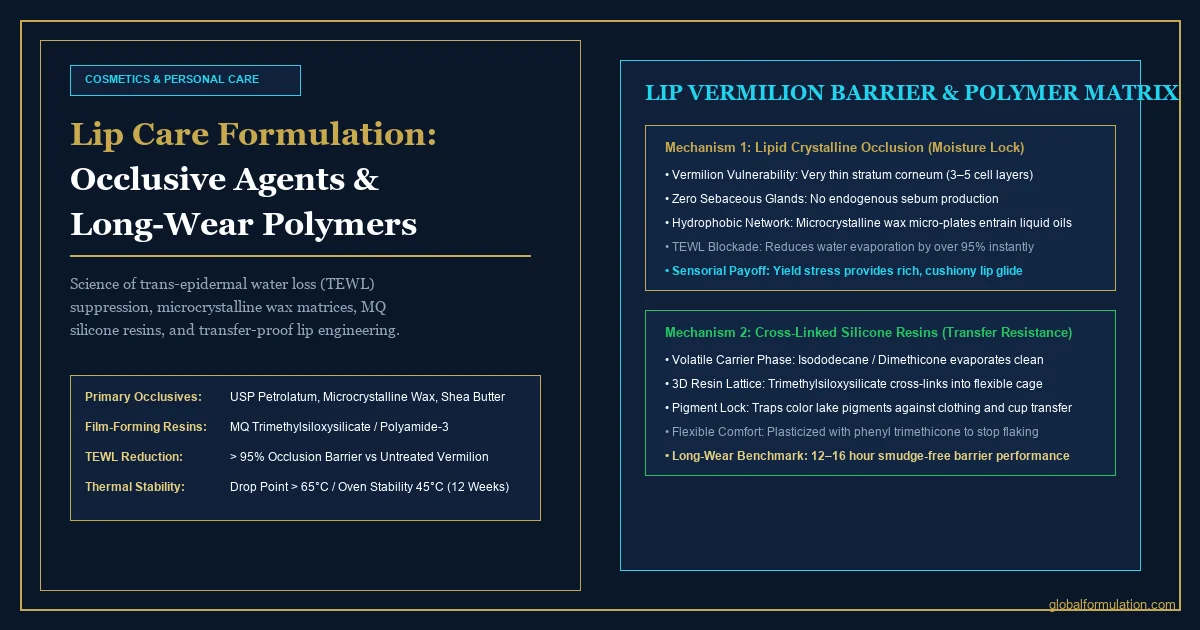
The vermilion — the coloured part of the lip — is a transition zone between facial skin and oral mucosa, and it is built like neither. Its stratum corneum is markedly thinner than that of the surrounding face, and it carries no sebaceous glands, no sweat glands, and no hair follicles. That leaves the lip with no way to produce its own protective lipid film or draw on the natural moisturising factor that keeps facial skin supple. The result is a permanently weak barrier and an unusually high rate of transepidermal water loss.
- Thin horny layer — the vermilion has far fewer corneocyte layers than adjacent facial skin, giving water a shorter and less tortuous escape path
- No glandular supply — without sebaceous or sweat glands, the lip cannot replenish its own surface film once that film is removed
- Minimal melanin — the vermilion carries little intrinsic pigment protection, which is why the lower lip is a recognised site for cumulative sun damage
- Constant mechanical stress — eating, drinking, talking, and wiping physically strip whatever protective layer is present, many times a day
Saliva deserves separate attention, because it works against the user's instinct. Licking a dry lip deposits a thin water film that evaporates quickly and takes surface moisture with it, while salivary enzymes act on an already compromised surface. Habitual lip licking is a well-recognised driver of chapping, not a remedy for it.
If the product is the barrier, then material selection is the whole game. The next section covers what each occlusive class actually delivers.
Lip Care Formulation: How Occlusive Agents Build the Barrier
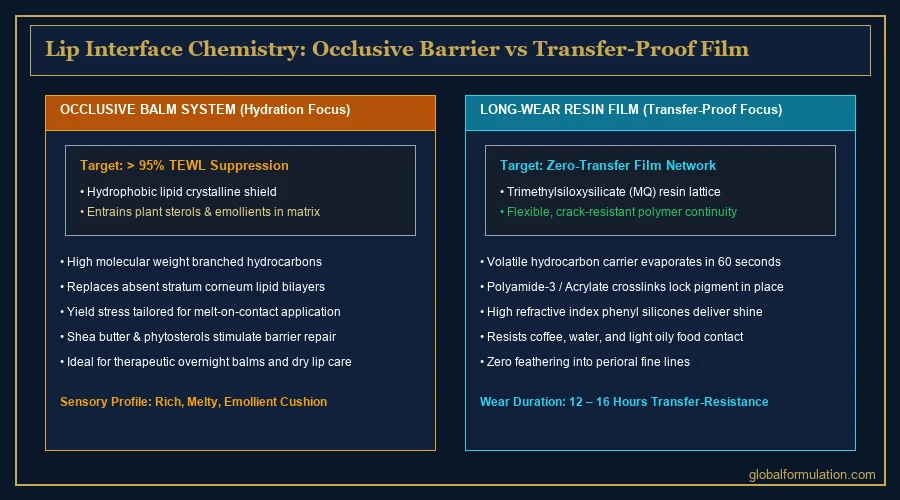
An occlusive works by covering the skin surface with a hydrophobic film that slows water's escape into the air. Its performance is judged by how far it reduces transepidermal water loss — not by how rich or expensive it feels in a sensory panel. The classes available to a lip formulator differ sharply on that measure, and also on melting behaviour, oxidative stability, and regulatory acceptability. Choosing among them is the most consequential single decision in a lip care brief, because everything downstream is built on top of it.
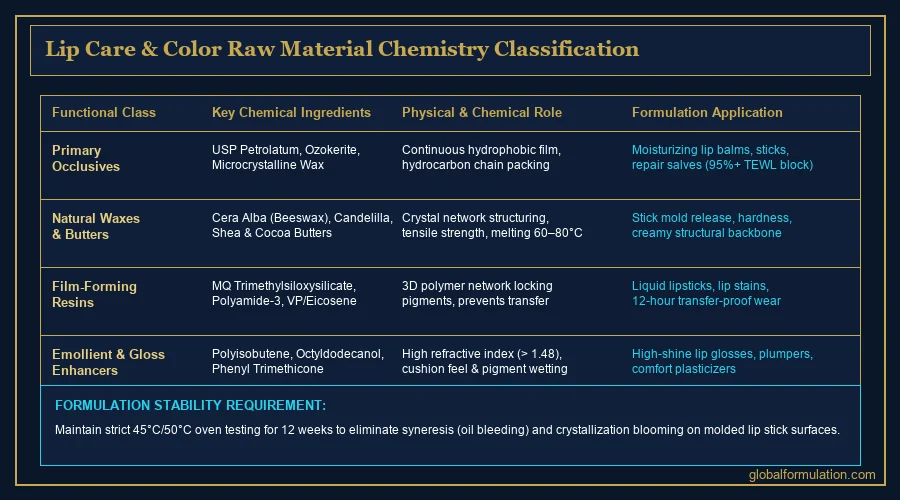
| Occlusive class | Representative materials | Barrier character | Typical formulation role |
|---|---|---|---|
| Petroleum hydrocarbons | Petrolatum, mineral oil, microcrystalline wax, ozokerite | The reference standard — an inert, fully saturated, near-complete hydrophobic film | Core barrier phase in treatment balms and medicated sticks |
| Natural waxes | Beeswax, candelilla wax, carnauba wax | Structural and occlusive at once; carnauba has the highest melting point of the common cosmetic waxes | Stick hardness, heat resistance, and mould release |
| Lanolin and derivatives | Lanolin, lanolin alcohol, acetylated lanolin | Semi-occlusive with strong emolliency and cling; lanolin alcohol is a recognised contact allergen | Cushion, softening, and adhesion to a mobile surface |
| Silicones | Dimethicone, high-viscosity dimethicone gum | Breathable semi-occlusive film with a light, non-greasy skin feel | Slip, shine control, and transfer-resistance support |
| Plant butters | Shea butter, cocoa butter, mango butter | Moderate occlusivity plus fatty-acid emolliency; cocoa butter is polymorphic and bloom-prone | Sensory richness and natural-origin positioning |
| Synthetic hydrocarbons | Hydrogenated polyisobutene, polybutene | Non-volatile and oxidatively stable, with pronounced tack and gloss | Shine, cling, and pigment wetting in glosses |
Regulatory status follows directly from this table in the United States. Several of these materials — petrolatum, white petrolatum, cocoa butter, dimethicone, and allantoin among them — are listed active ingredients in the FDA's OTC skin protectant drug monograph. That listing is what allows a lip balm to make a protective claim at all.
Occlusion is only one of three mechanisms that get casually labelled "moisturising", and confusing them is how briefs go wrong.
Occlusives, Emollients and Humectants Do Different Jobs
Three ingredient classes get bundled together under the word "moisturiser", and they work by entirely unrelated mechanisms. Treating them as interchangeable is the most common conceptual error in lip briefs, and it produces balms that feel pleasant but perform poorly. Each class solves a different part of the problem, and in a lip product the constraints on each are unusually tight. Understanding which one you are actually short of is what turns a reformulation from guesswork into a targeted fix.
- Occlusives — waxes, petrolatum, butters, and silicones that seal the surface and slow water loss outward; they add no water of their own
- Emollients — esters and light oils that fill the gaps between corneocytes to restore smoothness and flexibility, without forming a sealing film
- Humectants — glycerin, sodium PCA, and hyaluronic acid, which bind water but need water present to bind and an occlusive layer above them to keep it
That last constraint is where anhydrous lip formats hit a wall. A wax-and-oil stick contains no water phase, and humectants are poorly soluble in it, so they need a solubiliser or a deliberate micro-dispersion to sit in the base at all. Even then they contribute far less than they would in a water-containing cream. The same physics governs every waterless format, which is why the discipline covered in our guide to anhydrous cosmetic formulation applies directly here.
For most lip briefs, then, the productive lever is a better occlusive phase — not another humectant bolted onto an anhydrous base. Long-wear colour products change that calculation completely, because they answer to a different physical requirement.
Long-Wear Lip Technology: Film-Forming Polymers
Long wear is a different physics problem from occlusion, and solving it requires a different toolkit. A long-wear lip product deposits a continuous, cohesive polymer film that resists transfer and abrasion for hours. It gets there by carrying pigment and film former in a volatile solvent that evaporates seconds after application, leaving the film behind on the lip. The polymer chemistry chosen at that step decides transfer resistance, flexibility, and — critically — how the product feels four hours later.
- Application — the product is laid down as a fluid dispersion of pigment, film-forming polymer, and volatile carrier
- Flash-off — the volatile carrier evaporates within seconds to a few minutes, concentrating the polymer on the lip surface
- Film consolidation — the remaining polymer chains coalesce into a continuous hydrophobic film that locks pigment particles in position
- Wear phase — because the film is no longer solubilised, it resists transfer to a cup rim, a fork, or fabric
The film formers themselves fall into a small number of well-characterised classes, and most commercial long-wear systems blend two or more of them.
| Polymer class | Representative INCI | Property contributed |
|---|---|---|
| Silicone MQ resins | Trimethylsiloxysilicate | Hard, highly transfer-resistant film — the workhorse of long-wear colour |
| Silsesquioxanes | Polymethylsilsesquioxane | Film reinforcement and a soft-focus matte finish |
| Silicone acrylate copolymers | Acrylates/dimethicone copolymer | Balances film hardness against flexibility on a constantly moving surface |
| Non-volatile hydrocarbon tackifiers | Hydrogenated polyisobutene, polybutene | Cling, gloss, and pigment wetting within the film |
| Crosspolymer gellants | Dimethicone/vinyl dimethicone crosspolymer | Structure and oil binding, controlling how the film sets |
The carrier matters as much as the polymer. Volatile silicones such as cyclopentasiloxane were the traditional choice. Restrictions on cyclic volatile methylsiloxanes under the EU's REACH framework have moved much of the category toward volatile hydrocarbons such as isododecane and C13-15 alkane. That substitution is not a like-for-like swap, because evaporation rate and polymer solubility both shift with it.
Pigment behaviour inside the film is its own discipline. A poorly dispersed pigment will streak no matter how good the polymer is, a subject we cover in our guide to pigment dispersion in colour cosmetics. Get the film right and wear time follows. Get it too right, and comfort collapses.
The Comfort vs Wear Trade-Off
Transfer resistance and lip comfort pull in opposite directions, and no formulation trick eliminates the tension entirely. A film hard enough to survive a coffee cup is also a film that blocks emollients from reaching the lip beneath it. Add a high volatile fraction and a correspondingly low emollient fraction, and the product dries down to something the wearer describes as tight. The formula never contained water to lose in the first place. Managing that trade-off deliberately is what separates a category-leading long-wear product from an uncomfortable one.
- Two-step architecture — a long-wear colour base worn under a separate occlusive top coat, restoring comfort without weakening the underlying film
- Plasticised film systems — flexible co-monomers or ester plasticisers stop the film cracking as the lip moves and stretches
- Hybrid film formers — blending a hard MQ resin with a softer silicone acrylate trades a measurable amount of transfer resistance for wear comfort
- Volatile load management — cutting the volatile fraction softens the dry-down but lengthens set time and can raise early transfer
Where a project lands on that spectrum should be decided from the brief, not discovered in consumer testing. The three archetypes below cover most commercial lip products.
| Product archetype | Dominant chemistry | Wear character | Comfort character |
|---|---|---|---|
| Treatment balm or stick | Wax structure with a heavy occlusive phase | Short — removed by eating and drinking | High; the barrier is the product's whole purpose |
| Long-wear liquid lip | Silicone resin film former in a volatile carrier | Long, with strong transfer resistance | Lower; dry-down and film rigidity are inherent |
| Hybrid tint or cushion format | Softer film former blended with non-volatile emollients | Moderate, with even fade rather than patchy wear | Moderate to high, depending on the emollient load |
Neither wear nor comfort matters if the product fails on a warehouse shelf, which is where stability testing earns its place.
Stability, Regulation and the Tests That Matter
A lip product spends far more of its life in a hot handbag or a warehouse than it ever does in a laboratory. Failures in this category are visible and immediate — a bloomed stick, a sweating balm, a snapped bullet, a colour that has drifted from the shade card. Because the defects are so obvious to the end user, the testing programme has to be unusually thorough before launch. These are the checks that reliably catch problems while they are still cheap to fix.
- Heat and cycling stability — elevated-temperature holds combined with freeze-thaw cycling expose wax incompatibility long before a distributor does
- Bloom and sweating — a higher-melting wax migrating to the surface produces whitish bloom, while oil separating from the matrix produces sweating; both point to an unbalanced wax-to-oil ratio
- Hardness and break strength — penetrometer and bend tests convert "will the bullet survive shipping" into a number you can specify to a contract manufacturer
- Drop point and melting behaviour — dropping-point methods such as ASTM D127 characterise the wax phase and predict softening in transit
- Transfer resistance — controlled blot or press tests against fabric or glass, quantified instrumentally rather than judged by eye
- Oxidative stability — unsaturated plant oils develop rancid odour and off-colour, so antioxidant system and packaging barrier both need verifying over shelf life
Colour additive compliance runs alongside all of this, and it is stricter for lips than for almost any other cosmetic category. Lip products are incidentally ingested during normal use, so colourants must be approved specifically for that application. In the United States that means only listed colour additives, several of which require batch certification by the FDA. In the European Union, permitted colourants are set out in Annex IV of Regulation (EC) No 1223/2009. A shade that is legal in one market is not automatically legal in the other.
The decision framework, condensed: establish the claim set and target markets first, then choose the occlusive phase to match the barrier requirement. Select film-forming polymer technology against a stated wear-versus-comfort target rather than a maximum. Our deeper treatment of wax, oil and pigment chemistry in lip colour covers the structural side of that build. Our cosmetics and personal care practice page sets out how Global Formulation structures lip care development from brief to manufacturing handoff.
Frequently Asked Questions
Why do lips feel drier after wearing a long-wear liquid lipstick?
A long-wear lip product works by depositing a hard, continuous polymer film after its volatile carrier evaporates. That film is engineered to resist transfer, which means it also resists the passage of emollients and lipids back to the lip surface.
The formula carries a high volatile fraction and a low emollient fraction by design. The lip therefore spends the wear period sealed under a film that gives it very little back. The standard formulation answer is a two-step architecture: the long-wear colour base does the wear work, and a separate occlusive top coat or overnight balm restores the barrier.
Is petrolatum still the best occlusive for lip care products?
Petrolatum remains the reference standard against which other occlusives are compared. Its saturated hydrocarbon film is chemically inert, oxidatively stable, and almost completely hydrophobic on the skin surface. It is also a listed active in the United States OTC skin protectant framework, which makes claim support straightforward.
What displaces it in practice is positioning rather than performance: brands targeting natural certification, vegan claims, or petroleum-free marketing need plant waxes, butters, and synthetic hydrocarbons instead. Those alternatives can build a good barrier, but a formulator should expect to test the substitution rather than assume equivalence.
Does an anhydrous lip balm need a preservative?
A genuinely anhydrous lip balm contains no free water, so it cannot support the microbial growth that preservatives are designed to control, and conventional preservation is normally unnecessary. What it does need is antioxidant protection, because unsaturated plant oils and butters oxidise over shelf life into rancid odour and off-colour.
The distinction matters the moment any water-bearing ingredient enters the formula. A botanical extract in a glycerin or water carrier reintroduces water activity, and with it the need for a preservative system. Preservative efficacy testing should always be run on the finished formula rather than reasoned about from the ingredient list alone.
What causes a white film to appear on the surface of a lipstick?
That defect is wax bloom, and it happens when a higher-melting wax in the stick migrates to the surface and recrystallises there as a fine whitish layer. It is usually driven by an unbalanced wax-to-oil ratio or by temperature cycling during shipping and storage. Polymorphic materials such as cocoa butter can also recrystallise into a different, more visible crystal form.
A related but separate defect is sweating, where liquid oil separates and beads on the stick surface because the wax matrix cannot hold it. Both are caught by temperature-cycling stability protocols long before they reach a customer, which is why cycling is non-negotiable for stick formats.
Can a natural-certified lip balm match a petrolatum-based one for occlusivity?
Plant waxes, butters, and vegetable-derived esters can build a substantial occlusive barrier, and a well-constructed natural balm performs well in real use. It will not usually replicate petrolatum's barrier one-for-one, because petrolatum's fully saturated hydrocarbon film is unusually complete and unusually inert.
Natural systems also carry practical trade-offs a formulator has to design around. Unsaturated plant oils oxidise, natural waxes vary between agricultural lots, and butters such as cocoa are polymorphic and bloom-prone. The workable approach is to layer several complementary natural occlusives rather than search for a single drop-in replacement. Confirm the result with transepidermal water loss measurement instead of sensory impression.
Why doesn't adding hyaluronic acid or glycerin fix a dry lip balm?
Humectants such as glycerin, sodium PCA, and hyaluronic acid work by binding water. They need water available to bind, and an occlusive layer above them to hold what they capture. In an anhydrous wax stick there is no water phase for them to work in. They are also poorly soluble in the oil and wax matrix, so they sit as a dispersed phase that can feel tacky rather than hydrating.
Adding a humectant to a stick therefore requires a solubiliser or a deliberate micro-dispersion, and it still delivers less than the same humectant would in a water-containing format. For most lip briefs the more productive lever is improving the occlusive phase, not adding a humectant to an anhydrous base.
When does a lip balm become an OTC drug in the United States?
The claim determines the category, not the formula. A lip product sold purely for colour, shine, or conditioning is a cosmetic. One that claims to protect, relieve, or prevent chapped lips is making a therapeutic claim. That claim brings it under the FDA's OTC skin protectant drug framework.
That brings requirements the cosmetic route does not have, including use of monograph-listed active ingredients at monograph conditions, a Drug Facts panel, and manufacture under drug GMP. Adding an SPF claim moves the product into the OTC sunscreen category on top of that. Deciding the claim set before development starts is far cheaper than discovering the regulatory route after the formula is locked.
How is transfer resistance on a long-wear lip product actually measured?
The standard method applies the product to a substrate and allows a defined dry-down time. A clean receiving material — typically white fabric, paper, or glass — is then pressed against it under controlled pressure and duration. The residue transferred to the receiving material is then measured instrumentally with a colorimeter or spectrophotometer rather than judged by eye, which turns a subjective claim into a comparable number.
Well-run protocols also test after a wear interval and after exposure to oil or moisture. A film that resists a dry blot at two minutes may still fail after coffee and a meal. Instrumental transfer data should always be paired with a consumer wear panel, since perceived wear depends on comfort and even fade as much as on residue.
Developing a Lip Care or Long-Wear Lip Line?
Global Formulation provides lip care product development consultancy — occlusive system design, film-forming polymer selection, stability and transfer-resistance testing, and manufacturing handoff for indie beauty brands and colour cosmetics manufacturers.
Talk to Our Formulation Team