Low-VOC & Waterborne Adhesives: Regulatory Drivers and Chemistry
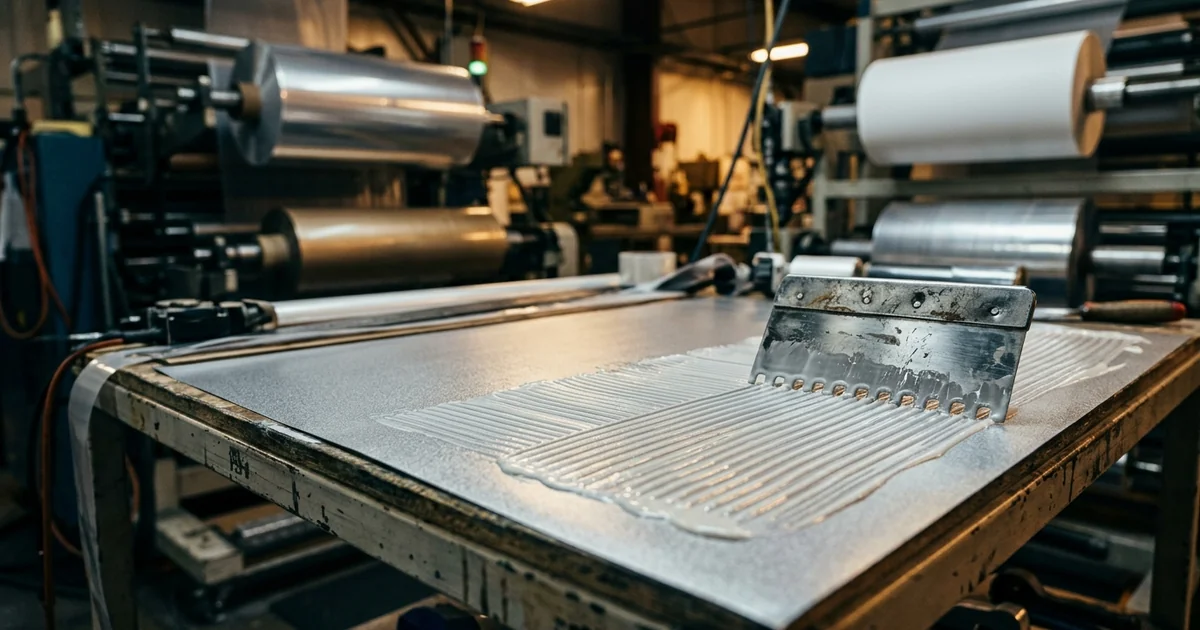
An adhesive formulator finishes a solvent-borne product that bonds beautifully, ships samples to a European customer, and gets the order rejected — not for a performance failure, but because the VOC content sits above the limit for that adhesive's specific application category. This scenario repeats constantly across the industry, because low VOC waterborne adhesive chemistry has moved from a niche sustainability talking point to a hard market-access requirement in construction, packaging, footwear, and automotive supply chains. Getting reformulation wrong costs a rejected shipment or a failed customer audit; getting it right opens markets that a solvent-based product simply cannot enter. This guide explains what actually drives the regulatory pressure, how polyurethane dispersion chemistry replaces solvent-borne systems at the molecular level, where waterborne adhesives still fall short of their solvent-based predecessors, and how to plan a reformulation that survives contact with a real production line. It sits alongside our broader adhesives and sealants industry overview and complements our detailed comparison of solvent-based, waterborne, and high-solids coatings and adhesives.
Why Adhesive VOC Regulation Tightened
Volatile organic compounds released during adhesive application and cure are regulated because they are a direct precursor to ground-level ozone and photochemical smog, and adhesive and sealant application was identified decades ago as a meaningfully large, geographically concentrated source of industrial VOC emissions in urban air basins. Unlike a single large point-source emitter, adhesive VOC emissions come from thousands of dispersed application sites — furniture plants, footwear factories, construction sites, packaging converters — which makes the problem harder to control through end-of-pipe abatement and pushes regulators toward controlling the VOC content of the product itself before it ever reaches the applicator.
That regulatory logic shows up in parallel frameworks across major markets, each covering the same underlying chemistry from a different legal angle:
- European Union — the Solvents Directive (1999/13/EC) and the subsequent VOC Directive (2004/42/EC) impose emission limits on coating and adhesive manufacturing and product categories
- United States — EPA National Emission Standards and, more granularly, regional air quality districts such as California's South Coast Air Quality Management District regulate adhesive VOC content directly
- Occupational exposure — solvent exposure limits for workers applying adhesives in enclosed spaces (shoe manufacturing cabinets being the historically largest example) have pushed reformulation independently of ambient air rules
The practical result for a manufacturer is that VOC compliance is no longer optional paperwork bolted onto a finished formulation — it is a design constraint that has to be built in from the first prototype, because the alternative is a product that cannot legally be sold or applied in an increasing share of its addressable market. Understanding exactly how those limits are structured is the next step, and this is where most formulators new to the category get caught out.
VOC Compliant Adhesive Regulation: Category, Not Blanket, Limits
The single most common mistake in adhesive VOC compliance planning is assuming one number applies across an entire product line. Real adhesive VOC regulation is built around dozens of narrowly defined application categories, each with its own ceiling, because the achievable VOC content for, say, a metal-to-metal structural adhesive is genuinely different from what is achievable for a plastic-welding cement that relies on solvent to physically fuse the substrate. SCAQMD Rule 1168 is the clearest illustration of this structure and is widely referenced globally as a specification benchmark even outside California, because of how granular its category system is.
| Adhesive category | VOC limit (g/L, less water and exempt compounds) |
|---|---|
| Metal to metal | 30 |
| Wood | 30 |
| Porous material (except wood) | 50 |
| Plastic foam | 50 |
| Contact adhesive (general) | 80 |
| Fiberglass | 80 |
| Structural wood member adhesive | 140 |
| Special-purpose contact adhesive | 250 |
| Reinforced plastic composite | 250 |
| ABS welding | 325 |
| CPVC welding | 490 |
| PVC welding | 510 |
Notice the pattern: substrate-bonding adhesives for wood, metal, and porous materials sit at the tightest end because waterborne and high-solids chemistry can already meet demanding performance requirements there, while plastic-welding cements sit far higher because their bonding mechanism genuinely depends on solvent softening the substrate itself, not simply adhering to its surface. A formulator planning a reformulation has to identify the correct category first — misclassifying a product against a more lenient category is a compliance failure waiting to surface at the next customer or regulatory audit. Read in full, Rule 1168's official category list is the reference formulators most commonly work from even outside its own jurisdiction.
Category-specific limits also explain why waterborne reformulation succeeds faster in some product lines than others — the target moves depending on what the adhesive is being asked to do, which brings the discussion to the chemistry doing the heaviest lifting in this transition.
Waterborne PU Dispersion Adhesive Chemistry
Polyurethane dispersion, universally abbreviated PUD, is the dominant waterborne chemistry behind modern low-VOC adhesive reformulation, and understanding how it achieves water dispersibility explains both its strengths and its formulation constraints. Unlike a conventional emulsion polymer that needs an external surfactant to stay suspended, a PUD is built to disperse itself: the polyurethane prepolymer is synthesised with pendant carboxylic acid groups built directly into its backbone, most commonly introduced using dimethylolpropionic acid (DMPA). Once those acid groups are neutralised with a base, typically triethylamine, the resulting ionic charge on the polymer chain lets it disperse spontaneously in water under moderate shear — no separate surfactant package required, which avoids the water sensitivity and foaming issues surfactant-stabilised systems can introduce.
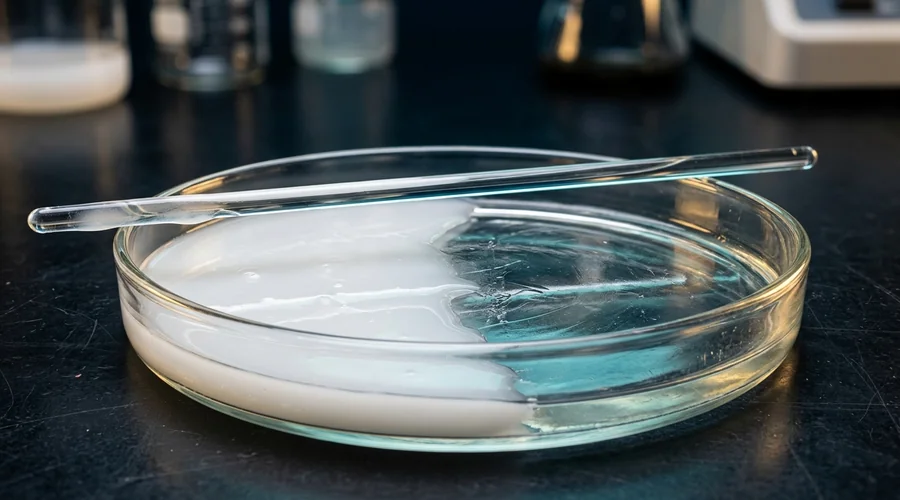
Once dispersed, the particles are typically chain-extended with a diamine to build final molecular weight while already in water, and many adhesive-grade PUDs are formulated to self-crosslink after application. A carbodiimide or aziridine crosslinker reacts with the residual carboxylic acid groups on the polymer once the water has evaporated, converting a linear, thermoplastic film into a lightly crosslinked network with substantially better heat resistance, solvent resistance, and long-term bond durability than an uncrosslinked PUD film could achieve alone. This crosslinking step is frequently the difference between a PUD adhesive that is adequate for light-duty lamination and one that can genuinely replace a solvent-borne structural product.
PUD chemistry alone does not cover the whole waterborne adhesive landscape, though — several other platforms solve the low-VOC problem through different mechanisms entirely, and knowing when to reach for each one matters as much as understanding PUD itself.
Solvent Free Adhesive Formulation Beyond PUD
Polyurethane dispersion dominates the conversation because of its versatility, but it is far from the only route to a compliant low-VOC or zero-VOC adhesive, and a formulator limiting the search to PUD alone can miss a better-fitting chemistry for a specific application. Three other platforms account for most of the remaining low-VOC adhesive market, each solving the solvent-elimination problem through a fundamentally different route rather than simply being "PUD with a different name."
- Acrylic emulsions — waterborne acrylic polymer dispersions dominate pressure-sensitive adhesive tape and label manufacturing, offering excellent UV and weathering stability at a materially lower cost than PUD for high-volume applications
- Hot melt adhesives — eliminate the solvent question entirely rather than substituting water for it, since the polymer is applied molten and solidifies on cooling with essentially zero VOC content by design
- 100%-solids reactive systems — two-component epoxy and polyurethane reactive adhesives cure through chemical crosslinking rather than carrier evaporation, so there is no solvent or water to remove at all
Each of these carries its own trade-off against PUD. Acrylic emulsions generally cannot match PUD's peel and shear strength on demanding substrates. Hot melts require heated application equipment and have a limited open time once dispensed. Reactive 100%-solids systems avoid the drying-time penalty that all waterborne chemistries share, but usually cost more per unit of adhesive and require more careful metering and mixing control on the production line. Our guide to acrylic vs rubber pressure-sensitive adhesive chemistry covers the acrylic emulsion route in depth for tape and label applications specifically.
Choosing between these platforms is a genuine engineering decision, not a formality — and it becomes sharper still once the application conditions the adhesive will actually face are factored in.
Water Based Contact Adhesive: Application Realities
Contact adhesives deserve their own discussion because the switch from solvent-based neoprene or SBS contact cement to a water-based alternative changes the application process more visibly than almost any other adhesive category. A solvent-based contact adhesive develops handling strength as its more volatile carrier flashes off within minutes; a water-based contact adhesive depends on water evaporating and dispersed polymer particles coalescing, which is a slower and far more condition-sensitive process. This is the practical reason many operators who switch report longer waiting times before parts can be bonded, even when the underlying polymer chemistry is comparable in final bond strength.
The application variables that matter most when moving to water-based contact adhesive are:
- Substrate temperature — waterborne systems generally need substrates several degrees above their minimum film formation temperature to coalesce into a usable film at all
- Relative humidity — high ambient humidity slows water evaporation directly, extending open time unpredictably compared to a controlled solvent-based process
- Substrate porosity — porous substrates give evaporating water somewhere to go; non-porous, low-energy substrates can trap moisture and leave a weak, underdeveloped bond
- Open time and working window — waterborne contact adhesives typically extend open time compared with solvent-based equivalents, which changes production line pacing rather than simply extending a coffee break
For the neoprene and SBS-specific version of this transition, including the exact polymer chemistry behind water-based polychloroprene dispersions, our dedicated article on contact adhesive chemistry for neoprene and SBS systems covers the formulation detail directly. The broader lesson that applies across every adhesive category, not just contact cement, is that reformulating the chemistry without also reformulating the application process is where most low-VOC transitions fail in the field rather than in the lab — which raises a separate compliance question that content-focused VOC rules do not fully answer.
Content Limits vs Emissions Testing: Two Different Rules
VOC content regulation and VOC emissions testing sound similar but answer genuinely different questions, and confusing the two is a recurring compliance gap for manufacturers entering building-products markets. Content regulation, the SCAQMD Rule 1168 and EU VOC Directive category, measures what is physically present in the wet adhesive as sold. Emissions testing measures something that content regulation cannot capture at all: what actually off-gasses from the cured, dried adhesive film once it is installed inside an occupied building, months or years after application.
Emissions testing operates under an entirely separate set of standards, most of them built around sealed environmental chamber measurement:
- CDPH Standard Method V1.2 — the primary North American emissions standard, required for LEED v4 Low-Emitting Materials credits, testing total VOCs and specific compounds against chamber concentration limits
- AgBB scheme — the German evaluation scheme for indoor building product emissions, assessing total VOC and a defined list of individually regulated substances at set time points after application
- French VOC emissions labelling — a mandatory classification (A+ to C) for building and decoration products sold in France, based on chamber-measured emissions of a defined substance list
A manufacturer supplying flooring, panel lamination, or interior construction adhesives into LEED, AgBB, or French-labelled markets needs both data packages ready, because a buyer's specification will typically demand proof of both rather than accepting one as a proxy for the other. With both regulatory dimensions now on the table, the practical question becomes how solvent and waterborne systems actually compare once all of this is accounted for.
Solvent vs Waterborne Adhesive: A Direct Comparison
Laying the two platforms side by side makes clear that this is not a story of waterborne simply being "better" — it is a set of genuine trade-offs that a formulator has to weigh against the specific bonding application, not resolve with a generic sustainability preference. The pattern that consistently emerges is that waterborne systems have closed most of the historical performance gap for general bonding while retaining real, measurable disadvantages in a smaller set of demanding application conditions.
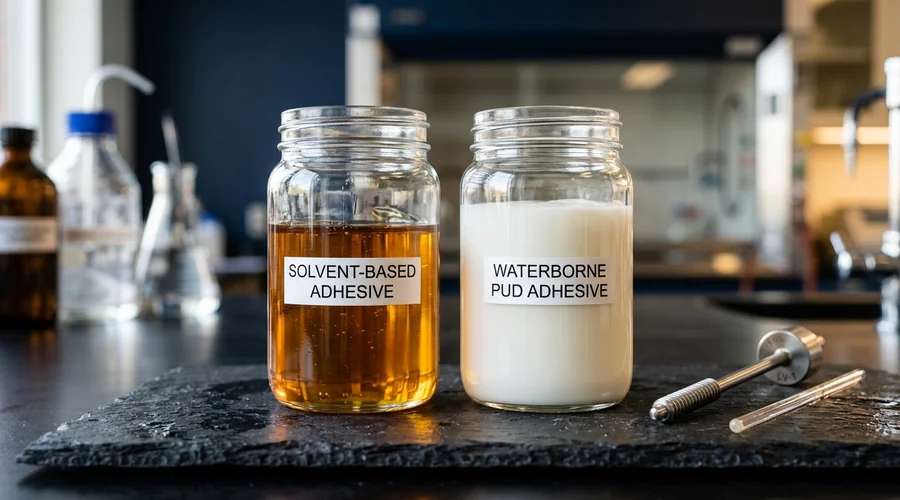
| Attribute | Solvent-based adhesive | Waterborne (PUD / acrylic emulsion) |
|---|---|---|
| Typical VOC content | 300–600 g/L uncontrolled | Often well under 50 g/L depending on category |
| Film formation | Solvent evaporation, fast flash-off | Water evaporation and particle coalescence, generally slower |
| Application temperature window | Wide, tolerant of cool conditions | Narrower — needs minimum film formation temperature |
| Humidity sensitivity | Low | High — elevated humidity extends open time significantly |
| Non-porous substrate performance | Strong, no carrier-escape constraint | Can be limited — water needs somewhere to evaporate to |
| Regulatory market access | Increasingly restricted by category | Broadly compliant across most jurisdictions |
| Worker exposure profile | Requires ventilation, exposure controls | Substantially reduced solvent exposure risk |
Read that comparison as a decision framework rather than a scoreboard: the categories where solvent still leads are shrinking but real, and a manufacturer who treats every application as suitable for immediate waterborne conversion will eventually hit one of those genuine performance limits. The more useful question is how to sequence a reformulation project so those limits get discovered in testing, not in a customer's warehouse.
A Practical Reformulation Path Toward Green Adhesive Chemistry
Moving an existing solvent-based adhesive line toward compliant, waterborne, low-VOC chemistry works best as a staged process rather than a single reformulation event, because each stage surfaces a different category of problem — chemical, regulatory, or operational — that is much cheaper to catch early than after a customer has qualified the product.
- Classify the product correctly under every target market's category system — the same physical adhesive can face different VOC ceilings depending on how it is marketed and applied, so get the classification right before formulating to a number
- Select the waterborne platform against the actual bonding job — PUD for demanding lamination and structural bonding, acrylic emulsion for cost-sensitive tape and label work, hot melt or 100%-solids reactive systems where drying time cannot be tolerated at all
- Validate under realistic, not laboratory-ideal, application conditions — test at the actual substrate temperature, humidity range, and porosity the product will see in the customer's facility, not just standard lab conditions
- Generate both content and emissions data if targeting building-product markets — a Rule 1168 or VOC Directive content pass does not substitute for CDPH, AgBB, or French emissions chamber data where those certifications are required
- Re-engineer the application process alongside the formulation — equipment, drying capacity, and operator technique frequently need to change together with the chemistry, not after it
Manufacturers who follow this sequence tend to reach a compliant, field-reliable product on the first qualification attempt, while those who treat reformulation as a pure chemistry substitution frequently discover the application-side problems only after the product has already shipped. Getting the sequence right the first time is, in the end, what turns a regulatory obligation into a genuine competitive advantage in markets that increasingly specify low-VOC adhesives by default rather than as an exception.
Frequently Asked Questions
What makes an adhesive count as low-VOC or waterborne?
Waterborne describes the carrier: the adhesive polymer is delivered as a colloidal dispersion or solution in water rather than dissolved in organic solvent, so the bulk of what evaporates during film formation is water rather than volatile organic compounds. Low-VOC is a regulatory classification measured directly — grams of volatile organic compound per litre of product, excluding water and specifically exempt compounds — and the exact ceiling a product must meet depends on which adhesive category it falls into under the applicable rule.
The two terms usually travel together because switching the carrier from solvent to water is the most common way manufacturers hit a lower VOC ceiling, but a formulation can also be low-VOC while still being solvent-based, using high-solids resin technology or exempt solvents to keep the measured VOC content down without removing water as the question at all.
How does polyurethane dispersion (PUD) adhesive chemistry actually work?
A polyurethane dispersion is built by first synthesising a polyurethane prepolymer with pendant carboxylic acid groups, most commonly introduced using dimethylolpropionic acid (DMPA) built into the polymer backbone. Once those acid groups are neutralised with a base such as triethylamine, the resulting ionic centres let the prepolymer disperse spontaneously in water under moderate shear, without needing an external surfactant to hold the particles apart.
The dispersed particles are then chain-extended, typically with a diamine, to build the final molecular weight while the polymer is already in water. Many adhesive-grade PUDs are also formulated to self-crosslink after application, commonly through a carbodiimide or aziridine crosslinker that reacts with the residual carboxylic acid groups once the water has evaporated, which raises heat and moisture resistance well above what an uncrosslinked linear PUD film can achieve on its own.
What is SCAQMD Rule 1168 and why does it matter for adhesive formulators?
Rule 1168, Adhesive and Sealant Applications, is issued by California's South Coast Air Quality Management District and has regulated VOC content in adhesives and sealants sold or used in the South Coast air basin since 1989, with its limits tightened significantly in a 2017 amendment. It matters beyond California because it is one of the most detailed, product-category-specific adhesive VOC rules in the world and is widely used as a de facto specification reference even outside the region it legally governs.
Rather than setting one blanket limit, it assigns a distinct VOC ceiling in grams per litre to dozens of narrowly defined categories — contact adhesive at 80 g/L, metal-to-metal adhesive at 30 g/L, porous material adhesive (other than wood) at 50 g/L, and structural wood member adhesive at 140 g/L are representative examples — which means a formulator cannot simply target one number for an entire adhesive product line; the compliant VOC ceiling depends on the specific bonding application the adhesive is sold for.
Are waterborne adhesives always a straightforward replacement for solvent-based systems?
No, and treating the switch as a simple ingredient swap is the most common cause of failed reformulation projects. Waterborne systems form a film only after water evaporates and the dispersed polymer particles coalesce, which means they generally need warmer application temperatures, tolerate humidity far less well, and develop working strength more slowly than a solvent system that only needs its more volatile carrier to flash off.
They are also far more sensitive to porous versus non-porous substrates, since a non-absorbent surface gives the water nowhere to go and can leave the film wet and weak long after a solvent-based adhesive on the same surface would already be handling-strength. None of this makes waterborne adhesives inferior — it means the application process, not just the raw material, has to be re-engineered alongside the formulation change.
What is the difference between VOC content regulation and VOC emissions testing for adhesives?
VOC content regulation, the kind enforced by rules like SCAQMD Rule 1168 or the EU VOC Directive, measures what is physically inside the wet adhesive as sold — grams of volatile organic compound per litre of product. VOC emissions testing measures something different: what actually off-gasses from the cured, dried adhesive film over time once it is installed in a building, assessed in a sealed environmental chamber under standards such as the CDPH Standard Method V1.2 in North America or the AgBB scheme in Germany.
A product can have a very low VOC content by weight and still generate a measurable emissions profile from residual monomer, catalyst breakdown products, or plasticiser migration, which is why building-product certifications such as LEED and the French VOC emissions label evaluate adhesives against emissions chamber data rather than accepting content compliance as a substitute.
Can waterborne adhesives match solvent-based bond strength?
For a large and growing share of applications, yes — modern waterborne polyurethane dispersion and acrylic emulsion technology has closed most of the historical performance gap for flexible packaging lamination, footwear sole bonding, textile lamination, and pressure-sensitive labelling. The gap that remains is concentrated in a smaller set of demanding conditions: very fast initial tack on non-porous, low-energy substrates; long-term wet or immersion bond durability; and structural bonding at low application temperatures, where solvent evaporation kinetics and solvent-swelling of the substrate still give solvent-based systems a real, measurable advantage.
For most general industrial bonding, packaging, and construction applications, the honest answer today is that waterborne systems are the default choice, with solvent-based or 100%-solids reactive systems reserved for the specific performance envelopes waterborne chemistry has not yet fully closed.
Why do some adhesives stay solvent-based despite VOC regulation pressure?
Some bonding problems are still genuinely easier to solve with a solvent carrier than a water carrier, and regulators generally acknowledge this by setting a higher VOC allowance for those specific categories rather than banning them outright. Contact adhesives used in cold-temperature or outdoor field applications, certain plastic-welding adhesives that rely on solvent to soften and fuse the substrate itself rather than simply bond to it, and some low-temperature-cure structural applications fall into this group.
In these cases the industry response has generally been to reduce VOC content through high-solids reformulation or exempt-solvent substitution rather than eliminating solvent altogether, and regulatory categories such as Rule 1168's PVC and CPVC welding adhesive limits reflect that these are treated as a genuinely different chemistry problem, not simply an unreformed legacy product.
What should a startup check before committing to a waterborne adhesive reformulation?
Start by identifying every market the product will be sold or applied into, because VOC limits are set at the jurisdiction and even city-region level and the strictest applicable limit is the one that governs the formulation, not the average. Next, confirm which specific adhesive-application category the product falls under, since the same chemistry can face a very different VOC ceiling depending on whether it is marketed as, say, a general-purpose contact adhesive or a specialty substrate-specific adhesive.
Then validate the realistic application conditions the end customer will actually use — temperature, humidity, substrate porosity, and required open time — because a formulation that performs in a controlled lab often fails in an uncontrolled field or factory-floor environment. Finally, budget for a genuinely different application process, not just a different raw material cost, since waterborne systems frequently require modified equipment, drying capacity, or application technique compared to the solvent-based product they are replacing.
Reformulating Toward Low-VOC Adhesive Chemistry?
Global Formulation provides adhesives consultancy — waterborne PU dispersion selection, category-specific VOC compliance strategy, application-process reformulation, and support across low-VOC and solvent-free adhesive platforms.
Talk to Our Formulation Team