Medical Device Coating Technology: Types and Selection
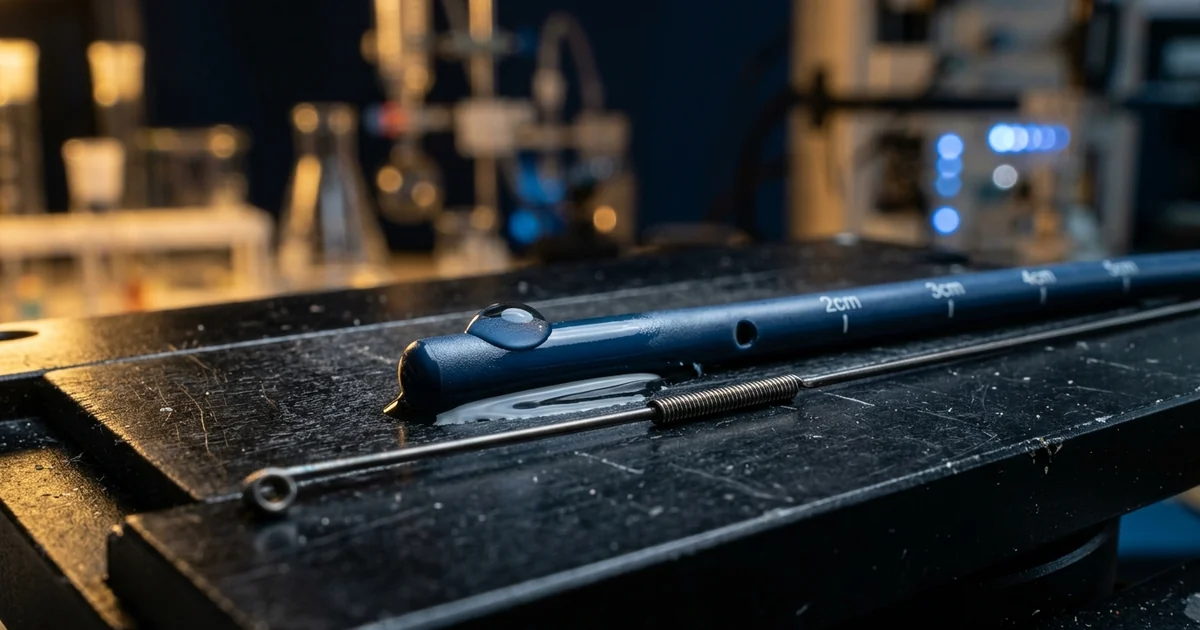
A guidewire that binds halfway through a tortuous vessel, a coronary stent that triggers renewed tissue growth weeks after implantation, a urinary catheter colonised within days — each of these is a surface problem, and each is solved or worsened by a coating only a few microns thick. Medical device coating technology is the discipline of engineering that surface layer to do a specific job: cut friction, release a drug on a defined schedule, resist microbial attachment, or improve blood compatibility, without compromising the device underneath. The stakes are unusually high because a coating change alters the tissue-contacting surface, which resets the biological risk assessment and often the regulatory pathway for the whole device. This guide covers the main coating classes — hydrophilic lubricious, drug-eluting, and antimicrobial — how each is formulated and applied, why adhesion and durability failures dominate development, and how the biocompatibility and sterilisation work is sequenced. It draws on the cross-disciplinary formulation and process expertise behind our pharmaceuticals and healthcare consulting practice.
Why Medical Device Coating Technology Decides Device Performance
Almost every interaction between an implanted or inserted device and the body happens at the outermost surface — friction against a vessel wall, protein adsorption that triggers clotting, bacterial attachment that seeds infection, and the local drug concentration that controls a tissue response. The bulk material of a device is chosen for mechanical properties like stiffness, radiopacity, and fatigue resistance, and those requirements rarely coincide with the ideal surface chemistry. A coating decouples the two problems: the substrate delivers the mechanics, and a thin engineered layer delivers the biological and tribological behaviour.
- Tribological function — reducing insertion and navigation force through lubricious surfaces
- Pharmacological function — delivering an active locally at a controlled rate from a drug-eluting matrix
- Anti-infective function — suppressing microbial colonisation on indwelling devices
- Haemocompatible function — limiting platelet adhesion and thrombus formation on blood-contacting surfaces
Because a single device may need two or three of these functions at once — a lubricious, anti-thrombogenic, drug-eluting surface is a realistic specification — coating development is rarely about one polymer and one property, and the trade-offs between functions are where most of the formulation work sits, starting with the most widely used class: hydrophilic lubricious coatings.
Hydrophilic Lubricious Coatings
Hydrophilic coatings are the workhorse of interventional device technology because they transform a dry, high-friction polymer or metal surface into a slippery hydrogel the moment it contacts blood or saline. The coating polymer carries a high density of water-binding groups, so on hydration it swells into a soft, lubricious layer with a coefficient of friction that can be an order of magnitude below the uncoated surface. This is what lets a modern guidewire or microcatheter navigate distal vasculature that would be inaccessible with a bare device.
- Polyvinylpyrrolidone (PVP) systems — widely used for strong lubricity; usually crosslinked or interpenetrated with a base layer to resist wear
- Polyethylene glycol and polyacrylic acid coatings — high water uptake, tunable thickness, used where a very low insertion force is the priority
- Hydrophilic polyurethane and multi-layer constructions — a tie or primer layer bonds to the substrate, a top layer delivers lubricity, balancing adhesion against slip
The engineering challenge with hydrophilic coatings is almost never generating lubricity — it is keeping that lubricity durable and particulate-free across the full simulated-use protocol, which is fundamentally an adhesion and crosslink-density problem rather than a surface-chemistry one.
Drug-Eluting Coatings and Release Control
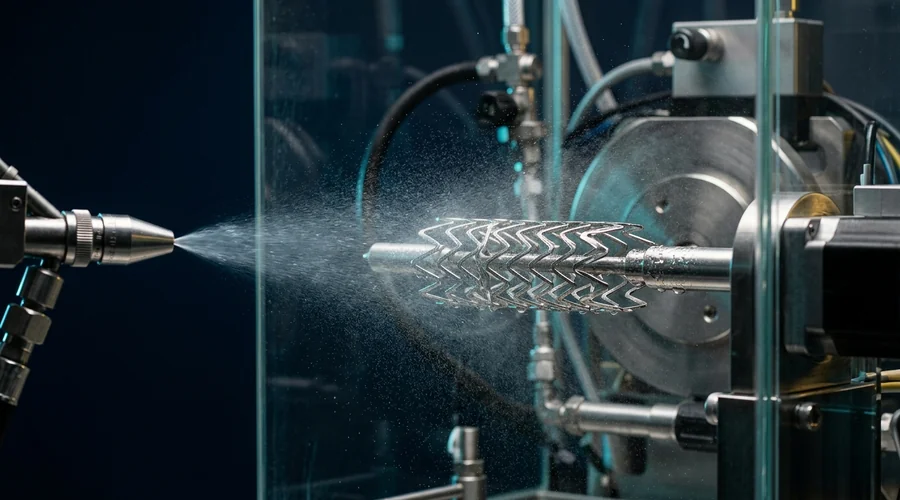
A drug-eluting coating is a local drug-delivery system built onto a device surface, and its purpose is to place an active exactly where a biological process needs to be modified — most famously, an antiproliferative drug on a coronary stent to suppress the neointimal growth that causes in-stent restenosis. The active is combined with a polymer that governs how fast the drug partitions out once the device is in place, so the same drug on the same device can be engineered for a burst over days or a sustained release over months. This release-engineering logic overlaps closely with other controlled-delivery formats, and the polymer-matrix principles are shared with the systems covered in our guide to nanoparticle drug delivery.
- Durable polymer matrices — remain on the device after drug depletion; well-characterised release control, but a permanent foreign polymer at the tissue interface
- Bioresorbable polymer matrices — poly(lactic acid), PLGA, or polycaprolactone that degrade after delivering the drug, leaving the bare device
- Polymer-free and reservoir designs — drug held in surface microstructures or abluminal wells, eliminating or minimising the polymer carrier
- Multi-layer constructions — a barrier topcoat over a drug layer to shape the release curve and reduce the initial burst
| Matrix Type | Release Control | Key Trade-off |
|---|---|---|
| Durable polymer | Well established, tunable | Permanent polymer at tissue interface |
| Bioresorbable polymer | Good, coupled to degradation rate | Degradation by-products and timing must be validated |
| Polymer-free / reservoir | Geometry-dependent, often faster | Harder to achieve long sustained release |
Whichever matrix is chosen, the coating has to hold its structure and its release profile through crimping onto a delivery balloon, expansion at the target site, and years of arterial flexing — so mechanical integrity testing on the deployed geometry is as central to the programme as the dissolution profile itself.
Antimicrobial and Anti-Thrombogenic Surfaces
Indwelling devices such as central venous catheters, urinary catheters, and some orthopaedic hardware are vulnerable to microbial colonisation and biofilm formation, which is why antimicrobial coatings aim to reduce attachment and early growth on the device surface during the highest-risk window after placement. Blood-contacting devices face a parallel problem: protein adsorption and platelet activation on a foreign surface, which anti-thrombogenic coatings are designed to blunt. Both are surface-modification strategies, and both must clear the same biocompatibility bar as any other coating.
- Silver-based coatings — broad-spectrum activity from released silver ions; performance depends on controlling the release rate and total loading
- Chlorhexidine and antibiotic combinations — used on some vascular catheters; require data on the active and on local and systemic exposure
- Anti-adhesive polymer surfaces — highly hydrated or zwitterionic layers that resist protein and cell attachment without a released agent
- Heparin and other bioactive anti-thrombogenic coatings — surface-bound agents that reduce clot formation on blood-contacting devices
Antimicrobial and anti-thrombogenic coatings carry an extra regulatory dimension because they introduce a pharmacologically or biologically active element, which means the classification question has to be resolved early — and that resolution, in turn, shapes how the application and testing programme is built.
Application, Adhesion, and Durability
How a coating is applied is as decisive as its chemistry, because thickness uniformity, drying dynamics, and cure conditions all feed directly into friction, release rate, and adhesion. Dip coating, spray coating, and plasma-assisted deposition each suit different geometries and different coating systems, and the process has to be developed on the real device shape rather than on flat coupons. Most coating failures in development are adhesion and durability failures, and they trace to the interface between the coating and the substrate — the same class of interface-bonding problem that governs performance in fields as different as GMP-controlled pharmaceutical manufacturing environments where particulate control is paramount.
- Surface preparation — cleaning, plasma treatment, or chemical activation to raise surface energy and give the coating something to bond to
- Primer or tie layer — an intermediate chemistry matched to both the substrate (nitinol, stainless steel, PEBA, silicone) and the functional top layer
- Functional layer application — dip, spray, or deposition with controlled withdrawal speed, spray parameters, and solvent evaporation
- Cure and crosslink — thermal or UV cure to build the network that resists wear and shedding
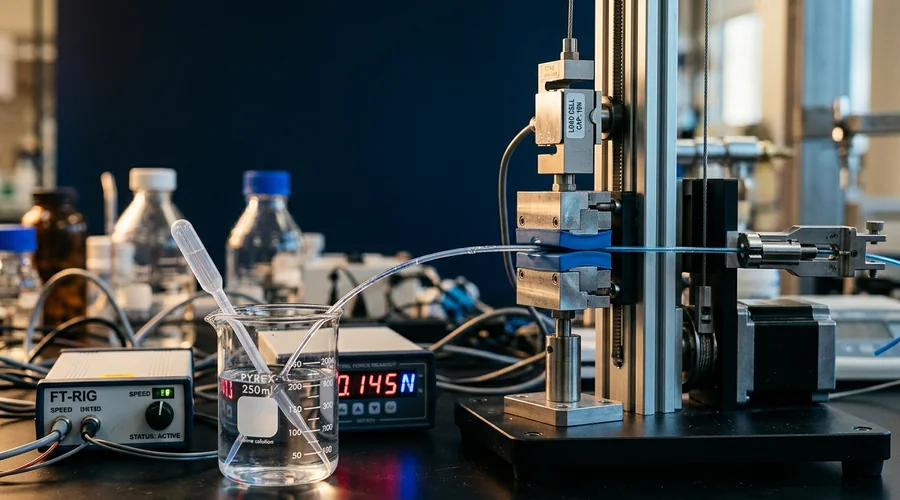
- Simulated-use and aging validation — flex, track, crimp/expand, and accelerated aging on the finished device, with particulate and friction endpoints
The practical lesson is that coupon testing tells you whether a coating can work, but only mechanical and simulated-use testing on the actual device geometry tells you whether it will survive handling, deployment, and service life — and that testing needs to start early, because an interface failure usually means reworking the primer chemistry, not tweaking the top layer.
Biocompatibility, Sterilisation, and Regulatory Path
A coating changes the surface that contacts tissue or blood, so it changes the biological evaluation of the entire device, and that work usually sits on the critical path of a coated-device programme. Testing follows the ISO 10993 series, scoped by the nature and duration of body contact, and it needs finished, sterilised samples — which means the sterilisation method has to be chosen and validated in parallel, not afterward. Any change to the coating can reset these studies, so the formulation should be as close to final as possible before the biocompatibility programme starts in earnest.
- Biological evaluation — cytotoxicity, sensitisation, irritation, and for blood-contacting devices haemocompatibility, per ISO 10993, scoped to contact type and duration
- Chemical characterisation — extractables and leachables analysis of what the coating can release, with toxicological risk assessment
- Particulate testing — quantifying coating fragments shed under simulated use, a specific concern for intravascular devices per applicable FDA guidance
- Sterilisation compatibility — friction, adhesion, drug content, and release profile re-tested on gamma-, e-beam-, or ethylene-oxide-sterilised samples; EO residuals within permitted limits
- Classification and submission strategy — device, device-with-drug, or combination product, confirmed with the regulator early
| Coating Change | What Must Be Repeated |
|---|---|
| New coating polymer or crosslinker | Full ISO 10993 scope, extractables/leachables, particulate, simulated use |
| Sterilisation method change | Friction, adhesion, drug content and release, EO residuals or radiation dose effects |
| Drug load or release-layer change | Release profile, mechanical integrity on deployed geometry, toxicology of exposure |
| Substrate or primer change | Adhesion, durability, particulate, simulated-use on real geometry |
The through-line across every coating class in this guide is that the coating is the easy part to make and the hard part to validate — lubricity, drug release, and antimicrobial activity can each be demonstrated quickly at the bench, but proving durability, particulate safety, sterilisation stability, and biocompatibility on the finished device is where programmes stall. A structured plan that sequences the simulated-use and ISO 10993 work against a near-final formulation, rather than iterating the coating in parallel with testing, is what keeps a coated-device project on schedule — and that sequencing discipline is exactly what a formulation and process partner experienced in coated devices is built to provide.
Frequently Asked Questions
What does a hydrophilic coating actually do on a catheter or guidewire?
A hydrophilic coating is a thin polymer layer that binds a large amount of water when it contacts body fluid or saline, forming a slippery gel-like surface with a very low coefficient of friction. That lubricity makes it far easier to advance a catheter, guidewire, or introducer through a tortuous vessel or narrow lumen, reduces the insertion force felt by the clinician, and lowers the mechanical irritation and endothelial trauma associated with a dry device surface.
The coating is bonded to the device rather than applied as a separate lubricant, so the low-friction surface travels with the device and stays in place during navigation. Performance is characterised by friction testing before and after repeated wipe or flex cycles, because a coating that is slippery once but sheds after a few passes is not clinically useful.
How is a drug-eluting coating different from just applying a drug to a device?
A drug-eluting coating is an engineered release system, not simply a drug film. The active is dispersed in or layered with a polymer matrix, and that matrix is designed to control how quickly the drug leaves the surface once the device is implanted, whether that is over hours, weeks, or months, and whether release is roughly constant or front-loaded.
The polymer can be durable, staying on the device indefinitely, or bioresorbable, gradually breaking down so that only the bare device remains after the drug has been delivered. The formulation work is in matching the release profile to the biological objective, such as suppressing the localised cell proliferation that causes restenosis around a coronary stent, while keeping the coating mechanically intact through crimping, expansion, and flexing.
What polymers are typically used for medical device coatings?
Hydrophilic lubricious coatings commonly use polyvinylpyrrolidone, polyethylene glycol, polyacrylic acid, or hydrophilic polyurethanes, often crosslinked or interpenetrated with a base layer for adhesion. Drug-eluting coatings have used durable polymers such as poly(styrene-b-isobutylene-b-styrene) and various acrylate and fluoropolymer systems, alongside bioresorbable options such as poly(lactic acid), poly(lactic-co-glycolic acid), and polycaprolactone.
Antimicrobial coatings may incorporate silver, chlorhexidine, or antibiotic combinations within a carrier polymer. Every one of these choices is constrained by biocompatibility data, sterilisation compatibility, and the mechanical demands of the specific device, so the polymer is selected against the full requirement set rather than picked for a single property.
Why does biocompatibility testing dominate the development timeline?
A coating changes the surface that contacts tissue or blood, so from a regulatory standpoint it changes the biological risk profile of the whole device, and that has to be re-evaluated. Testing follows the ISO 10993 series and is scoped by the nature and duration of body contact, covering endpoints such as cytotoxicity, sensitisation, irritation, and for blood-contacting devices, haemocompatibility, along with chemical characterisation of what the coating can leach.
Particulate testing is also critical, because coating fragments that shed into the bloodstream are a recognised failure mode for intravascular devices. Because these studies are sequential, need finished sterilised samples, and any coating change can reset them, biocompatibility work is usually the critical path in a coated-device programme.
Can a coating survive ethylene oxide or gamma sterilisation?
It depends on the coating chemistry, and sterilisation compatibility has to be designed in rather than checked at the end. Gamma and electron-beam sterilisation deposit energy that can crosslink or chain-scission a polymer, potentially embrittling a lubricious coating or altering a drug-release rate, and can degrade some drug actives directly.
Ethylene oxide is gentler on polymers but requires the coating and device to outgas residual ethylene oxide and its by-products to within permitted limits, which some hydrophilic gels do slowly. The practical approach is to select the sterilisation method early, test the coating's friction, adhesion, drug content, and release profile on sterilised samples, and treat any of those shifting outside specification as a formulation problem to solve before design freeze.
What is the most common reason a medical device coating fails in development?
Adhesion and durability failures are the most frequent, and they usually trace back to the interface between the coating and the device substrate rather than the coating bulk. A coating can meet its friction or release target in isolation and still delaminate, crack, or shed particulate when the device is crimped, expanded, flexed, tracked through an introducer, or aged.
The fix is normally in surface preparation and the tie or primer layer chemistry, matching the coating system to the specific substrate, whether that is nitinol, stainless steel, a polyether block amide, or silicone. Catching this requires mechanical and simulated-use testing on the real device geometry early, not just coupon testing on flat samples.
Are antimicrobial device coatings regulated as drugs or as devices?
It depends on the primary mode of action and the jurisdiction, and this classification question should be settled early because it determines the entire regulatory pathway. When the antimicrobial agent provides an ancillary action supporting the device's main purpose, such as reducing colonisation of a catheter, the product is often regulated as a device with a drug component, requiring additional data on the active.
When the antimicrobial effect is a primary therapeutic claim, the pathway can shift toward a combination product or drug-led review. Because the evidence burden differs substantially between these routes, a pre-submission conversation with the relevant regulator on classification is a standard early step.
Why work with a formulation consultant on a device coating rather than an in-house team?
A device coating sits at the intersection of polymer chemistry, drug-release engineering, surface science, mechanical testing, sterilisation, and ISO 10993 biocompatibility, and few device companies carry deep expertise across all of those at once. A consultant who has taken coated devices through development brings validated coating systems for common substrates, established relationships with contract application and testing houses, and a structured plan that sequences the biocompatibility and simulated-use work so it does not become an open-ended critical path.
That shortens the iteration cycle and reduces the risk of a late-stage failure, such as particulate shedding or a sterilisation-induced release shift, that forces a full coating redesign after significant investment.
Developing a Coated Medical Device?
Global Formulation provides pharmaceutical and healthcare product development consultancy — coating formulation, drug-release engineering, and the biocompatibility and simulated-use testing strategy a coated device needs.
Talk to Our Formulation Team