Nutraceutical Formulation Bioavailability: A Complete Guide
A curcumin supplement can list a generous dose on its label and still deliver almost none of that compound into the bloodstream, because turmeric's active compound is one of the least bioavailable natural molecules ever studied — and curcumin isn't the exception in nutraceutical formulation, it's closer to the rule. Nutraceutical formulation bioavailability is the single biggest gap between what a supplement's label promises and what actually reaches a consumer's system, and unlike prescription drugs, the market rarely forces a manufacturer to prove the difference. That gap matters commercially as much as physiologically: a product that genuinely works builds repeat purchase and word-of-mouth, while a poorly bioavailable formulation can look identical on a label while delivering a fraction of the benefit. This guide covers why so many popular nutraceutical bioactives absorb poorly, the regulatory context that makes bioavailability a quality choice rather than a legal requirement, and the lipid-based, particle-engineering, and delivery-format technologies formulators actually use to close that gap. It draws on the same pharmaceutical and healthcare formulation expertise we apply across our pharmaceuticals and healthcare consulting work.
Why Bioavailability Is the Central Problem in Nutraceutical Formulation
Bioavailability describes the fraction of an administered dose that reaches systemic circulation in an active, unmetabolized form, and for a large share of the compounds most popular in the nutraceutical market, that fraction is remarkably small. Curcumin, resveratrol, quercetin, and coenzyme Q10 are all lipophilic or poorly water-soluble molecules with limited intestinal absorption and, in several cases, rapid first-pass metabolism that further reduces how much of an ingested dose ever becomes available to tissues. This isn't a manufacturing defect — it's an intrinsic property of the molecule itself, which means no amount of raw ingredient purity or dosage increase alone fixes the problem; the compound has to be delivered differently.
- Poor aqueous solubility — many bioactive natural compounds are lipophilic and dissolve poorly in the aqueous environment of the gastrointestinal tract, limiting the amount available for absorption
- Rapid first-pass metabolism — some compounds, notably curcumin, are extensively metabolized in the intestinal wall and liver before reaching systemic circulation, regardless of how much is initially absorbed
- Chemical instability — certain bioactives degrade under gastric pH or light and oxygen exposure before absorption can occur
- Limited membrane permeability — some natural compounds have structural features that restrict passive diffusion across the intestinal membrane even when dissolved
| Common Nutraceutical Bioactive | Primary Bioavailability Limitation |
|---|---|
| Curcumin | Poor solubility combined with rapid first-pass metabolism |
| Coenzyme Q10 | Very poor aqueous solubility, large lipophilic molecule |
| Resveratrol | Rapid metabolic conjugation despite reasonable initial absorption |
| Quercetin | Poor solubility and limited membrane permeability |
None of these limitations are fixed by simply putting more raw material into a capsule — they're fixed by changing how the compound is delivered to the gastrointestinal tract, which is exactly the formulation science this guide covers. But before getting to that technology, it's worth understanding why the nutraceutical market tolerates this problem at a scale the pharmaceutical industry never would.
The Regulatory Context: Why Nutraceuticals Don't Face the Same Proof Requirements as Drugs
In the United States, the Dietary Supplement Health and Education Act (DSHEA) of 1994 established that dietary supplements are regulated as a category of food, not drugs, which means a manufacturer does not need to prove a supplement's efficacy, including its bioavailability, to bring it to market. A New Dietary Ingredient notification is required for ingredients not marketed before DSHEA's cutoff, but that notification addresses safety, not whether the finished product actually delivers a meaningfully bioavailable dose of its stated ingredient. Good Manufacturing Practice requirements under 21 CFR Part 111 still apply and are enforced, so the identity, purity, strength, and composition of what's actually in the bottle must be accurate — but accurately labeled strength says nothing about how much of that labeled dose the body can actually use.
- No mandated bioequivalence testing — unlike generic drugs, competing supplement products with the same labeled ingredient and dose aren't required to demonstrate equivalent bioavailability to each other
- Structure/function claims only — supplements may claim to "support" a bodily function but cannot claim to treat, cure, or prevent disease without triggering drug regulation
- A parallel EU framework — the EU Food Supplements Directive (2002/46/EC) similarly regulates supplements as a food category with harmonized rules on permitted vitamins and minerals, but doesn't mandate bioavailability proof for botanical or novel bioactive ingredients
- Quality is enforced, efficacy isn't — GMP inspection covers identity and contamination testing, not whether the finished product performs as marketed
This regulatory gap is exactly why bioavailability becomes a genuine competitive and quality differentiator rather than a compliance checkbox — a manufacturer that solves it delivers a product that measurably outperforms a competitor's identically labeled capsule, and that difference shows up in consumer results and repeat purchase even without a regulatory mandate forcing the investment.
Lipid-Based Delivery Systems: Self-Emulsifying and Liposomal Technology
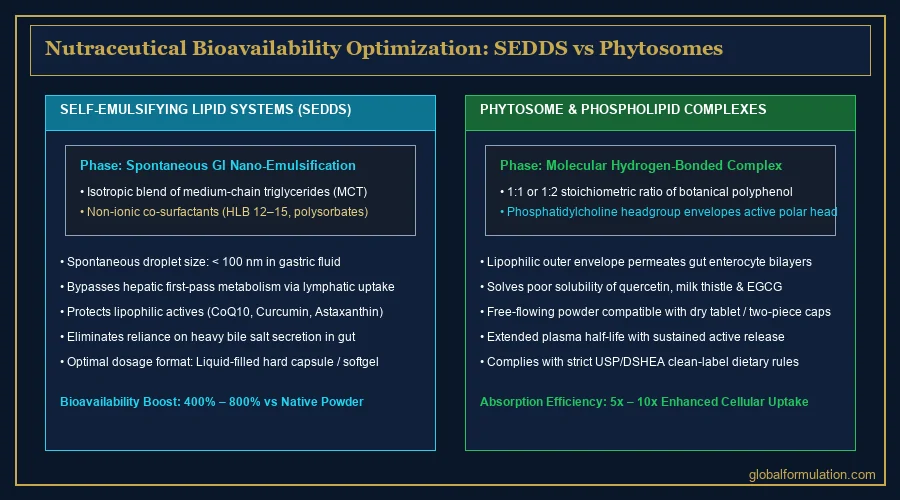
Because so many of the most commercially important nutraceutical bioactives are lipophilic, lipid-based delivery systems are the single most widely applied bioavailability-enhancement strategy in the industry, working by presenting the compound to the intestine already dissolved in or associated with a lipid carrier rather than as a solid particle that first has to dissolve.
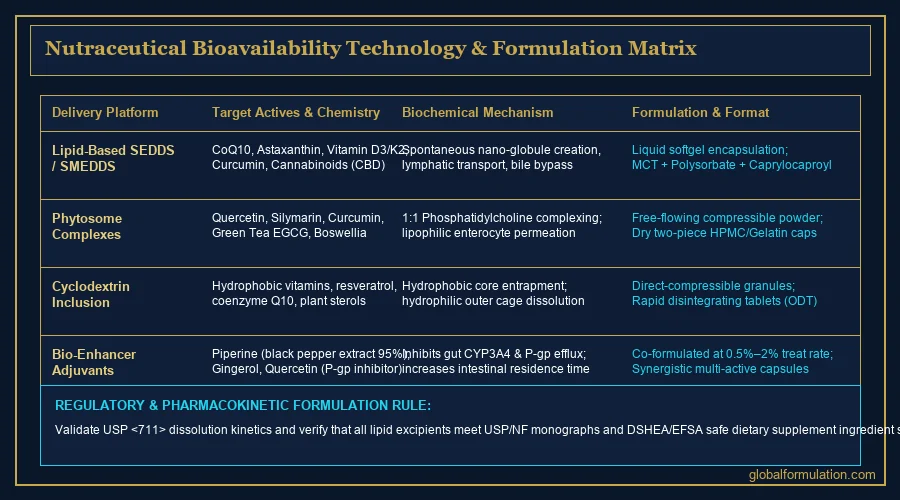
- Self-(micro)emulsifying delivery systems (SEDDS/SMEDDS) — a blend of oils, surfactants, and co-surfactants that spontaneously forms a fine emulsion or microemulsion on contact with gastrointestinal fluid, presenting the bioactive in a pre-dissolved state that bypasses the dissolution-rate bottleneck entirely
- Liposomal encapsulation — the bioactive is enclosed within a phospholipid bilayer vesicle, which can improve both solubilization and membrane permeability for compounds that also face absorption barriers beyond simple solubility
- Phospholipid complexes (phytosome technology) — the bioactive is complexed with phosphatidylcholine to improve lipid solubility and membrane interaction; curcumin-phosphatidylcholine complexes are among the most extensively published examples of this approach in the peer-reviewed literature
- Co-administration with absorption enhancers — piperine (black pepper extract) has been shown in published pharmacokinetic studies to increase curcumin bioavailability by inhibiting the glucuronidation pathway responsible for its rapid first-pass metabolism
Lipid-based systems solve the solubility side of the problem particularly well, but they aren't the only formulation lever — particle engineering, adapted from pharmaceutical solubility-enhancement science, offers a complementary or alternative path for compounds where a lipid vehicle isn't practical.
Particle Size Reduction and Solid-State Engineering
The particle-engineering techniques used to improve bioavailability of poorly soluble pharmaceutical drug candidates, covered in depth in our guide to solubility enhancement for poorly soluble drugs, apply conceptually to nutraceuticals as well, though the economics and material complexity of natural extracts change how they're used in practice. A nutraceutical formulator has to weigh the same dissolution-rate science against a natural ingredient's typically lower price point and, often, a more complex and variable starting material than a single purified pharmaceutical API.
- Micronization and nanocrystal technology — reducing particle size increases the surface area available for dissolution, directly improving dissolution rate for solid, crystalline bioactives
- Amorphous solid dispersion — dispersing the bioactive in a polymer matrix in its higher-energy amorphous form can dramatically increase apparent solubility versus the crystalline form, though it introduces a physical stability risk (recrystallization) that has to be managed through polymer selection and packaging
- Cyclodextrin complexation — forming an inclusion complex with a cyclic oligosaccharide can improve aqueous solubility for compounds with a suitably sized lipophilic core, a technique with growing use in nutraceutical-grade curcumin and CoQ10 products
Whichever particle-engineering route is chosen, the underlying goal is identical to the lipid-based approach: get the bioactive into a form the gut can actually absorb, faster and more completely than the raw material manages on its own — and the delivery format the finished formulation ends up in has to be built around whichever technology gets selected.
Delivery Format Selection: Softgels, Capsules, and Emerging Formats
The bioavailability-enhancement technology chosen upstream largely dictates which finished dosage form makes sense, because not every delivery format can physically accommodate every enhancement technology. Lipid-based systems like SEDDS and liposomal formulations are liquid or semi-solid at room temperature, which makes softgel encapsulation the natural fit, while solid-state technologies like amorphous dispersions or micronized powders are more compatible with conventional hard capsules or tablets — a format contrast covered from the tablet side in our guide to oral disintegrating tablet technology.
- Softgel capsules — a gelatin (or vegetarian HPMC-based) shell filled with a liquid or semi-solid matrix, ideal for oil-based lipid delivery systems and for protecting oxygen-sensitive lipophilic actives like CoQ10 and omega-3s from oxidative degradation
- Hard capsules — filled with powder blends, granules, or micronized/solid-dispersion material; more flexible for multi-ingredient formulas and typically lower-cost to manufacture than softgels
- Microencapsulation and beadlets — used to protect sensitive actives (probiotics, certain vitamins, unsaturated oils) from moisture, oxygen, or gastric pH degradation until they reach the intended site of release
Choosing the right format is a formulation decision with real manufacturing and shelf-life consequences, not just a packaging preference — but even a well-matched enhancement technology and delivery format still need to be verified, not assumed, before a bioavailability claim reaches a label.
Verifying Bioavailability Claims: Testing and Quality Considerations
Because the nutraceutical market doesn't mandate bioavailability proof the way drug approval does, verification becomes a voluntary but increasingly important quality and marketing differentiator, and the credible players in the space still invest in it even without a legal requirement to do so. In vitro dissolution testing, adapted from pharmaceutical methodology, serves as a practical, lower-cost surrogate for predicting how a formulation will behave in the gastrointestinal tract before committing to more expensive human studies.
- In vitro dissolution/release testing — measures how quickly and completely the active dissolves under simulated gastrointestinal conditions, used as a formulation-development and quality-control tool
- Human pharmacokinetic studies — measure actual blood plasma levels of the bioactive (or its metabolites) after dosing, the gold-standard evidence for a bioavailability claim, though costly enough that they're typically reserved for flagship or premium products
- Third-party quality certification (USP Verified, NSF Certified for Sport, and similar programs) — independently confirms label-claim accuracy and screens for contamination, addressing the broader adulteration and quality-control reputation problem that affects consumer trust across the supplement category
- Stability-indicating testing — confirms the enhanced-bioavailability form, such as an amorphous dispersion or liposomal system, remains in its intended physical state throughout shelf life, since some enhancement technologies can revert to a less bioavailable form over time if poorly stabilized
For a manufacturer or entrepreneur entering the nutraceutical space, the real competitive opportunity is treating bioavailability with the same formulation rigor the pharmaceutical industry applies as standard practice, backed by the right delivery technology, format selection, and verification testing, rather than relying on the regulatory floor the supplement category currently allows. A dedicated formulation partner can shortcut that development path considerably, from selecting the right lipid or particle-engineering technology through coordinating the dissolution and stability testing needed to substantiate a genuine bioavailability advantage. Get that formulation science right, and a nutraceutical product can measurably outperform an identically labeled competitor — get it wrong, and even a well-marketed supplement may deliver only a fraction of the benefit its label implies.
Frequently Asked Questions
What does bioavailability actually mean for a nutraceutical supplement?
Bioavailability is the fraction of an administered dose of a compound that reaches systemic circulation in an active, unmetabolized form and is therefore available to have a physiological effect. A supplement label's stated dose only tells you how much of a compound was put into the capsule — it says nothing about how much of that dose the body actually absorbs and can use.
For many popular nutraceutical bioactives, that absorbed fraction can be a small percentage of what's listed on the label unless the formulation specifically addresses it.
Why are compounds like curcumin and CoQ10 so poorly absorbed in their raw form?
Compounds like curcumin and coenzyme Q10 share properties that make them intrinsically difficult for the body to absorb: they are highly lipophilic and poorly soluble in the aqueous environment of the gastrointestinal tract, which limits how much dissolves and becomes available for absorption in the first place.
Curcumin faces an additional barrier — even the portion that does get absorbed is rapidly metabolized (primarily glucuronidated) in the intestinal wall and liver before it can reach systemic circulation intact, a combination of poor solubility and rapid first-pass metabolism that published pharmacokinetic studies have repeatedly documented.
Are nutraceutical manufacturers required to prove their product's bioavailability?
No — under the U.S. Dietary Supplement Health and Education Act (DSHEA), dietary supplements are regulated as a category of food, and manufacturers are not required to prove a finished product's bioavailability or efficacy before bringing it to market, unlike the rigorous approval pathway drugs go through.
Good Manufacturing Practice requirements under 21 CFR Part 111 do require that a product's identity, purity, strength, and composition match its label, but accurate labeling of the raw dose says nothing about how much of that dose the body can actually absorb and use.
How does a self-emulsifying delivery system (SEDDS) improve bioavailability?
A self-(micro)emulsifying delivery system is a blend of oils, surfactants, and co-surfactants that spontaneously forms a fine emulsion or microemulsion when it contacts aqueous gastrointestinal fluid, presenting the bioactive already dissolved within tiny lipid droplets rather than as an undissolved solid particle.
This matters because dissolution is often the rate-limiting step for poorly soluble compounds — by delivering the compound pre-dissolved, a SEDDS formulation skips that bottleneck and can significantly increase the fraction of the dose available for intestinal absorption compared to the same compound in a conventional powder-filled capsule.
What is a phytosome, and how is it different from a regular extract?
A phytosome is a complex formed between a plant extract's bioactive compound and a phospholipid, typically phosphatidylcholine, which improves the compound's compatibility with cell membranes and its solubility in lipid environments compared to the unmodified extract.
A regular standardized extract simply concentrates the bioactive compound to a specified potency without changing its underlying absorption behavior, while a phytosome chemically pairs it with a phospholipid carrier specifically to improve how well the body absorbs it — curcumin-phosphatidylcholine phytosome complexes are among the most extensively studied examples of this approach in the peer-reviewed pharmacokinetic literature.
Does black pepper extract (piperine) really improve curcumin absorption?
Yes, and the mechanism is reasonably well characterized in published pharmacokinetic research: piperine, the primary pungent alkaloid in black pepper, has been shown to inhibit glucuronidation, the metabolic pathway primarily responsible for curcumin's rapid clearance from the body before it can act.
By slowing that clearance pathway, piperine co-administration can meaningfully increase the concentration and duration of curcumin available in the bloodstream, which is why it appears alongside curcumin in many commercial formulations. It's worth noting piperine addresses curcumin's metabolism problem specifically, not its solubility problem, so it's often combined with a solubility-enhancing delivery system rather than used as a stand-alone solution.
Should a softgel or a hard capsule be used for a nutraceutical product?
The choice generally follows the physical form of the bioavailability-enhancement technology being used rather than being a preference decision on its own. Lipid-based systems such as SEDDS and liposomal formulations are liquid or semi-solid at room temperature, which makes softgel encapsulation the natural and often only practical format, and softgels also protect oxidation-sensitive lipophilic actives like CoQ10 and omega-3 oils from air exposure better than an open powder blend.
Hard capsules suit powder, granule, or solid-dispersion-based formulations and are typically less expensive to manufacture, making them the more common choice for multi-ingredient blends or particle-engineered solid actives.
How can a bioavailability claim actually be verified before it goes on a label?
In vitro dissolution testing, adapted from pharmaceutical methodology, is the most accessible verification step, measuring how quickly and completely the active dissolves under simulated gastrointestinal conditions as a practical surrogate for real-world absorption behavior. The strongest evidence comes from human pharmacokinetic studies that directly measure blood plasma levels of the compound after dosing, though the cost typically limits these to flagship or premium product lines rather than an entire catalog.
Third-party quality certification programs such as USP Verified or NSF Certified for Sport add an independent layer of label-claim and contamination verification, which addresses the supplement industry's broader quality and adulteration reputation problem even though they don't specifically certify bioavailability performance.
Developing a Nutraceutical or Supplement Product?
Global Formulation provides pharmaceutical and nutraceutical consultancy — bioavailability-enhancement technology selection, delivery format engineering, and dissolution testing support for supplement manufacturers.
Talk to Our Formulation Team