Polyurethane vs Silicone Sealant for Construction Joints
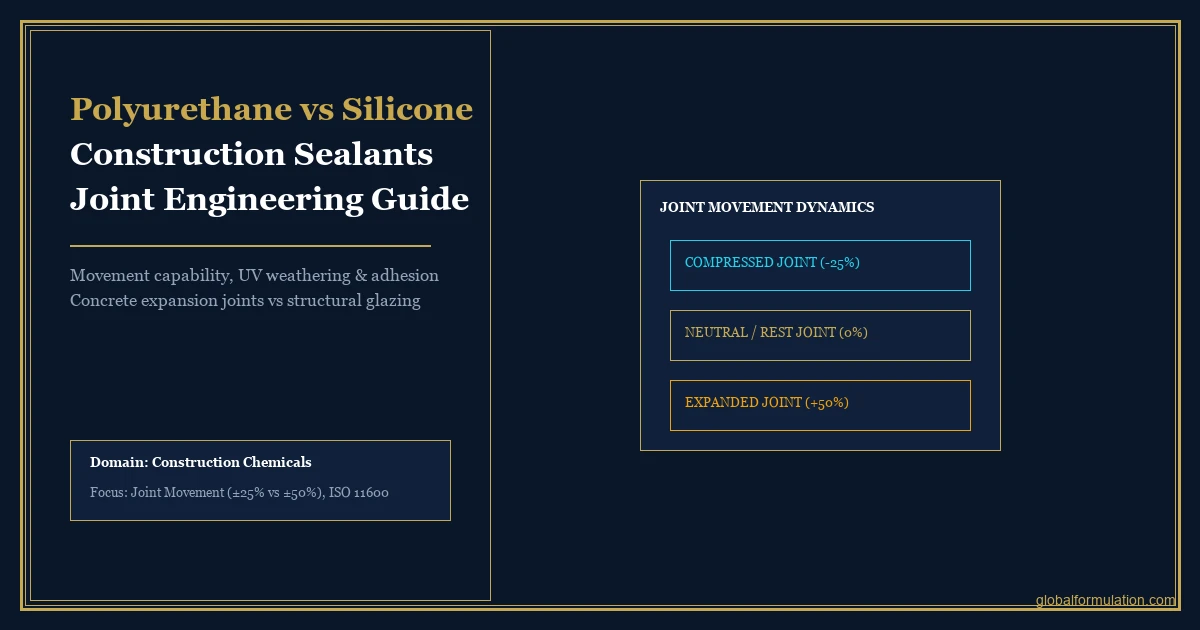
A building envelope with the wrong sealant in the wrong joint doesn't fail quietly — it shows up as water intrusion, cracked caulk lines, or a curtain wall that's suddenly leaking after five winters instead of twenty. Specifying engineers and manufacturers face this choice constantly, and getting it wrong on a commercial project means callbacks, warranty claims, and re-caulking costs that dwarf the price difference between the two products in the first place. The polyurethane vs silicone sealant decision comes down to a genuine chemistry trade-off: polyurethane brings paintability and strong adhesion at a lower cost, while silicone brings superior movement capability and weathering life at a premium price. This guide walks through how each sealant cures, where their performance actually diverges, and how to match the right chemistry to the right joint — information that matters equally to specifiers choosing a product and to manufacturers formulating one. Global Formulation works with both sealant producers and construction chemical brands on exactly this kind of formulation and specification decision.
Chemistry: How Polyurethane and Silicone Sealants Actually Cure
Every practical difference between these two sealant families traces back to one thing: the backbone chemistry that forms once the sealant cures. Polyurethane sealants are built from isocyanate-terminated prepolymers that react with atmospheric moisture, generating carbon dioxide and forming urea linkages that knit the polymer into a flexible, rubber-like solid. Silicone sealants take a different path entirely, curing through moisture-triggered cross-linking of siloxane chains — an inorganic Si-O-Si backbone rather than polyurethane's organic, carbon-based one. That single structural distinction, inorganic versus organic backbone, explains almost every downstream performance gap between the two chemistries.
- Polyurethane backbone — Organic urea/urethane linkages formed from isocyanate-moisture reaction; carbon-based and UV-reactive over time
- Silicone backbone — Inorganic Si-O-Si siloxane chain; the same bond type found in glass and quartz, giving it exceptional UV and thermal resistance
- Cure byproducts — Polyurethane systems release CO2 during cure, which can cause bubbling in thick sections if applied too fast; silicone systems typically release acetic acid, alcohol, or oxime depending on the cure type
- Cure speed — Both are moisture-cured and skin over within 30–60 minutes under standard conditions, though full cure depth depends on joint geometry and ambient humidity
Understanding which backbone you're specifying explains why the two chemistries diverge sharply once you get past cure and into real-world joint performance, starting with how much movement each one can actually absorb.
Movement Capability and Joint Design
Every building joint moves — thermal expansion, structural settlement, seismic drift, and live load deflection all place cyclic stress on a sealed joint, and a sealant that can't accommodate that movement will eventually tear cohesively or pull away from the substrate. Movement capability is tested and published under ASTM C920, which rates sealants by the percentage of joint width they can stretch and compress through repeated cycling without failure. This is one of the clearest quantitative divides between the two chemistries, and it directly determines how a joint gets dimensioned during design.
| Property | Polyurethane Sealant | Silicone Sealant |
|---|---|---|
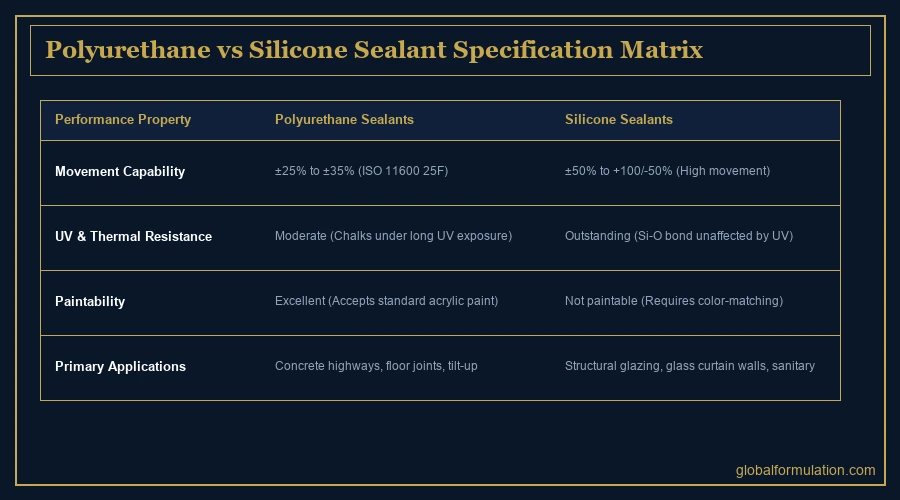
| Typical movement capability (ASTM C920) | ±25% to ±35% | ±25% to ±50% (high-performance grades) |
| Modulus options | Low- and medium-modulus grades common | Low-, medium-, and high-modulus grades available |
| Recovery after extension | Good elastic recovery | Excellent elastic recovery, retained over service life |
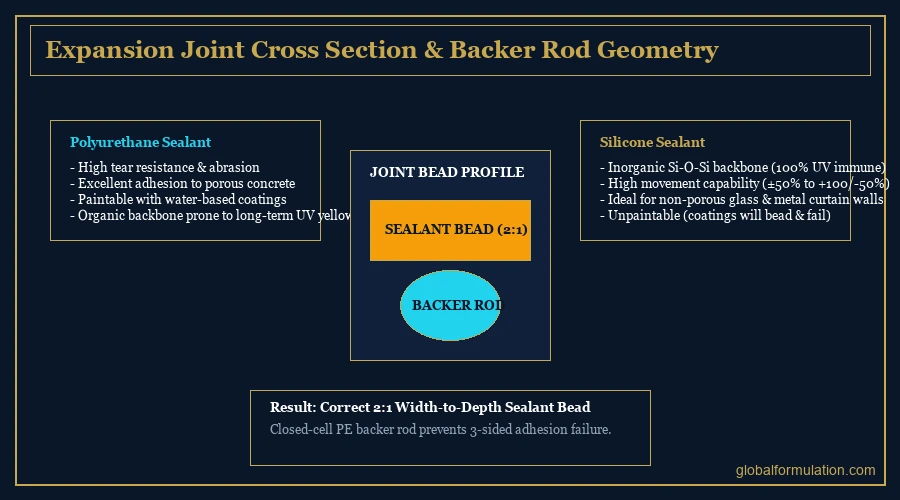
| Recommended joint width-to-depth ratio | 2:1 (standard for most butt joints) | 2:1, though structural grades follow separate design guidance |
Joint width has to be sized around the sealant's rated movement capability, not the other way around — a joint expected to see large seasonal thermal swings needs either a wider joint or a higher-movement-capability sealant, and silicone's wider published range gives designers more flexibility on tight architectural details where a wide joint isn't an option.
Movement capability determines whether a joint survives its first decade of thermal cycling, but survival over multiple decades depends just as much on how the cured sealant holds up against sunlight and weather.
Weathering, UV, and Long-Term Durability
Sun-facing joints put sealant chemistry through the harshest possible stress test, and this is where silicone's inorganic backbone earns its reputation as the more durable long-term choice. Polyurethane's carbon-based linkages absorb UV radiation and undergo gradual photo-oxidative chain scission over years of direct sun exposure, which manifests as surface chalking, progressive hardening, and eventually micro-cracking that compromises weathertightness. Silicone's Si-O-Si backbone has a substantially higher bond dissociation energy and simply doesn't absorb UV in the same damaging way, which is why silicone joints routinely remain flexible and crack-free decades after installation in applications where polyurethane would already need replacement.
- Polyurethane in direct sun — Progressive surface chalking and stiffening; service life in exposed vertical joints is typically shorter than in shaded or horizontal applications
- Silicone in direct sun — Minimal UV-driven degradation; commonly specified for curtain walls and south/west-facing facades for this reason
- Thermal cycling resistance — Silicone retains flexibility across a wider temperature range, from sub-zero winters to hot roof-deck surface temperatures
- Ozone and pollutant resistance — Both chemistries perform reasonably well, but silicone's inert backbone gives it a further edge in industrial or high-pollution environments
Weathering performance settles the durability question, but durability alone doesn't decide which sealant belongs on a given substrate — that depends on how well each chemistry actually bonds and whether the finished joint needs to be painted.
Adhesion, Substrate Compatibility, and Paintability
Adhesion failure is one of the most common reasons a correctly chosen sealant chemistry still underperforms in the field, and it usually traces back to surface preparation rather than the sealant itself. Both families require the joint to be clean, dry, and free of laitance, dust, and old sealant residue, but they diverge in how forgiving they are of the substrate condition and in whether the finished joint can be painted to match surrounding surfaces. This distinction matters enormously to specifiers working on facades where the sealant line needs to disappear visually into the surrounding finish.
- Concrete and masonry — Polyurethane's isocyanate chemistry tolerates some residual substrate moisture better than silicone, making it a common choice for pavement and structural concrete joints
- Glass and metal curtain wall — Silicone, particularly neutral-cure formulations, bonds reliably to glass and coated aluminum and is the default choice in glazing applications
- Paintability — Polyurethane accepts most water- and solvent-based architectural paints once cured; silicone's very low surface energy prevents durable paint adhesion in essentially all cases
- Primers — Both chemistries may require a compatible primer on non-porous or marginal substrates; manufacturer adhesion data should always be checked per substrate rather than assumed
A joint that will eventually be painted to match a facade almost always calls for polyurethane, since silicone's release-like surface simply won't hold a paint film — a constraint that shapes which chemistry belongs on the most visually prominent joints on a building.
Structural Glazing: A Silicone-Specific Application
Structural silicone glazing is a distinct, purpose-engineered product category rather than a general-purpose sealant used in a demanding location, and it deserves separate treatment because the stakes of a failure are so much higher. In structural glazing systems, the sealant itself transfers wind and dead-load stresses from the glass panel directly to the building frame, replacing or supplementing mechanical fasteners — meaning the sealant is a load-bearing structural component, not just a weather seal. This application is unique to silicone chemistry; polyurethane sealants are not qualified or specified for structural glazing due to their lower long-term modulus stability and UV performance under sustained structural load.
- Two-sided and four-sided systems — Structural silicone can secure glass on two or all four edges of a panel, depending on the facade design
- Fabricator certification — Structural glazing typically requires factory-controlled application by a certified fabricator rather than field application, to guarantee consistent bite dimension and cure quality
- Qualification testing — Specific glass, frame, and sealant combinations undergo adhesion and durability qualification testing before approval, following structural glazing guidance published by bodies including ASTM International
Understanding this distinction between general-purpose silicone caulk and structural glazing silicone is essential — the two are formulated and tested to very different standards even though both fall under the same broad chemistry, which brings the discussion to how to actually decide between the two sealant families for a given project.
Choosing Between Polyurethane and Silicone: A Decision Framework
Neither sealant chemistry is universally superior — the right choice depends on joint location, movement demand, substrate, and whether the finished joint needs to be painted, and most large commercial projects end up specifying both chemistries in different locations. Manufacturers formulating a new sealant line face a parallel decision: which chemistry platform matches the market segment and application niche they're targeting, since the raw material costs, cure systems, and shelf-life behavior differ substantially between isocyanate-based and silicone-based platforms. Working through this decision systematically avoids both over-specifying an expensive silicone where polyurethane would perform adequately and under-specifying polyurethane where UV exposure will shorten its service life.
- Choose polyurethane when — the joint will be painted, is shaded or horizontal, involves concrete-to-concrete substrates, or budget is the primary constraint
- Choose silicone when — the joint faces sustained UV exposure, involves glass or curtain wall glazing, needs movement capability beyond ±35%, or long-term maintenance-free performance justifies the higher material cost
- Consider hybrid MS polymer sealants — for joints needing a middle ground of paintability and weathering performance not fully served by either pure chemistry
This kind of chemistry-to-application matching is exactly the kind of specification and formulation question a construction chemicals consultancy works through with manufacturers and specifiers, and it's covered in more depth alongside broader joint design principles in our guide to construction sealant joint design and movement capability.
Getting this decision right the first time avoids the far more expensive alternative: discovering the wrong chemistry was specified only after joints start failing years into a building's service life.
Frequently Asked Questions
What is the main chemical difference between polyurethane and silicone sealants?
Polyurethane sealants cure through a reaction between isocyanate-terminated prepolymers and atmospheric moisture, forming urea linkages as the backbone chemistry, while silicone sealants cure through moisture-triggered cross-linking of siloxane (Si-O-Si) polymer chains. That backbone difference is the root cause of nearly every practical distinction between the two families.
Silicone's inorganic Si-O-Si backbone resists UV and thermal degradation far better than polyurethane's organic carbon-based backbone, while polyurethane's chemistry gives it superior paintability and abrasion resistance that silicone cannot match.
Can polyurethane sealant be painted, and can silicone sealant be painted?
Polyurethane sealants accept most water- and solvent-based paint systems once fully cured, because the cured surface has enough polarity and surface energy for paint to key onto. Silicone sealants are effectively unpaintable in any durable, professional application.
The very low surface energy that gives silicone its excellent weathering and release properties also prevents paint from forming a mechanical or chemical bond, so paint applied over silicone typically beads, cracks, or peels away within a short time.
Which sealant has better movement capability for expansion joints?
High-performance silicone sealants generally offer the widest published movement capability ratings, with many structural- and weatherseal-grade products rated at plus-or-minus 50% of joint width under ASTM C920, compared to plus-or-minus 25% to 35% for most polyurethane sealants.
This gives silicone an advantage in joints subject to large thermal cycling or structural movement, though correctly designed and dimensioned polyurethane joints still perform reliably within their rated movement range across the vast majority of standard building applications.
Why do polyurethane sealants sometimes fail faster in direct sunlight?
Polyurethane's cured backbone contains carbon-carbon and urethane linkages that absorb UV radiation and undergo progressive photo-oxidative chain scission over years of direct sun exposure, which shows up as surface chalking, hardening, and eventual micro-cracking.
Silicone's Si-O-Si backbone has a much higher bond dissociation energy and does not absorb UV in the same damaging way, which is why silicone consistently outperforms polyurethane in exposed, sun-facing joint applications over a multi-decade service life.
Is silicone sealant suitable for structural glazing?
Yes — structural silicone glazing sealants are a specific, purpose-engineered product category distinct from general-purpose silicone caulk, formulated and tested to transfer wind and dead-load stresses from glass panels to the building frame without mechanical fasteners.
These systems are qualified under standards bodies' structural glazing guidelines and typically require certified fabricators, controlled factory application, and long-term adhesion and durability testing before a specific glass-and-frame combination is approved for use.
Which sealant is more cost-effective for large commercial projects?
Polyurethane sealants typically carry a lower material cost per cartridge or drum than premium silicone systems, which makes them attractive for large-volume applications like expansion joints in parking structures, pavement joints, and general perimeter sealing where paintability or extreme weathering resistance isn't the deciding factor.
Silicone's higher unit cost is usually justified on projects where its movement capability, UV stability, or structural glazing performance directly reduces long-term maintenance and re-caulking cycles, which lowers total lifecycle cost even though the upfront material spend is higher.
Can polyurethane and silicone sealants be used together on the same building?
Yes, and it's common practice — many buildings use polyurethane for horizontal expansion joints, pavement joints, and areas requiring paint-matching, while reserving silicone for curtain wall perimeters, structural glazing, and other high-movement or UV-exposed vertical joints.
The two chemistries should not be applied directly on top of one another or mixed in the same joint, since compatibility between the two cured systems and their respective primers is not guaranteed, but using each sealant family in the location suited to its strengths is standard specification practice.
What surface preparation does each sealant type need for reliable adhesion?
Both sealant families require the joint substrate to be clean, dry, and free of laitance, dust, oil, or old sealant residue, typically achieved through mechanical abrasion or solvent wiping followed by a compatible primer where the manufacturer's adhesion data calls for one.
Polyurethane sealants are generally more forgiving of slightly damp or porous substrates like concrete because their isocyanate chemistry can tolerate some residual moisture, while silicone sealants, particularly neutral-cure and structural grades, often demand more rigorous primer protocols on non-porous substrates like glass, aluminum, and coated metals to achieve rated long-term adhesion.
Formulating or Specifying Construction Sealants?
Global Formulation provides construction chemical consultancy — sealant chemistry selection, joint design support, and contract formulation for manufacturers and specifiers.
Talk to Our Formulation Team