Pour Point Depressant Lubricants: Cold Flow Chemistry Guide
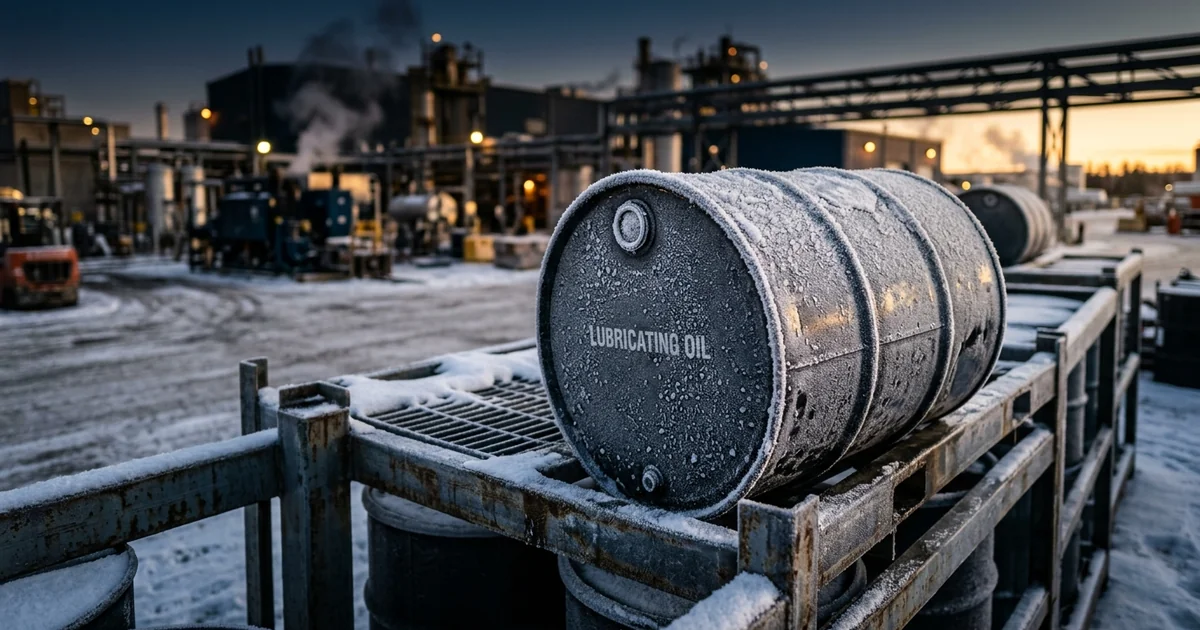
A hydraulic pump on an unheated outdoor rig refuses to draw oil on a subzero morning, even though the reservoir shows a lubricant rated well below that temperature on its data sheet. The oil hasn't gelled solid and it hasn't thickened outside its viscosity grade — a network of wax crystals has quietly locked the bulk fluid in place overnight. Pour point depressant lubricants exist precisely to prevent that failure, using polymer chemistry that interferes with how paraffin wax crystallizes rather than removing the wax itself. This guide walks through why wax crystallization causes cold-flow failure, the mechanism and chemistry classes behind modern pour point depressants, the standardized tests that actually predict cold-weather performance, and how formulators build arctic-grade products around all three. It draws on the same base-oil-first formulation logic we apply across lubricant consulting work, where a cold-start failure gets traced back to wax chemistry as often as it does to the wrong viscosity grade.
Why Wax Crystallization Locks Up Cold-Weather Lubricants
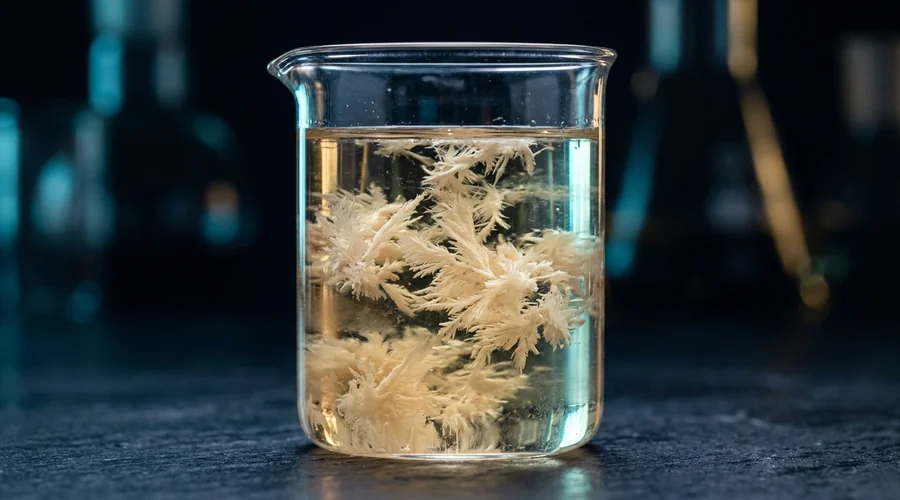
Every mineral base oil carries a small residual fraction of dissolved paraffin wax left over from refining, and that wax stays invisible in solution as long as the oil is warm enough to keep it dissolved. As temperature drops, the oil reaches a point where wax molecules begin nucleating into visible crystals — first as fine platelets, then as larger needle- and plate-shaped structures that keep growing the colder the oil gets. Left unchecked, those crystals eventually link together into a continuous three-dimensional lattice that physically traps the remaining liquid oil inside its structure, and the oil stops flowing even though its underlying molecular viscosity hasn't changed dramatically. That distinction matters because it means a wax-locked oil isn't simply "too thick" — it has failed structurally, in a way that ordinary viscosity grading doesn't predict.
- Cloud point — the temperature at which wax crystals first become visible in the oil, fixed by the base oil's own wax content and unaffected by a pour point depressant
- Pour point — the lowest temperature at which the oil's surface still shows movement, determined largely by whether the wax crystals have interlocked into a rigid network
- Base oil dependence — paraffinic base oils generally carry more wax than naphthenic stocks, and hydrocracked or hydroisomerized oils carry different wax fractions than solvent-refined ones
- Exposed equipment — outdoor hydraulic systems, arctic mining and construction machinery, refrigeration compressors, and wind turbine gearboxes all sit at the sharp end of this failure mode
Removing the wax entirely through deep dewaxing is possible but expensive and can sacrifice other base oil properties, which is why the industry standard solution works differently: leave the wax in place and change how it crystallizes instead.
How Pour Point Depressants Modify Wax Crystal Growth
A pour point depressant does not dissolve wax, remove it, or lower the cloud point at which it first appears — the additive leaves the underlying chemistry of wax formation completely untouched. What it changes is the crystal's shape and its ability to link up with its neighbors. According to the mechanism documented for pour point depressants, these polymers work by altering wax crystal shape and size so that lateral crystal growth is inhibited, rather than by preventing crystallization itself. The polymer's linear alkyl side chains are built to closely match the carbon-chain length of the oil's wax molecules, letting those side chains co-crystallize directly into the growing wax lattice, while the polymer's remaining backbone — polar, bulky, or otherwise non-wax-like — physically interrupts the crystal from extending outward and interlocking with adjacent crystals.
That crystal-modification function isn't delivered by a single fixed chemistry — several distinct polymer families accomplish it, each tuned differently to the wax it's meant to interrupt.
Pour Point Depressant Chemistry Classes
Formulators reach for a handful of polymer families to deliver wax crystal modification, and the differences between them come down to backbone chemistry and how precisely the alkyl side-chain length can be tuned to a given base oil's wax profile. Polymethacrylate (PMA) depressants dominate the market because their ester side chains can be engineered across a wide carbon-number range, giving formulators a lever to match almost any paraffinic, naphthenic, or synthetic base stock. Ethylene-vinyl acetate (EVA) copolymers and alkylated naphthalenes fill in where PMA alone underperforms, each solving a slightly different piece of the wax-modification problem.
| PPD Chemistry Class | Structural Basis | Where It Fits Best |
|---|---|---|
| Polymethacrylate (PMA) | Tunable alkyl ester side chains matched to wax carbon number | Broadest general-purpose use; default choice across engine, hydraulic, and gear oils |
| Ethylene-vinyl acetate (EVA) | Vinyl acetate content and molecular weight, not a tunable side chain | Lower-cost option where it has been validated against a specific base oil's wax |
| Alkylated naphthalene (AN) | Aromatic ring structure with alkyl substitution | Synergist blended with PMA to address wax fractions PMA alone modifies weakly |
Because each class interacts with wax through a slightly different mechanism, the same nominal treat rate of two different PPDs can produce meaningfully different pour points in the same base oil — which is exactly why cold-flow performance has to be verified by standardized testing rather than assumed from the additive's data sheet alone.
Testing Pour Point, Cloud Point and Low-Temperature Pumpability
Cold-weather lubricant performance isn't a single number — it's answered by several standardized tests, each probing a different practical failure mode. Pour point tests only confirm that the oil's surface can still move at all; they say nothing about whether an oil pump can actually push that oil through a filter and delivery line fast enough to protect a cold engine or gearbox on start-up. A product can pass one of these tests with margin to spare and still fail in service if the wrong test was used to qualify it for its actual application, which is why formulators run the full panel rather than relying on pour point alone for anything beyond a basic screening spec.
| Test Standard | What It Measures | Practical Relevance |
|---|---|---|
| ASTM D97 | Manual pour point — lowest temperature at which surface movement is observed | Baseline cold-flow screening spec on most lubricant data sheets |
| ASTM D5950 | Automatic tilt-method pour point, same physical endpoint as D97 | Higher-throughput lab testing with less operator variability |
| ASTM D2500 | Cloud point — temperature wax first becomes visible | Confirms whether a PPD is masking rather than preventing wax formation |
| ASTM D4684 (MRV) | Apparent yield stress and viscosity after slow controlled cooling | Predicts whether an oil pump can actually deliver oil on a cold start |
Understanding which test actually applies to a given piece of equipment turns cold-flow qualification from a paperwork exercise into a genuine engineering decision — one that feeds directly into how the finished lubricant gets formulated for its climate.
Formulating Arctic-Grade and Winter-Grade Lubricants
Building a lubricant for genuinely cold service starts with base oil selection, not additive selection — the PPD is a correction layered on top of whatever wax the base oil already contains, not a substitute for choosing a lower-wax stock in the first place. Base oil groups differ substantially in residual wax content depending on their refining route, a distinction covered in more depth in our guide to base oil groups, and that starting wax content sets how much work the PPD has left to do. Getting this sequence backward — picking a PPD treat rate before the base oil is locked in — routinely forces a costlier reformulation once the actual wax profile shows up in qualification testing.
- Solvent-refined base oils — typically carry more residual wax after conventional solvent dewaxing, often needing higher PPD treat rates to hit an arctic-grade pour point target
- Hydrocracked and hydroisomerized base oils — generally leave less problematic wax structure behind, sometimes reaching a usable pour point with a lighter PPD treat rate
- Typical treat rate — published formulation literature generally places PPD loading in the range of roughly 0.1% to 1.0% by weight, well below the treat rates typical of viscosity index improvers
- VI improver interaction — some polymethacrylate viscosity index improvers can be engineered to double as a partial pour point depressant, while olefin copolymer VI improvers can instead interact unfavorably with wax crystallization if not screened together with the PPD
Because base oil wax content, PPD chemistry, and VI improver type are mechanistically linked at low temperature, arctic-grade formulation only works as a system-level exercise — changing any one component without re-testing the other two is how a product that passed qualification testing fails in the field.

Selecting a Pour Point Depressant for the Application
PPD selection logic shifts depending on what the finished lubricant actually is, since engine oils, hydraulic fluids, and gear oils each carry a different mix of competing additive functions that the PPD has to coexist with. Engine oils generally default to a PMA-based package validated for compatibility with the dispersant and VI improver system already in the formulation, following the same additive-interaction screening logic covered in our lubricant additive packages guide. Outdoor hydraulic systems, of the kind covered in our hydraulic oil manufacturing guide, place unusually heavy weight on pumpability testing specifically, since a stalled pump on a cold morning is an immediate operational failure rather than a gradual performance drift.
For formulators building a genuinely new arctic-grade product line, the practical sequence runs in one direction only. Fix the base oil and target pour point specification first, then screen PPD chemistry classes against that specific base oil's wax profile using the D97/D5950 and D4684 test pair, and only then finalize treat rate. Reversing that order — picking a PPD supplier first and force-fitting it to whatever base oil is on hand — is the most common route to a product that looks fine on a data sheet and fails its first genuine cold snap.
Frequently Asked Questions
What is a pour point depressant and why do lubricants need one?
A pour point depressant (PPD) is a polymer additive blended into a lubricant to keep it flowing at low temperatures by modifying how paraffin wax crystals grow and interlock as the oil cools. Mineral base oils contain small amounts of dissolved wax that crystallizes below the cloud point, and without a PPD those crystals link into a rigid, continuous lattice that traps the remaining liquid oil and stops it from flowing entirely.
Lubricants need a PPD whenever they will see service temperatures near or below that wax-locking point — outdoor hydraulic equipment, arctic mining machinery, refrigeration compressors, and any winter-grade engine or gear oil all depend on PPD chemistry to remain pumpable on a cold start.
Does a pour point depressant lower the cloud point of an oil?
No, and this is one of the most commonly misunderstood points about PPD chemistry. A pour point depressant does not change the temperature at which wax first becomes visible in the oil, nor does it reduce the total amount of wax that eventually crystallizes — that temperature and quantity are fixed by the base oil's own wax content and are measured separately as the cloud point.
What the PPD actually changes is the shape and interlocking behavior of the crystals that form after the cloud point is reached, keeping them small and isolated instead of letting them link into the continuous network that immobilizes the oil at the pour point.
What's the difference between PMA and EVA pour point depressants?
Polymethacrylate (PMA) depressants use an alkyl methacrylate backbone whose ester side-chain length can be tuned precisely to match the carbon-number distribution of the target base oil's wax, giving PMA broad effectiveness across paraffinic, naphthenic, and synthetic base stocks. Ethylene-vinyl acetate (EVA) copolymers rely on the vinyl acetate content and molecular weight of the polymer rather than a tunable side chain, which makes them lower-cost to produce but generally more sensitive to the specific wax composition of a given base oil batch.
Many formulators treat PMA as the more universally reliable choice and reserve EVA, or an alkylated naphthalene synergist, for base oils where it has been specifically validated.
Why can the same PPD work well in one base oil and poorly in another?
A pour point depressant works by co-crystallizing with the wax molecules present in a specific base oil, which means its effectiveness depends directly on how closely the polymer's alkyl side-chain length matches the carbon-chain length of that oil's particular wax fraction. Two base oils can carry similar total wax content but different wax carbon-number distributions because they came from different crude sources or were refined through different dewaxing routes, and a PPD tuned for one distribution can perform noticeably worse against the other.
This is exactly why formulators re-validate PPD treat rate and performance whenever a base oil supplier, grade, or refinery batch changes, rather than assuming an existing treat rate transfers automatically.
What's the difference between pour point and low-temperature pumpability?
Pour point, measured under ASTM D97 or the automated ASTM D5950 tilt method, only records the lowest temperature at which the oil's surface is observed to move at all inside a static test jar after slow, controlled cooling. Low-temperature pumpability is a separate and more demanding question: can an oil pump actually draw oil from a sump and deliver it to critical surfaces fast enough to prevent damage during a cold start, which is what the mini-rotary viscometer test under ASTM D4684 specifically measures through apparent yield stress and viscosity.
An oil can pass its pour point specification with room to spare and still fail a pumpability requirement, because the two tests are probing different physical failure modes.
How much pour point depressant is typically used in a formulation?
Published formulation literature generally places pour point depressant treat rates in the range of roughly 0.1% to 1.0% by weight of the finished lubricant, which is meaningfully lower than the treat rates typically required for viscosity index improvers.
The exact rate for any specific product depends on the base oil's residual wax content and carbon-number distribution, the target pour point specification, and which polymer chemistry class is being used, so formulators determine the working treat rate experimentally for each base oil and grade rather than applying a single fixed number across a product line.
Can a VI improver replace a separate pour point depressant?
Sometimes, but not reliably enough to plan around by default. Polymethacrylate viscosity index improvers can be engineered with side-chain architectures that also perform a wax-crystal-modification function, occasionally reducing or eliminating the need for a standalone PPD in some multigrade formulations. Olefin copolymer VI improvers behave differently and can even interact unfavorably with wax crystallization in certain base oil combinations, partially offsetting whatever PPD is present.
Because the two additive functions are mechanistically coupled at low temperature, formulators test VI improver and PPD combinations together on the actual base oil rather than assuming one additive can be dropped in favor of the other.
Formulating a Cold-Weather or Arctic-Grade Lubricant?
Global Formulation provides lubricant formulation consultancy — base oil and PPD chemistry selection, cold-flow testing strategy, and scale-up from bench trial to commercial-volume blending.
Talk to Our Formulation Team