REACH SVHC and Lubricant Additive Restrictions: What Formulators Must Know

REACH restrictions on lubricant additives can quietly disqualify a formulation from the EU market long after it has passed every performance test. Under REACH (EU Regulation No 1907/2006, as amended), an additive that performs perfectly in a tribology bench test can still be a Substance of Very High Concern (SVHC) once ECHA adds it to the Candidate List — triggering supply chain disclosure obligations at 0.1% by weight, and in rarer cases a full Annex XIV authorisation requirement or an Annex XVII use ban. Non-compliance costs are not abstract: distributors reject shipments, downstream customers demand reformulation on short notice, and Article 33 SVHC information requests carry a strict 45-day response deadline. This article explains how the Candidate List, Authorisation List, and Restriction List apply specifically to lubricant additive chemistry — antioxidants, extreme-pressure (EP) agents, anti-wear packages, and base oil PAH content — as they stand under the Candidate List update current at time of writing.
What REACH SVHC Restriction Is and Why It Exists
REACH — Registration, Evaluation, Authorisation and Restriction of Chemicals — is the EU's core chemical safety regulation, entering into force in 2007 and consolidated as Regulation (EC) No 1907/2006. Its central purpose is to shift the burden of proving a substance is safe onto the companies that manufacture, import, or use it, replacing the older system in which regulators had to prove harm before acting. For lubricant additive chemistry, this matters because many high-performance additive classes — extreme-pressure agents, certain antioxidants, and some corrosion inhibitors — rely on chemistries that predate REACH and were never subjected to this scrutiny at the time they entered widespread use.
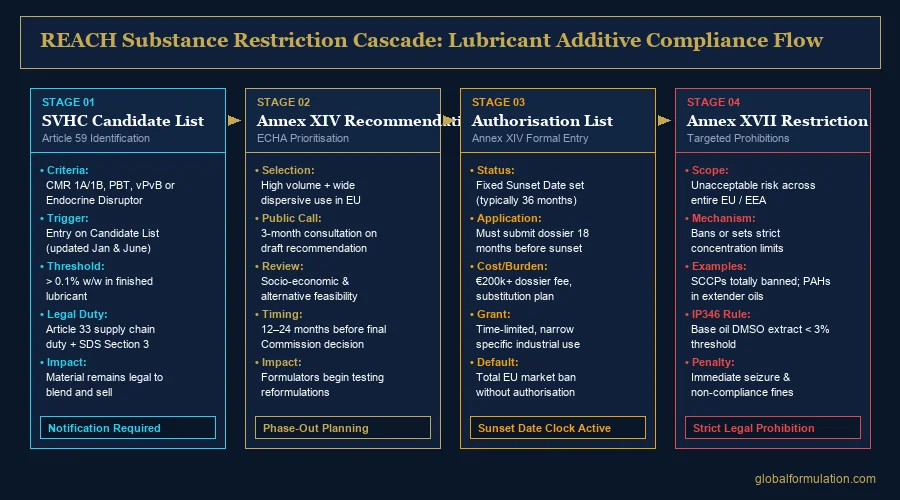
The SVHC mechanism operates in three escalating tiers. First, ECHA screens substances against criteria for carcinogenicity, mutagenicity, reproductive toxicity (CMR), persistence/bioaccumulation/toxicity (PBT), or equivalent level of concern, and adds qualifying substances to the Candidate List. Second, a subset of Candidate List substances is moved to Annex XIV, the Authorisation List, after which use requires an explicit, time-limited authorisation past a stated sunset date. Third, Annex XVII imposes outright restrictions or conditions on use for specific substances regardless of Candidate List status. Full text of the consolidated regulation is published on EUR-Lex.
Scope: Who It Applies To and Which Lubricant Additives Are Covered
REACH SVHC obligations apply to any manufacturer, importer, or downstream user placing a substance, mixture, or article on the EU or UK market, which in practice covers every lubricant manufacturer selling finished product into those markets and every additive supplier feeding that manufacturer. The obligation is triggered at a low bar — 0.1% by weight of an SVHC in the finished mixture — so even a minor additive component present at trace concentration can create a disclosure obligation for the entire formulated lubricant.
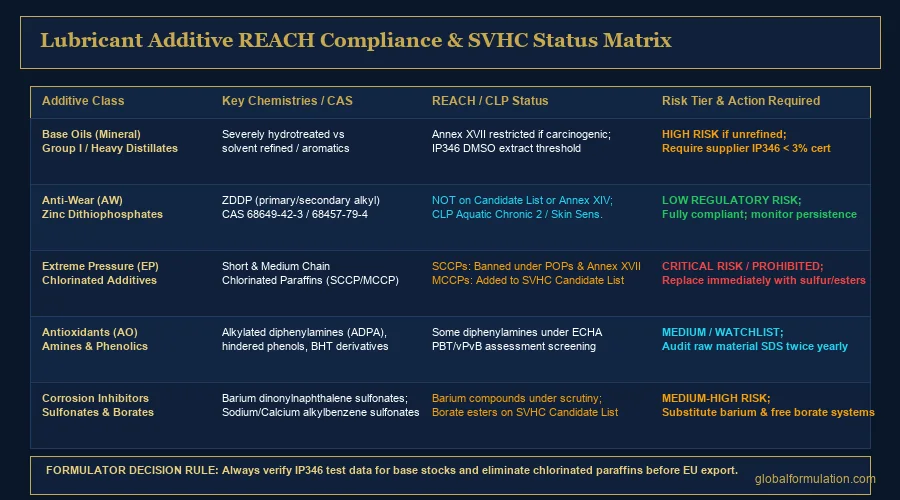
Not every additive class carries equal exposure. Antioxidant and anti-wear chemistries built on well-characterised, fully registered substances generally present low SVHC risk, while base oil components with incomplete refining history and certain legacy corrosion inhibitors carry materially higher risk. The table below summarises where SVHC and restriction exposure concentrates across common lubricant additive classes.
| Additive Class | Typical Chemistry | REACH SVHC/Restriction Exposure | Key Driver |
|---|---|---|---|
| Anti-wear (AW) agents | Zinc dialkyldithiophosphate (ZDDP) | Low — not Candidate List listed | CLP aquatic/skin classification only, no restriction |
| Base oils (Group I, under-refined) | Mineral oil with residual PAH content | High — CMR classification risk | Polycyclic aromatic hydrocarbon content above IP346 threshold |
| Base oils (Group II/III, hydrotreated) | Severely hydroprocessed mineral or synthetic base stock | Low — generally exempt | PAH content reduced below classification threshold by refining |
| Extreme-pressure (EP) additives | Sulphur-phosphorus, chlorinated paraffin (legacy) | Variable — chlorinated paraffins restricted | Short-chain chlorinated paraffins on Annex XVII / Candidate List |
| Antioxidants | Aminic and phenolic antioxidants | Low to moderate — substance-specific | Requires per-substance Candidate List check |
| Corrosion inhibitors | Metal deactivators, borate esters (legacy) | Moderate — some borates SVHC-listed | Boric acid/borate reproductive toxicity classification |
Key Requirements: What REACH SVHC Compliance Demands
Compliance with REACH SVHC obligations for lubricant additives rests on three linked duties that must all be current at the same time. A formulation team that satisfies one duty but lets another lapse — for example screening raw materials once at launch but never again — is not compliant, because the Candidate List itself changes twice a year and a formulation's status can change without any reformulation on the manufacturer's part.
- Continuous SVHC screening — every raw material and finished formulation checked against the current Candidate List, not a one-time check at product launch
- Article 33 disclosure readiness — the ability to confirm or deny SVHC presence above 0.1% within 45 days of any customer request
- Authorisation and restriction monitoring — tracking whether any raw material has moved from Candidate List to Annex XIV (authorisation) or is newly subject to an Annex XVII restriction or ban
These three duties sit on top of, not instead of, the standard REACH registration obligation for substances manufactured or imported above one tonne per year — SVHC status is a separate and additional layer of scrutiny applied to substances that are otherwise already registered.
Testing and Documentation Requirements
Demonstrating REACH SVHC compliance for a lubricant formulation requires evidence at both the raw material and finished product level. Regulators and downstream customers alike expect a documented screening trail, not just a verbal assurance that a formulation is "REACH compliant" — that phrase alone means nothing without the underlying substance-level records.
- IP346 test data — DMSO extract percentage for any Group I or under-characterised base oil, confirming PAH content is below the CMR classification threshold
- Supplier REACH registration numbers — for every substance manufactured or imported above one tonne per year, obtained from the raw material SDS Section 3 or 15
- Candidate List cross-reference records — a dated log showing each raw material was checked against the Candidate List version in force at that date
- Article 33 response template — a pre-prepared, substance-accurate response ready to issue within the 45-day statutory window if a customer requests SVHC information
Retaining dated records matters as much as the underlying data: an enforcement inspection or customer audit typically asks not just "is this compliant now" but "how do you know it was compliant on the date you shipped it," and only a dated screening log answers that question.
Step-by-Step REACH SVHC Compliance Pathway for Lubricant Formulators
Building a durable REACH SVHC compliance process for a lubricant additive portfolio is a repeatable cycle, not a one-off project. The sequence below reflects the process an EU/UK-facing lubricant formulator should run at product development and then repeat on a fixed schedule thereafter.
- Compile a full raw material substance inventory. List every base oil, additive, and minor component by CAS number, sourced from current supplier SDSs. Incomplete substance identification at this stage undermines every following step.
- Screen every substance against the current Candidate List. Cross-check each CAS number against the ECHA Candidate List in force at the time of screening. Flag any match and calculate its concentration in the finished formulation.
- Confirm base oil PAH status via IP346 or equivalent data. For any Group I or unspecified-refining base oil, obtain IP346 DMSO extract data from the supplier. Treat missing data as a compliance gap requiring either testing or substitution.
- Check Annex XIV and Annex XVII status for any flagged substance. If a raw material appears on the Candidate List, determine whether it has also progressed to the Authorisation List or is subject to an Annex XVII restriction, and note any applicable sunset date.
- Prepare Article 33 disclosure documentation. For any formulation containing an SVHC above 0.1% by weight, prepare the substance name, concentration range, and safe-use information needed to answer a customer request within 45 days.
- Re-screen at every Candidate List update and on any raw material change. Repeat the screening cycle at each twice-yearly Candidate List revision and immediately whenever a supplier changes an additive source.
Realistic Timeline and Cost Expectations
Establishing a REACH SVHC screening process from scratch takes materially less time than building a full REACH registration dossier, because the manufacturer is checking existing published lists rather than generating new toxicological data — but it still requires real effort to do properly across a full additive portfolio.
For a lubricant manufacturer with a moderate additive portfolio — perhaps 20 to 40 distinct raw materials across several product lines — an initial full screening exercise, including CAS number verification, Candidate List cross-referencing, and IP346 data collection from base oil suppliers, typically takes four to eight weeks of dedicated effort. The main cost drivers are analyst or regulatory consultant time for the screening itself, any IP346 or equivalent testing commissioned for base oils lacking supplier data, and the administrative cost of chasing REACH registration confirmations from smaller or less organised raw material suppliers. Ongoing maintenance at each twice-yearly Candidate List update is far lighter — typically a few days of re-screening against the incremental list changes, provided the original substance inventory is kept current.
Our work across the lubricants formulation practice integrates this screening step directly into new product development, so that additive selection accounts for REACH exposure before a formulation is finalised rather than as a late-stage compliance retrofit.
Common Mistakes Lubricant Formulators Make — and How to Avoid Them
REACH SVHC non-compliance in lubricant manufacturing rarely stems from ignorance of the regulation itself. It stems from treating a one-time screening exercise as permanent, or from assuming a well-known additive is automatically safe because it has been used for decades.
- Treating the Candidate List check as a launch-only exercise — the list grows twice yearly, and a formulation clean at launch can become non-compliant years later with zero change to the recipe
- Assuming legacy additives are automatically exempt — long-standing use in the market is not evidence of REACH compliance; some legacy corrosion inhibitors and chlorinated EP additives have been restricted after decades of use
- Missing base oil PAH exposure — assuming all mineral base oil is equally low-risk, when unrefined or lightly refined Group I stock without IP346 data is the single most common SVHC exposure point
- No prepared Article 33 response process — discovering the 45-day disclosure deadline only after a customer request arrives, rather than having substance data ready in advance
For formulation and regulatory support across rust preventive oil chemistry and the broader compressor and specialty lubricant segment, building REACH SVHC screening into the standard formulation review avoids exactly these gaps.
Frequently Asked Questions
Does REACH ban ZDDP (zinc dialkyldithiophosphate) in lubricants?
Which lubricant base oils are most at risk from REACH SVHC restrictions?
What is the difference between the SVHC Candidate List and the Authorisation List?
How often should I re-check the REACH Candidate List for my lubricant formulations?
Do REACH restrictions on lubricant additives apply to products I export outside the EU?
What should I do if a supplier cannot confirm REACH registration status for an additive?
Need Regulatory Guidance for Your Lubricant Additive Portfolio?
Our team provides end-to-end regulatory strategy — from SVHC screening and base oil PAH risk assessment through to Article 33 disclosure readiness and additive substitution support.
Get a Free Consultation