Reaction Calorimetry: What RC1 Measures and Why Scale-Up Needs It
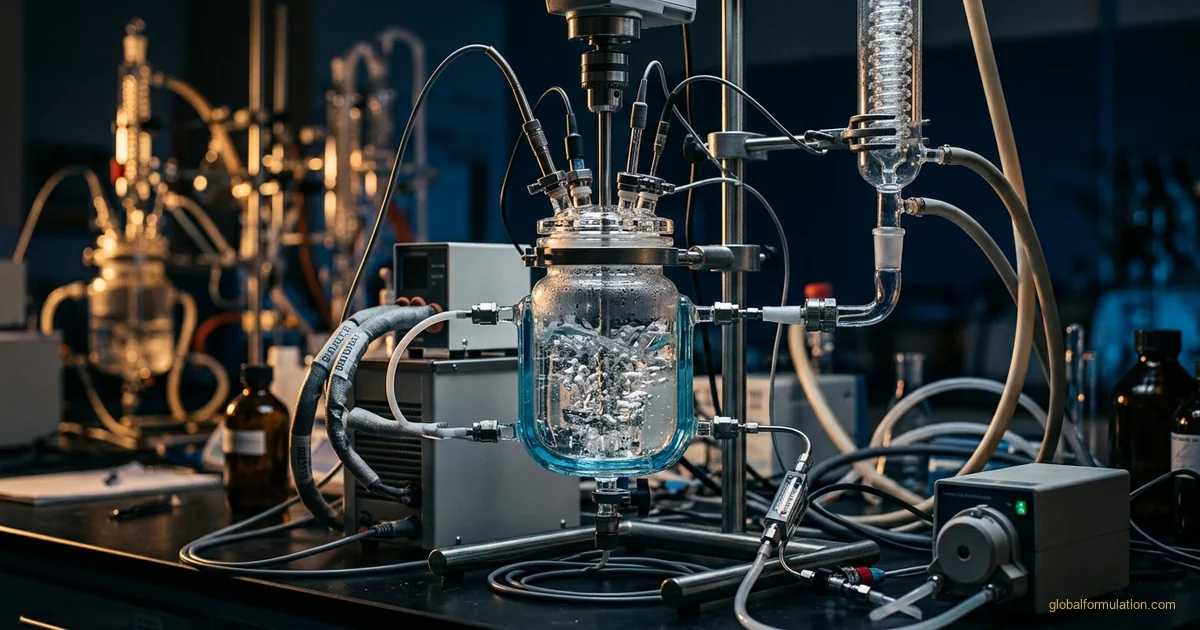
A process that behaves perfectly on the bench can turn into an uncontrolled exotherm the first time it runs in a plant-scale vessel. The chemistry has not changed — only the geometry has. Reaction calorimetry is the measurement that closes that gap. It quantifies the heat a reaction actually releases, and the rate it releases it, under conditions close enough to production that the numbers can be trusted. Those numbers feed reactor sizing, cooling design and thermal risk assessment directly. Skipping the measurement does not remove the risk; it just delays where the risk is discovered. Instead of surfacing on a controlled laboratory instrument, it surfaces in an uncontrolled plant vessel, where the cost is a lost batch, damaged equipment, or worse. This guide explains what a reaction calorimeter such as the RC1 actually measures, and how that data differs from a DSC or ARC screening result. It also covers what a plant manager or project engineer should expect to receive from a calorimetric study, and when it needs to be commissioned. Throughout, it reflects the same evidence-first standard we apply in process safety review work ahead of a scale-up decision.
Why Reaction Calorimetry Comes Before Scale-Up
Heat generation in an exothermic reaction scales with the mass reacting, while heat removal through a jacket scales with the vessel's wetted surface area. As vessel size increases, the ratio of surface area to volume falls. A reaction a chemist controls comfortably in a 500 mL flask can outrun the cooling capacity of a much larger reactor using the identical recipe. This is one of the most common — and most avoidable — causes of a scale-up that looked safe in development and was not safe in production. Our guide to reactor selection for specialty chemicals covers this in more depth: heat release rate is one of the first gates a configuration decision has to clear. Reaction calorimetry exists to put a number on that gap before the plant vessel finds it.
A handful of situations should always trigger the question of whether current thermal data is good enough:
- Exothermic step chemistry — any reaction with a measurable heat of reaction (ΔHr), particularly addition, oxidation, hydrogenation, neutralisation or polymerisation steps.
- A first scale-up to a new vessel size — the surface-area-to-volume ratio changes with every step up, so plant experience at one scale does not validate the next.
- A new or modified route — a changed catalyst, solvent or addition sequence can shift the heat release profile even when the target product is unchanged.
- A loss-of-cooling or loss-of-agitation scenario under review — calorimetric data is the direct input to that assessment, not an assumption standing in for one.
Each of these triggers points to the same underlying question: how much energy does this reaction release, and how fast? Calorimetry is the only way to answer it with measured data, rather than an estimate carried over from a different scale.
What a Reaction Calorimeter Actually Measures
A reaction calorimeter is, in effect, a fully instrumented miniature version of the plant reactor. The most widely used design, the RC1, runs the real reaction — real reagents, real solvent, real addition sequence — inside a jacketed glass vessel of bench-pilot scale. Throughout the run it continuously measures the heat flow crossing the vessel wall. Because the vessel's geometry, agitation and heat transfer are characterised and calibrated beforehand, the instrument converts a temperature signal into a genuine heat-flow curve rather than an inferred one. That is the fundamental difference between calorimetry and simply logging reactor temperature. Temperature tells you what happened to the batch; calorimetry tells you how much energy was released and at what rate. That figure is what a reactor and its cooling system are actually designed against — the discipline we describe in more depth in our chemical reaction engineering practice.
A well-run RC1 study typically produces four linked outputs:
- Heat of reaction (ΔHr) — the total energy released by the step, integrated from the heat-flow curve.
- Heat release rate profile — how that energy is released over time, which governs peak cooling demand rather than total duty alone.
- Conversion and accumulation behaviour — whether reagent is reacting as fast as it is dosed, or accumulating unreacted in the vessel.
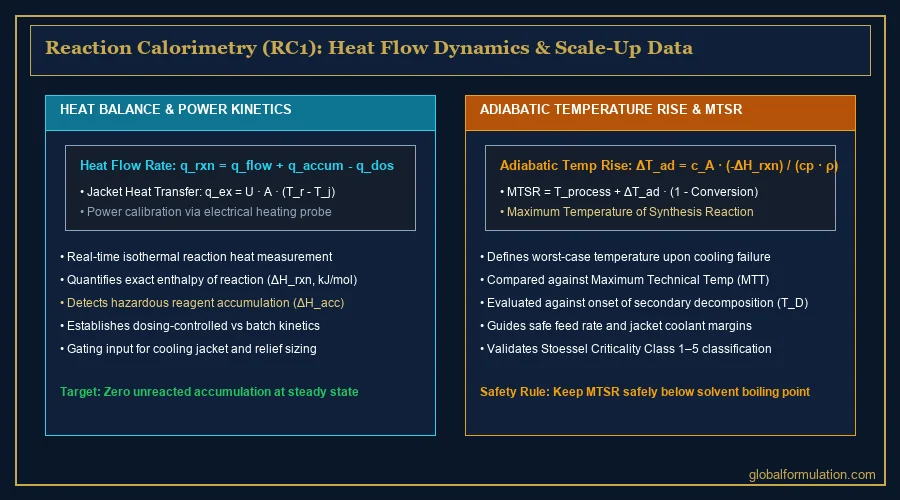
- Adiabatic temperature rise (ΔTad) — the temperature the batch would reach if all cooling were lost, derived from ΔHr and the reaction mass's heat capacity.
Every one of those four outputs feeds a specific downstream decision: reactor selection, cooling duty, and the thermal risk classification covered next. That is why calorimetry sits upstream of all three, rather than being an optional check performed afterward. It is not, however, the only calorimetric method in use, and knowing where it fits among the alternatives is the next question.
Screening to Full Study: DSC, ARC and RC1 Compared
Calorimetric assessment is staged. The industry converged on that staging because no single instrument answers every question a scale-up needs answered. Differential scanning calorimetry (DSC) and simple sealed-tube heating tests — the Carius tube method among them — come first. They need only milligrams of material, run quickly, and screen for the presence of an exotherm and its approximate onset temperature. An accelerating rate calorimeter (ARC) comes next when a screening result is positive. It runs adiabatically, so the sample's own heat drives further self-heating exactly as an uncontrolled batch would. That behaviour underpins time to maximum rate under adiabatic conditions (TMRad). The RC1 completes the sequence, because it is the only one of the three that runs the actual process chemistry — real dosing, real stoichiometry, real solvent. Its conditions are the ones a reactor design can actually be built against.
| Method | Typical Sample | Runs Real Process? | Primary Output | Typical Role |
|---|---|---|---|---|
| DSC / sealed-tube screening | Milligrams | No | Onset temperature, presence of an exotherm | First-pass hazard screening |
| ARC | Grams | No — idealised adiabatic | TMRad, self-heating rate | Adiabatic stability and criticality classification |
| RC1 (heat-flow calorimetry) | Hundreds of grams to kilograms | Yes | ΔHr, heat release rate, accumulation | Process-representative design data |
| Power-compensation calorimetry | Bench-pilot scale | Yes | Heat release rate via calibrated heater duty | Alternative to jacket heat-flow measurement |
None of the three stages substitutes for another. A DSC result showing no exotherm at the conditions it used does not mean the process is safe to scale. It only means screening found nothing at the scale and heating rate applied. RC1 data is what the reactor design and cooling system are actually sized against. That is also why a route change deserves scrutiny: switching between, for example, homogeneous and heterogeneous catalysis can shift the heat release profile enough to invalidate an earlier study.
Reading the Output: ΔHr, MTSR and TMRad
Three terms recur through every calorimetric report. A plant manager does not need to run the calculations to use them well — only to understand what each one is protecting against. The maximum temperature of the synthesis reaction (MTSR) is the highest temperature the batch would reach if all the accumulated, unreacted material reacted at once, typically under a loss-of-cooling scenario. It differs from the adiabatic temperature rise in that it accounts specifically for accumulation. That is why semi-batch and fed-batch processes, where accumulation is the real hazard, depend on it more than a single-charge batch does.
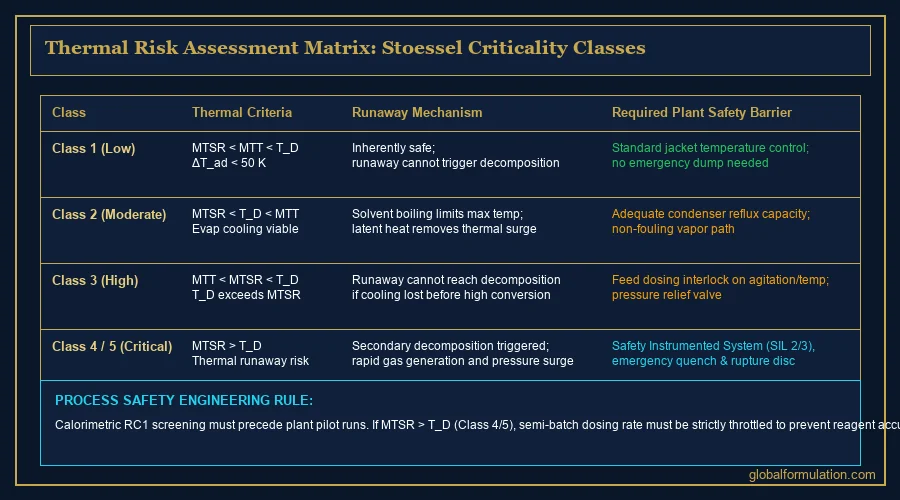
Time to maximum rate under adiabatic conditions (TMRad) answers a different question. Given that a reaction has run away, how long does an operator have before the rate becomes uncontrollable? A short TMRad at the expected process temperature — hours rather than days — is one input to the Stoessel criticality classification. That classification ranks how urgently a process needs engineering controls. The other input is where MTSR sits relative to the onset of any secondary decomposition.
Read together, not individually, these figures do three things:
- Screening severity — ranking which process steps need the most safety engineering attention first.
- Basis-of-safety selection — informing whether cooling capacity alone is an adequate control, or whether additional protective layers are needed.
- Emergency response planning — TMRad shapes how much time is available to intervene if cooling is lost.
That reading is specific to the actual recipe, charge size and vessel in question. That is exactly why a competent process safety engineer interprets it — a point this article returns to before closing.
When to Commission a Calorimetric Study
Calorimetry earns the best return when it happens early enough to influence reactor selection, and late enough that the recipe it characterises is close to final. Commissioning it too early means retesting after every recipe change. Commissioning it too late means a plant order may already be placed for equipment that cannot handle the heat release the study eventually reveals. In practice, well-run scale-up programmes commission a first RC1 study once the chemistry is fixed at bench scale, but before pilot-plant trials. They then repeat key measurements if the route, solvent or addition strategy changes materially afterward.
Specific points that should trigger a study, or a review of an existing one:
- Before sizing a pilot or plant reactor for a new or transferred process
- Before increasing batch size beyond the scale at which the process has been calorimetrically characterised
- When a route, catalyst or solvent change alters the reaction mechanism or exotherm profile
- As part of a periodic process hazard review under a process safety management programme
What an RC1 Study Actually Requires
A calorimetric study is only as good as the information supplied to the laboratory running it. The most common cause of a delayed or unusable result is an incomplete brief, rather than an instrument limitation. An RC1 study typically needs enough material to run the process at bench-pilot scale. That is usually a few hundred grams to a few kilograms of combined reagents, depending on concentration and vessel size. It also needs a written description of the intended charge sequence, addition rate, and target temperature range, close to what the plant is expected to use.
Four inputs consistently determine whether a study produces a usable result:
- Representative raw materials — the actual grades and purities intended for plant use, since impurity profile can shift onset temperature and heat release.
- A realistic addition strategy — dosing time and pattern matched to what the plant reactor can achieve, not an idealised instant charge.
- Target temperature and pressure range — the conditions the plant process is expected to run at, with margin either side.
- Known upset scenarios — loss of cooling, loss of agitation, or a missed reagent addition, so the study characterises the consequence rather than only normal operation.
A well-briefed RC1 study typically takes one to a few weeks from sample receipt to report. That is short, compared with the cost of discovering a heat-removal problem after a plant order has already been placed.
Troubleshooting: When Scale-Up Surprises Point Back to Calorimetry
Most of the thermal problems that surface during scale-up were predictable from calorimetric data that either was not collected, or was not read carefully enough. Recognising the pattern is useful even after the fact. It tells a plant team where to look first, rather than treating every batch upset as a one-off.
| Symptom on Scale-Up | What Calorimetric Data Usually Explains |
|---|---|
| Unexpected exotherm on scale-up | Heat release rate was estimated from a screening test rather than a process-representative RC1 study |
| Cooling capacity insufficient for the reaction | Peak heat release rate, not total ΔHr, was not established before reactor selection |
| Batch temperature overshoot during dosing | Accumulation of unreacted feed was not characterised, so the reaction was assumed to track the dosing rate |
| Reaction runs slower at plant scale than lab scale | Heat removal, not the chemistry itself, is limiting the achievable addition rate at plant scale |
| Accumulation of unreacted feed | The reaction stalled below the point calorimetry would have flagged as needing an interlock or confirmation step |
Read this way, calorimetric data is diagnostic as well as predictive. A plant that keeps encountering the same category of surprise almost always has a gap in its thermal data, not a run of bad luck.
Who Should Run the Assessment
Interpreting a calorimetric study is specialist process safety engineering, not a checklist a plant team applies independently. It means translating ΔHr, MTSR and TMRad into a basis of safety for a specific reactor and recipe. The instrument produces data. Deciding what that data means for cooling capacity, protective layers, and operating limits at a specific site requires judgement trained against the applicable regulatory framework. Organisations such as AIChE's Center for Chemical Process Safety (CCPS) publish the methodology that governs how this interpretation is done. Where cooling capacity alone cannot provide an adequate basis of safety, the same calorimetric data also becomes the required input to a relief-system evaluation under the DIERS methodology. That is a separate, specialist study, and this article does not attempt to summarise it.
The thermal safety assessment built on this data is site- and recipe-specific. It requires calorimetric data measured for the actual reaction, at conditions representative of the intended process. It must be interpreted by qualified process safety engineers against the regulatory regime that applies to the site. In the United States that typically means the framework set out in OSHA's Process Safety Management standard (29 CFR 1910.119), alongside the EPA's Risk Management Program. Equivalent regimes apply in other jurisdictions. This article explains what calorimetric data means and why it matters — it is not a substitute for that assessment.
Our scale-up support engagements begin with exactly this kind of process safety review, for any process approaching a scale-up decision on nothing more than a DSC screen. Where the reaction itself needs re-evaluating alongside it, our broader process and EHS consulting work picks up from there. That applies equally to manufacturers scaling up processes in India, the Gulf and Southeast Asia.
Frequently Asked Questions
What is reaction calorimetry used for?
Reaction calorimetry measures the heat a chemical reaction releases, and how fast it releases it, under conditions close to how the process will actually run. That data feeds three decisions directly. It sizes a reactor's cooling system for the peak heat release rate rather than a guess, and it informs which reactor configuration can remove heat fast enough. It also gives a process safety engineer the measured input needed to classify the thermal risk.
Without it, all three decisions are made on assumption rather than data.
Why do you need calorimetry before scale-up?
Heat generation in an exothermic reaction scales with the reacting mass, but heat removal through a jacket scales with the vessel's surface area. The ratio between the two falls as the vessel gets bigger. A reaction that a chemist controls easily on the bench can outrun the cooling capacity of a much larger plant vessel using the identical recipe, simply because the geometry changed.
Calorimetry puts a number on that gap before it is discovered in a production vessel. There, the consequence is a lost batch, damaged equipment, or a genuine safety event, rather than an instrument reading.
What is the difference between DSC and reaction calorimetry?
Differential scanning calorimetry (DSC) uses milligrams of material to screen quickly for the presence and approximate onset temperature of an exotherm. It is fast and cheap, but it does not run the actual process chemistry, dosing sequence or scale. Reaction calorimetry, most commonly performed on an RC1-type instrument, runs the real reaction at bench-pilot scale with real dosing, and measures the heat flow crossing the vessel wall directly.
A negative DSC screen tells you the screening test found no exotherm at the conditions it used. It does not tell you what a process-representative RC1 study would show, which is why the two are complementary rather than interchangeable.
How much sample does a reaction calorimetry study need?
An RC1-type study typically needs enough material to run the process at bench-pilot scale. That is usually on the order of a few hundred grams to a few kilograms of combined reagents, depending on concentration and the vessel size the laboratory uses. It is considerably more than a DSC screen, which needs only milligrams. The instrument has to reproduce real agitation, real dosing rates and a real heat-transfer surface, rather than just heating a sealed sample.
Laboratories running these studies will specify an exact quantity once they know the recipe and target scale.
When should reaction calorimetry be done?
The best timing is once the chemistry is fixed at bench scale, but before a pilot or plant reactor is sized. That way the data can actually influence the equipment decision, rather than just confirm one already made. Commissioning it earlier usually means retesting after recipe changes. Commissioning it after equipment is ordered risks discovering a heat-removal mismatch the design cannot accommodate.
Any material change afterward — a different catalyst, solvent, or addition strategy — should trigger a review of whether the existing data still applies. It was measured against a specific recipe, not a general reaction type.
Who performs reaction calorimetry studies?
The measurement itself is run by specialist process safety laboratories or in-house process safety groups equipped with RC1 or equivalent instrumentation, following recognised test methods. Interpreting the output is a separate step — translating heat of reaction, MTSR and TMRad into a basis of safety for a specific reactor and recipe. That step requires a qualified process safety engineer, working against the regulatory regime that applies to the site.
A plant team should expect both the raw measurement and a written interpretation as deliverables, not the data alone.
Is a DSC screen enough on its own for a scale-up decision?
No. A DSC screen answers a narrower question than a scale-up decision needs answered. It tells you whether an exotherm exists and roughly where it starts, using milligrams of material and a controlled heating ramp. That ramp does not resemble how the plant process actually runs. It cannot tell you the heat release rate, whether reagent is accumulating during dosing, or how the process behaves under the specific charge sequence the plant intends to use.
Treat a clean DSC result as permission to keep developing the process, not as evidence the process is ready to scale.
Planning a Scale-Up That Needs Thermal Data?
Global Formulation provides thermal hazard assessment and process safety review ahead of scale-up decisions — from scoping a calorimetric study to interpreting what it means for reactor design and basis of safety.
Talk to Our Process Safety Team