Reactor Materials of Construction: SS316L, Glass-Lined, Hastelloy
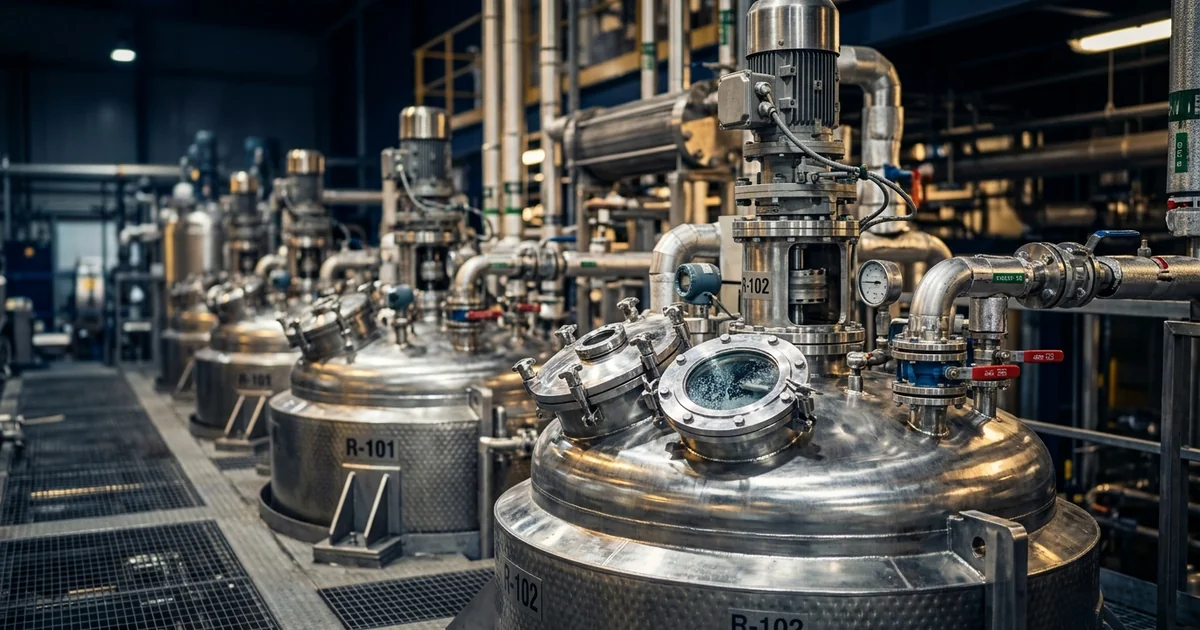
A process that ran for years in a glass-lined pilot reactor is transferred to a stainless production vessel to save capital, and within two campaigns the product is failing its colour spec and the reactor coil shows pitting. The chemistry did not change; the wetted surface did. Choosing the reactor materials of construction is one of the highest-consequence decisions in a plant project, because the wrong call is not a tuning problem but a re-purchase, and a marginal call shows up months later as a corroded coil, a contaminated batch or a cracked weld. This article compares the three families that cover almost every specialty reaction — austenitic and duplex stainless, glass-lined steel, and the nickel alloys and reactive metals — on corrosion resistance, thermal shock tolerance, contamination risk, inspectability and cost. It also sets out how a material is actually qualified for a specific process, and the failure modes that tell you the original selection was wrong. It reflects the equipment-selection work we do when a reactor-based process is specified or transferred, described in our chemical reaction engineering practice.
Why the Material of Construction Decision Is Hard to Reverse
Almost every other reactor decision can be revisited after commissioning. Agitator speed, addition rate, jacket temperature, even the control strategy can be changed on a running plant. The material of the vessel cannot. A stainless reactor that turns out to be wrong for a chloride-bearing process is a new vessel, a new lead time of many months, and a gap in production that often costs more than the reactor itself. That asymmetry is why material selection deserves disproportionate engineering effort at the datasheet stage.
The decision is also unusually easy to get wrong, for three reasons:
- The lab vessel hides the problem — a reaction run in borosilicate glassware or a small glass-lined vessel never tests the material that production will use, so a corrosion issue can stay invisible until the first metal reactor sees the liquor.
- Trace species dominate — a process is nominally a benign organic reaction, but a catalyst residue, a hydrochloride salt, or a chloride-containing raw material impurity is what actually attacks the wall. Handbook resistance data for the main solvent tells you nothing about it.
- Cleaning chemistry is forgotten — the vessel may be well matched to the process but exposed to hot caustic or an acidic descaling wash between batches that the process itself never sees. Glass-lined steel in particular is far more vulnerable to hot alkali than to most process streams.
Getting this right means treating the wetted surface as a process variable in its own right, characterised as carefully as the reaction, before the vessel is ordered rather than after it leaks.
Stainless Steel: 304L, 316L and Duplex Grades
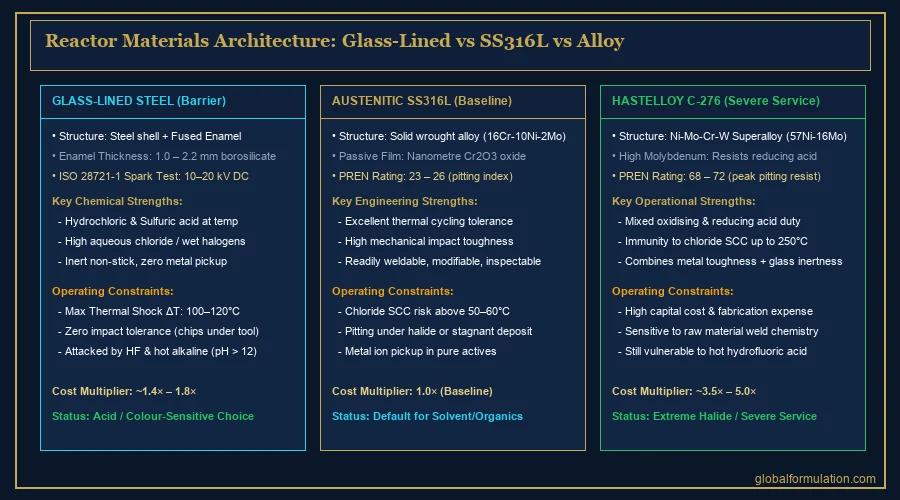
Austenitic stainless steel is the default reactor material for specialty chemistry because it is a genuine all-rounder: the wall itself is corrosion resistant so there is no lining to protect, it takes thermal cycling and mechanical work without complaint, and it is easy to weld, modify, polish and inspect. Where the process chemistry allows it, stainless gives the lowest total cost of ownership by a wide margin. The question is almost always which grade, not whether stainless at all.
- 304L — the low-carbon variant of the most common stainless. Adequate for water, steam, many organics and mild aqueous chemistry. The low carbon (the "L") reduces sensitisation during welding, which otherwise leaves the heat-affected zone vulnerable to intergranular attack.
- 316L — adds roughly two to three percent molybdenum, which markedly improves resistance to pitting and to dilute reducing acids. This is the workhorse reactor grade for solvent-based specialty processes and non-halogenated aqueous work-ups.
- Duplex 2205 — a mixed austenitic-ferritic structure with higher chromium and molybdenum. Its pitting resistance equivalent number (PREN), a figure calculated from chromium, molybdenum and nitrogen content, is around 35 against roughly 24 to 26 for 316L, and it resists chloride stress corrosion cracking far better. It is the step before a nickel alloy for moderately chloride-bearing service.
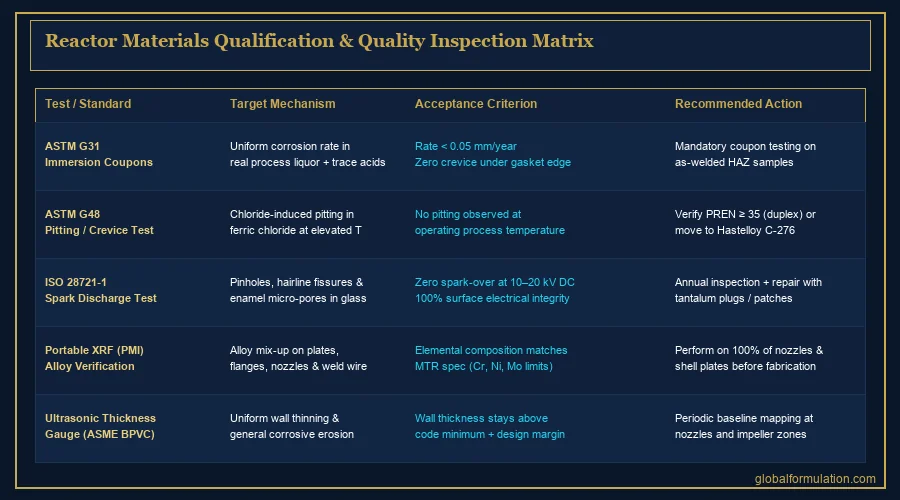
The hard limit for standard austenitic stainless is chloride stress corrosion cracking: with tensile stress, chloride ions and temperature above roughly 50 to 60 degrees Celsius all present, 304 and 316 crack in a fine branched pattern that is invisible until the vessel leaks. Any process with meaningful chloride content at temperature pushes the selection to duplex, a nickel alloy, or a lining. Design and fabrication also matter as much as grade choice — vessels are built to a pressure code such as ASME BPVC Section VIII, and positive material identification on incoming plate and weld consumables is a cheap safeguard against the wrong grade being installed.
Glass-Lined Steel: Where It Wins and Where It Fails
A glass-lined reactor is a carbon or low-alloy steel shell with a fused zirconia-toughened borosilicate enamel a few millimetres thick on every wetted surface. It solves the problem stainless cannot: near-universal chemical resistance, including to hot mineral acids, hydrochloric and sulfuric acid, and high-chloride streams, plus a smooth, non-stick surface that resists fouling and does not contaminate the product with metal ions. For colour-sensitive products, acid-catalysed chemistry, and anything where iron or nickel pickup is a quality problem, glass-lined steel is often the only acceptable choice.
The weakness is entirely mechanical and thermal. The enamel is a brittle ceramic bonded to steel, and it fails when that bond or the glass itself is overstressed:
- Impact damage — a dropped tool, or lump raw material charged directly onto the vessel bottom rather than through a chute, chips the enamel and exposes bare steel that then corrodes and undercuts the surrounding glass.
- Thermal shock — adding cold liquid to a hot vessel, or applying full jacket heating to a cold charge, sets up a stress between the glass and the steel that have different expansion coefficients. Manufacturers publish a maximum permissible temperature difference, and it is tight, often around 100 to 120 degrees Celsius.
- Chemical attack — hydrofluoric acid, hot concentrated phosphoric acid, and alkaline solutions above roughly pH 12 at temperature dissolve the silica network. Hot caustic cleaning is a more common cause of enamel loss than any process stream.
In service, glass-lined vessels are protected by spark testing (a high-voltage probe that detects pinholes), a defined slow heat-up and charging procedure, and prompt repair of any detected defect with a tantalum plug or a proprietary patch. Managed that way, a glass-lined reactor lasts decades; managed carelessly, it needs re-lining in a few years. The care regime is covered in more depth in a dedicated companion article on glass-lined reactor inspection and repair.
Nickel Alloys and Reactive Metals
When the process defeats both stainless and glass — thermal cycling too severe for enamel, chemistry too aggressive for 316L — the answer is a high-performance metal. These materials combine the corrosion resistance of glass with the mechanical robustness of steel, at a price several times that of a stainless vessel, so they are specified only where the corrosion data leave no cheaper option.
| Material | Best at | Typical use | Watch out for |
|---|---|---|---|
| Hastelloy C-276 / C-22 | Mixed oxidising and reducing acids, wet chlorine and bromine chemistry, high chloride at temperature | Halogenation, chlorination, hot HCl service, aggressive pharmaceutical intermediates | Cost; still attacked by hot hydrofluoric acid |
| Alloy 20 | Hot sulfuric acid across a wide concentration range | Sulfation and sulfonation work-ups, sulfuric-acid-catalysed processes | Poorer than Hastelloy in hydrochloric or mixed-halide service |
| Titanium grade 2 | Oxidising chlorides, wet chlorine, seawater and brine, nitric acid | Chlor-alkali derivatives, bleach and hypochlorite chemistry | Fails in reducing acids and in dry chlorine; hydrogen embrittlement risk |
| Tantalum (as cladding or bayonet) | Almost everything except hydrofluoric acid, fuming sulfuric and strong hot alkali | Localised use — heating bayonets, repair plugs, small critical parts | Very high cost; used as a thin liner or component, not a whole vessel |
| PTFE-lined steel | Broad chemical resistance where thermal cycling rules out glass | Acid storage and transfer, moderate-temperature aggressive service | Lower temperature ceiling than glass; permeation and lining collapse under vacuum if unsupported |
The selection within this group is entirely chemistry-specific: titanium and Hastelloy have almost opposite strengths, one favouring oxidising conditions and the other tolerating reducing acids, so a wrong choice here is as bad as defaulting to stainless. This is where a process with real corrosion risk connects to the broader question of reactor configuration, since the vessel type, heat-transfer arrangement and material all have to be resolved together — our guide to batch, semi-batch and continuous reactor selection covers how those decisions interact.
Reactor Materials of Construction Compared: Stainless, Glass-Lined and Nickel Alloy
No single choice among the reactor materials of construction wins on every axis, which is why the decision has to be made against a weighted set of criteria rather than a single "best" answer. The comparison below is the one that usually frames a material-selection review, and it makes clear why most plants run a mix of stainless and glass-lined vessels with a small number of alloy reactors reserved for specific chemistries.
| Criterion | SS316L | Glass-lined steel | Hastelloy C-276 |
|---|---|---|---|
| Broad chemical resistance | Moderate — fails on halides, reducing acids | Excellent — near universal, except HF and hot strong alkali | Excellent — mixed acids, wet halogens |
| Chloride SCC resistance | Poor above ~60 °C | Not applicable (glass barrier) | Excellent |
| Thermal shock tolerance | Excellent | Poor — limited ΔT, typically ~100–120 °C | Excellent |
| Mechanical / impact tolerance | Excellent | Poor — chips on impact | Excellent |
| Product contamination risk | Metal ion pickup possible | Very low — inert, non-stick surface | Low |
| Inspectability & repair | Easy — weld, polish, NDT | Specialist — spark test, plug or re-line | Easy but costly consumables |
| Relative capital cost | Baseline (1×) | ~1.3–1.8× a stainless vessel | ~3–5× a stainless vessel |
The pattern that falls out of this table in practice: for the reactor materials of construction that cover most specialty plants, use 316L wherever the chemistry genuinely allows it, move to glass-lined steel for acid-catalysed, halide-bearing or contamination-sensitive chemistry that does not demand hard thermal cycling, and reserve nickel alloys for the specific processes where corrosion data rule out both. A borderline case is not resolved by the table — it is resolved by testing.
How a Material of Construction Is Actually Qualified
A defensible material selection is not a handbook lookup. It is a small qualification programme, and skipping it is how plants end up with the wrong vessel. The reason coupon testing matters is that published resistance data are generated in pure reagents, while a real process liquor carries trace acids, halides, oxidisers and catalyst residues that shift the corrosion behaviour, sometimes by an order of magnitude.
- Define the full exposure — every chemical species present including impurities and trace catalyst, the complete temperature range, the pressure, the duty cycle, and every cleaning agent the vessel will contact between batches.
- Screen against standards — compare candidate materials against iso-corrosion charts and recognised test methods. ASTM G31 covers laboratory immersion corrosion testing, ASTM G48 covers pitting and crevice resistance in ferric chloride, and NACE MR0175 governs materials for sour service.
- Run immersion coupons — expose weighed coupons of each candidate, including welded and heat-affected-zone samples, to the real or a faithfully simulated process liquor at temperature for a representative time. Measure weight loss to get a corrosion rate, then inspect under magnification for pitting and crevice attack.
- Document the basis — record the corrosion rate, the pitting and cracking assessment, the recommended material and a corrosion allowance, in a form that survives a design review and can be re-checked if the process changes.
Because this work needs a corrosion engineer, real process liquor, and time before the vessel is ordered, it is best commissioned early — it is a standard part of an equipment selection and materials of construction assessment engagement, and it is far cheaper than discovering the answer from a failed reactor.
Troubleshooting Material Failures on a Running Plant
When the reactor materials of construction are wrong for the service, the plant usually learns it from a symptom rather than a report. Reading those symptoms correctly saves a great deal of investigation, because each failure mode points at a specific mismatch between the material and the chemistry it contacts. The list below covers what actually shows up at inspection and in the product.
- Pitting on a stainless coil or wall — localised chloride or halide attack, often concentrated where flow is slow or deposits collect. Confirms 316L is under-specified for the halide content; the fix is duplex, a nickel alloy or a lining.
- Fine branched cracks in a stainless vessel — chloride stress corrosion cracking, driven by chloride, tensile stress and temperature together. Frequently found near welds. The vessel is at end of life for that service.
- Enamel chipping around the manway or on the bottom dish — impact damage from charging solids or tools directly into the vessel. Introduce a charge chute and revise the charging procedure, then repair the defects before bare steel undercuts the surrounding glass.
- Enamel loss over a broad area — chemical dissolution, almost always from hot alkaline cleaning above pH 12 or from a fluoride-bearing stream. Review the cleaning chemistry, not the process.
- Product discolouration or a failed metals spec — iron, chromium or nickel pickup from a corroding stainless surface. A common trigger for moving a colour-sensitive product to a glass-lined vessel.
- General wall thinning found at a thickness survey — uniform corrosion, meaning the material is broadly compatible but the corrosion allowance was too small for the service life. Track the rate and plan replacement.
- Coil fouling with underdeposit pitting — a scaling or polymer-fouling problem that then drives localised corrosion under the deposit. Address the fouling mechanism; the material may be adequate once the deposit is controlled.
Where the same failure recurs across campaigns, the root cause is a specification gap rather than an operating error, and the correction belongs in a documented material reassessment. Isolating a temperature-sensitive or high-purity product adds its own material constraints downstream of the reactor, as covered in our article on crystallisation fundamentals, where mother-liquor corrosivity and metal pickup in the isolation train matter as much as in the reactor itself.
A Practical Selection Sequence for Reactor Materials of Construction
Choosing reactor materials of construction becomes tractable when it is run as an ordered sequence rather than a debate about favourites. The sequence below is the one we use on a reactor specification or a transfer, and it resolves the great majority of cases without argument, leaving only the genuinely borderline chemistries for coupon testing.
- List every wetted species and condition — process, impurities, catalyst residues, temperature range, and cleaning agents. This is the input everything else depends on.
- Test 316L first — if the chemistry is non-halogenated, not strongly acidic, and free of chloride stress-cracking risk at temperature, stainless is the answer and the exercise is short.
- If 316L fails on chloride SCC or mild pitting — step to duplex 2205 before jumping to an alloy; it often closes the gap at a fraction of the cost.
- If the chemistry is acid-catalysed, halide-bearing or contamination-sensitive, and thermal cycling is gentle — glass-lined steel, with the charging and heat-up procedures written into the operating instructions from day one.
- If the service needs both aggressive-chemistry resistance and hard thermal or mechanical duty — a nickel alloy or reactive metal, chosen by matching the specific chemistry (oxidising versus reducing, which halide) to Hastelloy, Alloy 20 or titanium.
- Confirm any borderline call with welded immersion coupons in real process liquor, and document the corrosion rate and allowance.
Run that way, the material decision is made once, early, with evidence behind it, and it holds through scale-up and future recipe changes. For a new line or a transferred process where the corrosion picture is uncertain, that assessment is a core part of the scale-up support we provide, and it is what keeps a reactor purchased in India, the Gulf or Southeast Asia fit for the chemistry it will actually run. The same corrosion thinking runs downstream into protective coatings for structures and secondary containment, which our paints and coatings work addresses from the formulation side.
Frequently Asked Questions
What is the difference between SS316L and glass-lined reactors?
SS316L is a low-carbon austenitic stainless steel: the vessel wall itself resists corrosion, it tolerates thermal shock and mechanical abuse well, and it is straightforward to weld, modify and inspect. A glass-lined reactor is a carbon or low-alloy steel shell with a fused borosilicate enamel coating a few millimetres thick on every wetted surface.
The glass gives near-universal chemical resistance, including to hot acids and chlorides that would pit stainless, and a very smooth, non-contaminating surface. The trade-off is fragility: the enamel cannot take a hard knock, a sudden thermal shock or exposure to hydrofluoric acid and strong hot alkali, and a chip means a repair or a re-lining.
When do you need a Hastelloy reactor?
You move to a nickel-molybdenum-chromium alloy such as Hastelloy C-276 or C-22 when the process combines conditions that defeat stainless steel: hot reducing acids like hydrochloric or sulfuric, wet chlorine or bromine chemistry, high chloride concentrations at elevated temperature, or a mix of oxidising and reducing species in the same batch.
Hastelloy resists pitting, crevice attack and chloride stress corrosion cracking far better than 316L, and unlike glass-lined steel it tolerates thermal cycling and mechanical work. The reason it is not the default is cost, typically several times the price of a stainless vessel of the same size, so it is specified only where the corrosion data justify it.
Why do glass-lined reactors fail?
The enamel fails mechanically far more often than chemically. The common causes are impact damage from tools or dropped charge material during solids addition, thermal shock from adding cold liquid to a hot vessel or applying full jacket heating to a cold charge, and abrasion where a baffle or thermowell meets fast-moving slurry.
Once the glass is breached, the exposed steel corrodes quickly and undercuts the surrounding enamel, so a pinhole spreads. Chemical attack does happen with hydrofluoric acid, hot concentrated phosphoric acid, and alkaline solutions above roughly pH 12 at temperature. Regular spark testing and a defined heat-up and charging procedure prevent most in-service failures.
Is 316L stainless steel good enough for my process?
For a large share of specialty organic chemistry, solvent-based reactions, mild aqueous work-ups and non-halogenated systems, 316L is the correct and economical choice. It becomes marginal or wrong when the process sees appreciable chloride or bromide ions, especially above about 60 degrees Celsius where chloride stress corrosion cracking becomes a real risk, or hot dilute reducing acids, or oxidising halogen chemistry.
The honest answer for any borderline case is that it cannot be settled from a handbook. It needs immersion corrosion coupons in the actual process liquor, at the actual temperature, over a representative time, assessed by a corrosion engineer against the recognised test standards.
What is chloride stress corrosion cracking in reactors?
Chloride stress corrosion cracking is a brittle cracking mechanism that attacks austenitic stainless steels such as 304 and 316 when three factors coincide: tensile stress (including residual stress from welding or forming), chloride ions in the process fluid, and temperature, usually above about 50 to 60 degrees Celsius.
The cracks are fine, branched and often invisible on the surface until the vessel leaks or fails suddenly. It is one of the main reasons a process with any significant chloride content is moved to a duplex stainless, a nickel alloy, or a glass or PTFE lining rather than run in standard 316L at temperature.
How do you qualify a material of construction for a reactor?
Qualification starts with the full process chemistry: every species present, including trace acids, halides and catalyst residues, the full temperature range, and any cleaning chemicals the vessel will see. Candidate materials are screened against published iso-corrosion charts and standards, then confirmed with immersion coupon testing in the real or a faithfully simulated process liquor, measuring weight loss and inspecting for pitting and crevice attack.
For welded construction the tests should include welded and heat-affected-zone coupons. The output is a corrosion rate, a pitting and cracking assessment, and a recommended material with a corrosion allowance, documented so it can be defended at the design review and reused if the process changes.
What does PREN mean for stainless steel?
PREN is the pitting resistance equivalent number, a single figure calculated from the chromium, molybdenum and nitrogen content of an alloy that ranks how well it resists pitting and crevice corrosion in chloride environments. Standard 316L sits around 24 to 26; duplex 2205 is around 35; superduplex and the high-nickel alloys are above 40.
It is a useful first screen for comparing candidate stainless and duplex grades, but it is only an indicator: it does not account for temperature, crevice geometry, or the specific chemistry, so it never replaces coupon testing for a real decision.
Specifying or Re-Lining a Reactor?
Global Formulation runs plant engineering and equipment selection: materials of construction assessment, corrosion coupon programmes, reactor and utilities specification, and debottlenecking of existing reactor bays.
Talk to Our Plant Engineering Team