Repair Mortars for Concrete Restoration: Polymer-Modified Systems
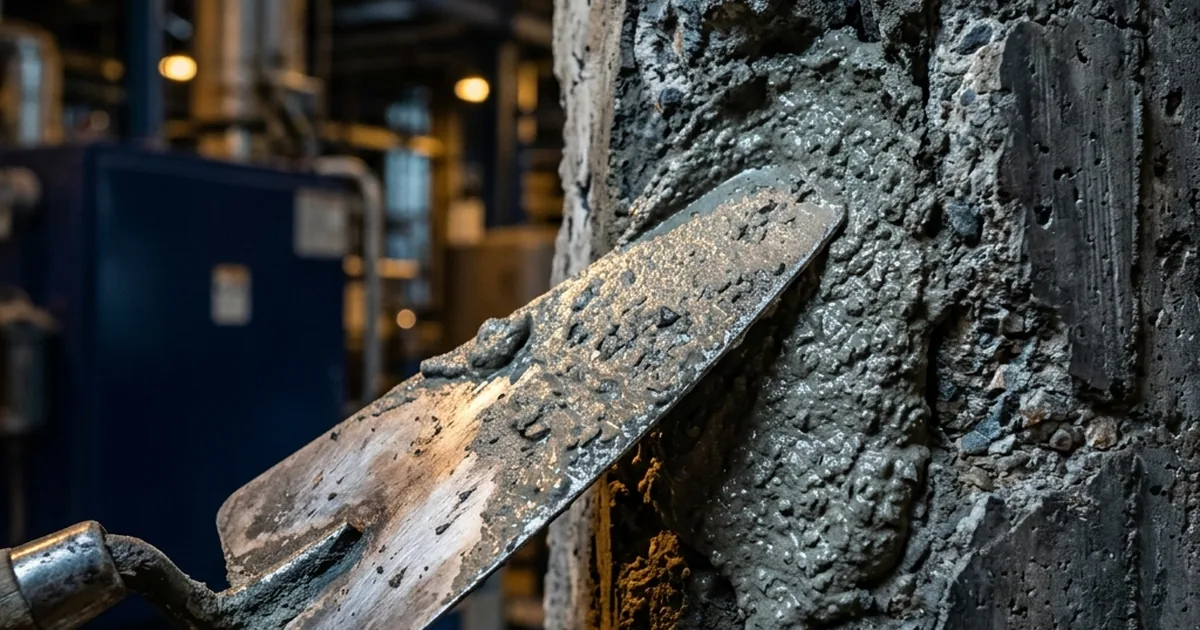
A concrete repair that looks flawless on the day it's finished but delaminates from its substrate within two years is one of the most expensive failures in the construction chemicals industry, because the cost of re-repair almost always exceeds the original job several times over. Concrete repair mortars exist specifically to solve the hardest problem in restoration work: bonding new material permanently onto old, already-weathered concrete without the two materials fighting each other through differential shrinkage, thermal movement, or moisture transfer. The stakes are significant at scale — deteriorating infrastructure, parking structures, and industrial facilities worldwide represent a restoration market where formulation quality directly determines whether a repair lasts five years or twenty-five. This guide walks through how polymer-modified repair mortars are formulated, how bond strength and shrinkage control are engineered into the product, and what separates a repair mortar that holds up in the field from one that fails prematurely. Understanding these mechanics gives manufacturers, formulators, and specifiers the technical vocabulary to evaluate a repair mortar system with genuine confidence rather than relying on marketing claims alone.
Repair Mortar Systems: Comparing the Main Technology Classes
Every concrete restoration project starts with a system-class decision, and that single choice shapes bond strength, cure speed, moisture tolerance, and long-term durability all at once. Repair mortars are not interchangeable formulations wearing different labels — polymer-modified cementitious systems, epoxy-based systems, and specialty shrinkage-compensated systems are built on genuinely different chemistries suited to different repair scenarios. This decision sits at the core of practical construction chemicals formulation work, spanning everything from cosmetic patching to structural restoration.
| System Type | Typical Basis | Best Suited For |
|---|---|---|
| Polymer-modified cementitious mortar | Portland cement, graded aggregate, redispersible polymer powder | General restoration, vertical and overhead patching, moderate structural repair |
| Epoxy repair mortar | Epoxy resin binder with mineral filler, no water content | High-strength structural bonding, chemically aggressive environments, fast cure |
| Shrinkage-compensated / expansive mortar | Cementitious base with expansive or shrinkage-reducing additives | Deep-section repairs, large-volume patches, structural fills |
Structural bonding applications that demand maximum strength and near-zero permeability often shift entirely to resin-based systems, a subject covered in detail in our guide to epoxy injection grout chemistry. Selection frameworks published by bodies such as the American Concrete Institute provide additional structured guidance for matching a repair material class to structural demand, exposure condition, and expected service life. For the polymer-modified cementitious mortars that dominate general restoration work, the next design question is what actually happens inside the mortar once polymer is introduced into the cement matrix.
Polymer Modification Chemistry: How It Improves Repair Performance
Plain cement mortar bonds to old concrete poorly and cracks easily under the stress of differential shrinkage, which is precisely the gap polymer modification exists to close. Redispersible polymer powders, most commonly vinyl acetate-ethylene (VAE) copolymers, are dry powders added directly into the mortar's cement-aggregate blend that re-disperse into a liquid polymer emulsion the moment water is added during mixing.
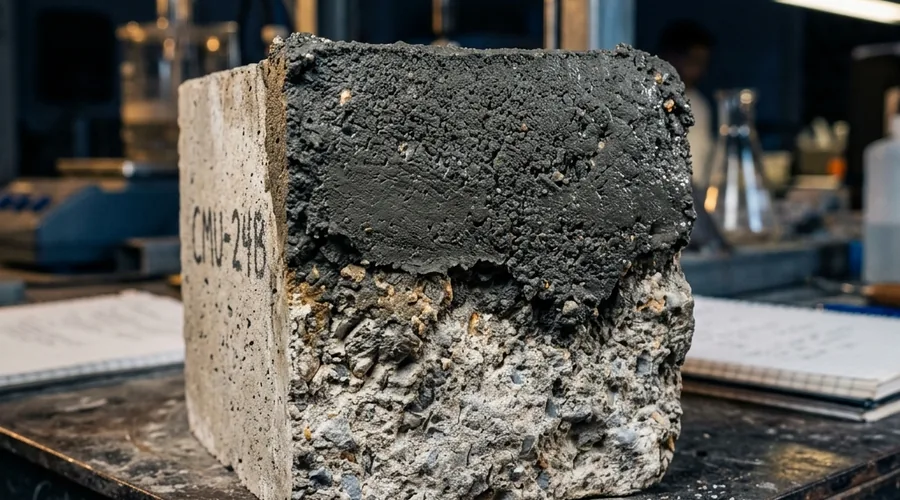
- Improved flexural strength — the polymer film network allows the cured mortar to flex slightly under load rather than cracking, absorbing minor differential movement against the substrate
- Reduced permeability — the polymer film restricts water and chloride ingress pathways through the mortar's pore structure, protecting embedded reinforcement steel
- Enhanced adhesion — polymer emulsion wets the substrate surface more effectively than cement paste alone, improving mechanical and chemical bond at the interface
- Impact and abrasion resistance — the polymer network absorbs energy that would otherwise propagate cracks through a purely mineral matrix
Polymer chemistry gives the mortar its internal toughness and adhesion potential, but none of that matters if the bond to the actual substrate fails — which is a question of surface preparation and interface engineering, not formulation alone.
Bond Strength and Substrate Preparation
The single most common cause of repair mortar failure in the field is not a formulation defect — it is inadequate substrate preparation that no repair mortar, however well engineered, can compensate for. A repair mortar's bond strength is only ever as good as the surface it is asked to adhere to, which makes preparation a formulation-critical step rather than a separate trade concern.
- Unsound material removal — all delaminated, cracked, or weakened concrete must be removed back to solid, sound substrate before any repair material is applied
- Surface roughening — scarifying, sandblasting, or high-pressure water jetting opens the substrate's pore structure and increases mechanical keying for the repair mortar
- Reinforcement cleaning — any exposed, corroded rebar must be cleaned to bright metal and often coated with a corrosion-inhibiting primer before mortar placement
- Saturated-surface-dry conditioning — most polymer-modified mortars require the substrate pre-wetted to SSD condition so it does not draw water unevenly out of the fresh mortar during cure
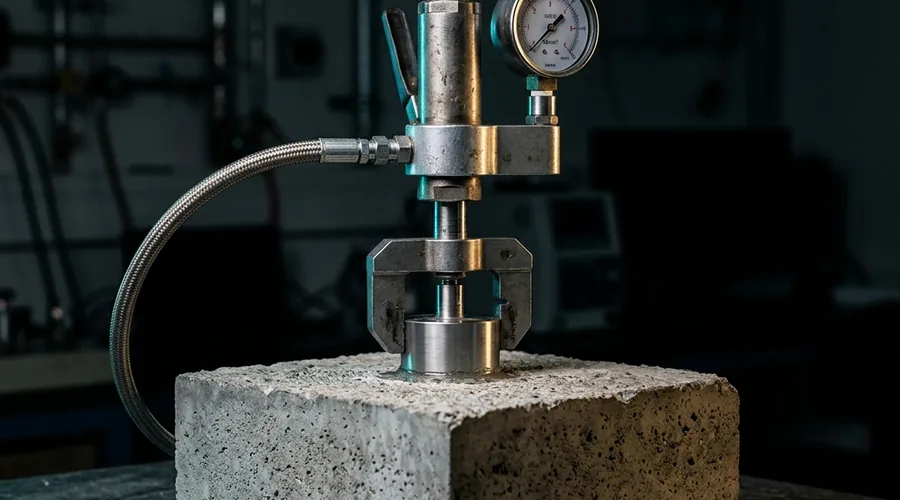
Bond quality is verified using a pull-off adhesion test, in which a steel dolly is bonded to the cured repair surface and pulled to failure under a calibrated tensile rig, a method standardized under ASTM C1583. The failure mode reveals as much as the numeric result — cohesive failure within the original substrate concrete indicates the bond itself exceeds the substrate's own tensile capacity, which is the outcome specifiers are actually looking for. Repair projects involving fiber-reinforced concrete substrates carry their own additional bond and crack-control considerations, covered in our guide to fiber reinforced concrete fiber selection.
A strong initial bond is necessary but not sufficient on its own — the repair also has to survive the dimensional changes that occur as it cures and ages alongside a substrate that is no longer moving in the same way.
Shrinkage Control and Long-Term Durability
Fresh repair mortar shrinks as it cures and dries, but the concrete substrate around it has already finished shrinking years or decades earlier, creating a dimensional mismatch that generates stress precisely at the bond line where the repair is most vulnerable. Managing this mismatch through deliberate shrinkage-control chemistry is what separates a repair that stays intact from one that cracks loose at its edges within months.
| Repair Depth | Shrinkage Control Approach |
|---|---|
| Thin, feather-edged cosmetic repairs (under ~20 mm) | Standard polymer-modified mortar; total shrinkage movement is small in absolute terms |
| Moderate-depth structural patches (20–50 mm) | Shrinkage-compensated mortar with expansive or shrinkage-reducing additives |
| Deep-section or large-volume repairs (over ~50 mm) | Expansive cementitious systems, often placed in staged lifts to manage heat and shrinkage |
Shrinkage-induced microcracking at the bond line is more than a cosmetic issue — it creates a direct ingress pathway for moisture, chlorides, and carbon dioxide to reach embedded reinforcement steel, restarting the corrosion process the repair was meant to stop. This is why durable restoration work treats shrinkage control as inseparable from corrosion protection, not as a secondary property. Fresh mortar also needs a properly managed curing regime — inadequate moisture retention during the first days of cure accelerates shrinkage cracking regardless of how well the shrinkage-compensation chemistry was formulated.
Formulating shrinkage control correctly protects the repair's structural integrity over years of service, but none of that engineering delivers value in the field unless it is matched to the right application method for the specific repair geometry.
Application Methods and Product Selection by Repair Type
Repair mortars are formulated in distinct rheological classes matched to how they will physically be placed, and using the wrong rheology class for a given application is one of the most common specification errors in restoration work. A mortar engineered for trowel application behaves completely differently under a spray nozzle or in a formwork pour, so product selection has to start with the intended placement method.
- Trowel-applied mortars — thixotropic rheology that stays in place on vertical and overhead surfaces without sagging, used for general patching and cosmetic restoration
- Spray-applied mortars — formulated for pump and nozzle delivery across large surface areas, common on parking structures and building facades
- Pourable / formwork mortars — flowable, self-consolidating rheology for encased or confined repair sections such as column jacketing
- Fast-set / low-temperature mortars — accelerated cure chemistry for time-critical repairs or cold-weather application windows
Matching rheology class to placement method is what allows a technically sound formulation to actually be installed correctly in the field, which is the last variable standing between a well-designed repair mortar and a repair that performs as intended for its full service life.
Manufacturing and Quality Control for Repair Mortar Producers
Repair mortars are manufactured as dry-mix products, blending cement, graded aggregate, polymer powder, and functional additives in precise proportions before bagging — and consistency at this manufacturing step determines whether every bag a customer buys performs identically to the one that passed laboratory testing. Dry-mix blending uniformity is a quality-control discipline distinct from formulation chemistry itself, and gaps here are a common source of field complaints even when the underlying formula is sound.
Manufacturers scaling from lab-developed formulas to plant production face the same nonlinear scale-up challenges common across construction chemicals, where mixer geometry and blending time at production scale rarely transfer directly from small batch trials — a topic explored further in our broader guide to construction chemicals manufacturing. Batch-to-batch quality control typically includes bulk density checks, flow or consistency testing on trial mixes, and periodic compressive and bond strength testing on cured samples pulled from production batches, giving manufacturers an early warning system before a quality drift reaches customers.
Getting manufacturing quality control right closes the loop between formulation science and field performance, ensuring the repair mortar that leaves the plant delivers the same bond strength, shrinkage control, and durability that was engineered and tested in development.
Frequently Asked Questions
What makes a concrete repair mortar different from ordinary structural concrete?
A concrete repair mortar is formulated specifically to bond onto an existing, already-hardened concrete substrate rather than to cure as a fresh monolithic pour, which means bond strength at the old-to-new interface is as critical a performance property as the mortar's own compressive strength. Repair mortars are almost always polymer-modified with redispersible polymer powders or latex to improve adhesion, flexibility, and resistance to the shrinkage cracking that would otherwise separate a patch from the substrate it is meant to protect.
They are also engineered with tighter shrinkage control and often finer aggregate gradation than structural concrete, since repair sections are typically thinner and more exposed to differential movement against the surrounding original material. Choosing the right repair mortar class depends on the repair's structural role, thickness, and exposure conditions, not simply matching the original concrete's strength grade.
Why is polymer modification so central to repair mortar performance?
Polymer modification, typically using redispersible polymer powders such as vinyl acetate-ethylene copolymers, forms a secondary polymeric film network within the cured cement matrix that runs alongside the mineral hydration structure. This polymer film significantly improves flexural strength and impact resistance compared to unmodified mortar, allowing the repair to absorb minor movement and stress without cracking away from the substrate.
It also reduces water permeability and improves adhesion to the old concrete surface by wetting the substrate more effectively than an unmodified cement paste alone. The tradeoff is that polymer-modified mortars are more sensitive to application conditions like temperature and curing humidity than plain cementitious repair material, so manufacturer application windows have to be followed closely for the polymer film to form correctly.
How is bond strength between the repair mortar and the substrate actually tested?
Bond strength is most commonly evaluated using a pull-off adhesion test, in which a steel dolly is epoxy-bonded to the cured repair mortar surface and then pulled perpendicular to the substrate using a calibrated tensile testing rig until failure occurs. The failure mode matters as much as the numeric bond strength value — a cohesive failure within the substrate concrete itself generally indicates the repair bond exceeds the substrate's own tensile strength, which is the desired outcome, while an adhesive failure cleanly at the interface signals a genuine bonding deficiency.
Standards such as ASTM C1583 define the pull-off test procedure and how to interpret failure modes, giving repair specifiers an objective, repeatable basis for accepting or rejecting a repair mortar's field performance rather than relying on visual inspection alone.
What is shrinkage-compensated repair mortar and when is it required?
Shrinkage-compensated repair mortars incorporate expansive additives or shrinkage-reducing admixtures specifically to counteract the drying shrinkage that would otherwise pull a repair patch away from the surrounding original concrete as it cures. This is particularly important for larger-volume repairs, deep patches, or structural repairs where any shrinkage-induced microcracking at the bond line could become a pathway for moisture and chloride ingress that eventually undermines the repair's durability.
Shrinkage compensation is generally less critical for very thin, feather-edged cosmetic repairs, where total shrinkage movement is small in absolute terms, but becomes essential once repair depth exceeds roughly 20-25 millimeters or the repair carries structural load. Manufacturer technical data sheets specify the depth ranges and application conditions each product's shrinkage-compensation chemistry has been formulated and tested for.
How does a formulator decide between a cementitious, epoxy, or polymer-modified repair system?
Cementitious polymer-modified mortars are the default choice for most non-structural to moderately structural repairs because they are breathable, compatible with the thermal expansion behavior of the surrounding concrete, and cost-effective at scale. Epoxy repair mortars and injection resins, by contrast, offer much higher strength and near-zero permeability but are impermeable to vapor, which can trap moisture behind the repair and create a different failure mode if used on damp or actively wet substrates.
The decision ultimately comes down to the repair's structural demands, moisture exposure, substrate condition, and required cure speed, with cementitious systems favored for general restoration work and epoxy systems reserved for high-strength structural bonding or crack injection where our guide to epoxy injection grout chemistry covers the relevant selection criteria in depth.
What surface preparation does concrete repair require before mortar application?
Surface preparation is frequently the single biggest determinant of long-term repair success, more so than the repair mortar's own formulation quality, because even the best-formulated repair mortar cannot bond to a substrate contaminated with laitance, oil, dust, or unsound, delaminated concrete. Preparation typically involves removing all unsound material back to solid concrete, exposing and cleaning any corroded reinforcement steel, and roughening the substrate surface to open its pore structure for mechanical and chemical bond, often through scarifying, sandblasting, or high-pressure water jetting.
Most polymer-modified repair mortars also require the substrate to be pre-wetted to a saturated-surface-dry condition immediately before application, since a substrate that is either bone-dry or actively wet with standing water will draw water unevenly out of the fresh mortar and compromise its cure and bond.
When should a manufacturer engage a construction chemicals formulation consultant for repair mortar development?
A formulation consultant adds the most value at the raw material selection and system design stage, where polymer type, aggregate gradation, shrinkage-control chemistry, and cementitious binder blend have to be balanced against the target application's strength, workability, and cost requirements simultaneously. Consultants are also valuable during scale-up from lab batch to plant production, where dry-mix blending uniformity and quality control procedures need to be established to ensure every bag performs consistently once it leaves the factory.
Engaging that expertise early is particularly important for manufacturers entering the repair mortar category for the first time, since field failures traced back to formulation gaps are costly to remediate after a product has already reached distribution and been specified into restoration projects.
Developing a Concrete Repair Mortar Product?
Global Formulation provides construction chemicals formulation consultancy, polymer-modified mortar system design, dry-mix scale-up guidance, and contract development support for restoration product manufacturers worldwide.
Talk to Our Formulation Team