Rust & Scale Remover Chelation Chemistry Guide
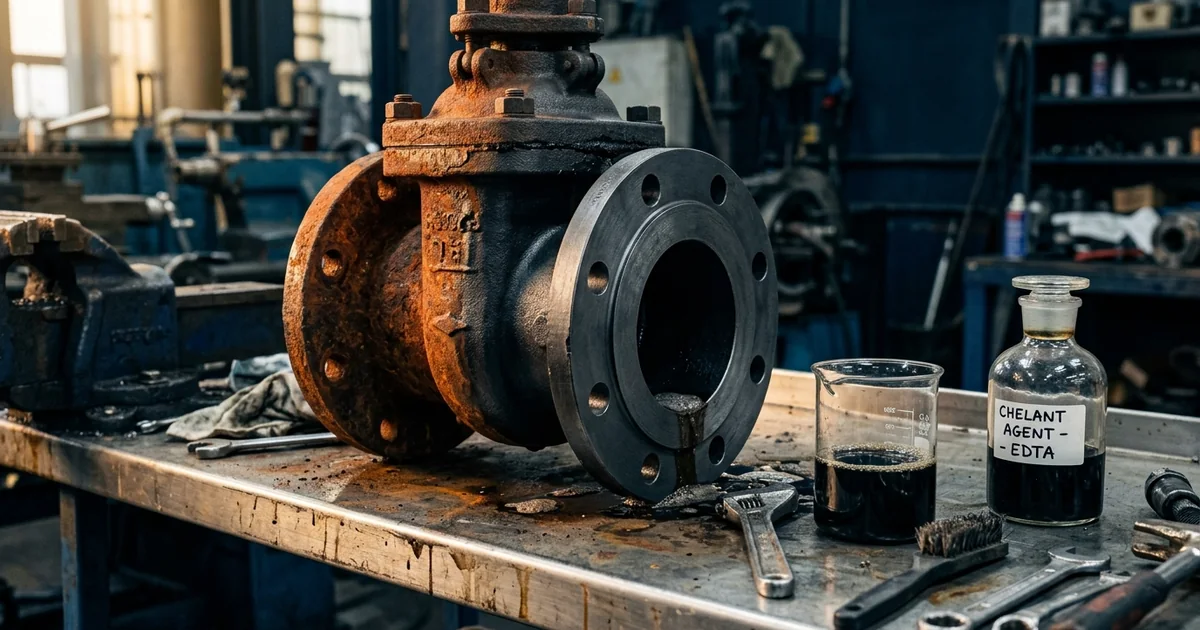
A boiler tube loses a fraction of a millimeter of usable diameter to scale every month, and by the time a plant engineer notices the fuel bill creeping upward, thousands of dollars in wasted energy have already gone up the stack. The same failure shows up at a smaller scale wherever iron, calcium, or magnesium meet water and air — a rusted valve stem that no longer seals, a heat exchanger tripping on high differential pressure, a cooling tower fill choked with carbonate deposit. Rust scale remover chelation chemistry is the discipline that solves both problems, because dissolving iron oxide and dissolving calcium carbonate rely on the same underlying trick: a ligand molecule wraps around a metal ion and pulls it into solution. This guide explains how phosphoric and citric acid chemistries actually remove rust, how boiler descaling programs apply the same chelation principle at industrial scale, and where a mismatched acid turns a routine descaling job into a corrosion failure of its own. It reflects the formulation discipline we apply across household and industrial cleaners consulting work.
The Chelation Chemistry Behind Every Rust Remover
Plain water dissolves almost nothing useful here: iron oxide and calcium carbonate are both highly insoluble, which is exactly why they accumulate as hard deposits in the first place. A simple acid can force some of that solid into solution, but the freed metal ion is often just as happy to precipitate straight back out once the local pH climbs again, undoing the job before a rinse even finishes. Chelating agents solve that problem by wrapping several bonding sites around a single metal ion at once, forming a ring-shaped complex that holds the ion in solution far more stably than a simple acid ever could. Chemists call this the chelate effect, and it explains why a multidentate ligand outcompetes ordinary acid dissolution at keeping dissolved iron, calcium, or magnesium from redepositing mid-process.
The rust and scale industry draws on a fairly short list of true chelating agents, each suited to a different aggressiveness and cost point:
- EDTA — the strongest and most persistent general-purpose chelator, tolerant of heavy, tenacious iron oxide deposits
- Citric acid — a mild, biodegradable tricarboxylic acid that chelates ferric iron efficiently at moderate temperature
- Gluconic acid — a gentle chelator often blended into alkaline cleaners where a strong acid isn't tolerable
- Phosphonates (HEDP, DTPA) — used mainly to prevent redeposition and scale nucleation rather than to strip heavy deposits outright
- Oxalic acid — forms a soluble ferric oxalate complex and is effective on rust staining, though it is more hazardous to handle than citric acid
Not every acid marketed as a rust remover works this way, though. Some of the most familiar rust chemistry on the market doesn't chelate iron at all — it takes an entirely different route.
Phosphoric Acid Rust Removers: Dissolution and Passivation, Not Chelation
Phosphoric acid is the active ingredient behind most commercial rust converters, and its mechanism is genuinely different from the chelators covered above. At low pH, phosphoric acid dissolves existing iron oxide and hydroxide into soluble phosphate species, lifting the visible rust from the surface. As the acid is consumed and the local pH rises back toward neutral, that dissolved iron doesn't stay in solution — it precipitates onto the bare steel as a thin, insoluble ferric phosphate layer that passivates the surface against immediate re-rusting. That dual action is why a phosphoric-acid rust converter can be brushed onto a rusted panel and simply left to dry, rather than requiring an immediate mechanical rinse and coat.
Hydrochloric acid dissolves rust faster than phosphoric acid in most cases, but it leaves nothing behind. Bare steel pulled straight from an HCl bath has no protective residue at all and will visibly flash rust within minutes of drying unless it's immediately primed or coated. That trade-off — speed versus a built-in protective step — is the main reason phosphoric acid dominates the rust-converter segment while hydrochloric acid is reserved for applications where the metal goes straight into a coating line afterward. The same acid-driven scale chemistry, at a much milder concentration, is also what makes toilet bowl cleaner formulations effective against limescale and hard-water rings.
Phosphoric acid's passivating chemistry works well on plain carbon steel, but true chelators earn their place wherever that passivating film isn't acceptable — starting with anything destined for further processing or a food-contact surface.
Citric Acid Descalers: The Gentler Chelation Route
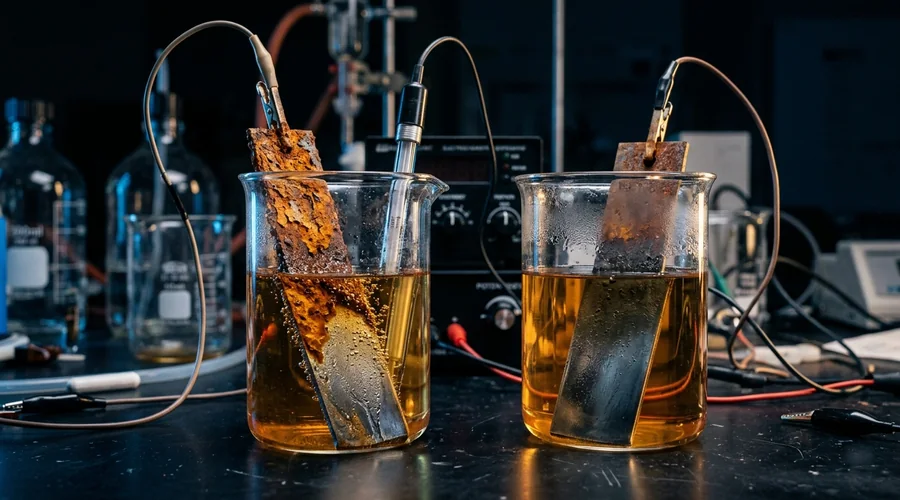
Citric acid is a genuine chelating agent for ferric iron: its three carboxylate groups wrap around a single Fe³⁺ ion and hold it as a stable, soluble ferric citrate complex rather than letting it precipitate back onto the surface. Because it's a weak organic acid rather than a strong mineral one, it attacks base metal far more gently than hydrochloric or even phosphoric acid, which is why it's the standard choice wherever protecting the substrate is the priority. Nuclear power plants have relied on ammoniated citric acid decontamination processes for decades specifically because the chemistry removes radioactive iron oxide deposits without aggressively attacking the underlying steel. That same gentleness is what puts citric acid in consumer kettle and coffee-machine descalers, where an aggressive mineral acid would damage seals and heating elements over repeated use.
| Acid / Chelant | Removal Mechanism | Bare-Metal Aggressiveness | Typical Setting |
|---|---|---|---|
| Hydrochloric acid | Direct dissolution; no chelation | High — no passivating residue | Industrial pickling ahead of immediate coating |
| Phosphoric acid | Dissolution, then passivating phosphate precipitation | Moderate — leaves protective film | Rust converters, metal restoration prep |
| Citric acid | True Fe³⁺ chelation; stays in solution | Low — mild organic acid | Nuclear decon, food-grade equipment, consumer descalers |
| Sulfamic acid | Dissolution; forms soluble iron sulfamate | Low to moderate — non-oxidizing, non-fuming | Cooling towers, stainless steel and copper-bearing systems |
| EDTA | Strongest chelation; very persistent complex | Low, but slow to biodegrade | Heavy boiler scale, tenacious iron deposits |
That range of chemistries scales up directly into industrial boiler and cooling-system descaling, where the same trade-off between strength and gentleness decides which chelant a program actually uses.
Boiler Descaling Chemical Programs: Chelation at Industrial Scale
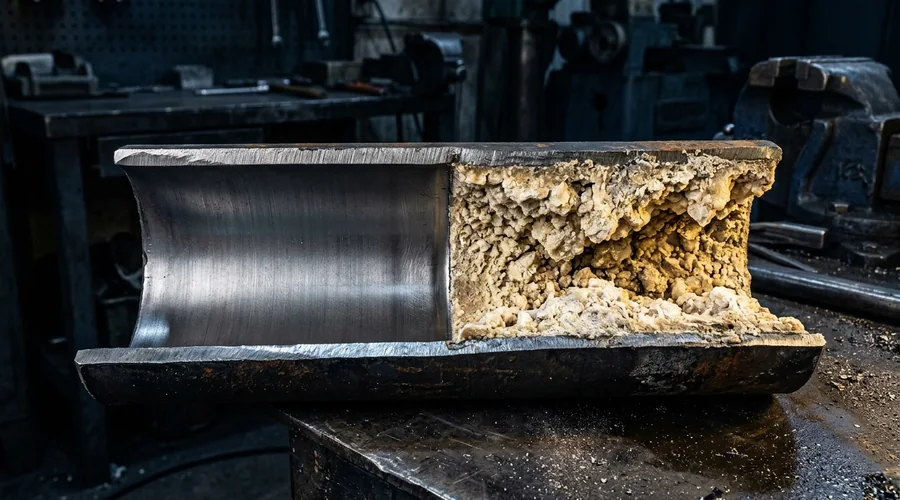
Boiler and cooling-tower scale is mostly calcium carbonate, and it forms precisely because heating water works against its solubility — calcium carbonate is one of the few common minerals that becomes less soluble as temperature rises, so it precipitates fastest exactly where the water is hottest: on the tube wall. That deposit insulates the metal from the water it's supposed to be heating, forcing higher firing rates to hold steam output and risking localized overheating or even tube failure where the scale is thickest. Magnesium, silica, and iron oxide carried over from corrosion elsewhere in the system typically co-precipitate alongside the calcium carbonate, so a real-world deposit is rarely a single, simple compound.
Industrial chemical cleaning programs — as distinct from mechanical descaling with rotary tools — draw on a fairly consistent pair of chelant chemistries:
- Ammoniated EDTA — the more tolerant option, generally reserved for heavy, tenacious iron-oxide-rich deposits where extended contact time is needed
- Ammoniated citric acid — usually preferred for pre-commissioning cleans and lighter, mostly-iron deposits, partly because the spent solution is easier to treat and dispose of than spent EDTA
- Controlled circulation temperature and duration — held within a range that dissolves scale without needlessly attacking the base tube metal
- Iron or hardness monitoring — used to define the cleaning endpoint by measurement rather than a fixed clock time
Getting the chelant right only solves half the problem, though, because the cleaning step is never the end of the procedure — and the system it's cleaning is rarely built from one metal alone.
Metal Substrate Compatibility: Where Descaling Chemistry Goes Wrong
Industrial systems are almost never a single metal. A boiler loop can carry carbon steel tubes, copper-alloy condenser tubing, brass fittings, and galvanized ductwork in the same circuit, and the single most common cause of a descaling job creating new damage is picking one chemistry for all of it. High-strength or hardened steel exposed to strong mineral acids — hydrochloric acid especially — absorbs atomic hydrogen generated during the pickling reaction, and that hydrogen can diffuse into the metal lattice and trigger a delayed cracking failure that shows up only after the equipment is back in service. Galvanized steel is even less forgiving: its zinc coating is far less noble than the underlying steel, so essentially any acid strong enough to dissolve scale will strip the galvanizing along with it.
Copper, brass, and bronze face a different threat from the same chemistry: ammonia-based chelant formulations are a well-documented cause of stress corrosion cracking in copper alloys, so any loop containing copper needs a non-ammoniated formulation regardless of how well the ammoniated version performs on steel. Stainless steel adds its own constraint — chloride-bearing acids like hydrochloric are avoided wherever possible because residual chloride drives pitting and chloride stress corrosion cracking, which is exactly why sulfamic acid, carrying no chloride and no strong oxidizing character, is the standard fallback for mixed stainless and copper systems. Oil and grease films complicate this further, since acid can't reach the scale underneath them until a compatible industrial degreaser step has removed them first.
None of this is a reason to avoid chemical descaling — it's a reason to design the procedure around the whole system, not just the dirtiest part of it.
Building an Industrial Descaling Procedure That Doesn't Create a Bigger Problem
A defensible industrial descaling procedure treats chemistry, monitoring, and disposal as one sequence, not three separate afterthoughts bolted onto an acid wash. Skipping the metallurgy survey or the neutralization step is how a routine maintenance job turns into an unplanned outage a few weeks later. The same logic that decides scale-inhibitor selection on the prevention side — covered in our guide to scale and corrosion inhibitor manufacturing — applies in reverse once scale has already formed and needs to come back out.
- Survey the metallurgy first — identify every metal in the circuit before selecting an acid or chelant, since one chemistry rarely suits carbon steel, copper, and stainless in the same loop
- Remove oil and grease ahead of the acid step — organic films block acid contact with the scale underneath and must come off first
- Circulate at a controlled temperature and concentration — aggressive enough to dissolve scale within a reasonable time, mild enough not to needlessly attack the base metal
- Define the endpoint by measurement — monitor dissolved iron or hardness rather than cleaning for a fixed, arbitrary duration
- Neutralize before further handling — bring the spent solution to a safe pH before it is moved, stored, or discharged anywhere
- Passivate the bared metal immediately — freshly cleaned steel has no protective oxide layer and will flash rust within the hour without a deliberate passivation step
- Classify the spent solution before disposal — descaling acid at a pH of 2 or below meets the EPA's corrosivity characteristic for hazardous waste, so it cannot simply be discharged to drain
The descaling programs that don't repeat themselves every eighteen months are the ones that treat the seventh step as seriously as the first. A program that dissolves scale perfectly but mishandles the spent acid, skips passivation, or ignores a stray copper fitting hasn't actually solved the problem — it's relocated it, and usually made it more expensive to fix the second time around.
Frequently Asked Questions
What is chelation and why does it matter for rust and scale removal?
Chelation is when a ligand molecule bonds to a metal ion at multiple points simultaneously, forming a stable ring-shaped complex around it. For rust and scale chemistry, that matters because a metal ion held this way stays in solution far more reliably than one freed by a simple acid, which can redeposit as soon as the local pH shifts.
That is the practical reason chelating agents like citric acid and EDTA outperform straightforward acid washing whenever the goal is to keep dissolved iron or calcium from settling straight back out mid-process.
What is the difference between phosphoric acid and citric acid for rust removal?
Phosphoric acid dissolves rust and then deliberately lets the freed iron precipitate back onto the steel as an insoluble ferric phosphate film, which passivates the surface against immediate re-rusting — that is why brushed-on rust converters can be left to dry without an instant rinse. Citric acid works differently: its structure genuinely chelates the iron, holding it dissolved in solution rather than letting it redeposit.
Citric acid is also the gentler chemistry on base metal, which is why it is favored in nuclear decontamination and consumer descaling, while phosphoric acid's built-in passivation step makes it the more common choice for exposed rusted steel.
Is citric acid strong enough to remove heavy rust or boiler scale?
It depends on how heavy and tenacious the deposit is. Citric acid handles light-to-moderate iron oxide well and is the standard choice for pre-commissioning boiler cleans where deposits are expected to be thin and freshly formed.
For heavy, long-accumulated scale — particularly deposits that have baked on over years — ammoniated EDTA is generally the more tolerant chelant, since it can sustain extended contact time without risking damage to the tube metal. A competent descaling program picks between the two based on deposit history, not on citric acid's reputation as the gentler option alone.
Why does boiler scale form even in a well-maintained system?
Calcium carbonate is one of the few common minerals that becomes less soluble as water gets hotter, so it precipitates fastest exactly where the boiler is doing its job — on the hottest tube surfaces. Even water treated to reduce hardness still carries some residual calcium and magnesium, and over enough operating hours that residual load accumulates as scale.
Silica and iron oxide carried over from elsewhere in the system typically co-precipitate alongside it, which is why real deposits are rarely pure calcium carbonate and why a descaling chemistry has to handle more than one mineral at once.
Can the same descaling chemical be used on stainless steel and carbon steel?
Not safely as a default choice. Hydrochloric acid is effective on carbon steel but introduces chloride, and residual chloride is a recognized driver of pitting and chloride stress corrosion cracking on stainless steel, so it is generally avoided wherever stainless is present.
Sulfamic acid is the more common fallback for mixed systems because it is non-oxidizing, carries no chloride, and performs acceptably on both carbon steel and stainless. Ammoniated chelants add a further wrinkle: they clean steel well but are a known corrosion risk for any copper or brass fittings sharing the same loop.
Why does bare steel flash rust so quickly after descaling?
Freshly descaled steel has no protective oxide layer left on it at all — the acid or chelant that removed the scale also stripped away whatever thin natural oxide film was there before. Bare iron is highly reactive with atmospheric oxygen and moisture, so visible rust can reappear within minutes if the surface is left wet and unprotected.
That is exactly why a deliberate passivation step, applied immediately after cleaning and before the surface has a chance to dry unprotected, is treated as a mandatory part of the procedure rather than an optional finishing touch.
Is spent descaling acid considered hazardous waste?
Often, yes. Under U.S. EPA rules, an aqueous waste with a pH of 2 or lower — or 12.5 or higher — meets the regulatory definition of corrosive hazardous waste, given waste code D002, regardless of what industry produced it.
Spent descaling acid frequently falls well below pH 2 before it is neutralized, which means discharging it to a drain or storm sewer without treatment is a regulatory violation, not just poor practice. Any descaling procedure needs a defined neutralization and disposal step built in from the start, not handled as an afterthought once the tank needs emptying.
Developing a Rust or Scale Removal Product Line?
Global Formulation provides cleaning product consultancy — chelant and acid selection, metal-compatibility testing, boiler and cooling-system descaling program design, and disposal compliance strategy.
Talk to Our Formulation Team