Anti-Hair-Loss Formulation: Actives Beyond Minoxidil
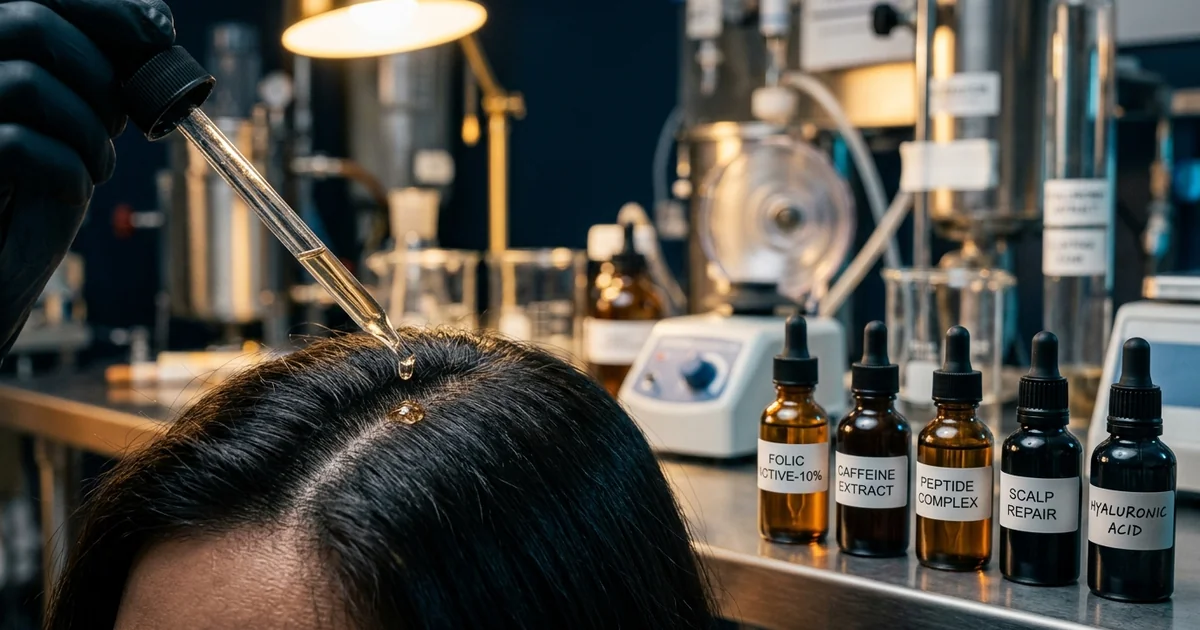
A founder briefs a chemist for a "hair regrowth serum," the lab builds a hydro-alcoholic tonic around a fashionable peptide, and the regulatory review kills the launch: the claim says regrowth, which makes the product a drug, and the dossier for a drug does not exist. This is the defining trap of the category, and it is why an anti-hair-loss formulation built on cosmetic actives has to be designed backwards from what it is legally allowed to say. Beyond minoxidil, which is a registered drug, there is a real toolbox of cosmetic ingredients — caffeine, redensyl, adenosine, peptides, scalp-microbiome agents — that can support a fuller-looking head of hair and a visibly reduced amount of shedding without crossing the line. This guide covers where that line sits, how minoxidil actually works so you can benchmark against it honestly, which cosmetic actives have credible mechanisms and evidence, how the scalp environment fits in, and how to keep a serum full of fragile actives stable on the shelf. It reflects the pattern we see repeatedly in cosmetics and personal care development, where the science is the easy part and the claim strategy is what decides whether the product ever ships.
The Cosmetic-vs-Drug Claim Line Comes First
Before any active is chosen, the formulator and the brand have to agree on what the product will claim, because that single decision determines whether it is a cosmetic or a drug. A cosmetic is legally a product intended to cleanse or beautify and to affect appearance; a drug is intended to treat disease or to affect the structure or function of the body. Hair loss sits right on that boundary, and the wording on the pack, the website and the influencer brief is what pushes a product to one side or the other. Get this wrong and the most elegant formula in the world is unsellable.
The US FDA states the position plainly: claims that a product will "restore hair growth" establish it as a drug even if it also affects appearance, because the intended use is to affect the structure or function of the body. The same logic runs through the FDA's cosmetics labeling claims guidance and applies equally to "stimulates follicles," "reverses hair loss" and "clinically proven to regrow hair." What remains available to a cosmetic is appearance and shedding language:
- Appearance claims — hair looks fuller, thicker, denser; the scalp looks healthier; the parting looks less visible
- Shedding claims — fewer loose hairs during washing and brushing, measured by hair-collection or wash tests, framed as reduced breakage and fall of hairs that were already loose
- Scalp-condition claims — soothes, balances oil, reduces flaking, supports a comfortable scalp as the foundation for hair that looks its best
- Sensory and care claims — strengthens the hair fibre, reduces breakage, improves manageability, all of which are cosmetic because they act on the visible hair shaft
Some markets add a middle tier — Japan's "quasi-drug" category, for instance, sits between cosmetic and drug and covers several hair-growth actives — so the exact wording that is safe depends on where the product sells. Lock the claim set with regulatory sign-off before the brief goes to the lab, and every downstream choice about actives, evidence and packaging follows from it.
Minoxidil as the Benchmark You Formulate Against
Cosmetic actives are almost always positioned relative to minoxidil, so a formulator needs to understand how the drug works and why it is not a cosmetic. Minoxidil is a prodrug: it does nothing until the enzyme sulfotransferase SULT1A1, present in the hair follicle, converts it to minoxidil sulfate. That metabolite is an ATP-sensitive potassium channel opener that hyperpolarises the cell membrane, and the downstream effects — increased local blood flow, growth-factor release, and Wnt signalling — prolong the growth phase of the follicle and partly reverse the miniaturisation seen in pattern hair loss. It was originally an oral antihypertensive approved in 1979, and hair growth was an unexpected side effect that led to the topical product a decade later.
Two facts from that mechanism shape how you should benchmark against it:
- It is a genuine pharmacological effect on the follicle — opening ion channels and changing growth-factor signalling is exactly the "structure or function" activity that defines a drug, which is why minoxidil cannot be sold as a cosmetic regardless of concentration
- Response is not universal — one assay of plucked follicles found that people with low follicular SULT1A1 activity had roughly a 95% chance of being topical non-responders, so a meaningful share of users get little from the reference drug itself
That second point is the opening for cosmetic actives. A well-tolerated scalp serum that reduces visible shedding and improves the look of density is a reasonable adjunct or alternative for the large group who cannot or will not use a drug — provided it is honest about being a cosmetic. As covered in how cosmetic formulations are developed, the winning brief defines the consumer and the claim first, then reverse-engineers the formula.
Anti-Hair-Loss Formulation Actives Beyond Minoxidil
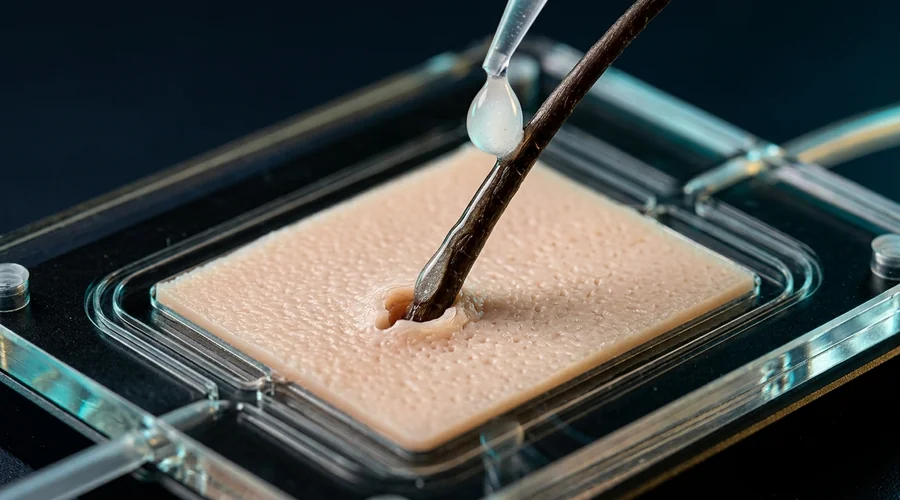
Once the claim set is cosmetic, the job is to assemble actives that have a credible published mechanism, tolerable safety, and workable formulation behaviour. None of these will match a drug head-to-head, and the honest framing is that they support the appearance of density and reduce visible shedding rather than regrow hair. The strongest of them cluster around three mechanisms: raising cyclic AMP and follicle metabolic activity, pushing growth-phase signalling in the dermal papilla, and protecting the perifollicular anchoring structures.
| Active | Reported mechanism | Formulation notes |
|---|---|---|
| Caffeine | Phosphodiesterase inhibition raises intracellular cAMP; counteracts testosterone-induced follicle growth suppression in vitro | Water-soluble, robust, inexpensive; watch solubility limit to avoid cold-storage crystallisation |
| Redensyl (DHQG + EGCG2 + glycine + zinc) | Supplier data: DHQG acts on outer root sheath stem cells and lowers FGF5, the anagen-termination signal | Water-phase; catechin component is oxidation-prone and can brown — needs chelation and opaque packaging |
| Adenosine | A2b adenosine receptor signalling in dermal papilla cells raises FGF-7; small trials show more thick hairs | Low use level, water-soluble; quasi-drug status for hair growth in Japan, cosmetic in some other markets |
| Peptides (e.g. biotinoyl tripeptide-1 in Procapil, acetyl tetrapeptide-3 in Capixyl) | Marketed as targeting perifollicular collagen and follicle anchoring, and moderating DHT effects | pH-sensitive hydrolysis; keep within the peptide's stable pH window and avoid strong nucleophiles |
| Anagain (pea sprout extract) | Supplier data: stimulates dermal papilla growth factors FGF7 and Noggin, shifting follicles toward the growth phase | Extract solubility drops as alcohol is reduced; check clarity across the full temperature range |
Caffeine deserves a realistic anchor point. In a 2024 controlled trial, 5% minoxidil produced about 17 additional hairs per square centimetre over 24 weeks against roughly 7 for a caffeine solution — the caffeine effect was real but around 40% of the drug response. That is a useful supporting active and a legitimate shedding-reduction claim ingredient, not a minoxidil substitute. Branded actives such as Redensyl and Capixyl come with supplier clinical studies showing density and anagen-ratio improvements; treat those as marketing-grade evidence adequate for cosmetic claim support, not as equivalent to a registered-drug dossier.
With the actives chosen, the next question is whether the scalp they are landing on is in a state to respond, which turns on the surface environment and its resident microbes.
The Scalp Environment and the Microbiome
A scalp serum works on living skin, and the condition of that skin — its oil level, its barrier integrity, and the microbial community living on it — sets the baseline the actives have to work against. Sequencing studies over the last few years have made the scalp microbiome a genuine formulation consideration rather than a marketing flourish. The healthy scalp is dominated by the bacteria Cutibacterium and Staphylococcus and the yeast Malassezia, held in a rough balance by sebum supply and the skin's own defences.
In pattern hair loss, that balance shifts. Multi-study reviews report the most consistent finding as an enrichment of Cutibacterium acnes, particularly in men, alongside less consistent changes in Malassezia and Staphylococcus. The proposed mechanism is a microbiome-lipid-immune interaction that sustains low-grade inflammation in the tissue around the follicle, although causality has not been demonstrated and the direction of the relationship is still open. For a formulator, that uncertainty still points to concrete choices:
- Keep the cleansing system mild — pairing the serum with a harsh sulfate shampoo strips sebum and disturbs the resident flora with every wash, working against the serum; a sulfate-free surfactant system is a better companion
- Include a gentle antimicrobial or balancing agent — piroctone olamine, climbazole, or zinc pyrithione where its use is still permitted, at cosmetic scalp-conditioning levels, to moderate Malassezia and support a comfortable scalp
- Consider prebiotic and postbiotic ingredients — oligosaccharides and fermentation lysates marketed for microbiome balance, useful mainly for a scalp-condition claim rather than a hair-count one
- Support the barrier — niacinamide and panthenol reduce the irritation that alcohol-heavy tonics can cause, keeping the scalp calm enough to tolerate daily use
The scalp-condition angle also gives the brand a claim territory that is comfortably cosmetic and hard to challenge. A healthier-looking, less flaky, less irritated scalp is a legitimate benefit in its own right, and it is the platform the appearance-of-density claims sit on. Getting the actives and the scalp agents to coexist in one stable formula is the final technical hurdle.
Formulating a Stable Scalp Serum
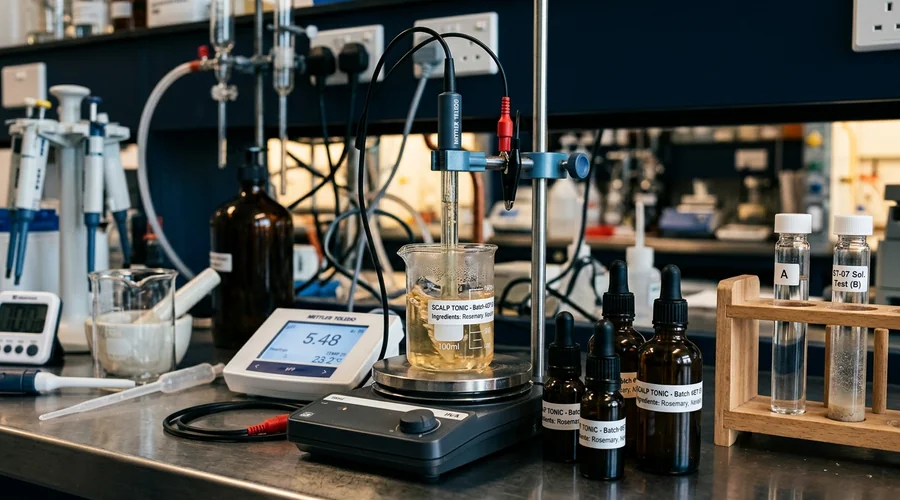
Anti-hair-loss serums fail on the shelf more often than they fail on the head, because they carry several of the least stable ingredient classes in personal care at once. Peptides hydrolyse outside their pH window. The catechins in Redensyl and green-tea extracts oxidise and turn the product brown. Plant extracts precipitate as the alcohol level is trimmed to improve skin feel. Caffeine crystallises if it is pushed near its solubility ceiling and the warehouse turns cold. A serum that looked perfect at the bench can be unsellable after three months in a distribution centre.
| Stability risk | Cause | Formulation response |
|---|---|---|
| Browning / discolouration | Oxidation of polyphenols and catechins | Chelating agent, compatible secondary antioxidant, opaque or airless packaging, low headspace |
| Peptide activity loss | Hydrolysis outside the stable pH range | Hold a defined mildly acidic pH; avoid incompatible strong bases and reducing agents |
| Cloudiness / precipitation | Botanical extracts dropping out as solvent polarity changes | Solvent blend (water, glycols, limited alcohol) tuned to keep every active dissolved; freeze-thaw testing |
| Caffeine crystallisation | Concentration near the cold-temperature solubility limit | Stay well below the limit; add a co-solvent; run low-temperature cycling before sign-off |
| Preservation failure | High water, glycol and extract load feeding microbial growth | Broad-spectrum system validated by challenge test; see our preservation guide |
The reliable route is a defined mildly acidic pH, a chelator as standard, a solvent blend proven to hold every active in solution across the full temperature range, a challenge-tested preservative system, and packaging that keeps out light and air. As with the sensitive antioxidants in skincare, the stability plan has to be designed before the first bench batch, and it should be validated with full stability and accelerated-aging testing — retrofitting stability after a failure almost always means reformulating.
Building an Anti-Hair-Loss Product: A Practical Framework
Pulling the previous sections together, a scalp-serum brief is best worked as a sequence of decisions, each one narrowing the next. The mistake that produces the killed launch is starting from a hero active and hoping the claim, the evidence and the stability fall into place around it. Starting from the claim and the consumer keeps everything aligned.
- Fix the claim set with regulatory sign-off — appearance of density and reduced visible shedding for a cosmetic; if the brand wants a growth claim, it needs a drug or quasi-drug pathway and a different budget entirely
- Define the consumer and the companion routine — a daily leave-on serum used alongside a mild shampoo, for a user who has tried or rejected minoxidil, sets the base, the sensory target and the price ceiling
- Choose a small active blend across mechanisms — three to five actives covering cAMP/metabolism, dermal-papilla signalling and perifollicular support, each kept above its effective use level
- Add the scalp-environment layer — a gentle antimicrobial or balancing agent plus a barrier soother, which also unlocks a defensible scalp-condition claim
- Design the stability and packaging system first — pH, chelation, solvent blend, preservative and opaque low-air packaging specified before the first batch, then confirmed by full stability testing
- Match each claim to a planned test — a wash test or hair-collection study for shedding, instrumental or expert-graded imaging for density appearance, decided with the exact wording, not after the formula is locked
Work in that order and the formulation, the shelf life and the marketing claim reinforce each other. Skip the first step and the product either fails regulatory review, cannot support its claim, or reaches the consumer already oxidised — the three ways an anti-hair-loss launch goes wrong, and all of them avoidable at the brief stage. For a broader view of the ingredient-to-market path, see our hair conditioner formulation guide, which covers the companion products a scalp serum is used with.
Frequently Asked Questions
Can a scalp serum legally claim to regrow hair without being a drug?
In most major markets, no. Regulators treat a claim to restore hair growth, stimulate follicles or reverse hair loss as a drug claim, because it describes an effect on the structure or function of the body rather than on appearance. The US FDA states this explicitly, listing "restore hair growth" among claims that make a product a drug even if it also affects appearance.
A cosmetic scalp serum can talk about the look and feel of fuller, thicker, denser-looking hair, a healthier-looking scalp, and reduced shedding of loose hairs during washing and brushing. But the moment the label promises regrowth or follicle stimulation, the product needs a drug pathway, which is why the whole cosmetic anti-hair-loss category is built around appearance and shedding language.
How does topical caffeine work on hair, and is it as good as minoxidil?
Caffeine is a phosphodiesterase inhibitor, so it slows the breakdown of cyclic AMP inside cells and raises the intracellular cAMP that supports follicle metabolic activity. Laboratory work also shows it can counteract the growth suppression that testosterone exerts on cultured follicles.
It is not equivalent to minoxidil. A 2024 head-to-head trial reported roughly 17 additional hairs per square centimetre for 5% minoxidil against roughly 7 for a caffeine solution over 24 weeks, so the caffeine effect was around 40% of the drug response. Caffeine's real value in a cosmetic is that it is well tolerated, water-soluble, inexpensive, and works as a supporting scalp active and shedding-reduction claim ingredient rather than a minoxidil replacement.
What is Redensyl and what does it actually do?
Redensyl is a branded cosmetic active built around DHQG, a glucosylated dihydroquercetin derived from larch wood, plus a stabilised green-tea catechin (EGCG2), glycine and zinc chloride. The supplier data positions DHQG as acting on outer root sheath stem cells and reducing FGF5, the signal that ends the growth phase, with the marketing claim of extending anagen and increasing the visible density of hair.
In a formulation it behaves as a water-phase active that is reasonably robust, and it is usually paired with caffeine, peptides or adenosine rather than used alone. Treat the supplier's clinical numbers as marketing-grade evidence: useful for claim support within cosmetic limits, not a substitute for a registered drug.
Does the scalp microbiome matter for hair loss formulations?
The healthy scalp is dominated by Cutibacterium, Staphylococcus and the yeast Malassezia, and sequencing studies of androgenetic alopecia have repeatedly found a shifted balance, most consistently an enrichment of Cutibacterium acnes in men, alongside changes in Malassezia and Staphylococcus. The proposed link is a microbiome-lipid-immune interaction that feeds low-grade inflammation around the follicle, though causality is not established.
For a formulator this justifies including gentle antimicrobial or microbiome-balancing agents such as piroctone olamine, zinc pyrithione where permitted, or prebiotic sugars, and keeping the surfactant system mild so the barrier and the resident flora are not stripped with every wash.
Why do so many hair growth tonics separate, discolour or lose potency on the shelf?
Most hair growth tonics are hydro-alcoholic or hydro-glycolic solutions carrying several fragile actives at once: peptides that hydrolyse at the wrong pH, polyphenols such as the catechins in Redensyl that oxidise and brown, plant extracts that drop out of solution as the alcohol level is trimmed for skin feel, and caffeine that can crystallise if it is pushed near its solubility limit in a cool warehouse.
The fixes are the same as for any sensitive system: hold a defined mildly acidic pH, add a chelating agent to control trace metals, choose a solvent blend that keeps every active dissolved at low temperature, and use opaque or airless packaging. Design that stability system before the first bench batch, because retrofitting it usually means reformulating.
What is the difference between minoxidil and adenosine as follicle actives?
Minoxidil is a prodrug: the enzyme sulfotransferase SULT1A1 in the follicle converts it to minoxidil sulfate, which opens ATP-sensitive potassium channels and drives the downstream growth-factor and vascular signalling that prolongs the growth phase. It is a regulated drug, originally an antihypertensive, and roughly a third to half of users lack enough follicular SULT1A1 to respond well.
Adenosine acts through the A2b adenosine receptor on dermal papilla cells to raise FGF-7 expression, and small controlled trials in Japanese men and women showed it increases the proportion of thick hairs. Adenosine is used as a cosmetic scalp active in several markets and, in Japan, has quasi-drug status for hair growth, which is a stricter category than a plain cosmetic.
Should a startup build a single hero active or a blend into a scalp serum?
A blend, for the same reason antioxidant skincare uses a network rather than one molecule: hair loss has several drivers at once, and the actives cover different points. Caffeine supports follicle metabolism, a peptide such as the biotinoyl tripeptide in Procapil targets the perifollicular anchoring, adenosine and Redensyl push growth-phase signalling, and a mild antimicrobial keeps the scalp environment calm.
Just as important, a blend gives the marketing team several defensible appearance and shedding claims from one formula. Keep the blend small, three to five actives, so each stays above its effective use level and the stability system stays manageable, and anchor the serum in a well-tolerated hydro-glycolic or light-emulsion base the target consumer will actually keep using.
Developing a Scalp or Anti-Hair-Loss Product?
Global Formulation provides cosmetic formulation consultancy — active selection, claim strategy, stabilisation, packaging compatibility and stability testing from concept to launch. For the commercial side of a hair-oil business, the Hair Oil Manufacturing Standard Project Report is a costed India-basis feasibility study — perfumed light, amla / coconut and herbal oils, three investment configurations and a five-year financial model.
Talk to Our Formulation Team